
The Pixel Fold has always marched to its own beat. While Samsung’s foldables went tall and narrow, Google’s stayed wide like a passport — and with the Pixel 11 Pro Fold, that design gets thinner, lighter, and dramatically brighter. Announced at Made by Google on August 12 alongside the Pixel 11 and the Pixel 11 Pro, the third-generation Fold starts at $1,899 in the US and hits stores August 20.
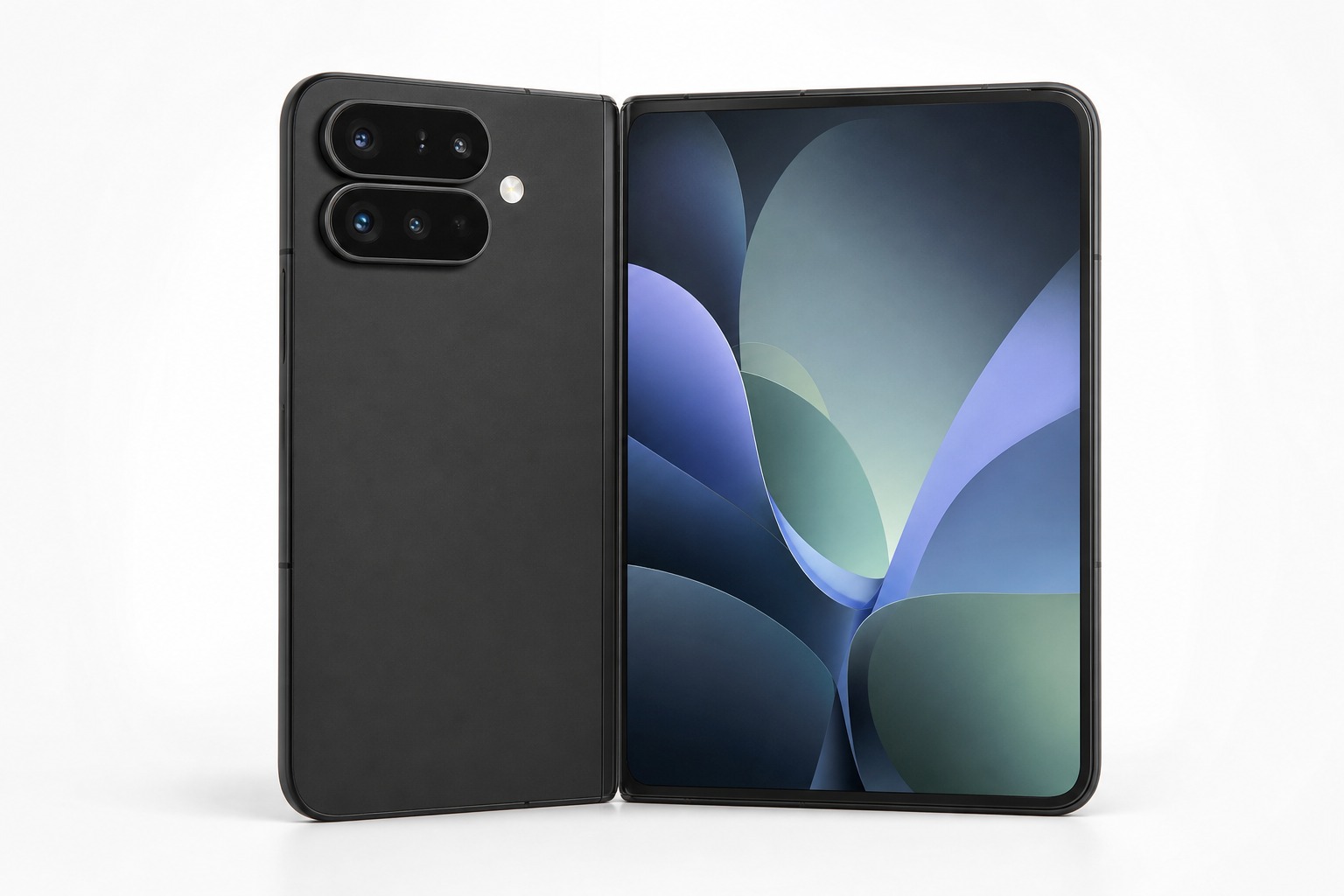
Here’s the thing nobody expected: while both displays jump to 3,600 nits and the main camera gets a bigger sensor, the battery actually got smaller. Google cut the cell from 5,015mAh on the Pixel 10 Pro Fold to 4,806mAh here, betting the Tensor G6’s efficiency makes up for it. Whether that bet pays off is the most interesting question about this phone.
Design & Build Quality
The Pixel 11 Pro Fold is the slimmest book-style foldable Google has made. Folded shut it measures 155.2 x 76 x 10.1mm — a hair thinner than last year’s 10.2mm — and it sheds 19 grams, dropping from 258g to 239g. Hold it closed and it genuinely feels closer to a regular phone than the previous generation did, which was exactly the point Google was making at launch.
It keeps the passport proportions: 155.2mm tall and 76mm wide when folded, so the cover screen is a proper tall slab rather than Samsung’s narrow candy bar. The frame is aluminum, the back is Gorilla Glass Victus 2 with a soft-touch composite finish, and the cover screen uses a new “ultra-durable ceramic” glass Google says is three times stronger — a claim based on internal pre-production testing, so take the exact multiplier with a grain of salt.
The durability rating is the real differentiator. The Fold is IP68, matching the rest of the Pixel 11 line, while the Galaxy Z Fold8 settles for IP48. That means dust protection Google’s rivals don’t offer on a folding device. It comes in two colors only — Obsidian and Olive — with the Olive option pairing a gray satin metal frame. There’s no 3.5mm jack and no microSD slot, standard for this class.
Display
Both screens get the Super Actua treatment this year. The 8.0-inch inner display is a foldable LTPO OLED at 2076 x 2152 (roughly 1:1, ~374 ppi) with 1-120Hz refresh. The cover screen grows from 6.4 to 6.5 inches, now 1080 x 2342 at 399 ppi, and for the first time it also gets LTPO — the previous cover was stuck at 60-120Hz, so this is a genuine upgrade for always-on display battery life.
Brightness is the headline number: both panels are rated at 2,000 nits high-brightness mode and 3,600 nits peak, which Google says is 20 percent brighter than the Pixel 10 Pro Fold. Treat 3,600 nits as a local peak for HDR highlights rather than sustained full-screen brightness — that’s the standard reading for these marketing figures. Outdoors, the 2,000-nit HBM figure is what matters, and that’s comfortably bright for direct sunlight.
HDR10+ support and 120Hz on both screens make the foldable feel properly premium whether you’re watching video unfolded or checking notifications on the cover. The inner panel is protected by ultra-thin glass with the crease still present down the middle — it’s visible at an angle, less so head-on, same as every foldable on the market.
Performance
The Pixel 11 Pro Fold runs the same Tensor G6 as the rest of the 2026 lineup — Google’s first chip built on TSMC’s 2nm process, and the first smartphone chip from that node. It’s a 7-core design: one ARM C1-Ultra at 4.1GHz, four C1-Pro cores at 3.4GHz, and two more at 2.65GHz, paired with a PowerVR C-Series GPU and a vapor chamber for cooling.
Google claims up to 25 percent faster performance and 20 percent better power efficiency over the Tensor G5, plus a 50 percent more powerful TPU for on-device AI. The real-world caveat: Tensor chips have historically traded raw benchmarks for sustained efficiency, and the Fold’s larger chassis should help thermals versus the smaller Pixel 11 Pro. We haven’t seen independent sustained-load numbers yet — flagging that as unverified rather than repeating the marketing figures as fact.
The RAM story is the pleasant surprise of this generation. While the vanilla Pixel 11 and Pixel 11 Pro cut base RAM to 12GB during the memory shortage, the Fold keeps 16GB across every configuration — 256GB, 512GB, or 1TB of UFS 4.x storage, all with 16GB. For heavy multitaskers and anyone running Gemini-powered features, that’s the right call. Security is handled by the Titan M3 chip with post-quantum encryption support.
Camera
The Fold’s camera hardware sits below the Pixel 11 Pro’s triple, and Google doesn’t pretend otherwise. The headline change: the main camera jumps to a 48MP sensor at 1/1.56-inch with 1.0µm pixels and OIS — up from the smaller 48MP sensor on the Pixel 10 Pro Fold, with Google claiming 56 percent more light captured. That should be the biggest real-world camera upgrade here.
The other two rear lenses are unchanged from last year: a 10.8MP 5x periscope telephoto at f/3.1 with OIS, and a 10.5MP ultrawide at 127 degrees with autofocus and Macro Focus. Engadget’s hands-on notes they’re “genuinely, spec-for-spec, identical” to the previous model. Super Res Zoom extends to 30x, well short of the Pro’s 120x. There are two 10MP selfie cameras — one on the cover, one inside — both with 87-degree lenses.
Video tops out at 4K60 on all cameras (4K24/30/60 on the rear), with 10-bit HDR and gyro-EIS. The Fold doesn’t get the Pro line’s 8K30 Video Boost or its 42MP selfie — this is the same camera package as the 10 Pro Fold, minus the sensor upgrade up front. The dual-pill rear layout now includes the HiLight LED ring, which glows for notifications when the phone is face down and pulses when Gemini is listening.
Expect typical Google computational photography: Night Sight, Magic Capture, Camera Looks, and Best Take are all here, and the bigger main sensor should close some of the low-light gap to the Pro models. But if camera hardware is your priority, the Pro or Pro XL is the better buy at a lower price.
Battery & Charging
This is the honest trade-off of the entire review. The Pixel 11 Pro Fold ships with a 4,806mAh battery — down from 5,015mAh on the Pixel 10 Pro Fold, and comfortably below the Z Fold8 Ultra’s 5,000mAh (it roughly matches the standard Z Fold8’s 4,800mAh). Google promises the same 24-hour endurance as last year, leaning on the Tensor G6’s efficiency gains. The EU energy label shows 45:05 hours of endurance with Class B efficiency and 1,000 charge cycles — decent, but a foldable this expensive losing capacity is a genuine regression to flag.
Charging is 30W wired PPS — Google claims 50 percent in 30 minutes — plus 25W magnetic wireless via the Qi2.2 Pixelsnap standard, up from 15W on the 10 Pro Fold. There’s also bypass charging so plugged-in gaming doesn’t cook the battery. The 30W wired figure trails Samsung’s 45W on the Z Fold8, and consistent with Google’s recent practice you’ll likely need to supply your own 30W adapter. For a phone this expensive, 30W feels conservative in 2026.
Software
The Fold ships with Android 17 and Google’s promise of seven major OS updates, taking it through Android 24 in 2033 — the same commitment as the rest of the Pixel 11 line. That’s best-in-class longevity for a foldable, matching Samsung’s seven-year pledge.
Gemini Intelligence is the software story: proactive context cards from your apps, voice-to-text that strips filler words, Live Translate for video and podcasts, and Circle to Search straight from the camera. The Fold also gets the sign-language-to-text model in Gboard and Live Transcribe at launch (American Sign Language first). Some Gemini automation — ordering groceries, booking rides — is US-only at launch, so Filipino buyers won’t get the full agentic feature set immediately.
Google is also pushing Assistant out the door in September, fully replaced by Gemini, which is a bigger behavioral shift for long-time Pixel owners than any spec on the sheet. Six months of Google AI Pro comes free with the Fold if you want the heavier AI tier.
Pros and Cons
| Pros | Cons |
|---|---|
| Both displays hit 3,600 nits and now run 1-120Hz LTPO | Battery shrinks to 4,806mAh from 5,015mAh — a genuine regression |
| 16GB RAM on every configuration, even the base 256GB | 30W wired charging trails Samsung’s 45W on the Z Fold8 |
| Lighter (239g) and thinner (10.1mm) than its predecessor | Camera hardware still lags the Pixel 11 Pro: no 8K, no 42MP selfie, no 48MP tele |
| Bigger 1/1.56-inch main sensor with 56% more light claimed | $100 price hike to $1,899, with no official PH release |
| IP68 dust and water resistance — rare for a foldable | Telephoto and ultrawide are unchanged from last year |
| 25W Qi2.2 magnetic wireless charging, up from 15W | 24-hour battery claim unverified until independent testing |
| Seven years of OS updates, Gemini Intelligence included | Only two colors, no charger in the box |
Should You Buy This?
Buy it if
- You want a foldable that feels like a normal phone in the hand — 239g and 10.1mm is the most “regular phone” a Pixel Fold has ever been
- You need 16GB of RAM and don’t want to pay for the 512GB tier just to get it, unlike the rest of the Pixel 11 line
- Outdoor visibility matters to you — both screens at 2,000-nit HBM brightness is class-leading
- You value dust resistance in a foldable; IP68 is a genuine advantage over the Z Fold8’s IP48
- You’re in a Pixel ecosystem and want seven years of updates on a folding screen
Skip it if
- Battery life is your top priority — the 4,806mAh cell is smaller than last year’s 5,015mAh, and the Z Fold8 Ultra’s 5,000mAh battery beats it
- You want flagship camera hardware — the Fold’s 10.8MP telephoto and 10.5MP ultrawide are the same as the Pixel 10 Pro Fold’s, and the Pro line’s cameras are clearly better
- You’re buying in the Philippines — there’s no official PH release, so you’re looking at gray-market units around ₱125K or more with no local warranty
- You need the fastest charging in the segment — 30W is fine but not competitive with 45W rivals
Final Verdict
The Pixel 11 Pro Fold is a story of two halves. On one side, Google delivered exactly what you’d want from a 2026 foldable refresh: both screens are dramatically brighter with proper 1-120Hz LTPO on the cover, the chassis is lighter and thinner, the main camera sensor gets meaningfully bigger, and 16GB of RAM on every tier is a smart move during a memory shortage. It’s also the only foldable in its class with IP68 dust protection.
On the other side, the battery regression is hard to ignore. Cutting 4,806mAh into a $1,899 phone while Samsung pushes 5,000mAh into the Z Fold8 Ultra is a bold bet on Tensor G6 efficiency, and we won’t know if it pays off until independent endurance testing lands. The camera package, too, is a generation behind the Pro siblings — fine for most shots, but a $1,899 flagship should arguably do better than 10.8MP telephoto hardware Google hasn’t touched in two years.
For Filipino buyers the calculus is harsher. With no official PH release, you’re paying gray-market premiums — expect around ₱125K plus for the base 256GB model, against the Z Fold8’s official ₱109,990 PH pricing — for a phone without local warranty. If you’re a Pixel loyalist who wants the passport form factor, this is the best Fold Google has made. If you’re comparing on spec sheets alone, the Galaxy Z Fold8’s value and the Z Fold8 Ultra’s battery make it a real conversation.
This is a very good foldable that made one very public compromise. The displays, the design, and the software are all upgrades. The battery is not — and at this price, that’s the trade you’re signing up for.