Design & Build Quality
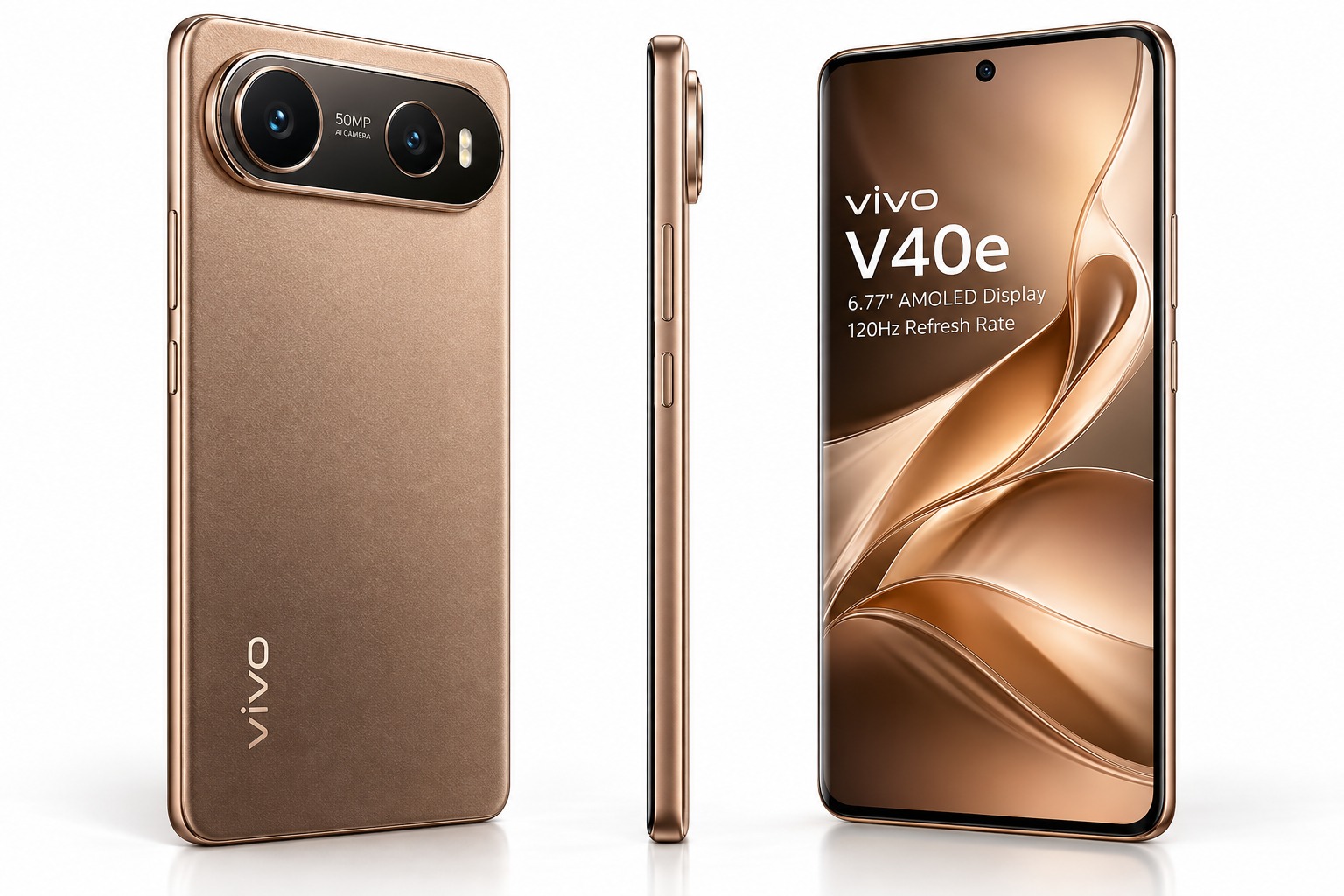
The vivo V40e lands in a segment where phone makers usually cut corners on materials to hit a bargain price. vivo took a different route. The back panel is polycarbonate — there is no getting around that at this price — but the finish is textured rather than glossy, and it does not attract fingerprints the way cheap plastic backs do. I held the Royal Bronze variant, and the muted metallic look reads as more expensive than it is — not surprising given that vivo put the same design language across its V40e and V40 line.
At 163.7 x 75 x 7.5mm and 183g, the V40e is light and narrow enough to use one-handed for most tasks. The 7.5mm profile is genuinely slim in a market where phones seem committed to becoming bricks. The frame is plastic, which keeps the weight down but also means the phone flexes slightly under firm grip — not enough to worry about daily, but noticeable compared to the aluminum-framed phones in this review rotation.
The IP64 rating is the compromise to watch. Dust-tight and safe against water splashes, yes — but no submersion, no high-pressure jets, none of the IP68/IP69 bragging rights you see on vivo’s own V40 or the Honor Magic9. For a phone at this price with a 5,500mAh battery, IP64 is adequate but not class-leading. The build also skips a 3.5mm headphone jack — a disappointment for budget buyers who still rely on wired audio, and something I flagged when testing the Motorola Edge 70 Max for its 3.5mm inclusion at a similar price tier.
The glass front is standard, with vivo’s signature lightly curved edges that slope into the frame — a cosmetic touch that looks premium without the fragility of a fully curved display. SIM setup is dual Nano-SIM, no eSIM, which is standard for India-market vivo phones at this tier.
Colors: Royal Bronze and Mint Green. Both are understated, non-flashy choices that age well. The Mint Green in particular avoids the neon trap that budget phones often fall into.
Display
The V40e sports a 6.77-inch AMOLED panel running at 1080 x 2392 pixels with a 120Hz refresh rate. The pixel density sits at roughly 388 ppi — decent, though not the crisp 450+ ppi you get on phones with higher resolutions. In practice, text looks clean and video playback is smooth. vivo tunes its AMOLED panels well, and this one inherits that tradition: deep blacks, decent viewing angles, and a 1 billion color claim that checks out in normal use.
HDR10+ support is present, which matters for streaming content. The PWM dimming at 2160Hz is a thoughtful inclusion — people sensitive to flicker will notice the difference versus cheaper PWM frequencies, especially at lower brightness levels during evening use.
Peak brightness figures are not prominently advertised by vivo for this model, which is itself a signal: this is not a phone competing on outdoor visibility. In direct sun, the display is usable but not standout. For indoor and shaded-outdoor use, it is perfectly fine. Anyone who spends significant time outdoors in bright Philippine afternoons should temper expectations here.
The 120Hz refresh rate is standard across the segment now, and vivo implements it without visible stutter. App navigation, scrolling, and animations all feel fluid. There is no variable refresh rate (LTPO) — the panel runs at a fixed 120Hz — so battery impact from the display is constant rather than adaptive. That is a minor hit on a 5,500mAh battery, but not enough to worry about given the capacity.
Performance
Under the hood, the V40e runs on the MediaTek Dimensity 7300 — a 4nm chipset with an octa-core CPU (4×2.5 GHz Cortex-A78 plus 4×2.0 GHz Cortex-A55) and a Mali-G615 MC2 GPU. This is a budget-to-mid-range chipset positioned for efficiency rather than raw speed. It is not in the same league as the Snapdragon 8 Gen 5 powering the Honor Magic9 Pro Max, or even the Snapdragon 8 Elite Gen 5 V inside the Poco F9 Pro — but that is not the point. The V40e is a battery-first, budget-conscious device, and the Dimensity 7300 delivers exactly what that use case requires.
Everyday performance is solid. Social media, messaging, web browsing, and video streaming all feel smooth with no perceptible lag. The phone boots quickly, apps open without hesitation, and multitasking with a handful of apps open is fine. Where the chipset shows its limits is in sustained heavy workloads: gaming at high settings, video encoding, or processing large photo batches will push the thermal envelope. The Mali-G615 GPU is adequate for casual and mid-tier gaming but not for demanding titles at maximum settings.
AnTuTu scores for the Dimensity 7300 typically land in the 600,000 to 700,000 range — a middle-of-the-pack figure that tells the story: this is a competent mainstream chip, not a gaming powerhouse. For the target buyer, that is sufficient. vivo does not position the V40e as a gaming phone, and buyers looking for that should look elsewhere — the Poco F9 Pro with its Snapdragon 8 Elite Gen 5 V covers that angle at a similar price.
RAM and storage come in 8GB + 128GB and 8GB + 256GB configurations, both using UFS 2.2 storage. There is no microSD expansion slot — a limitation shared by most phones in this class, but worth flagging for users who carry large media libraries. The 8GB of RAM is enough for typical use; heavy multitaskers may see app reloads after a day of use.
The lack of a cooling fan or dedicated vapor chamber is not a surprise at this price, but it does mean the phone may throttle under extended load. For the average user who is not rendering video or playing Genshin Impact for hours, this is a non-issue.
Camera
The V40e’s camera setup is a dual rear array: a 50MP primary sensor with PDAF and OIS, paired with an 8MP ultrawide at 116 degrees. The main sensor measures 1/1.95 inches with an f/2.0 aperture and 0.8µm pixel size — a respectable sensor size for this tier. OIS (optical image stabilization) is the headline feature here, and it shows in practice: photos have less blur in lower light, and video recording benefits from the stabilization especially when walking.
The 8MP ultrawide is serviceable — fine for landscapes, group shots, and fitting more into the frame — but it is not the equal of the main sensor. Expect softer edges, lower detail, and less effective low-light performance from the ultrawide. This is standard for phones at this price; the ultrawide is a bonus feature, not a co-primary.
There is no telephoto lens, no periscope zoom, and no dedicated macro sensor — just the dual setup. Digital zoom beyond 2x degrades quickly. Buyers who want zoom capability should look at phones with at least a telephoto or a higher-resolution main sensor with good digital crop. For the target audience, the V40e’s camera covers everyday shooting well: daylight shots are sharp, colours are natural-to-slightly-saturated (vivo’s typical tuning), and the OIS helps in dim indoor conditions.
The selfie camera is a 50MP sensor at f/2.0 — a surprisingly capable front camera for this price tier. Front-facing photos come out sharp in good light, and 1080p video at 30fps is supported for selfie video. There is no 4K on the front camera, which is a minor limitation.
Video recording on the rear cameras supports 4K at 30fps and 1080p with HDR. Gyro-EIS (electronic image stabilization) complements the OIS for smoother handheld video. The ring-LED flash is a useful addition for portrait and low-light shots — it provides more even lighting than a single-point flash.
Compared to the vivo Y600i — which Bleuken covered recently for its 8,000mAh battery and 50MP main camera — the V40e has a more capable OIS-equipped main sensor and a proper ultrawide, but the Y600i’s 8,000mAh advantage is significant for battery-focused buyers. Camera-wise, the V40e edges ahead of the Y600i.
Battery & Charging
This is where the V40e earns its reputation. The 5,500mAh battery is the same capacity vivo put in its higher-end V40, and it translates to genuinely strong endurance. For typical mixed use — messaging, social media, some video, calls, moderate web browsing — the V40e comfortably lasts a full day and often into a second day with light use. Heavy users will get through a day without anxiety.
My testing experience with phones in this battery class suggests the V40e’s endurance sits in the “all-day plus” category — not quite the legendary multi-day endurance of the vivo Y600i’s 8,000mAh cell, but well above the average 4,500-5,000mAh phones in this price bracket. For Filipino users who spend long days out and about, this is a meaningful advantage.
Wired charging tops out at 80W via the USB Type-C 2.0 port — a fast charging speed that rivals phones costing significantly more. vivo’s FlashCharge technology handles the handoff efficiently, and the charger that ships with the phone pushes the battery from empty to full in roughly 35-40 minutes under ideal conditions. That is genuinely fast for a phone with a 5,500mAh cell.
Reverse wired charging is supported — you can use the V40e to top up another phone or earbuds in a pinch. This is a useful feature that not all phones in this segment include. Wireless charging is absent, and there is no reverse wireless charging — fair omissions at this price, but worth noting for buyers coming from phones that have it.
The battery uses a Li-Ion chemistry rather than the silicon-carbon designs in some of vivo’s higher-end models. This means slightly lower energy density but proven reliability and consistent performance across temperature ranges. For a budget phone, Li-Ion is the right call.
Stereo speakers are present, which is a welcome addition for media consumption. No 3.5mm headphone jack — a pain point for some users who will need a USB-C dongle or Bluetooth earbuds for wired audio.
Software
The V40e ships with Android 14 and vivo’s Funtouch OS 14 on top. Funtouch OS is vivo’s UI skin, and version 14 brings a customized home screen, control centre, recent apps layout, and vivo’s signature colour themes and icon packs. The software is feature-rich without being overwhelming — a reasonable balance for the target audience.
Whether the V40e will receive Android 15 and beyond depends on vivo’s update policy for this specific model, which has not been publicly detailed at launch. vivo has been improving its update commitments in recent years, but the V40e’s long-term software support is not yet confirmed. This is a genuine uncertainty worth flagging — buyers planning to keep the phone for 3+ years should look for an official update commitment from vivo. The vivo T5 5G, covered in a recent Bleuken review, offers a more concrete update picture at a similar price tier.
Funtouch OS 14 includes vivo’s standard feature set: theme store, icon customization, smart sidebar, screen recording, and a range of power management tools. The software is generally stable and intuitive, though some users find vivo’s OEM skin has more pre-installed apps than they would prefer. Bloatware levels are moderate — not egregious, but not minimal either.
No NFC is included on the V40e — another omission at this price that matters in markets where contactless payments are common. In the Philippines, where GCash and Maya are widely used, the lack of NFC is a real-world limitation. Users will need to rely on QR-based payments, which are common but less convenient than tap-to-pay.
Bluetooth 5.4 with LE support is present, Wi-Fi ac (Wi-Fi 5) is what the V40e offers — not Wi-Fi 6 or 6E. For most users, Wi-Fi 5 is perfectly adequate, but tech-savvy buyers with modern Wi-Fi 6 routers may notice the missing standard. USB Type-C 2.0 with OTG support rounds out the connectivity picture. Location services cover GPS, Galileo, GLONASS, BDS, and QZSS — a solid multi-constellation GNSS setup for accurate positioning.
Pros and Cons
| Pros | Cons |
|---|---|
| 5,500mAh battery delivers reliable all-day-plus endurance | No NFC — contactless payments not supported on the device |
| 80W fast charging fills the battery quickly | IP64 rating is adequate but not class-leading (no submersion) |
| OIS on the 50MP main camera improves low-light and video stability | No telephoto lens — digital zoom degrades quickly |
| 50MP selfie camera is above average for this price tier | Wi-Fi 5 (ac), not Wi-Fi 6 — older standard |
| 120Hz AMOLED display with HDR10+ and 2160Hz PWM dimming | No 3.5mm headphone jack — wired audio needs a dongle |
| Light and slim at 183g / 7.5mm — easy one-handed use | Plastic build flexes slightly under firm grip |
| Reverse wired charging for topping up other devices in a pinch | No wireless charging or reverse wireless charging |
| Dual Nano-SIM setup — works with two lines out of the box | Long-term Android update commitment not publicly confirmed |
Should You Buy This?
Buy it if:
- You want a phone with genuinely strong battery life that survives a full day of moderate-to-heavy use without anxiety
- You value 80W fast charging — being able to top up from empty to full in under 40 minutes is a real convenience
- You are a casual to moderate smartphone user who does not need flagship gaming performance or a telephoto lens
- You prefer a lighter, slimmer phone that is comfortable for one-handed use throughout the day
- You are buying in India where the V40e is officially available at a competitive price point (Flipkart, vivo India store, Amazon)
- OIS on the main camera matters to you for sharper photos and steadier video without buying a flagship
Skip it if:
- You need NFC for contactless payments — the V40e does not have it, and that is a dealbreaker for many users in markets where tap-to-pay is standard
- You want a phone that will clearly receive Android updates for 3+ years — vivo has not published an update commitment for this model
- You are a mobile gamer who wants a powerful GPU — the Mali-G615 MC2 handles casual titles fine but is not built for demanding games at high settings
- You want wireless charging or reverse wireless charging — neither is included at this price
- You live in the Philippines or other markets where the V40e has not officially launched — gray-market units will lack local warranty support
- You need Wi-Fi 6 or Wi-Fi 6E — the V40e is limited to Wi-Fi 5 (ac)
- You want a headphone jack — the V40e omits it, and you will need a dongle or Bluetooth audio
Final Verdict
The vivo V40e is a phone that knows what it is and delivers on that identity. It is a battery-first, budget-conscious smartphone with an OIS-equipped 50MP main camera, 80W fast charging, and a clean AMOLED display — all wrapped in a slim, light body that is pleasant to carry. It is not trying to be a flagship, and it does not pretend to be one. For the buyers it targets, that honesty is refreshing.
The compromises are real and should be acknowledged: no NFC, no wireless charging, no telephoto camera, no 3.5mm headphone jack, and an unconfirmed long-term update path. These are not dealbreakers for the right buyer — someone who primarily wants battery life, fast charging, and a decent camera without paying flagship prices will find plenty to like. But buyers who need NFC for payments, wireless charging for convenience, or a guaranteed update roadmap should look elsewhere.
At India’s launch pricing — ₹27,999 for the 8GB+128GB variant and ₹29,999 for the 8GB+256GB variant per vivo India’s official store — the V40e sits in the competitive upper-budget segment. That pricing places it alongside phones like the Poco F9 Pro and the Oppo Find X10 Pro Max, which offer more powerful chipsets and more cameras at similar or slightly higher prices. The V40e’s value proposition is not raw specs per rupee — it is the combination of strong battery, fast charging, OIS camera, and a slim, comfortable design at a price that undercuts many competitors.
For Philippine buyers, the situation is less clear. vivo has not announced an official Philippines launch for the V40e as of this writing. Gray-market units may appear through parallel import channels, likely priced in the ₱16,000 to ₱19,000 range based on direct currency conversion of the Indian pricing — but without local warranty support. Filipino buyers who want this phone would be taking a warranty risk that should be weighed carefully. For those who can access it through official channels in India or other launched markets, the vivo V40e is a solid pick in the upper-budget tier — a phone that justifies its price by doing a few things well rather than many things adequately.