
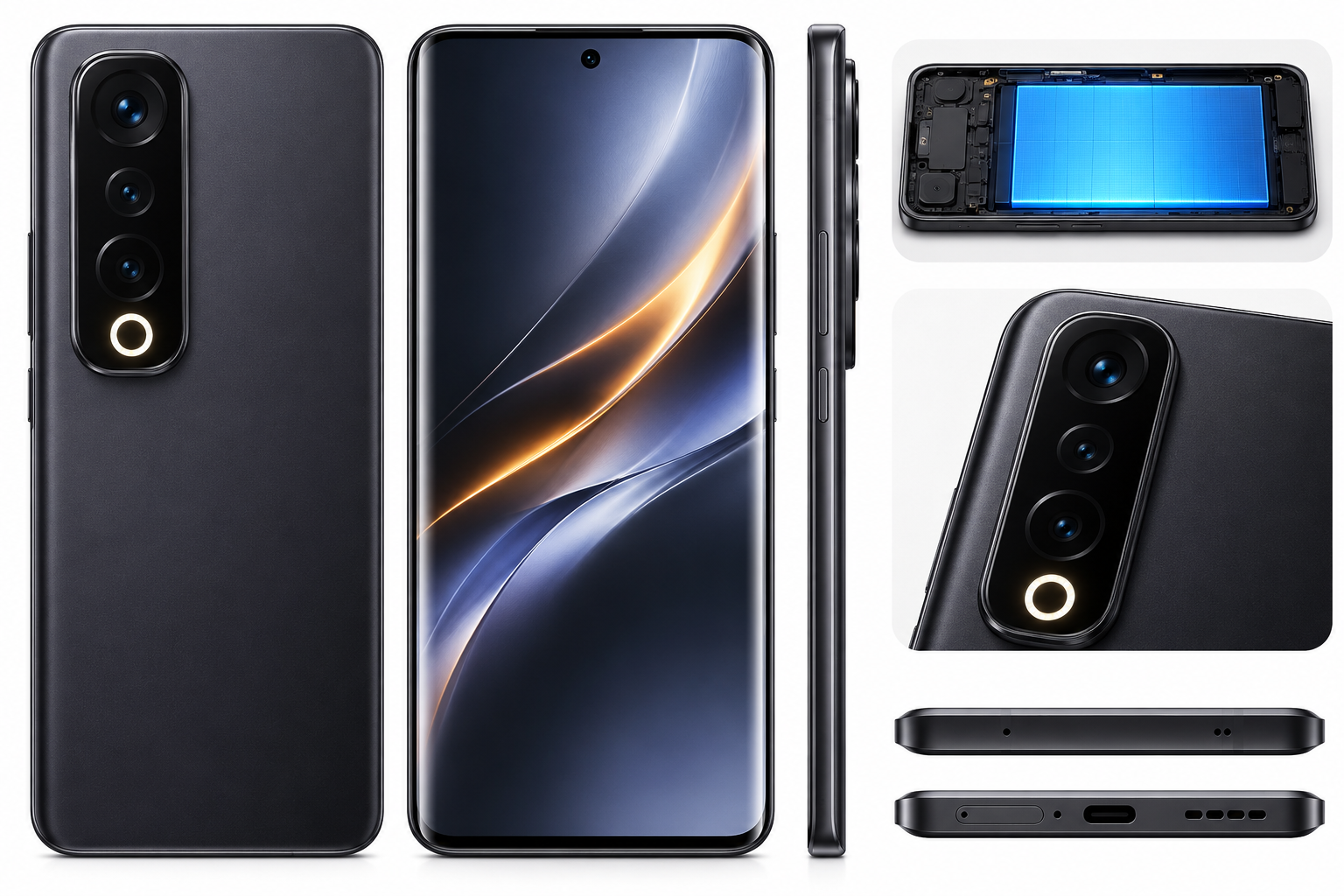
Design and Build Quality
The first thing you should know is that the vivo I2606 is not a phone you can hold yet. It exists on a Geekbench score page (as “vivo I2606”), in a BIS certificate listing, and in a handful of leaked renders. What I can tell you is what the official cluster says, and what we still do not know. The rumor anchor is that this device is the iQOO 16R: iQOO’s India-focused mid-range flagship that follows the iQOO 15R (February 2026, Snapdragon 8 Gen 5, 7,600mAh, 100W).
Confirmed: it carries the model number I2606, clears BIS (India) and TKDN (Indonesia), and runs the Snapdragon 8s Gen 4 with 12GB of RAM and Android 17. The 16R naming is used by Digit and Geekbench; other reports suggest a “16s” global name and even a Z12 Turbo rebrand for China, which tells you this is a flexible lineup rather than one firm device. Best case, the 16R is a battery-first answer to the iQOO Z11 (9,020mAh) and Poco M8 Power (8,000mAh), but with a genuinely flagship-class processor instead of a mid-range one.
Design is tipped as a flat metal frame with a 6.59-inch 1.5K OLED and a large vertical battery cell. The first thing to say about durability is the honest one: there is no confirmed IP rating for the production unit. What leaks is an IP69 claim, which would be a step up from the 15R’s IP68/IP69 if it lands — but until a real unit ships, treat the dust and water rating as an open question, not a fact. The same goes for weight and thickness: a 10,000mAh cell is a heavy proposition, and any real build will be chunkier than the 15R’s 7.9mm body.
Display
The display is unconfirmed at the spec-sheet level, but the shape is clear. A 6.59-inch 1.5K OLED at about 165Hz is the expected lineup, which would push the pixel density past 400ppi and put it ahead of the 15R’s 144Hz. The “flat high refresh rate OLED measuring around 6.59 inches” is GSMArena’s own projection, and the active-cooling fan rumor aligns with a big battery. One caution to hold onto: GSMArena’s spec page for “vivo I2606” still shows a 2020-era leak-era model (eMMC 5.1, 6000mAh, 25W wired) — the model number was reused, so treat that page as stale and the Geekbench/BIS cluster as authoritative. We will not know brightness, touch sampling, or peak nits until iQOO ships a unit.
What I can say is that a 6.59-inch 1.5K OLED is the right design for this phone. The 15R already set a comfortable 1.5K bar in this tier, and bumping the refresh rate to 165Hz closes the gap with the iQOO Z11’s 144Hz panel. The open question is local peak brightness — in 2026, “6,000 nits” marketing is common but rarely matches real-world daylight visibility. iQOO will need a single, honest peak number here, and the current leak cluster gives us none.
Performance
Here the story is the chipset, and it is the most interesting part of the whole story. The confirmed anchor is the Qualcomm Snapdragon 8s Gen 4 (SM8735) with an Adreno 825 GPU and 12GB of LPDDR5X RAM. The Geekbench result — 1,775 single-core, 6,680 multi-core — is a real number, not a rumor, and it places the 16R firmly in the mid-range-class tier.
What is striking is the contrast with the 15R’s Snapdragon 8 Gen 5. The 8s Gen 4 is a mid-range-class silicon (roughly 6nm, three performance cores plus five efficiency cores), while the 8 Gen 5 is a flagship. On paper that is a meaningful downgrade on raw CPU and GPU speed, and it will show under sustained gaming loads. iQOO 15T Review — 8,000mAh Dimensity 9500 Monster Edition, 200MP camera.
Why this matters is how iQOO framed it. The 15R’s 8 Gen 5 was the punch; the 16R’s 8s Gen 4 is the setup for a much bigger battery. The question for buyers is whether the 8s Gen 4 keeps up with modern gaming at 144Hz+. Early benchmarking is genuinely promising for a non-flagship, and iQOO’s active cooling suggests thermal headroom — but I would not take a chipset downgrade on raw speed, and the iQOO Z11 (which uses a Snapdragon 7s Gen 4 at 9,020mAh) shows how far the battery-first formula can go when the silicon is not the headline. The 12GB of RAM is the counterweight: it is best-in-class in this segment and keeps the phone feeling fast over weeks, not days. OnePlus N6 Review — 8,000mAh Dimensity 6360 Apex Budget/Durability
Camera
The confirmed camera story is minimal: a 50MP main sensor (tipped) and a 16MP selfie (tipped), with everything else unverified. A 16MP selfie is a notable regression from the 15R’s 32MP front, and it flags a phone optimised for screens and battery rather than photography. The 50MP main is plausible — it is the same width as the 15R’s main, and iQOO has used Sony sensors in this tier before — but it might be a different sensor, not a Sony LYT-700V. We will need a retail unit before the camera merits a score. Until then, the honest position is: camera quality is an open question, and the “50MP camera” claim is a rumor with a number, not a confirmed spec.
Redmi Note 17 Pro Review — 9,000mAh Battery, IP69K and 120Hz AMOLED Under 250.
Battery and Charging
This is the phone’s strongest argument. A approximately 9,000 to 10,000mAh cell with 100W charging is the headline, and the active-cooling fan is a sensible companion for such a large cell. The 15R’s 7,600mAh/100W is already a benchmark in this tier, and the 16R would add another 15 to 30 percent capacity on top. Charging speed, battery usable-capacity (silicon-carbon versus lithium-ion), and real-world endurance are all unconfirmed until launch-day reviews.
What I would not do is trust marketing quotes at face value. A battery this large needs actual test data — video-streaming hours, heavy-game hours, and wired and wireless charging curves. The active cooling fan is a good sign for a big cell (it suggests iQOO cared about sustained 100W delivery), but until a real unit goes through a full charge cycle, the numbers are projections, not measurements. iQOO Z11 Review — 9,020mAh Battery, India Launch August 20.
Software
Android 17 with OriginOS 7 is tipped, which is a big leap from the 15R’s Android 16 and OriginOS 6. The 8s Gen 4 cores are well suited to Android 17’s newer thermal and latency handling, so the OS should feel snappy. iQOO’s update track record for the 15R was decent (three major OS plus security updates is the current standard), and a 16R or 16s should offer at least the same — but there is no official commitment yet, and this is one of the unfirmest parts of the lineup.
One more honest note: India-spec phones in this line rarely carry Google Play Services at launch, so GCash, Maya, and local banking apps may need manual setup. That is a bigger deal in the Philippines than anywhere else, where a large share of the population depends on those services day to day. If the 16R lands in India first and ships without GMS out of the box, the local experience will be a major caveat, not a footnote.
Pros and Cons
| Pros | Cons |
|---|---|
| Massive ~9,000 to 10,000mAh battery target | Chipset downgrade from the 15R’s Snapdragon 8 Gen 5 |
| 12GB RAM, best-in-class for the tier | 16MP selfie, down from 32MP on the 15R |
| 100W charging tipped | Camera quality unverified until retail |
| Sharp 6.59-inch 1.5K OLED expected | No official pricing or launch date |
| Android 17 with OriginOS 7 expected | BIS and Geekbench only; largely pre-launch |
Should You Buy It?
Buy it if: you want a week of screen-on time and do not mind a mid-range-class chipset; you value battery capacity over raw gaming speed; you are in the Indian market or plan to import the 16R or 16s. The battery story alone is worth the shortlist, and the 12GB of RAM keeps the phone feeling fresh even if the chipset is not flagship-class.
Skip it if: you want the absolute fastest phone in 2027, rely on a high-resolution selfie camera, or expect a full flagship spec sheet from a company that has only confirmed the chipset so far. A phone this far from launch that publishes no pricing, no launch date, and no confirmed durability rating is a promise with numbers attached, not a finished product — and unfinished promises are fine for a wishlist, not for a cart.
Final Verdict
The iQOO 16R (vivo I2606) is a fascinating, frustrating, and potentially excellent phone — just not in the way iQOO’s marketing will probably frame it. The confirmed anchor is a real performance treat: Snapdragon 8s Gen 4, 12GB RAM, Android 17, and a Geekbench score that genuinely surprises for a mid-range-class chip. But the comparison with the 15R is unavoidably unfavourable on paper: a smaller chipset, a smaller selfie sensor, and zero confirmed launch date or price.
What still has to be answered is whether the roughly 9,000 to 10,000mAh cell and 100W charging make the tradeoff worthwhile. A flagship-class battery on mid-range-class silicon is a deliberate design choice, and it could be brilliant, or it could be a phone that charges fast, lasts forever, and performs just well enough to be overlooked. I will not call it a win or a loss until iQOO ships. For now, treat the 16R as a promise with numbers attached, and watch for a retail unit that can finally put the chipset, the camera, and the battery to the test.