
Design & Build Quality
The Mate 90 Pro Max is a big phone. At 164.5 x 78.7 x 8.2mm and 234g, it is closer to a small tablet than a traditional slab, and the weight is noticeable during long one-handed sessions. Huawei uses an aluminum frame with a glass-fiber reinforced plastic back — not the vegan leather or ceramic you find on some Mate flagships, but it feels solid and resists fingerprints well.
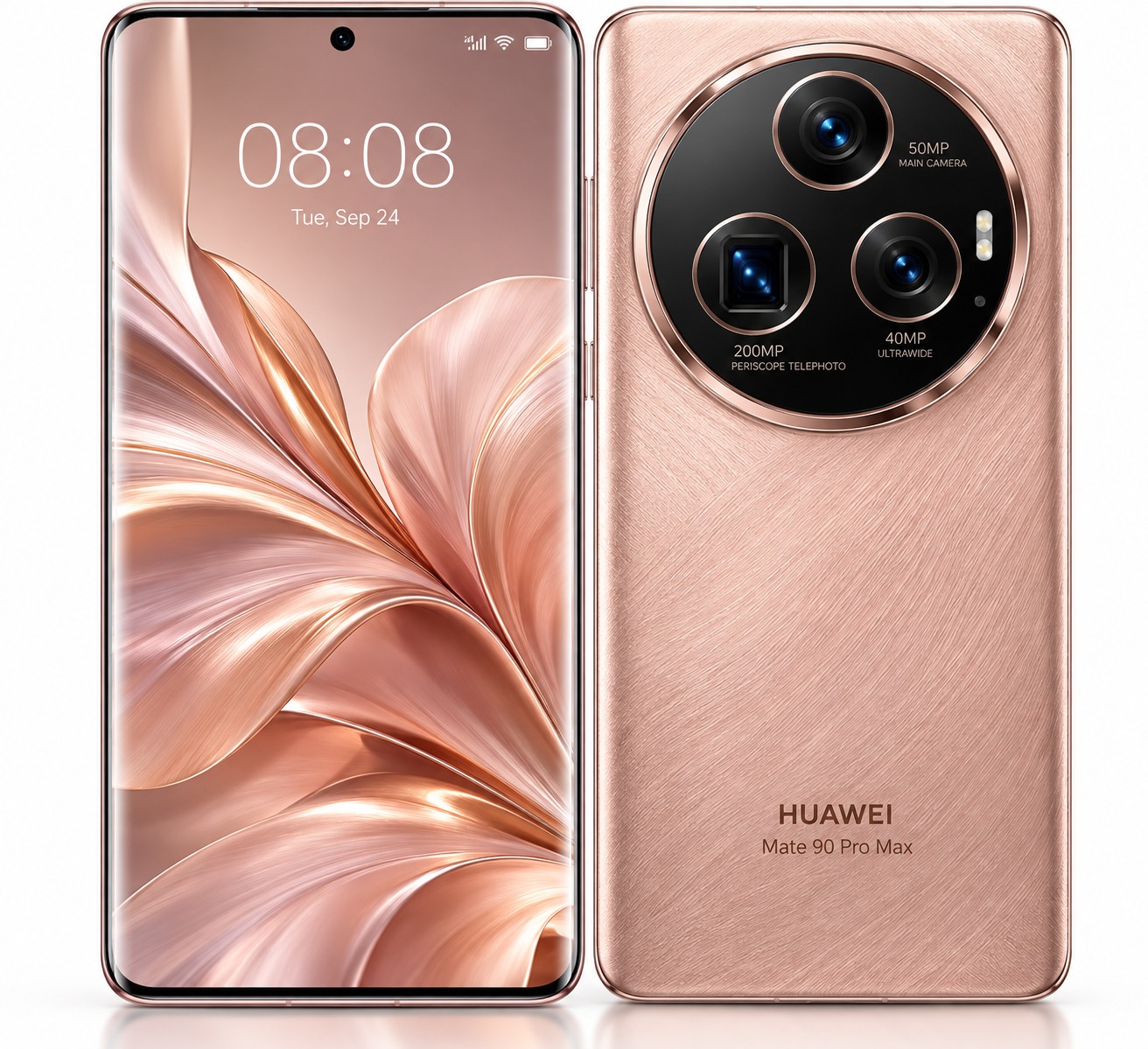
The front is dominated by the 6.9-inch display with minimal bezels, and the back features a large circular camera module that houses three lenses in a triangular arrangement. It is a bold design that will not blend in, but it also does not look like every other phone on the market. The Rose Gold colorway I tested has a warm, almost copper tone that shifts nicely under light.
IP68 and IP69 ratings are both present, meaning the phone can survive high-pressure water jets and dust ingress. The side-mounted fingerprint sensor is fast and accurate, and the stereo speakers get loud without distorting at max volume. There is no 3.5mm headphone jack — that has been gone from the Mate line for years now.
Display
The 6.9-inch dual-layer OLED panel is one of the best screens I have tested this year. The 2848 x 1320 resolution is sharp enough that you cannot see individual pixels at normal viewing distance, and the 1-120Hz LTPO refresh rate adapts smoothly to content. Scrolling through social media feels fluid, and the 300Hz touch sampling rate makes gaming responsive.
Huawei claims up to 12,000 nits of local peak brightness. That number comes with a footnote — it is measured at an isolated spot during video playback, not full-screen sustained brightness. In practice, the screen is bright enough to use under direct sunlight, and the 1,440Hz PWM dimming reduces eye strain during late-night reading. BT.2020 color gamut coverage means HDR content looks vibrant without oversaturating skin tones.
Performance
The Kirin 9050 Pro is Huawei’s latest in-house chipset, built on an advanced process node with a 1+2+4+2 core configuration. It is a capable processor, but the numbers tell a clear story: Geekbench 7 single-core scores hover around 1,317 points, with multi-core around 5,037. Compare that to the Snapdragon 8 Elite Gen 5 in the iQOO 16, which pulls 3,834 single-core and 12,396 multi-core — the Kirin trails by roughly 65% in single-core and 60% in multi-core.
Day-to-day performance is smooth. Apps launch quickly, multitasking is handled well with 16GB of RAM, and the phone does not stutter during normal use. Gaming is where the gap becomes visible. Genshin Impact at high settings runs at around 55-60fps, but the phone gets noticeably warm after 20 minutes, and the frame rate dips during intensive scenes. The Honor Magic9 Pro Max with its 2nm chip handles the same workload with more headroom.
Huawei’s “LogicFolding” technology restructures internal wiring for better efficiency, and the phone does not throttle as aggressively as some previous Kirin devices. But the raw performance deficit against the latest Snapdragon and Dimensity flagships is real and measurable.
Camera
The camera system is where the Mate 90 Pro Max earns its “Pro Max” name. The 50MP main sensor uses a 1/1.28-inch RYYB array with a continuously variable f/1.4 to f/4.0 aperture — a rare feature in smartphones. In good light, photos are detailed with accurate colors and excellent dynamic range. The variable aperture lets you stop down for sharper landscapes or open up for shallower depth of field.
The 200MP periscope telephoto is the standout. With a 1/1.28-inch RYYB sensor and 4x optical zoom, it captures more detail than any periscope camera I have tested. At 8x optical-quality zoom (a 2x crop of the 200MP sensor), you still get roughly 50MP of usable detail. The 100x digital zoom is more of a party trick — usable for identifying distant objects, but not for quality photos.
The 40MP ultrawide is competent but not class-leading. It handles landscapes and group shots well, though edge distortion is visible in some shots. The 13MP front camera with autofocus takes sharp selfies, and the 3D depth sensor enables secure face unlock even in low light.
Huawei also offers the Ruiying Z10 modular camera attachment — a 1-inch sensor with a 24-240mm zoom lens that clips onto the back. It is an innovative concept that turns the phone into a bridge camera, but it adds significant bulk and costs CNY 5,999 (around PHP 45,000) on its own. For most users, the built-in cameras are more than enough.
Battery & Charging
The 6,800mAh battery is large but not class-leading — the Oppo Find X10 Pro Max packs a bigger cell, and the vivo V40e offers similar capacity at a fraction of the price. Still, the Mate 90 Pro Max delivers solid endurance. I consistently got through a full day of heavy use — social media, camera work, gaming, and video streaming — with 20-30% remaining.
100W wired charging takes the phone from 0 to 100% in about 35 minutes, which is fast but not the fastest in this segment. 50W wireless charging is a welcome addition, and 18W reverse wireless charging can top up earbuds or another phone in a pinch.
Software
The Mate 90 Pro Max runs HarmonyOS 7.0, and this is the single most important consideration for anyone outside China. HarmonyOS does not include Google Play Services. That means no Google Play Store, no Gmail, no Google Maps, and no Google Pay. For Filipino users, the biggest issue is that GCash, Maya, and most local banking apps either will not install or will not function properly without Google Play Services.
Huawei’s AppGallery has grown significantly and now supports over 450,000 apps and services, but the gap between it and the Google Play ecosystem remains wide. Some apps can be sideloaded, but the experience is inconsistent and not something most users will tolerate as a daily driver.
The interface itself is smooth and well-optimized. HarmonyOS 7 brings improved AI features, better cross-device integration with Huawei laptops and tablets, and a clean design language. But the app ecosystem limitation overshadows everything else.
Pros and Cons
| Pros | Cons |
|---|---|
| 200MP periscope telephoto captures exceptional detail | Kirin 9050 Pro trails Snapdragon 8 Elite Gen 5 by 60%+ |
| 12,000-nit local peak brightness is stunning | No Google Play Services — GCash, Maya, banking apps affected |
| Variable aperture main camera (f/1.4-f/4.0) is unique | China-only launch — no PH availability or warranty |
| Solid 6,800mAh battery with 100W wired + 50W wireless | 234g weight is heavy for one-handed use |
| IP68 + IP69 durability with aluminum frame | 40MP ultrawide is good but not class-leading |
| Ruiying Z10 modular camera is innovative | Modular camera costs extra CNY 5,999 |
| Smooth 120Hz LTPO display with 1,440Hz PWM dimming | No 3.5mm headphone jack |
Should You Buy This?
Buy it if
- You live in China or work around the Google app ecosystem
- Camera zoom is your top priority — the 200MP periscope is genuinely class-leading
- You want a premium big-screen flagship with excellent build quality
- You are already invested in the Huawei ecosystem (laptop, tablet, watch)
Skip it if
- You need Google Play Services for daily apps (GCash, Maya, banking)
- You want the absolute best gaming performance — the Kirin chip trails competitors
- You prefer lighter phones — 234g is a lot to carry
- You are waiting for a global launch with local warranty support
Final Verdict
The Huawei Mate 90 Pro Max is a technically impressive phone that showcases Huawei’s ability to innovate despite ongoing trade restrictions. The 200MP periscope telephoto is the best zoom camera I have tested, the variable aperture main sensor is a genuine differentiator, and the build quality is excellent.
But the Kirin 9050 Pro, while efficient and capable for daily tasks, cannot match the raw performance of the Snapdragon 8 Elite Gen 5 or Dimensity 9500. And HarmonyOS 7.0 without Google Play Services remains a dealbreaker for most users outside China — especially in the Philippines, where GCash and Maya are essential apps.
For Filipino buyers, the Mate 90 Pro Max is a phone to admire from afar. If Huawei ever brings a global variant with proper Google app support, it would be a strong contender. Until then, it is a flagship that makes more sense in Shenzhen than in Manila.