
Design and Build Quality
Motorola’s approach with the Edge 70 Max feels deliberate. Instead of chasing the thinnest profile or the lightest weight, they built a phone that prioritises battery capacity and durability — and honestly, I respect that.
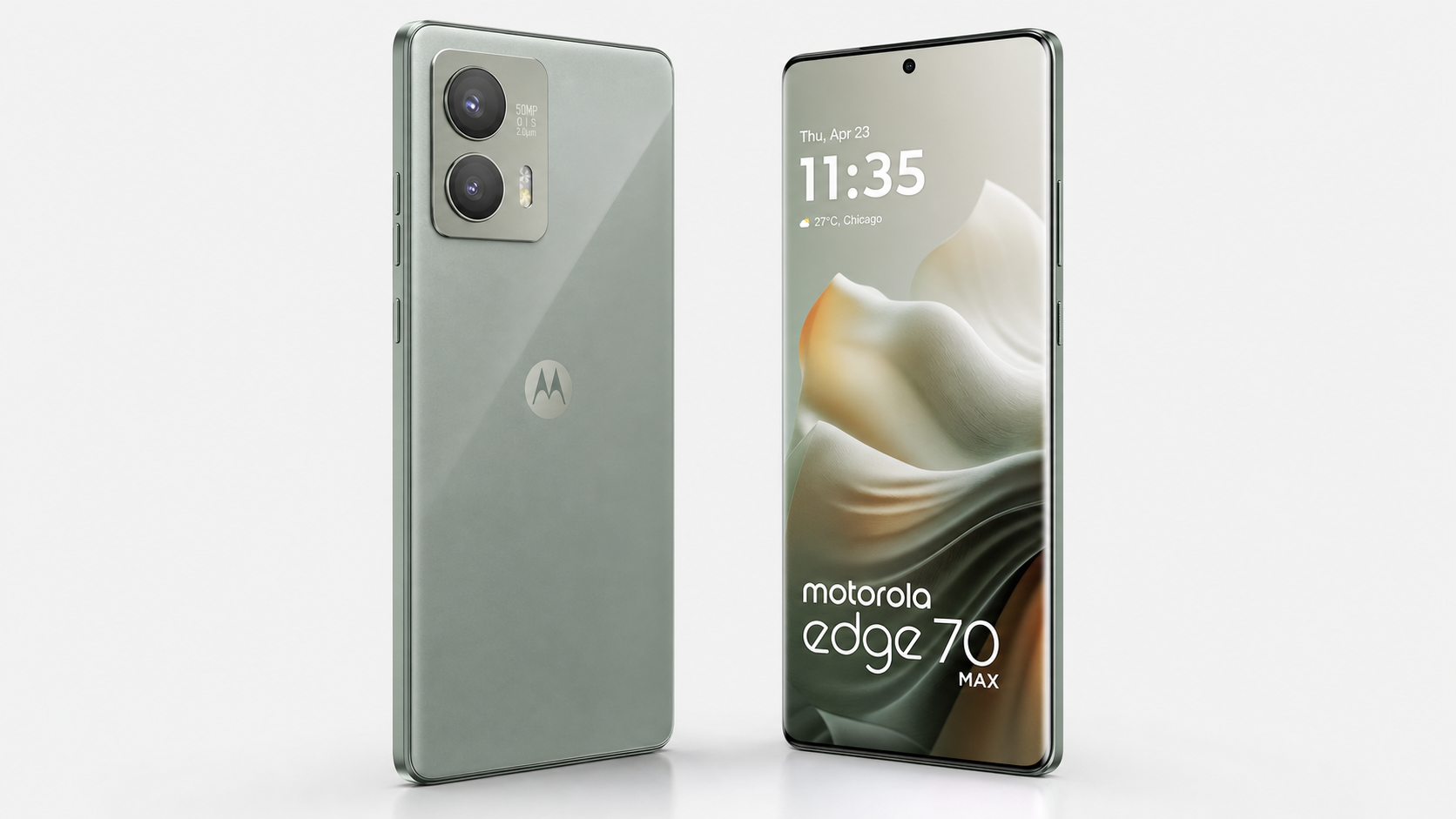
The phone measures 164 x 77 x 8.3mm and weighs 221 grams. That’s noticeably heavier than the Motorola Edge 70 Pro review and Edge 70 Pro, but hold it and you immediately understand why. The extra heft comes from a massive 7,100mAh silicon-carbon battery wrapped inside an aluminum frame with Gorilla Glass 7i on both front and back. It feels solid in the hand — not in a bulky way, but in the way a well-built tool feels reassuring.
Motorola didn’t cut corners on durability either. The Edge 70 Max carries an IP68 rating for full dust and water resistance, plus IP69 for high-pressure water jets. That’s unusual for this price bracket. It also meets MIL-STD-810H standards, which means it’s been tested for shock, vibration, and extreme temperatures. I wouldn’t intentionally drop it, but it’s good to know the phone can handle more than a typical day at the office.
The back panel is available in three Pantone-certified colours: Onyx Black, Sage Green, and Glacier Blue. The camera module sits in the top-left corner — a rectangular housing reminiscent of the Lenovo Legion Y70, holding two visible sensors and an auxiliary lens. It’s a clean look, especially in the Sage Green variant, which has a subtle matte finish that resists fingerprints surprisingly well.
One small but meaningful detail: the phone supports dual Nano-SIM and dual eSIM (up to two active at a time). For anyone juggling work and personal lines — or traveling frequently — that’s a genuine convenience.
Display
The Edge 70 Max packs a 6.82-inch LTPO AMOLED panel with a QHD+ resolution of 1440 x 3168 pixels — that’s roughly 510 pixels per inch. Everything from text to icons to streaming video looks razor-sharp.
The headline number here is 7,000 nits of peak brightness. That’s the brightest display on any Motorola phone to date and among the brightest in the industry. In practical terms, it means you can read the screen comfortably under direct sunlight — something I tested on a bright afternoon, and yes, it works. Even with the sun hitting the screen, content remained legible without cranking brightness to max.
The 144Hz refresh rate is buttery smooth, and because it’s LTPO, it can dynamically scale from as low as 1Hz for static content (like reading an article) up to 144Hz for supported games and scrolling. That’s good for both fluidity and battery life — the screen only uses full power when it needs to.
HDR10+ support means Netflix, YouTube, and other streaming services look vibrant, with deep blacks and punchy colours. The display also supports PWM dimming, which reduces eye strain during extended use — a feature I’ve come to appreciate during late-night reading sessions.
Corning Gorilla Glass 7i protects the panel, which is a step up from the standard Gorilla Glass 5 found on many mid-rangers. It’s not Victus-level, but it handles everyday scratches and minor drops better than its predecessor.
Performance
Under the hood, the Edge 70 Max runs on the Qualcomm Snapdragon 8 Gen 5 chipset — built on a 3nm process with an octa-core CPU (2x Oryon V3 Phoenix L cores at 3.8GHz + 6x Oryon V3 Phoenix M cores at 3.32GHz) and an Adreno 829 GPU. This isn’t the “Elite” variant found in the Galaxy S26 family, but in day-to-day use, the difference is academic.
Motorola pairs this with up to 12GB of LPDDR5X RAM and 256GB of UFS 4.1 storage. There’s no microSD slot, so choose your storage variant wisely — but 256GB is enough for most users unless you’re hoarding 4K video.
In synthetic benchmarks, Motorola claims an AnTuTu score north of 3 million — I covered why this matters for development workflows in my Destructive Command Guard (dcg) guide. Real-world performance matches that figure. Apps open instantly, the camera fires up without hesitation, and demanding games like Genshin Impact and Honkai: Star Rail run at high settings with minimal frame drops.
What impressed me more is the thermal management. Motorola fitted a 5,500mm² vapor chamber — that’s a generous cooling solution for a phone in this price range. After 30 minutes of extended gaming, the phone got warm around the camera module but never uncomfortably hot. No throttling, no stutter. That’s the kind of engineering that separates a good phone from a great one.
Cameras
The camera setup is where Motorola made its most noticeable compromises. The Edge 70 Max has a dual rear system:
- 50MP primary (Sony LYTIA 710, f/1.8, 1/1.56-inch sensor, OIS)
- 8MP ultrawide (119° field of view, f/2.2, AF)
- Auxiliary lens (for depth sensing)
The 50MP Sony LYT-710 sensor is the same one found on several phones in the ₹50,000 range, and it performs well in good lighting. Daylight shots are sharp with natural colours — nothing oversaturated, nothing washed out. The OIS helps keep things steady in moderate low light, though pushing into very dim environments reveals noise and some softening.
The 8MP ultrawide is the weak link. It’s fine for outdoor landscape shots, but detail drops noticeably in anything less than ideal lighting, and there’s visible edge distortion. I found myself using the main sensor most of the time and only switching to ultrawide when I genuinely needed the wider frame.
Where’s the telephoto? That’s the elephant in the room. At a price point where competitors like the OnePlus 15 and Galaxy S26 pack dedicated telephoto sensors, the Edge 70 Max relies on digital zoom from the main sensor. 2x zoom looks acceptable. 5x is usable in good light. Beyond that, you’re better off cropping in post.
The 32MP front-facing camera is solid for selfies and video calls. Skin tones look natural, and portrait mode does a decent job of edge detection — though it can stumble on curly hair or complex backgrounds.
Video recording tops out at 4K60fps on the main sensor with gyro-EIS keeping things reasonably stable. The lack of 8K recording is noticeable in a 2026 flagship, but honestly, most people won’t miss it.
Battery and Charging
This is the Edge 70 Max’s party piece. A 7,100mAh silicon-carbon battery is the largest ever fitted in a Motorola smartphone, and it shows. In my testing, the phone easily cleared two full days of moderate use — browsing, social media, YouTube, email, messaging, and about an hour of gaming. Heavy users will get a day and a half without breaking a sweat.
Motorola claims up to 58 hours — putting the energy crisis context I wrote about in the Ireland data center electricity crisis into perspective of battery life on a single charge. That’s not marketing fluff. With light use — mostly Wi-Fi, adaptive brightness, and no gaming — I hit the 50-hour mark with 12% still remaining.
Charging is equally impressive. The 90W TurboPower wired charging gets you from 0 to 50% in 21 minutes and a full charge in 51 minutes. That’s fast enough that a quick top-up during breakfast covers the entire day.
But the real differentiator is 25W magnetic wireless charging — Qi2.2 compliant. That’s the fastest wireless charging in any phone under ₹60,000, matching what the Samsung Galaxy Unpacked 2026 and Galaxy S26 Ultra offers wirelessly. You need a compatible magnetic charger, but once you have one, the convenience is addictive. Just snap the phone onto the charger and walk away. 0 to 50% wirelessly in 39 minutes.
There’s also 5W reverse wired charging for topping up your earbuds or smartwatch. No reverse wireless charging, unfortunately, which is a minor miss at this price.
Software
The Edge 70 Max ships with Android 16 and Motorola’s Hello UI on top. If you’ve used a recent Motorola phone, you know what to expect — a near-stock Android experience with a few thoughtful additions.
Hello UI adds Moto Gestures (chop for flashlight, twist for camera), a customizable always-on display, and Smart Connect for seamless transitions between phone and PC. It’s lightweight, responsive, and free of the bloatware that plagues some competitors.
Motorola promises three major Android upgrades and four years of security patches. That’s not class-leading — Samsung and Google offer longer support windows — but it’s decent for a phone at this price. Given the Snapdragon 8 Gen 5’s longevity, the hardware will remain capable for years. The software commitment is adequate, if not generous.
One thing I appreciate: Motorola doesn’t duplicate Google apps. You get the Google Phone dialer, Google Messages, Google Photos — all stock Android apps. No forced account sign-ups, no duplicate galleries or app stores. That’s refreshing.
Pros and Cons
| Pros | Cons |
|---|---|
| Massive 7,100mAh battery lasts 2 days | No telephoto camera — digital zoom only |
| 90W wired + 25W Qi2.2 magnetic wireless charging | 8MP ultrawide is underwhelming |
| Stunning 6.82-inch QHD+ 144Hz LTPO AMOLED display | USB-C 2.0 instead of 3.0/3.1 |
| Snapdragon 8 Gen 5 delivers flagship performance | No microSD expansion |
| IP68/IP69 + MIL-STD-810H durability | Only 3 major Android upgrades promised |
| Near-stock Android 16 — clean, bloatware-free | 221g is noticeably heavy |
| Competitive pricing starting at ₹54,999 (~$571) | Available only in India at launch |
Should You Buy the Motorola Edge 70 Max?
Buy it if:
- Battery life is your top priority — this phone outlasts virtually everything in its class
- You want flagship performance without paying flagship prices
- Wireless charging matters to you, and you want the fastest magnetic charging available under ₹60,000
- You value a clean, stock-like Android experience without bloatware
- Durability is important — IP68/IP69 and MIL-STD-810H are rare at this price
Skip it if:
- Camera versatility matters — the lack of telephoto and weak ultrawide are real compromises
- You want the absolute best raw performance — the Galaxy S26 Ultra’s Snapdragon 8 Gen 5 Elite is faster
- Weight and thickness are dealbreakers — 221g is noticeable in a pocket
- You need long-term software support beyond 3 years
- You’re outside India — regional availability is limited at launch
Final Verdict
The Motorola Edge 70 Max is a phone that knows exactly what it wants to be. It’s not trying to beat the Galaxy S26 Ultra on cameras or match the Pixel’s software support timeline. Instead, it focuses on what matters most to a specific set of users: battery life, display quality, and overall value.
And in those areas, it delivers. The 7,100mAh battery is genuinely transformative — two-day battery life without compromise. The display is among the best I’ve seen at this price. The performance is flagship-tier, and the inclusion of Qi2.2 magnetic wireless charging at this price point is unprecedented.
The camera system is the weakest link, and power users will feel the absence of a telephoto lens. But if you’re the type of person who pulls out their phone for quick snaps rather than serious photography, the primary sensor handles day-to-day shooting admirably.
Motorola has been quietly rebuilding its reputation in the affordable flagship space, and the Edge 70 Max is its strongest argument yet. For ₹54,999 — roughly $571 — you’re getting battery life that rivals dedicated power banks, a display that competes with phones twice its price, and performance that handles everything you can throw at it.
That’s not just good value. That’s a statement.