
India already has the iQOO Z11, the big-battery phone that launched last month at ₹34,999. Now iQOO is back with a cheaper, even more battery-focused Z11xa, priced at ₹27,499 effective and going on sale tomorrow, September 14. The catch is in the name: the “a” model drops to an IPS LCD panel and pairs a mid-range chipset with that giant 7,200mAh cell. For the price it’s a genuinely interesting value phone, but it forces you to accept compromises the pricier Z11 didn’t make. Here’s my honest look at who should care.
Design & Build Quality
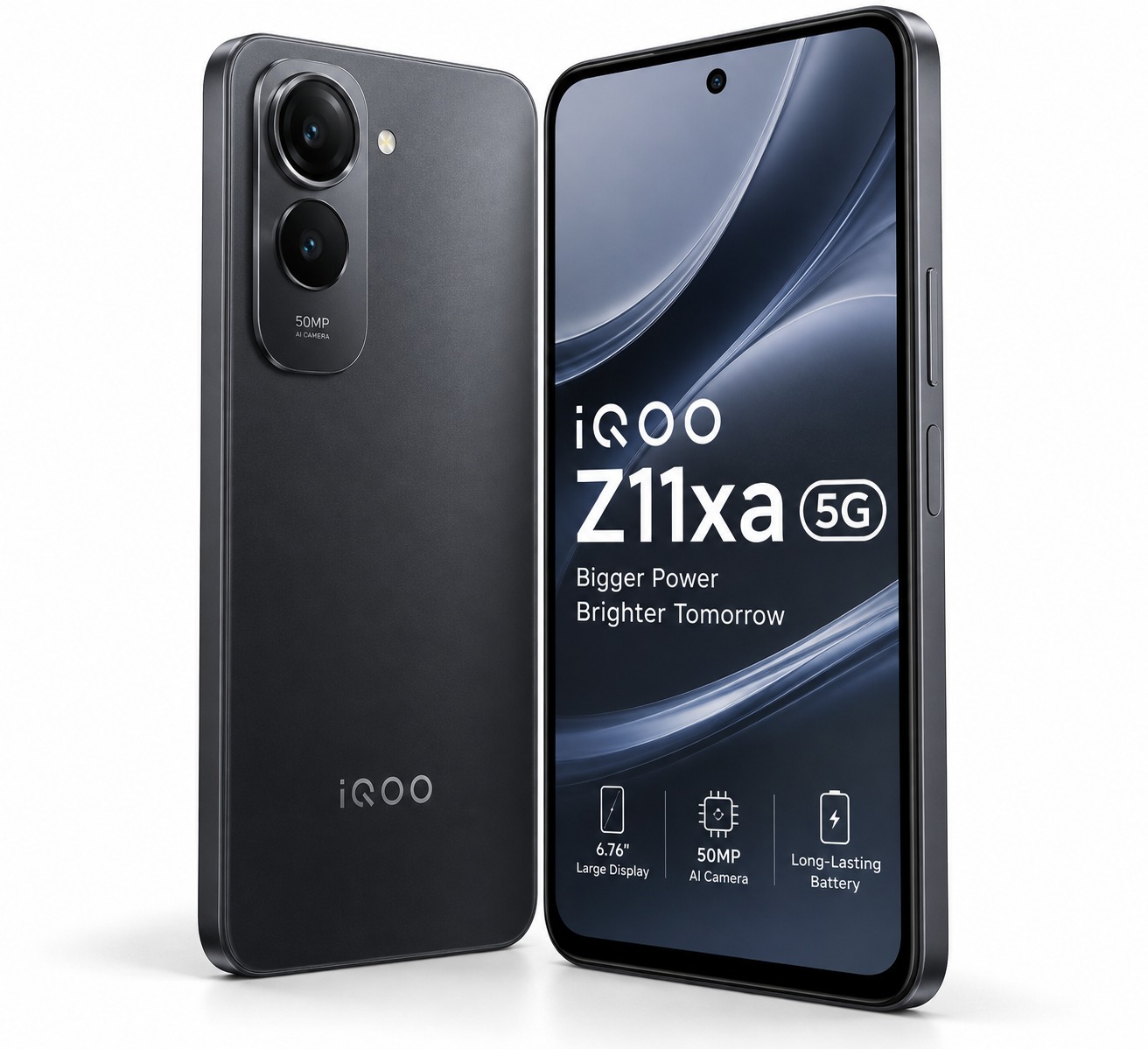
The Z11xa is a big, blocky phone in the best way. It measures 166.6 x 78.4 x 8.4mm and weighs a noticeable 219g, so it’s not something you’ll forget in your pocket. The frame is plastic and so is the back, but the front is glass and the whole thing carries IP68 and IP69 ratings, meaning it survives immersion as well as high-pressure water jets. iQOO also claims military-grade durability, and the side-mounted fingerprint sensor is easy to reach.
Compared side by side with the iQOO Z11 India we reviewed, the Z11xa feels chunkier and more utilitarian. That’s not a bad thing for a phone sold on endurance rather than looks. It arrives in two colors — Titan Black and Prismatic Green, the latter with a subtle textured finish that hides fingerprints well. There’s no 3.5mm headphone jack, but you do get a USB-C port, an IR blaster, and stereo speakers.
iQOO also worked on how the phone behaves when your hands aren’t dry. It supports wet-hand and greasy-hand touch, plus a one-tap mode that ejects water or grease from the screen surface. It’s a small thing, but it ties directly into the durability-first pitch — this is a phone built for kitchens, fieldwork, and rainy commutes, not just for sitting on a desk. If you’re someone who kills phones with drops and spills, the Z11xa is clearly aimed your way.
Display
Here’s the headline trade-off. The Z11xa uses a 6.76-inch FHD+ (1080 x 2344) IPS LCD running at 120Hz, with up to 1,200 nits of brightness in High Brightness Mode. It’s sharp, smooth enough for daily scrolling, and it reads clearly outdoors. But it is not the 1.5K 144Hz AMOLED you get on the costlier Z11, and the difference is obvious next to a phone with an OLED panel.
The display is TÜV Rheinland Low Blue Light certified and ships with an eye-comfort suite, including new Sleep Comfort Mode and Anti-Motion Sickness Mode aimed at reducing strain during long sessions. If you’re sensitive to PWM flicker on OLEDs, this LCD is actually a plus — several commenters on the GSMArena Z11x page praise it as a rare comfortable option. Just know you’re giving up the deep blacks and punchy contrast of AMOLED to save money and protect your eyes.
Performance
Inside is the MediaTek Dimensity 7400-Turbo, a 4nm octa-core chipset with four Cortex-A78 cores and four Cortex-A55s, paired with a Mali-G615 GPU. It’s genuinely mid-range silicon — iQOO claims an AnTuTu score above 890,000, which puts it in comfortable daily-driver territory but well short of flagship numbers. Apps open fast, scrolling is fluid, and casual games run fine. Push a demanding 3D title hard and it will thermal-throttle eventually, but the phone handles its lane admirably.
Memory is where the value story gets complicated. You get a single configuration: 8GB of LPDDR4X RAM and 128GB of UFS 2.2 storage, with no card slot and no larger variant. You can extend the RAM virtually by 8GB, but UFS 2.2 is slower than the UFS 3.1 on the pricier Z11, and a phone this focused on endurance feels like it deserved a 256GB option. If 128GB is enough for you, fine — just plan your storage carefully.
Camera
The rear is a Sony IMX852 50MP main sensor with an f/1.8 lens and PDAF, joined by a 2MP bokeh lens. That’s it — no ultrawide and no telephoto. The 2MP second camera is more decoration than tool. The front packs a 32MP sensor, and both the front and rear cameras can record 4K video at 30fps, which is a welcome surprise at this price.
In good light the main sensor captures clean, well-exposed shots with punchy color, and the 50MP mode gives you room to crop. Low light is workable but not exceptional for the price band — you’ll see softness in shadows. The 32MP front camera is solid for selfies and video calls. Be honest with yourself here: this is a two-trick camera (main plus selfie), not the all-rounder an ultrawide would give you.
What the Z11xa avoids is gimmickry. Instead of stacking a 2MP macro and a 2MP depth on top of a decent main camera just to inflate the count, iQOO keeps a single useful rear lens and one barely-useful bokeh companion. The result is a cleaner, less cluttered camera interface. If your photo diet is everyday scenes, group shots, and the occasional 4K clip, this is enough. If you’re chasing ultrawide landscapes or distant subjects, look at a phone with a proper secondary lens.
Battery & Charging
This is the reason to buy the Z11xa. It packs a 7,200mAh silicon-carbon cell — a number that used to sound like a tablet spec — and iQOO claims up to 40 hours of video playback and two full days of typical use. It also claims the battery holds up to six years of healthy capacity, which I’d treat as marketing until independent testing confirms it. Still, for most people this phone comfortably survives a full day plus a morning.
Charging is 44W FlashCharge, which gets you from 1% to 50% in about 43 minutes. That’s not the 100W you’ll find on bigger-battery rivals, and on a 7,200mAh cell it means a full top-up takes a while. But you’ll rarely need to charge frequently, and you get reverse wired charging plus bypass charging — the latter lets you run the phone on the charger without wearing the battery during long gaming sessions. In the same endurance league, the vivo V80 Lite pushes 10,000mAh and the Redmi Note 17 Pro Max pairs 10,000mAh with 100W, so the Z11xa’s charging speed is its weakest endurance link.
Software
The Z11xa runs OriginOS 6 on top of Android 16 — and notably, it’s one of the first iQOO phones to ship OriginOS in India instead of the old Funtouch OS. That’s a meaningful change. You get Origin Island, iQOO’s version of the Dynamic Island-style notification widget, plus Drag and Go for grabbing content across apps, a suite of AI creation tools, Google Circle to Search, and gaming extras like Monster Gaming Mode, 4D vibration, and an AI voice changer.
iQOO promises two years of Android OS upgrades and four years of security patches. That’s a shorter software commitment than the three-plus-five you’ll find on higher-tier phones, and it’s worth weighing against a device you may want to keep for years. The software itself is clean and fast, and you can uninstall most of the preloaded apps. If you want to compare, the bigger-cell iQOO Z11 (the 9,020mAh model) runs the same OriginOS 6 when it ships.
Pros and Cons
| Pros | Cons |
|---|---|
| Huge 7,200mAh battery with 2-day endurance | IPS LCD instead of AMOLED |
| IP68/IP69 + military-grade durability | Single 8GB/128GB config, no card slot |
| OriginOS 6 (rare OriginOS debut for iQOO India) | 2 major OS updates only |
| 4K video on front and rear cameras | No ultrawide or telephoto, 2MP bokeh only |
| Bypass charging + reverse wired charging | UFS 2.2 storage, slower than rivals |
| Eye-comfort LCD, low PWM flicker | 44W charging is slow on a 7,200mAh cell |
Should You Buy This?
Buy it if
- Battery life is your top priority and two-day endurance matters more than tech specs.
- You’re sensitive to OLED flicker and want a comfortable IPS LCD.
- You want durability — IP68/IP69 and military-grade build at a budget price.
- You’re after a fresh OriginOS experience at an entry iQOO price.
Skip it if
- You want an AMOLED screen — the Z11 at ₹34,999 keeps the 144Hz 1.5K panel.
- 128GB of storage won’t be enough; there’s no 256GB option and no card slot.
- You need an ultrawide or telephoto camera for your shooting style.
- Long-term software support matters — two OS upgrades is on the lean side.
Final Verdict
The iQOO Z11xa is a phone built around one idea: endurance. For ₹27,499 effective, you get a 7,200mAh battery that most people will charge every other day, genuine IP68/IP69 and military-grade toughness, and a surprisingly comfortable IPS display. If your phone dies by mid-afternoon on a typical day and you’re tired of carrying a power bank, this is exactly the kind of device that solves that problem without breaking your budget.
But you pay for that battery in real ways. The LCD panel gives up the vivid contrast of AMOLED, the single 8GB/128GB config leaves you no room to grow, the camera is a one-trick main lens, and the two-year OS commitment is on the short side. It’s a purpose-built companion to the pricier Z11 rather than a replacement — pick the Z11 if the display and storage matter most, and the Z11xa if raw endurance wins your wallet.
For a phone sold on one big number, it succeeds at that number better than most. The Z11xa isn’t the best all-rounder in India’s mid-range, but if two or three days away from a charger is what you actually need, it deserves a spot on any shortlist — and it fits comfortably among the best value phones of 2026.