
Oppo has opened pre-orders for its Find X10 series in China, and the headline act is the Find X10 Pro Max. It packs three 200MP cameras, an 8,000mAh silicon-carbon battery, and is the first Oppo flagship expected to run on MediaTek silicon. It’s not on shelves yet, so this is a launch-window look at everything Oppo has officially confirmed, plus the handful of specs that are still up in the air.
If triple 200MP camera modules sound familiar, it’s because Oppo has been teasing this one for weeks. Now the company has pinned down most of the details. Here’s what we actually know.
Design & Build Quality
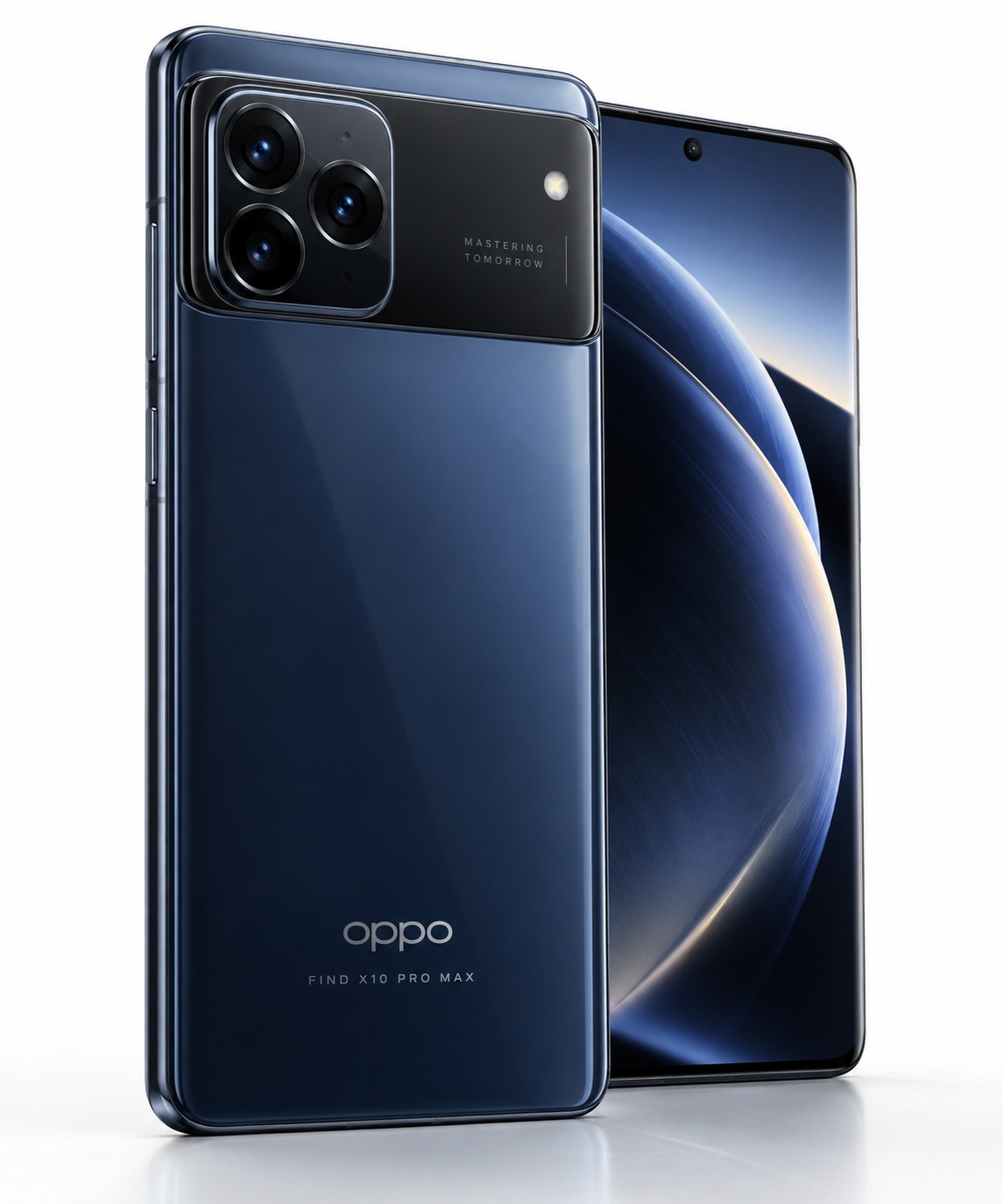
The biggest visual change is the camera island. Where the Find X9 Ultra used a circular module in the upper-left corner, the X10 Pro Max stretches a full-width rectangular camera bar across the back, with a square plate holding the three sensors, the flash, and a separate color sensor in their own cutouts.
The layout borrows a lot from the leaked iPhone 17 Pro design, and that’s worth being honest about. When every flagship settles on the same horizontal bar because bigger sensors need more physical space, you can’t help wondering who followed whose homework. Either way, the engineering argument holds — three 200MP sensors with periscope optics genuinely need the width.
Confirmed colors so far are a glossy deep blue and a white variant with a textured back that echoes the Find X9 Ultra’s Tundra Umber finish. Oppo has also confirmed a 0.99mm bezel on the standard Find X10, and the Pro Max is expected to follow the same ultra-thin bezel treatment, though that’s not official yet.
Display
Oppo is reportedly moving the series to a new Tianma Tiangong Screen 2.0 OLED panel. The headline claims are eye-comfort focused: a new N1 primary-color spectrum material that cuts harmful blue light by roughly 3.7% while boosting deep-red output by 5.5%, along with an AI De-Mura algorithm that can drop brightness as low as 0.01 nits.
Tianma says the panel is about 16% more power efficient and has a nearly 33% longer lifespan than before, and it covers an impressive 95% of the BT.2020 color gamut. All of that should make the display easier on the eyes during long stretches — nice for someone who reads or works on a phone all day.
Here’s the honest catch: the resolution and refresh rate are still unconfirmed, and reporting actually differs. Gadgets360 lists a 6.82-inch panel while other leaks point to a 6.78-inch 2K OLED at 120Hz. Oppo hasn’t locked this down officially, so treat the exact numbers as unsettled until the China launch.
Performance
This might be Oppo’s boldest move: the Find X10 Pro Max is expected to run the MediaTek Dimensity 9600 Pro, built on TSMC’s 2nm process. That would make it one of the first commercially available 2nm phones, and a statement in its own right after years of flagship duty going to Qualcomm.
A Geekbench listing under the PMX110 model number shows an octa-core part with two prime cores clocked at 4.55GHz, three performance cores at 4.35GHz, and three efficiency cores at 3.1GHz. It scored 3,691 single-core and 11,093 multi-core, with 16GB of RAM on the benchmarked unit, though retail configurations are unconfirmed.
I’ll flag this clearly: the chipset is expected and benchmark-listed, but Oppo hasn’t officially confirmed it. The Dimensity 9600 Pro is set to be formally announced on September 15, so this is one to watch for in the next few days. If the 2nm efficiency story holds, the real payoff should show up in battery life and thermals more than raw benchmark scores.
Camera
The Find X10 Pro Max’s reason to exist is three 200MP cameras — a first for any flagship. The main sensor uses Oppo’s DeepPix technology with up to 17EV of dynamic range, an f/1.5 aperture, and CIPA 6.5 stabilization. The ultrawide is also 200MP with a 124-degree field of view at f/2.2, and Oppo claims it captures 102% more light than the sensor on the Find X9 Pro. Rounding it out is a 200MP periscope telephoto at f/2.1 with CIPA 7.5 stabilization.
The consistency angle is the real story. Most phones deliver flagship quality from the main lens and then noticeably weaker ultrawide and telephoto shots because those use smaller, cheaper sensors. Put 200MP on all three and, in theory, you get the same pixel-binning quality from every lens. That consistency is exactly where rivals like the Google Pixel 11 Pro often stumble, since their ultrawide and telephoto lenses lean on smaller sensors.
Oppo is leaning into the Hasselblad partnership with the “Ultra-Clear Native Camera” system, plus a second-generation Danxia color reproduction lens that uses 24 sampling channels for up to 15EV of dynamic range, and its LUMO color science. For video creators, the Pro Max supports 8K recording on all three rear cameras and OpenGate capture, which uses the full 4:3 sensor area, with direct integration into the Blackmagic Camera app and O-Log2.
Being straight about it: none of this is tested yet. Camera quality on paper means nothing until the computational pipeline is proven, so treat the hardware claims as a promise, not a verdict. There’s also a small spec discrepancy worth noting — some listings show the rear as 200MP + 200MP + 50MP, which likely just describes the separate color sensor alongside the triple 200MP setup. I’d wait for Oppo’s final spec sheet to be sure.
Battery & Charging
The Find X10 Pro Max carries an 8,000mAh silicon-carbon battery, up 38% from the Find X9 Ultra’s 5,800mAh. Oppo claims the cell retains its capacity for up to five years. Battery longevity claims from manufacturers tend to be optimistic, so I’d treat that as a stretch goal rather than a promise.
Charging is the one piece that’s still rumored rather than confirmed: 80W wired and 50W wireless, per tipster Digital Chat Station. Oppo’s SUPERVOOC and AIRVOOC track record makes both plausible, but nothing official yet. Combined with the 2nm chip’s efficiency, multi-day endurance for moderate users is a realistic possibility. That would comfortably outlast the Galaxy S26 Ultra on paper, though the recent vivo V80 Lite still holds the biggest cell we’ve covered lately at 10,000mAh.
Software
The Find X10 Pro Max ships with Android 17-based ColorOS 17 out of the box. That matters more than usual this year because Oppo is streaming its entire software strategy: Realme UI is being retired in favor of ColorOS, and OnePlus is folding OxygenOS into the same platform. The color ecosystem is converging, and the Find X10 series is right at the center of it.
Oppo hasn’t confirmed how many OS updates or years of security patches the X10 Pro Max gets, so I’m flagging update commitment as an open question. The same goes for bloatware and any China-market quirks that global units might inherit.
Pros and Cons
| Pros | Cons |
|---|---|
| World’s first triple 200MP camera system | Real-world camera quality untested before launch |
| 8,000mAh silicon-carbon battery (+38% vs X9 Ultra) | Chipset still unconfirmed by Oppo |
| Possible first 2nm phone with Dimensity 9600 Pro | Charging speeds rumored, not confirmed |
| 8K on all three rear cameras + OpenGate / O-Log2 | Display resolution and refresh unsettled |
| ColorOS 17 on Android 17 out of the box | Premium ~$1,570 global price target |
| Hasselblad color science and Danxia 2 sensor | No confirmed Philippines launch or pricing |
Should You Buy This?
Buy it if:
- You want the most consistent triple camera setup on paper before 2026 is out
- You shoot a lot of video and care about 8K, OpenGate, and a real cinema color profile
- Battery endurance is your priority and you like the idea of a 2nm, 8,000mAh combination
- You’re willing to wait for early reviews before handing over roughly a thousand and a half dollars
Skip it if:
- You need a phone this month — the China launch is late September, and global availability isn’t expected until late October
- You live in the Philippines and need an official price and warranty before you commit
- You’re not a camera or battery-first buyer; the standard Find X10 likely covers everyday use for less
- Unconfirmed specs make you nervous — there are still real question marks here at pre-order stage
Final Verdict
The Oppo Find X10 Pro Max is shaping up to be the most aggressive imaging phone of the year. Three 200MP sensors with Hasselblad tuning, an 8,000mAh cell, and a likely 2nm MediaTek chipstack is a genuinely flagship package, and the OpenGate video story gives creators something none of the competition is matching yet.
But I won’t oversell it. This is a pre-order preview, not a tested review. The chipset, display, charging speeds, update commitment, and real camera quality all remain officially unconfirmed, and Oppo is expected to keep some details hidden until the China launch. The Dimensity 9600 Pro announcement on September 15 and the launch later this month should close most of those gaps.
Who is this for? A patient, camera-and-battery-first buyer who wants the best imaging specs of 2026 and is happy to wait for independent reviews to confirm the numbers actually deliver. If you need a phone today or you live outside China and want a locked-in local price, it’s worth holding back until Oppo tells us more. For everyone else, this is the flagship to watch between the iPhone 18 Pro and the Galaxy S26 Ultra this fall — and it’s earned a spot in our top phones of 2026 conversation.