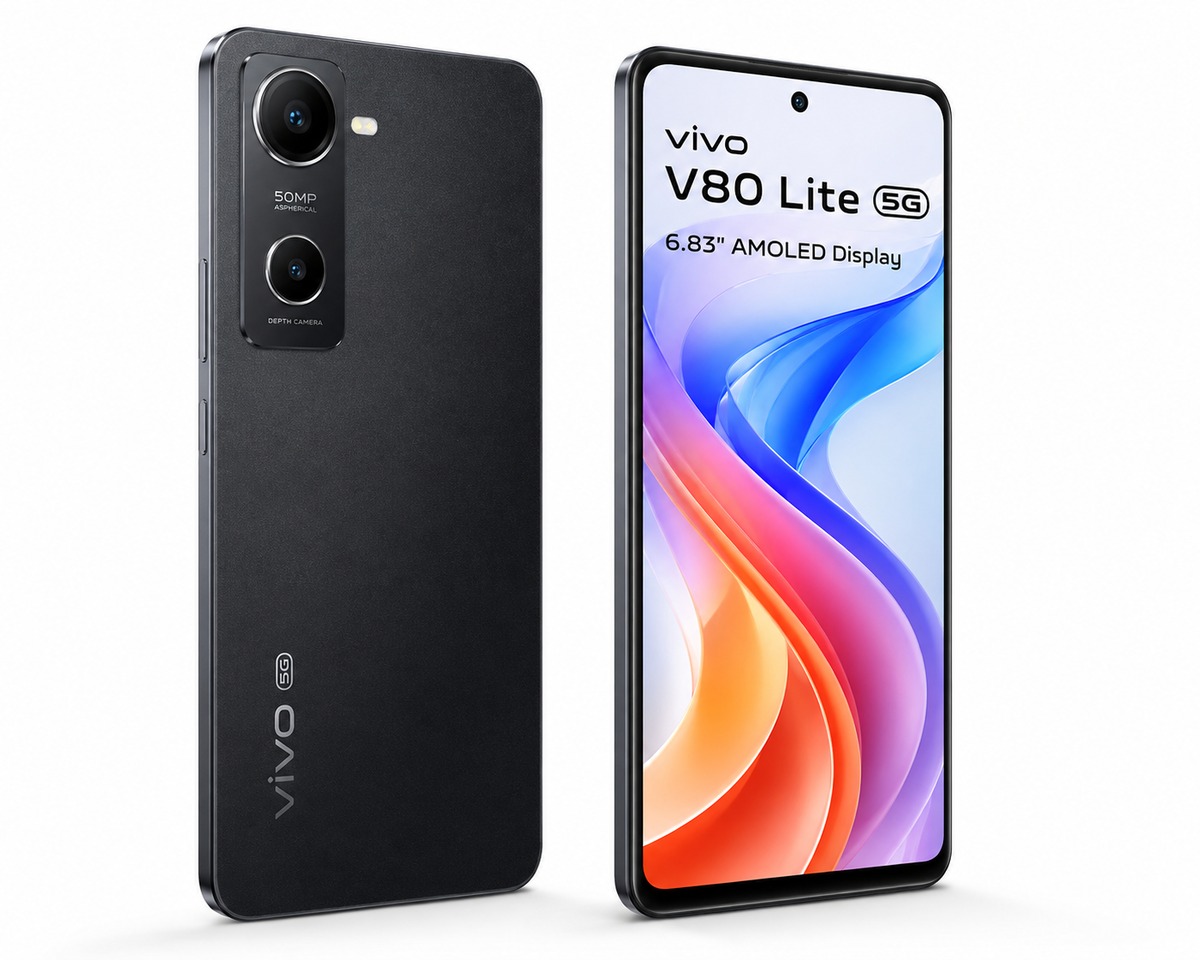
The vivo V80 Lite is the best example yet of the big-battery race that took over the mid-range in 2026. vivo just pushed a 10,000mAh silicon-carbon cell into a slim, IP68/IP69-rated slab priced under $350, and it lands as the first phone in the company’s V80 family. That single number scoops everything else the mid-range managed this fall.
But here’s the part worth reading twice: this is the global V80 Lite from Malaysia, not the model that launched in India and Pakistan last week. The two share the name and almost nothing else. The global unit runs a Dimensity 7300e chip with a 10,000mAh battery, while the South Asian unit is essentially a rebadged vivo S2 with a 7,050mAh cell. If you’re shopping by name, you need to know which one you’re actually buying.
Design and Build Quality
The V80 Lite doesn’t look like a phone carrying a battery twice the size of most flagships. At 163.9 x 76.5 x 8.59mm and about 224g it’s noticeably thicker and heavier than your average mid-ranger, but vivo has kept that 10,000mAh cell wrapped in a surprisingly tidy frame. The flat frame and textured back feel solid in hand — this isn’t the slippery, creaky budget chassis some battery champions fall back on.
What sets it apart from the crowd is the durability story. The phone carries both IP68 and IP69 ratings: it will survive submersion in 1.5m of water for 30 minutes and shrug off high-pressure hot water jets, the kind used in industrial kitchens. It’s also MIL-STD-810H certified. Compared to the vivo Y31t I reviewed — which pairs a 7,200mAh battery with the same IP68/IP69 and 44W charging — the V80 Lite trades a slim profile for a much larger cell while keeping the same toughness.
You get Green, Pink, and Black finishes, and vivo calls the back a textured panel that resists fingerprints. There’s no headphone jack here, and the in-display optical fingerprint reader sits under the AMOLED panel, in the usual spot. It fires in one tap.
Display
The V80 Lite ships with a 6.83-inch 1.5K AMOLED panel running at 1260 x 2800 pixels and a 120Hz refresh rate. That’s a punch-hole design with a centered selfie camera, and the 449ppi density keeps text and video looking sharp. Vivo rates this panel at 2000 nits peak brightness in high-brightness mode, which I read as a local peak for one spot of the screen rather than a figure you’ll hold across the whole display — treat it like a marketing number, not a full-screen guarantee.
Support for HDR10+, 100% DCI-P3 color, and 1.07 billion colors means streaming content and HDR video look vivid. GSMArena’s listing floats a 144Hz figure here, but vivo’s official Malaysia page and most launch coverage settle on 120Hz, so I’m treating 120Hz as the real spec and the 144Hz mention as a source discrepancy. Indoors the panel gets bright enough to read in daylight without hunting for shade, and the flat design with slim bezels keeps the display comfortable to swipe.
Performance
Under the hood is MediaTek’s Dimensity 7300e, a 6nm octa-core chip with four Cortex-A78-class cores at 2.0GHz and four efficiency cores at 2.5GHz. This is the energy-sipping “e” variant of the Dimensity 7300, and vivo tuned it toward battery life rather than peak throughput. You won’t mistake it for a flagship — AnTuTu numbers land in the mid-range zone, and vivo’s own claim of up to 940,000 is a lab figure, not an everyday result.
The phone ships with 6GB or 8GB of LPDDR4x RAM and 128GB or 256GB of UFS 3.1 storage. There’s no microSD card slot, so buy the size you plan to keep. Day-to-day use — social feeds, messaging, mobile banking, lightweight games — feels fluid. The 3.8K vapor chamber cooling keeps thermals respectable under sustained load, though heavy gaming titles will still strain the chip and you’ll notice frame drops before the phone gets hot.
Camera
The rear setup is a 50MP Sony IMX852 main shooter with an f/1.8 aperture paired with a 2MP depth sensor. That’s the honest headline any way you slice it: this is a single usable camera, not a triple array. The 50MP main is competent in good light, and vivo’s processing has gotten better at keeping colors natural rather than oversaturated. The 2MP sensor is basically a decorative placeholder — there’s no ultrawide and no telephoto.
The 32MP f/2.0 front camera handles selfies and video calls cleanly. One note: a GSMArena news piece mentioned a 50MP front camera, but vivo’s official page and every launch source I cross-checked agree on 32MP, so the 50MP figure looks like an error in one early update. Video tops out at a standard level; don’t expect 4K with advanced stabilization here.
Battery and Charging
This is the section that matters, because a 10,000mAh cell is the whole point of the phone. Vivo uses fourth-generation silicon-carbon anode tech with a BlueVolt battery, and it claims the cell retains at least 80% of its capacity after 1,400 charge cycles — read that as roughly seven years of normal use. For endurance, the phone is a monster: vivo advertises up to 30 hours of binge-watching, 64 hours of talk time, and 14 hours of gaming. No review has yet run its own endurance benchmark, so treat those as flagship-level claims rather than measured results.
The catch is charging. You get 44W wired FlashCharge, a 44W adapter included in the box, and USB-C reverse charging for your earbuds. Forty-four watts on a 10,000mAh cell is genuinely slow — expect an hour and a half or more for a full fill, which feels like a real compromise when rivals charge faster. Compare that to the Redmi Note 17 Pro Max, which matches the 10,000mAh battery but charges at 100W, or the Oppo A7 Pro Max at 80W. The iQOO Z11S I reviewed carries the same 10,000mAh battery with the same 44W catch. And there’s no wireless charging at all.
Software
The V80 Lite runs OriginOS 6 on top of Android 16. It’s a clean, customizable experience with none of the bloatware extremes I’ve seen on some rivals, and vivo’s smart assistant and Extended RAM features show up here. A software update scheduled for late September adds expanded virtual RAM. If you’re coming from stock Android, OriginOS is a gentle learning curve rather than a wall of surprises.
Pros and Cons
| Pros | Cons |
|---|---|
| Massive 10,000mAh battery with 7-year health claim | 44W charging is slow for a cell this big |
| IP68 + IP69 dust and water resistance plus MIL-STD-810H | No wireless charging |
| Slim, well-built frame for a battery champion | Dimensity 7300e is mid-range at best |
| Bright 1.5K 120Hz AMOLED display | Single 50MP rear camera, no ultrawide or telephoto |
| 44W charger included in the box | No microSD expansion |
| Clean OriginOS 6 software with good update base | PH availability and pricing not yet confirmed |
| USB-C reverse charging for accessories | No headphone jack |
Should You Buy This?
Buy it if
- You hate charging your phone and want real multi-day endurance
- You work or travel in dusty or wet conditions and value IP68/IP69 robustness
- You want a bright 120Hz AMOLED for streaming on a budget
- You’re willing to accept last-gen charging speeds for the capacity
Skip it if
- You need a versatile camera with ultrawide and telephoto lenses
- You want fast 80W+ charging or wireless charging
- You’re a gamer who needs flagship-grade silicon
- You want a PH price and availability commitment before committing
Final Verdict
The vivo V80 Lite is a specialist, and it owns its niche. No phone in this price band gives you a 10,000mAh battery inside a slim, IP68/IP69 and MIL-STD-810H-tough body with a bright 1.5K AMOLED display — that package is genuinely hard to beat if endurance and durability outrank everything else on your list. At around $350 for the 6/128GB model, it’s positioned as a battery-first buy for people who need a phone they don’t have to babysit.
But the compromises are real and worth naming. The Dimensity 7300e keeps pace with daily life but not with heavy gaming, the single 50MP camera is fine rather than flexible, and 44W charging on a 10,000mAh cell means you’ll wait over an hour to refill it. If vivo had paired a 10,000mAh battery with 80W or 100W charging like the Oppo A7 Pro Max or Redmi Note 17 Pro Max, this would be an easy recommendation.
For the Philippines, the big open question is availability. vivo prices and launches region-by-region, and the V80 Lite hasn’t been confirmed for PH yet. When it lands — if vivo brings it at a PH price near the Malaysian MYR 1,499 (~$370) start — it becomes one of the most interesting battery-first options in the local mid-range market, squarely in the lanes this site tracks in our top phones guide.
Who is this phone for? Someone who charges a phone every three days, works outdoors, drops gear, and doesn’t care about benchmark scores. If that sounds like you, the V80 Lite is one of the most sensible mid-range picks of 2026. If you need flexibility — a better camera, faster charging, more grunt — spend the extra elsewhere.