
The vivo Y31t is the budget battery phone that asks a pointed question
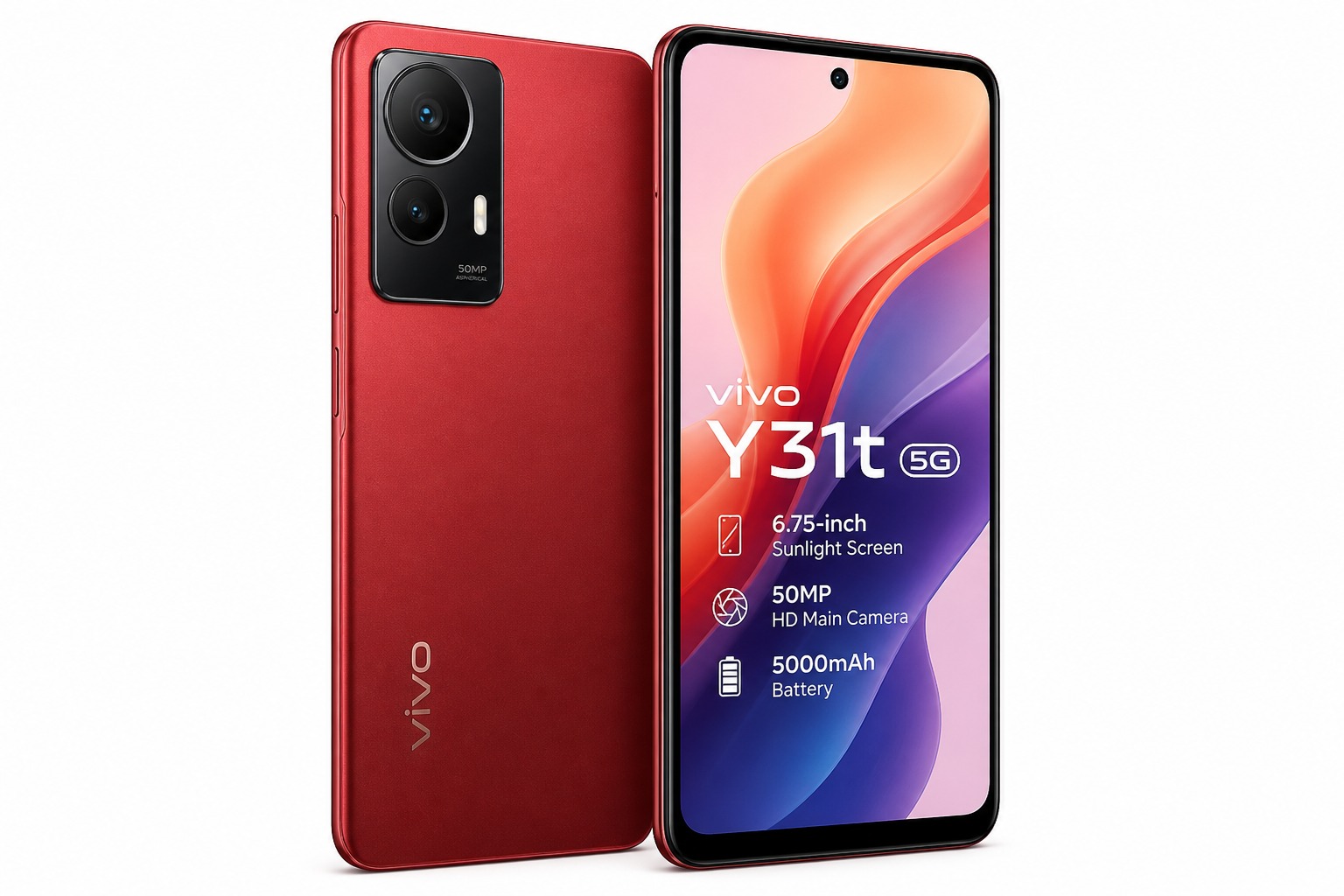
Vivo quietly dropped the Y31t on its Indian website on August 19, no fanfare, no launch event. Just a listing with a spec sheet that reads like a dare: a 7,200mAh battery in a budget frame, an IP68 plus IP69 dual rating, and 44W charging. That is an unusual combination at this price tier, and it makes the Y31t one of the more interesting value phones to land in the last week.
Image: AI-generated
Before we go further, the honest caveats. This is an India-first launch, so Philippine pricing and release timing are still unconfirmed. The specs team at GSMArena confirmed the whole sheet, but local availability, warranty terms, and that crucial peso price are open questions I could not verify. Treat the local details as tentative until vivo Philippines speaks up.
Design & Build Quality
The Y31t is a big, practical slab. It measures 166.6mm tall, 78.4mm wide, and 8.4mm thick, and it weighs 219g. That is heavy by current standards — you feel the 7,200mAh cell in your hand — but the weight is distributed well enough that it never tips forward awkwardly.
The back is plastic, which is fine at this price, and it comes in three colourways: Crimson Red, Seashore Green, and Golden Mist. The camera module sits in the upper-left corner in a vertical rectangular housing with two lenses. There is no glass sandwich here and no premium ceramic gimmickry — it is a workhorse build, and that is the right call for a battery-first phone.
The surprising part is the durability rating. Vivo gave the Y31t both IP68 and IP69. That means dust-tight and water-resistant to 1.5 metres for 30 minutes, plus resistance to high-pressure water jets. That second one is a real advantage for people who work outdoors, in kitchens, or anywhere a hose comes out. You are not going to find many phones in this budget segment carrying a dual IP68/IP69 badge.
The fingerprint scanner is side-mounted and doubles as the power button. There is an infrared blaster up top, which is a small but genuinely useful touch for controlling ACs and TVs — something Filipinos actually use daily. There is no 3.5mm headphone jack, and no expandable storage, two omissions worth knowing before you buy.
Display
The Y31t packs a 6.75-inch IPS LCD with a 720 x 1608 resolution, a 20:9 ratio, and a 120Hz refresh rate. Peak brightness is rated around 1,200 nits, with 1,000 nits in high-brightness mode. In plain terms: the refresh rate is smooth, but the resolution is the weak link.
At 720p on a screen this size, you get roughly 261 pixels per inch. Text is readable and videos look fine from arm’s length, but if you have been used to a 1080p phone, you will notice the softness — especially on small text and fine detail. On a bright afternoon, the 120Hz panel holds up better than most budget LCDs, and the 1,200-nit peak helps outdoor visibility, but this is where Vivo saved money to pay for the battery.
For a phone built around all-day endurance, the LCD is a sensible choice. OLED would have drained more power and cost more. But be honest with yourself about what you value: the Y31t prioritises battery over pixel density, and that trade is the entire story of this phone.
Performance
Under the hood sits a Snapdragon 4 Gen 2, built on a 4nm process. It pairs two Cortex-A78 cores at 2.2GHz with six Cortex-A55 efficiency cores, running an Adreno 613 GPU. It is a capable budget chipset, not a gaming monster.
Here is where the generational gap shows. The Redmi M100, announced the very same day, ships with the Snapdragon 4 Gen 5 — three generations newer. A GSMArena reader put it bluntly: “Y31t launches with 4 Gen 2, while Redmi M100 launches with 4 Gen 5. That’s 3 generations apart, and the launch time is not even 3 days apart.” That is a fair and legitimate criticism. On paper, the Y31t is behind its very newest competition.
In day-to-day use, though, the Snapdragon 4 Gen 2 handles messaging, social media, video, and web browsing without complaint. It is the same silicon family that powers a lot of capable budget phones in Southeast Asia. For heavy gaming you will need to drop settings, and sustained load will show its limits, but for a battery-first phone this chipset makes sense — it sips power.
RAM and storage come in three configurations: 4/128GB, 6/128GB, and 6/256GB. There is no card slot, so buy the storage you need upfront. A 4GB base RAM option in 2026 is tight for heavier multitasking — I would steer most people to the 6GB variants.
Camera
The camera setup is a 50MP main sensor with an f/1.8 aperture and PDAF, joined by a 2MP depth helper. Up front there is an 8MP selfie shooter. Both record video at 1080p/30fps.
The 50MP main is the workhorse, and it is a decent daylight sensor. It handles well-lit shots with good detail, especially when you are outdoors or near a window. Auto HDR does its job in mixed lighting. Low light is where budget sensors usually struggle, and the Y31t is no exception — expect softness and noise after dark, with no dedicated night mode to rescue it.
The 2MP depth sensor is effectively just there for portrait-mode blur, and it shows. The 8MP selfie camera is serviceable for video calls and social media, but do not expect flagship selfie quality. This is a “good enough” camera system aimed at people who mostly point their phone at documents, bright scenes, and everyday life — not demanding mobile photographers.
Battery & Charging
This is the headline, and it is genuinely impressive. The Y31t carries a 7,200mAh silicon-carbon battery with 44W wired charging and reverse wired charging. That is a flagship-level capacity in a budget phone.
Vivo does not publish an official endurance estimate yet, but a 7,200mAh cell with a 720p screen and an efficient chipset should comfortably stretch two full days of normal use, and light users could push toward three. The low-resolution display is the secret here — it does less work per frame than a 1440p panel, so the battery lasts longer. That is the real payoff of Vivo’s display decision.
Charging is 44W, which is solid for this capacity. Vivo rates it for fast top-ups, and reverse wired charging means you can top up earbuds or a friend’s phone in a pinch. Wireless charging is not offered, which is expected at this price.
Software
The Y31t runs Android 16 with Vivo’s OriginOS 6 on top. OriginOS is a colourful, animated skin with a distinctive aesthetic — toggle-heavy, customisable, and quite different from stock Android. Some people love the way it looks; others find it crowded.
The real, honest concern is the update commitment. At this budget level, Vivo typically promises a limited number of OS upgrades, and with a Snapdragon 4 Gen 2 the long-term prospects are modest. If you keep a budget phone for two or three years and upgrade the security patches as they come, this is fine. If you expect years of major Android updates, you will need to spend more money elsewhere.
Bloatware is lighter than past Vivo efforts, but there are still a few preloaded apps and P2P “recommendations” to uninstall on day one. It is the cost of the price tag, and it clears out quickly.
Pros and Cons
| Pros | Cons |
|---|---|
| Massive 7,200mAh battery with real multi-day potential | 720p display at 261ppi — soft text and detail |
| Rare dual IP68/IP69 dust and water resistance at this price | Snapdragon 4 Gen 2 trails the newer 4 Gen 5 rivals |
| 44W wired charging plus reverse wired output | No expandable storage, no 3.5mm headphone jack |
| Fast 120Hz refresh rate on the display | 4GB base RAM config is tight for 2026 multitasking |
| Infrared blaster for controlling ACs and TVs | Low-light and selfie camera performance is modest |
| Lightweight-feeling practical plastic build | Update commitment likely limited at this price tier |
Should You Buy This?
Buy it if
- You want a battery-first phone that can go two or more days on a charge.
- You work outdoors, in kitchens, or anywhere the IP68/IP69 water and jet-resistance rating is a real daily benefit.
- You are on a strict budget and value endurance and durability over pixel-perfect screens.
- You want the convenience of an infrared blaster and reverse wired charging in one device.
Skip it if
- You are sensitive to 720p screens and want crisp text and sharp photos when you zoom in.
- You plan to game seriously — the Snapdragon 4 Gen 2 and the older GPU are limited.
- You need lots of storage or want to expand it later, since there is no card slot.
- You want the newest budget silicon; rivals like the Redmi M100 ship with the newer 4 Gen 5.
- You are firmly on a Samsung or Xiaomi ecosystem and would rather not switch to OriginOS.
Final Verdict
The vivo Y31t is a phone that makes its priorities brutally clear. It puts two days of battery life, a rare IP68/IP69 rating, and 44W charging ahead of everything else, and it asks you to accept a 720p LCD and a modest chipset in return. For a lot of people, especially in markets where power cuts and long commutes are part of daily life, that is a trade worth taking.
The competition in this corner of the market is fierce, and the Y31t is not the most powerful budget phone you can buy this week. The Redmi M100 and other freshly launched rivals bring newer silicon, and you can find phones like the Realme 16x 5G with sharper displays in the same range. What few of them offer is this combination of a 7,200mAh battery and industrial-grade water resistance in one device.
If Vivo brings the Y31t to the Philippines at a competitive peso price — and that remains the big open question — this could be one of the most sensible endurance-first phones of the year. It is not for everyone. But if you have ever ended a day with a dead phone and thought “I just want it to last,” the Y31t was built for exactly you. It is a reminder that sometimes the smartest phone is the one you do not have to think about charging.