
Xiaomi’s Redmi 17 series went official on August 10, and the headline is impossible to miss: a 7,500mAh battery in a phone that starts at about $188. The Redmi 17 5G also brings a 45W wired charging upgrade, a Dynamic RGB Light on the back, and Gorilla Glass 7i to the budget segment. But it arrives with one very visible compromise — the display dropped from the Redmi 15’s FHD+ panel to a 720p screen. That trade-off defines this phone, so let’s dig into whether the battery-first formula still makes sense in 2026.
Design & Build Quality
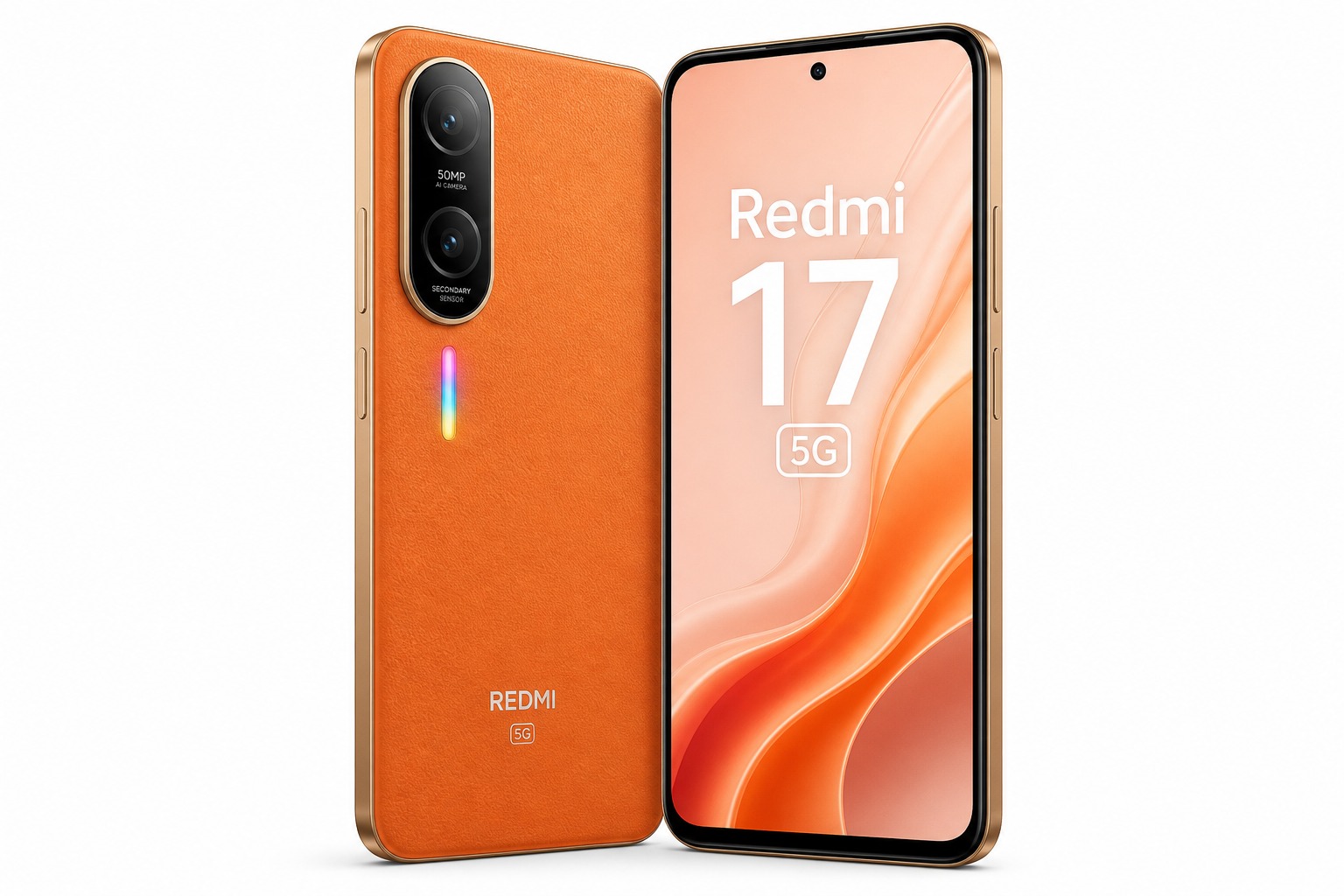
The Redmi 17 5G keeps the flat-edged, matte-frame language Xiaomi has been using across its budget line. The Vivid Orange finish uses a PU leather texture on the back — it’s soft to the touch, resists fingerprints, and gives the phone a slightly more expensive feel than the usual glossy plastic. Black and Deep Blue are the other two options if you want something understated.
The standout design detail is the Dynamic RGB Light, a programmable strip below the camera module that glows in eight colors. It doubles as a notification light, a charging status indicator, a camera status light, and — for a handful of games — a lighting effect during gameplay. It’s a gimmick, sure, but it’s a genuinely useful one if you’ve ever missed calls because your phone was face-down on a desk.
You get IP64 dust and splash resistance, a side-mounted fingerprint reader, face unlock, and a 3.5mm headphone jack that budget buyers still rely on. Wet Touch Technology means the screen keeps responding even with damp or sweaty fingers — a small mercy in Philippine weather. One omission to note: Xiaomi no longer bundles a charger in the box, so the 45W adapter is an extra purchase.
Display
Here’s where the Redmi 17 series makes its most controversial call. The 6.9-inch IPS LCD panel runs at 1600 x 720 (HD+) with a 120Hz refresh rate — a step down from the Redmi 15’s 1080 x 2340 FHD+ 144Hz screen. That’s a drop from roughly 374 ppi to about 254 ppi, and on a screen this large, the softness is visible. Text edges lose their crispness, and small icons in dense apps look slightly fuzzy up close.
Xiaomi frames it as a feature — the official product page says “HD clarity on a large display” — but make no mistake, this is a cost cut. The panel does get a few things right: a 120Hz AdaptiveSync refresh rate, up to 825 nits peak brightness (credible for outdoor use, though IPS is IPS), Gorilla Glass 7i protection, and TÜV Rheinland low blue light, flicker-free, and circadian-friendly certifications. If you mostly watch video and scroll social feeds, it’s workable. If you read a lot of text or do photo editing, you will notice the difference.
Performance
The Redmi 17 5G runs on the Snapdragon 4 Gen 5, a 4nm octa-core chip with a 2.4GHz peak clock and an Adreno GPU — a meaningful step up from the 4G model’s 12nm MediaTek Helio G91-Ultra. Paired with 4GB or 6GB of LPDDR4X RAM (expandable up to 12GB via memory extension) and UFS 2.2 storage, it handles day-to-day tasks smoothly: messaging, banking apps, video streaming, and light gaming are all fine.
Just don’t expect flagship muscle. Heavy games will run at reduced settings, and the HD+ panel actually helps here — the GPU has fewer pixels to push, which keeps frame rates steadier than the same chip would manage on an FHD+ display. Storage is where the two models diverge sharply: the 5G uses UFS 2.2, but the Redmi 17 4G ships with eMMC 5.1. Shipping eMMC in a 2026 phone is hard to defend — even entry-level devices have moved on — and it makes the 4G feel slower during app installs and large file transfers.
If you want benchmark context, my Geekbench 7 step-by-step guide explains how to test performance yourself.
Camera
Both Redmi 17 models carry the same optics: a 50MP f/1.8 main camera with a secondary sensor for depth and dual-view recording, plus an 8MP f/2.05 front camera. In good light, the main sensor produces solid, colorful shots for the price — the kind of images that look great on social media straight out of the camera. The dual-video mode records front and rear streams simultaneously, which vloggers will appreciate.
The limitations are predictable at this price. There’s no ultrawide and no telephoto, video tops out at 1080p/30, and low-light shots lean soft and noisy unless you hold very still. The 8MP selfie camera is fine for video calls but won’t flatter anyone in dim lighting. For a budget phone, the camera is exactly what you’d expect — capable in daylight, average everywhere else.
Battery & Charging
This is the Redmi 17’s reason to exist. The 7,500mAh silicon-carbon battery is a genuine upgrade over the Redmi 15’s 7,000mAh cell, and Xiaomi claims up to two days of typical use, 28 hours of video playback, or 109 hours of music. Real-world numbers will land a bit lower, but the direction is clear: this is a phone you can comfortably leave the charger at home overnight.
Charging also improves: 45W wired (up from 33W) fills 51% in 40 minutes and hits 100% in about 96 minutes per Xiaomi’s lab figures, with 22.5W reverse wired charging to top up your earbuds or a friend’s phone. The silicon-carbon chemistry is rated to hold 80% of its capacity after 1,000 cycles. Just remember the 45W adapter is sold separately, and the phone falls back to slower speeds with whatever charger you already own.
Software
Both models ship with HyperOS 3 on top of Android 16, with features like HyperIsland widgets, memory extension, and the usual Xiaomi app suite. The software is polished and fast on the 5G model’s Snapdragon chip, though you’ll find some preloaded apps you may want to remove.
One thing to flag honestly: Xiaomi has not officially announced the update commitment for the Redmi 17 series yet. The previous Redmi 15 lineup got two years of OS updates and four years of security patches, and newer Redmi Note models have been promised more, but until Xiaomi publishes a policy for the 17, treat long-term support as an open question. If you keep phones for three-plus years, this matters.
Pros and Cons
| Pros | Cons |
|---|---|
| 7,500mAh battery with genuinely multi-day potential | HD+ 720p display is a downgrade from the Redmi 15’s FHD+ panel |
| 45W wired charging, up from 33W, plus 22.5W reverse | 4G model still ships with eMMC 5.1 storage |
| Dynamic RGB Light is a fun, useful notification feature | No charger included in the box |
| Gorilla Glass 7i, IP64 rating, and Wet Touch support | No ultrawide or telephoto cameras |
| Stereo speakers with 300% volume boost and a 3.5mm jack | Update commitment not yet officially confirmed |
| Competitive price from about $188 | China variant differs (Unisoc chip, smaller battery) — check your market’s spec |
Should You Buy This?
Buy it if
- You hate charging your phone every day and want multi-day endurance for under $200.
- You want 45W charging and reverse charging in a budget device.
- You mostly watch video, scroll feeds, and use apps — the 720p screen won’t bother you much.
- You like having a physical headphone jack and stereo speakers.
Skip it if
- You read a lot of text or edit photos — the HD+ resolution will feel soft on a 6.9-inch panel.
- You want a proper ultrawide camera or 4K video recording.
- Long-term software support matters to you and you need a firm update promise now.
- You’re on a tight budget in the Philippines and want the best screen per peso — alternatives like the battery-first Poco M8 Power or the bigger-screened Redmi Note 17 Pro are worth comparing.
Final Verdict
The Redmi 17 5G is a phone built around one priority: battery life. At roughly MYR 769 (about $188), it delivers a 7,500mAh silicon-carbon cell, 45W charging, and the kind of endurance that reshapes how you think about plugging in — I tested the stamina-first approach on a long weekend and never once worried about finding an outlet.
The cost of that focus is the display. Dropping from FHD+ to HD+ on a 6.9-inch screen is a real regression, and Xiaomi’s choice to keep eMMC 5.1 on the 4G model is harder to forgive. The 5G model is the one to buy if you pick this family at all — the UFS 2.2 storage and Snapdragon 4 Gen 5 make it feel like a modern phone, while the 4G feels like one from several years ago.
Compared to the rest of the battery-first crowd — the 8,000mAh iQOO 15T in the flagship tier and the 8,580mAh Redmi K100 Pro above it — the Redmi 17 5G is the budget entry point into the same idea: giant battery, modest everything else. For students, seniors, or anyone who wants a reliable, long-lasting daily driver without spending much, it’s a solid pick — as long as you can live with a 720p screen.
Me? I’d wait for the Philippines launch price before committing, because at this end of the market a few hundred pesos can change the verdict entirely. The hardware formula is right; the display decision is the one I’d question.