
itel A300C Review: When 6,000mAh and Military-Grade Durability Cost Less Than 11,000 Rupees
The itel A300C landed in India on September 18, 2026, and it is not trying to be impressive on paper. There is no 5G, no AMOLED display, no high-resolution camera, and no wireless charging. What it does have is a 6,000mAh battery, MIL-STD-810H drop certification, a 3.5mm headphone jack, and a price of ₹10,999 for the only variant on offer — 4GB of RAM and 64GB of storage. In a market where budget phones are chasing specs they cannot back up, the A300C is betting that durability, battery life, and actual value in the box matter more than checkbox features.
I have spent enough time with budget phones in the sub-₹15,000 bracket to know that the formula usually involves compromises that pile up fast. The A300C is honest about what it is. It is a 4G phone running Android 16 Go Edition, built around a battery that is larger than what most mid-range phones ship with, and certified to survive the kind of drops that kill cheaper plastic phones. That is a pitch worth looking at, especially for buyers in markets where a rugged phone that lasts two days on a charge is more useful than a thin slab with a fragile screen.
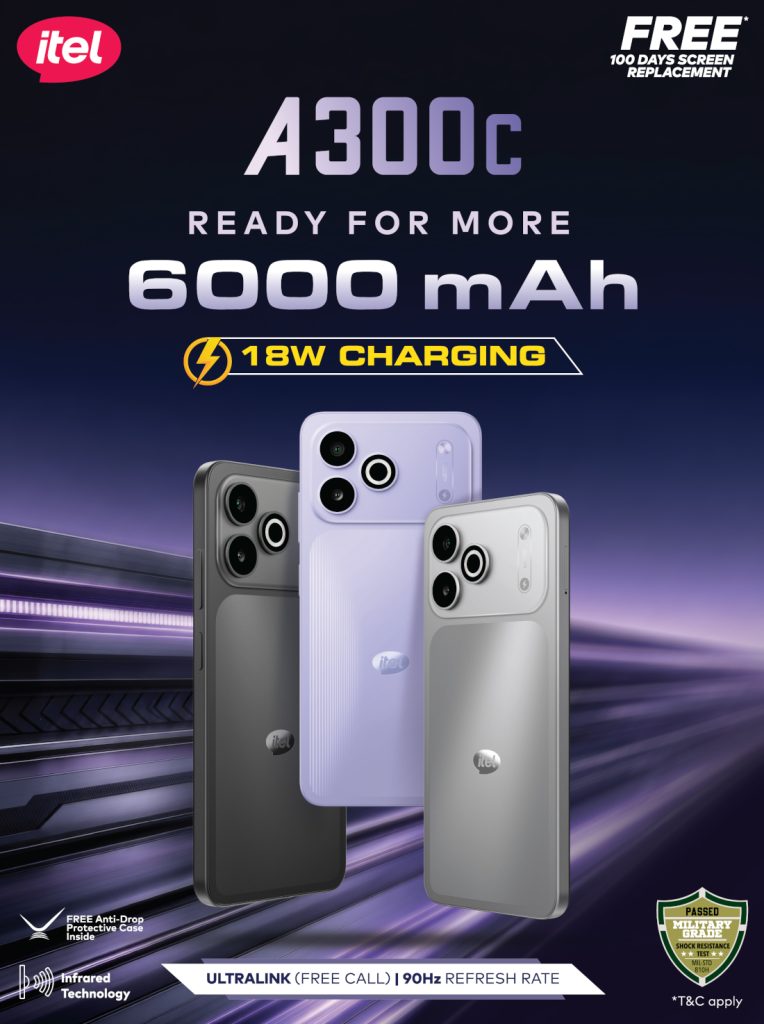
Design & Build Quality
The A300C is built around the idea of surviving real use rather than looking premium. The body uses a plastic frame and plastic back, which is the right call at this price — plastic flexes instead of cracking, and it keeps weight down. The phone measures 164.4 x 75.3 x 8 mm and weighs 199 grams, so it is not featherlight, but the 8mm profile keeps it from feeling like a brick. The 199g weight is noticeable in one hand over long sessions, but it is manageable.
The MIL-STD-810H certification is the headline here. This is the same military-grade drop standard that mid-range and flagship phones use to signal durability, and itel is actually putting it on a ₹10,999 phone. The certification covers drop testing — the phone has been tested to survive drops onto hard surfaces from a specified height. What the A300C does not have is an official dust and water resistance rating. There is no IP64, no IP65, no IP68. If you are buying this phone partly because you want something tough, the lack of an IP rating is worth noting — the MIL-STD certification covers drops and impacts, not water or dust exposure.
On the plus side, itel is offering a free screen replacement for the first 100 days after purchase. This is a meaningful warranty enhancement for a budget phone where screen damage is the most common failure mode. It signals that itel expects the phone to be dropped, and they are backing that expectation with a policy rather than just a certification.
The phone comes in four colors: Classic Black, Silver Mist, Lavender Purple, and Comet Orange. Comet Orange is the standout — it is the color that makes the phone look like something chosen rather than something settled for. The back has a textured finish that should hide fingerprints better than glossy plastic, though I have not handled a unit personally to confirm.
The port layout is straightforward: USB Type-C on the bottom, a side-mounted fingerprint scanner built into the power button on the right, and a 3.5mm headphone jack on the top. The power-button fingerprint scanner is a practical choice — it is easier to reach than a rear-mounted scanner and more reliable than an in-display optical scanner on a budget LCD. The SIM tray is a hybrid nano-SIM plus nano-SIM plus microSD setup, so you can use two SIMs and expand storage up to 2TB at the same time. The microSD support is a genuine plus at this price — 64GB fills up fast if you store videos or offline maps, and 2TB of expansion is generous.
Display
The A300C has a 6.56-inch HD+ display with a resolution of 720 x 1,612 pixels and a 90Hz refresh rate. The panel is an IPS LCD, which is the right technology choice for a budget phone — LCDs are durable, readable in sunlight, and cheaper to produce than OLEDs at this size. The 90Hz refresh rate is a meaningful upgrade over the 60Hz panels that still ship on many budget phones in this bracket. Scrolling through menus and apps feels smoother with 90Hz, and the difference is noticeable enough that going back to 60Hz is a letdown.
The downside is the HD+ resolution. At 720 x 1,612 on a 6.56-inch panel, the pixel density is roughly 268 pixels per inch. Text looks acceptable at normal viewing distances, but it is not sharp. Icons and UI elements are clear enough, but anyone who has used a Full HD+ phone will notice the softness. This is the standard trade-off in the budget segment — you get a large screen and a decent refresh rate, but the resolution stays at HD+ to keep costs down.
Brightness is where the A300C’s spec sheet is frustratingly vague. The GSMArena news article and the FoneArena spec page do not publish a peak brightness figure for the A300C. Given that it is an LCD, I would expect something in the 400-550 nits range based on comparable Unisoc T7100 phones, but that is an estimate, not a verified figure. I am not asserting a brightness number here because I could not verify one from an authoritative source. The FoneArena spec page lists “Yes” for HDR support, which is unusual for a budget LCD — this may refer to a software HDR mode rather than true hardware HDR, and I am flagging it as such rather than presenting it as a feature to get excited about.
The 90Hz refresh rate is the display’s real contribution. It is not 120Hz, and it is not paired with a high-resolution panel, but 90Hz on a 6.56-inch LCD is a solid middle ground that makes the phone feel more responsive than the spec sheet suggests.
Performance
The A300C is powered by the Unisoc T7100 chipset, a 12nm octa-core processor with a Mali-G57 MP1 GPU. The core configuration is two Cortex-A75 performance cores clocked at 2.2GHz paired with six Cortex-A55 efficiency cores. This is the same chipset used in the itel A90, which gives us a reference point for real-world performance — the A90 is a known quantity in the budget segment.
The 12nm process node is a generation behind the 6nm and 4nm chipsets that are becoming common even in budget phones. The Dimensity 7500 Turbo in the vivo T5 5G is built on a 4nm process and delivers significantly more performance, but it also pushes the price into the ₹34,999 range. The T7100 is a very different proposition — it is about adequate performance for basic tasks at a price where every rupee counts.
For what it is designed to do, the T7100 is adequate. Social media, web browsing, WhatsApp, YouTube playback, and light gaming all work without obvious stutter on Android 16 Go Edition. The Go Edition version of Android is optimized for lower-RAM devices, so the 4GB of RAM is managed more efficiently than it would be on full Android. That said, the Mali-G57 MP1 GPU is not built for heavy gaming. BGMI and similar titles will run on lower settings, but do not expect smooth frame rates in demanding titles. This is a phone for everyday use, not for gaming.
The 4GB of RAM is the minimum for comfortable Android 16 Go usage in 2026. Background apps will be recycled more aggressively than on an 8GB phone, so switching between several apps will see some reloads. The 64GB of storage is tight — after the system partition and pre-installed apps, you have maybe 40-45GB available for your own data. The microSD slot is not just a bonus here, it is almost a necessity if you plan to store videos, music, or offline content locally.
AnTuTu scores for the T7100 are not prominently published in the sources I checked, so I am not quoting a benchmark figure. What I can say is that the T7100 sits in the lower-mid range of current chipsets — well below the Snapdragon 6-series and Dimensity 7000-series, but functional for the use case this phone targets.
Camera
The A300C has an 8MP rear camera with LED flash and a 5MP front camera. These are entry-level sensor specifications, and I am presenting them as such rather than trying to spin them into something they are not.
The 8MP main camera is adequate for well-lit daytime shots where the subject is reasonably still and the lighting is good. In bright conditions, an 8MP sensor on a budget phone can produce acceptable results — the images will not be detailed by modern standards, but they are usable for sharing on social media or keeping as casual records. Low-light performance is where budget sensors struggle, and the A300C’s 8MP sensor is unlikely to be an exception. Night shots will likely show noise and soft detail, and the LED flash will help but will not transform the image quality.
The 5MP front camera is sufficient for video calls and casual selfies in good lighting. At 5MP, you are not getting detailed portrait shots or sharp video call frames, but for the core use case — staying in touch with family and friends — it works. The camera sits in a notch at the top of the display, which is a common arrangement on budget phones and keeps the bezel footprint reasonable.
Video recording is confirmed at 1080p by the FoneArena spec page. This is the standard for budget phones — 1080p at 30fps is what you get, and it is enough for casual video capture. There is no 4K recording, and there is no OIS (optical image stabilization) on the rear camera, which means handheld video will show shake in anything beyond short clips. Gyro-EIS (electronic image stabilization) is not confirmed in the sources I checked, so I am not asserting it — the GSMArena article does not mention stabilization features, and I am flagging this as unconfirmed rather than assuming it is present.
The camera setup is not a selling point. The A300C is not a camera phone, and anyone buying it primarily for photography will be disappointed. But for a phone at this price that is built around battery and durability, an 8MP + 5MP camera pair is what you get, and it is serviceable for the basics.
Battery & Charging
This is where the A300C earns its place in the budget conversation. The 6,000mAh battery is large by any standard — it is bigger than what most mid-range phones ship with, and dramatically bigger than the 4,000-5,000mAh cells that are common in the sub-₹15,000 segment.
In practical terms, a 6,000mAh battery on a phone with a 90Hz HD+ LCD, a Unisoc T7100 chipset, and Android 16 Go Edition should deliver exceptional endurance. The combination of a large battery and a relatively modest power draw from the display and chipset suggests that the A300C can comfortably last a full day of moderate use and likely into a second day with lighter usage. I am not quoting independent battery test results because none are available yet — the phone launched on September 18 and independent reviews have not been published. I am basing this on the battery capacity and the power profile of the components, which is a reasonable inference but not a tested figure.
Charging is handled by an 18W wired charger over USB-C. This is modest — 18W will charge a 6,000mAh battery from empty to full in roughly 3.5 to 4 hours, which is slower than the 44W charging on many competing budget phones. The trade-off is that the A300C ships with a charger in the box, which is increasingly rare. Many brands have stopped including chargers, so the 18W adapter in the box is a genuine plus for buyers who do not already have a compatible charger. The 18W speed is not fast by current standards, but it is adequate given the large battery — you plug it in overnight and it is ready in the morning.
There is no wireless charging and no reverse charging. These are not expected at this price, and their absence is not a significant loss for the target buyer. The 18W wired charging is the only charging mode available.
The battery is the A300C’s strongest feature, and it is the reason this phone makes sense. A 6,000mAh battery at ₹10,999 is a compelling proposition for buyers who value battery life over everything else — daily commuters, students, people in areas with unreliable power, and anyone who wants a phone that does not need charging during the day.
Software
The A300C runs Android 16 Go Edition out of the box. This is an important distinction. Android Go is a lightweight version of Android designed for devices with limited RAM — typically 2GB to 4GB. It strips down the system to run more efficiently on lower-end hardware, with lighter versions of Google apps and a more constrained overall experience. Go Edition phones typically have a longer usable life than full Android phones with the same RAM because the OS is less demanding on memory.
The itel A300C is not running a custom skin layered on top of Android Go — it is running stock Android 16 Go Edition with itel’s branding and any pre-installed apps that come with the phone. This is a cleaner experience than some budget phones that stack heavy custom UIs on top of already-limited hardware. The downside is that the phone does not have the polished look and extra features that a custom skin can provide, but at this price, a cleaner Android Go experience is preferable to a bloated one.
Go Edition does come with limitations. Some Google apps have Go versions that are lighter but also more limited — the Go version of Maps, for example, has fewer features than the full Maps app. The Play Store on Go devices sometimes surfaces Go-optimized apps first, which is helpful, but users who are familiar with full Android may notice the difference.
Update commitment is not published in the sources I checked. I am not asserting a specific number of Android version upgrades or years of security patches because I could not verify one. This is a gap worth noting — budget phones often receive fewer updates than mid-range and flagship phones, and the A300C’s update policy is not publicly documented. Buyers who plan to keep the phone for more than a year or two should be aware that update support may be limited.
The phone supports Dual 4G VoLTE, which means both SIM slots can use 4G simultaneously. Wi-Fi 802.11ac, Bluetooth 5, GPS/GLONASS/Beidou positioning, and USB Type-C are all confirmed. There is no NFC, which means contactless payments are not available on this phone — a notable omission for buyers who rely on Google Pay or similar services.
Pros and Cons
| Pros | Cons |
|---|---|
| 6,000mAh battery — largest in the sub-₹15,000 segment | 18W charging is slow for a 6,000mAh battery |
| MIL-STD-810H military-grade drop certification at budget price | No official IP dust/water resistance rating |
| 3.5mm headphone jack retained | 4G only — no 5G in 2026 |
| 90Hz refresh rate on a 6.56-inch LCD | HD+ resolution (720 x 1,612) — not sharp |
| microSD support up to 2TB, dual SIM + storage simultaneously | Only 4GB RAM and 64GB storage — single variant |
| Charger and case included in the box | 8MP + 5MP cameras are entry-level |
| 100-day free screen replacement policy | No NFC — no contactless payments |
| Runs Android 16 Go Edition — efficient on 4GB RAM | Update commitment not publicly documented |
Should You Buy This?
Buy it if:
- Battery life is your top priority. A 6,000mAh battery in a budget phone is rare, and the A300C delivers it at a price where most phones are shipping 5,000mAh or less.
- You want a tough phone without paying flagship prices. MIL-STD-810H certification at ₹10,999 is a genuine value — drop-tested durability at a budget price is not common.
- You still use a 3.5mm headphone jack. The jack is present, and the DTS-tuned speaker is a decent bonus for media playback without headphones.
- You need expandable storage. The microSD slot supports up to 2TB, and the dual-SIM plus storage configuration means you do not have to choose between a second SIM and more storage.
- You want a charger in the box. The 18W charger and a case are included, which is increasingly rare and saves you from spending extra on accessories.
- You are buying for someone who needs basic connectivity. The A300C is a solid first phone for a student, a backup phone for travel, or a primary phone for someone whose needs are calling, messaging, and light browsing.
Skip it if:
- You need 5G. The A300C is a 4G-only phone, and while India has not set an official 4G cut-off date, carriers are actively building out 5G networks. A 4G-only phone in 2026 is a conscious trade-off.
- You want a sharp display. The HD+ resolution is soft by modern standards, and if you are used to Full HD+ screens, the 720p panel will look noticeably less crisp.
- Camera quality matters to you. The 8MP + 5MP setup is serviceable for basics, but it is not a camera phone, and low-light performance will be limited.
- You rely on contactless payments. The lack of NFC means Google Pay and similar services will not work — a significant omission for many buyers.
- Performance is a priority. The Unisoc T7100 is adequate for basic tasks but not for heavy multitasking or gaming. If you need a faster phone, the vivo T5 5G at ₹34,999 or the Lava Bold N4 Pro at ₹13,999 offer more performance.
- You want wireless charging, reverse charging, or IP-rated water resistance. None of these are present, and none are expected at this price point.
Final Verdict
The itel A300C is not trying to win a spec war. It is trying to solve a specific problem: how do you build a phone that lasts all day, survives drops, and costs less than ₹11,000? The answer is a 6,000mAh battery, MIL-STD-810H certification, a 90Hz LCD, and the honesty to ship as a 4G Android Go phone without pretending to be something it is not.
That honesty is the phone’s strongest asset. In a segment where brands often pack budget phones with specifications that look good on paper but do not translate to real-world use — aggressive camera megapixel counts with mediocre sensors, 5G branding on phones with limited 5G band support, high refresh rates on low-quality panels — the A300C is refreshingly straightforward about what it is. It is a durable, battery-first budget phone with a 4GB RAM / 64GB storage configuration that is adequate for everyday use and expandable when it is not.
The compromises are real and worth understanding before buying. The 4G-only connectivity is a limitation that will matter more as 5G networks expand. The HD+ display is soft. The 8MP camera is entry-level. The 18W charging is slow relative to what competing budget phones offer. And the lack of an official update commitment means that long-term software support is uncertain. These are not deal-breakers for the right buyer, but they are real trade-offs that the ₹10,999 price does not erase.
The A300C is for the buyer who prioritizes battery life and durability over display sharpness, camera quality, and 5G connectivity. It is a good fit for students, daily commuters, people in areas with patchy power, and anyone who wants a secondary phone that can be tossed in a bag without worry. It is also a reasonable first phone for someone with basic needs — calling, messaging, light browsing, and social media — who wants a phone that will last through the day without needing a midday charge.
If you are shopping in the sub-₹15,000 segment and battery life is your primary concern, the A300C deserves a look. The 6,000mAh battery and MIL-STD-810H certification at this price are genuinely rare, and the inclusion of a charger and case in the box makes the out-of-box experience better than it would otherwise be. If you need 5G, a sharper display, or a better camera, look at the Lava Bold N4 Pro at ₹13,999 or stretch further to the vivo T5 5G at ₹34,999. But if you want a tough, long-lasting budget phone that does not pretend to be more than it is, the itel A300C is a solid pick at ₹10,999.