
The JAECOO J5 EV is officially rolling beyond Metro Manila. Omoda & Jaecoo Philippines brought the compact electric crossover to SM Seaside City Cebu from August 20 to 23, with test drives running until August 24 — a clear sign the brand wants electrified rides in the hands of buyers outside the capital.

It’s a smart next move. The J5 EV has sat at a sharp price since its PIMS 2026 debut in June — a single, fully equipped variant at P1.399 million. Now the company is betting the same formula works for the Visayas. Here’s a full look at what you’re actually getting for that peso figure, how it handles Filipino roads, and whether it deserves a spot on your shortlist.
JAECOO J5 EV Price in the Philippines
The J5 EV is sold as one loaded variant at P1,399,000. There’s no base-and-premium splitting here — every unit gets the big screen, the ADAS suite, and the 360-degree camera. That makes the value conversation refreshingly simple: one price, one spec.
Here’s what that figure looks like in other currencies, using a rough exchange of 61.3 PHP/USD and 95.5 INR/USD:
| Market | Equivalent |
|---|---|
| Philippines | P1,399,000 |
| United States | ~USD 22,800 |
| India | ~INR 21.8 lakh |
For context, that lands it right in the thick of the compact EV fight — above the micro-EV crowd, below the bigger crossovers. I covered the value math in my Chery QEV breakdown, and the J5 EV sits in the same conversation.
Full Specifications
| Specification | JAECOO J5 EV |
|---|---|
| Motor | Single front permanent-magnet synchronous, 155 kW |
| Power | 208 PS (~205 hp) |
| Torque | 288 Nm |
| Battery | 58.9 kWh CATL LFP |
| Range (NEDC) | 461 km (DOE-recognized) |
| Real-world range | 539.2 km (AAP supervised test) |
| AC charging | 6.6 kW |
| DC fast charging | 80 kW, 30-80% in ~28 min |
| Drive type | Front-wheel drive |
| 0-100 km/h | ~7.7 seconds |
| Dimensions | 4,380 x 1,860 x 1,650 mm |
| Wheelbase | 2,620 mm |
| Ground clearance | 184 mm (unladen) |
| Cargo | 480 L (seats folded) + 35 L frunk |
| Tires / wheels | 235/55 R18, 18-inch alloys |
| Seats | 5 |
Key figures cross-checked against the Department of Energy’s recognized-list specs (461 km NEDC) and the local spec sheets from AutoIndustriya and Zigwheels. The battery chemistry is LFP — worth remembering when we talk about our heat and flood conditions below.
What Others Are Saying
The local and international reviews have been largely positive, with a couple of honest caveats.
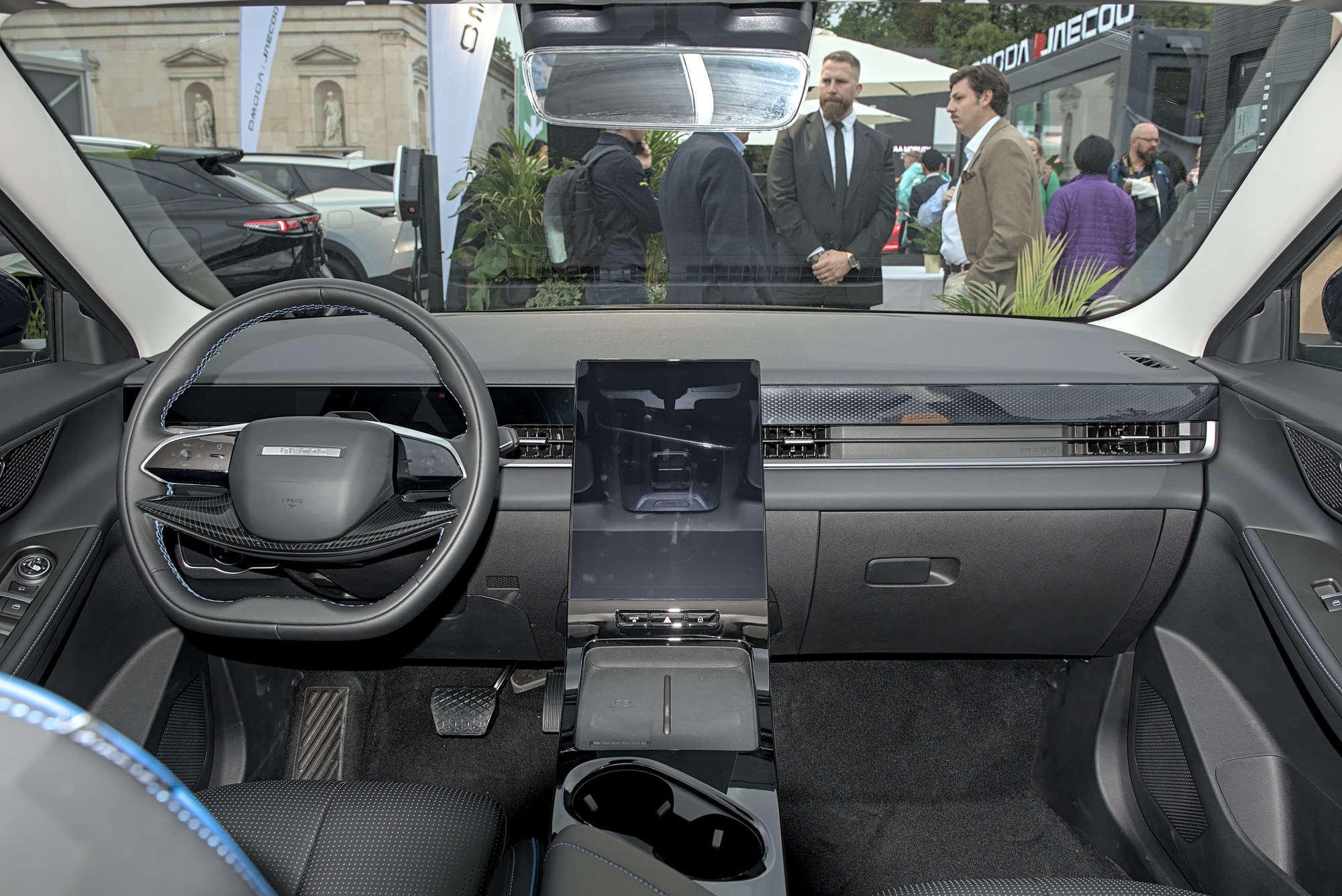
- Zigwheels Philippines (Arcen Gabriel Nacorda): calls the J5 EV a “peppy yet refined all-electric powertrain” that retains its hybrid sibling’s versatility on- and off-road. The reviewer highlighted the 480 L trunk plus a 35 L washable frunk, scratch-proof seats that stay supportive on long trips, and a ride setup that “soaks up bumpy, uneven concrete pavements” while staying planted through corners. The one gripe: most cabin controls live on the central 13.2-inch display.
- AutoIndustriya: frames it as “another option for Juan dela Cruz” in the compact EV segment, noting the 461 km NEDC range is roughly Manila-to-Vigan with reserve, and that a more accessible Comfort variant is coming to the lineup.
- Automobile Association of the Philippines: a supervised real-world test returned 539.2 km — an impressive case of the official number being beaten, not the usual the-other-way-around story.
- International (Australia): reviewers there position the J5 EV as one of the cheapest small electric SUVs, challenging the BYD Atto 2 and Kia EV3.
Overall, the consensus is a well-rounded, well-equipped compact EV at a value price. The main hesitation everywhere is long-term reliability on a new nameplate, and the screen-heavy interior.
How the J5 EV Handles Philippine Conditions
City Driving
This is where the J5 EV shines. Subcompact dimensions make EDSA and tight BGC or Makati parking feel manageable, instant torque makes metro stop-and-go effortless, and a 461 km official range means most commuters charge once or twice a week. The 360-degree camera and parking sensors help in tight U-turn situations. For the city-first buyer, this is nearly a perfect daily driver.
Long-Distance Travel
Manila to Baguio is about 250 km — comfortably within range on one charge, on paper. Realistically, with a ~539 km supervised result, intercity trips like Manila to Vigan doable too, though you’ll want to plan a fast-charge stop on longer hauls. The 80 kW DC charging gets you from 30% to 80% in roughly 28 minutes — enough time for a meal and a stretch at a charging station. The 480 L trunk plus frunk handles luggage for a weekend away.
Flooded Situations
The honest weak point. The J5 EV’s 184 mm ground clearance is decent for a subcompact crossover but not flood-proof — most flooded Metro Manila streets sit below that, yet deep floodwater along EDSA or provincial roads can still be risky. On the plus side, an EV has no exhaust to hydrolock, and the battery sits sealed under the floor. The rule still applies: if the water looks like it’s mid-wheel, don’t push through regardless of the badge.
High Temperature Conditions
The LFP battery is the good news here. Lithium iron phosphate chemistry handles heat far better than NMC and is thermally stable in sustained 36-38°C weather, so you’re not nursing battery degradation the way you would with older chemistries. The tradeoff is the air conditioner — in extreme heat, running the AC pulls meaningful range. Still, for typical Filipino use, LFP is the chemistry I’d rather have in a compact EV.
How It Compares
| Model | Price | Range |
|---|---|---|
| Geely EX2 | P938K – 1.038M | ~395 km |
| Chery QEV | P1,120,000 | 405 km |
| BYD Atto 2 EV | P1,338,000 | 380 km |
| MG4 Urban | P1,198,888 | 403 km |
| JAECOO J5 EV | P1,399,000 | 461 km |
| BYD Atto 3 | P1,598,000 | 480 km |
| Chevrolet Captiva EV | P1,999,000 | 415 km |
I’ve dug into several of these rivals before — the BYD Atto 2 and the MG4 Urban, for instance. The J5 EV’s edge is simple: more official range than the Atto 2 at a higher but still competitive price, and a more established-feeling cabin than some micro-EV options.
Who Should Buy It
- City commuters who want a genuine compact SUV footprint with a full ADAS suite and camera coverage.
- First-time EV buyers who want official 461 km range and LFP battery peace of mind in the heat.
- Provincial buyers — the Cebu rollout and growing Omoda & Jaecoo dealer network in the Visayas makes ownership more practical than the Metro Manila-only stigma suggests.
Where It Falls Short
- Ground clearance — not a flood warrior; keep it out of deep water.
- Screen-centric interior — most controls live in the 13.2-inch display, which some drivers find awkward.
- New nameplate reliability — the 7-year/200,000 km vehicle warranty and 8-year/160,000 km battery & motor cover help, but the long-term track record is still being written.
Bottom Line
The J5 EV is one of the more convincing compact EVs in the Philippines right now. You get a fully equipped crossover at a single, honest price, a genuine 461 km of official range, and LFP thermal safety — packaged for buyers both in Metro Manila and, now, the provinces. Its weakness is the usual EV caveat here: clearance in floods and the all-screen cockpit.
The electrified market around it is moving fast. I compared the shape of it all in my Lexus RZ and GAC GS4 Max pieces, and the pattern is the same everywhere: more range, more tech, better prices, every quarter. If the J5 EV sits in your budget — and you don’t have to wade through flood-prone areas daily — it’s very much worth a test drive at SM Seaside Cebu this week.