
Design & Build Quality
Mivi has been selling audio products in India for over a decade, but the Mivi One 5G marks its first attempt at a smartphone — and the company isn’t trying to pretend it’s something it’s not. The phone is plainly built: a polycarbonate back in five colours (Blue, Burgundy, Pink, Green, and Navy Blue), a thin plastic frame, and a 6.75-inch body that feels light in the hand at an estimated 190 grams. There’s no wireless charging, no IP68 rating, and no premium metal finish — but at ₹14,999, that’s a trade-off most buyers in this segment will happily make.
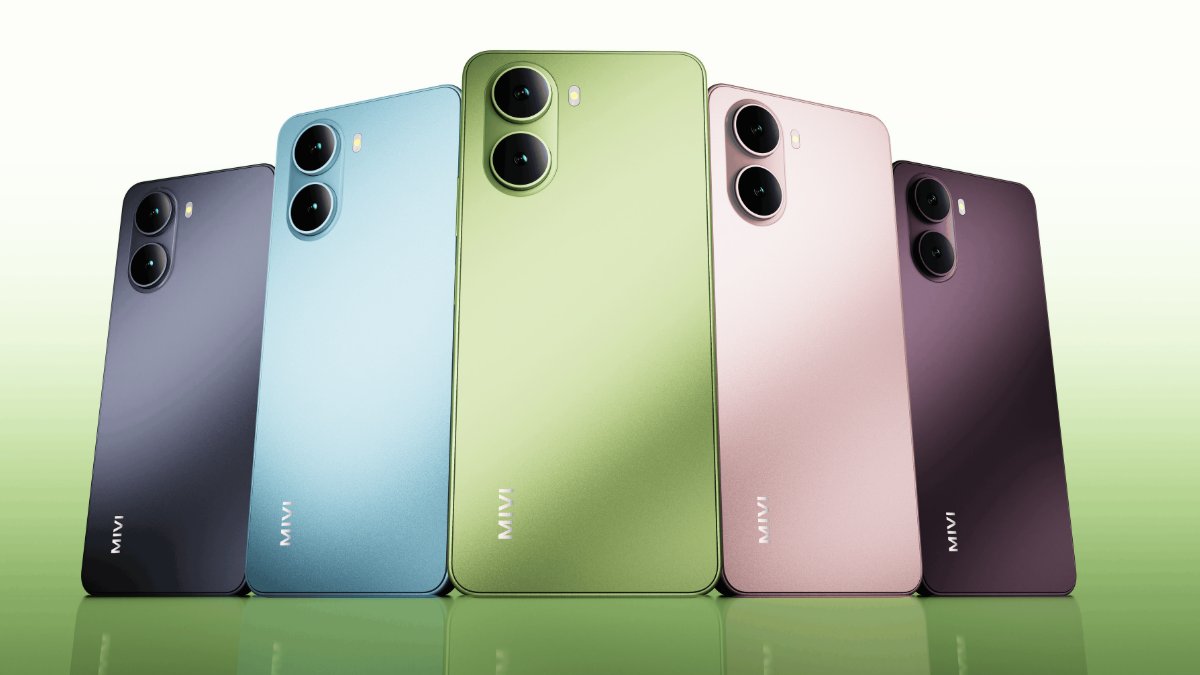
What Mivi got right is the physical design language. The back panel uses a subtle matte texture that resists fingerprints better than glossy budget phones, and the 2.5D curved glass on the front gives the LCD display a slightly more polished look than a flat glass sheet would. The phone isn’t especially slim — it’s a typical 8.5mm-ish slab — but the uniform thickness makes it easy to grip. There’s no 3.5mm headphone jack, which is increasingly standard in this price bracket but still worth noting for buyers who rely on wired earphones.
Display
The Mivi One 5G packs a 6.745-inch HD+ In-Cell LCD panel running at 720 x 1600 pixels with a 90Hz refresh rate. Let’s be clear about what that means in practice: this isn’t going to compete with AMOLED panels on contrast or colour vibrancy, and the pixel density (~268 ppi) means text won’t look as crisp as on FHD+ devices at this price. But for a phone that sells below ₹15,000, the LCD choice makes sense — it keeps costs down and battery drain manageable.
The 90Hz refresh rate is smooth enough for everyday scrolling through social media and messaging apps. Mivi claims a “Pure Android” experience, and in use that translates to a UI without the heavy custom skinning that bogs down many budget Android phones. The display gets bright enough for outdoor visibility in typical Indian conditions, though it’s not in the 1,000+ nits territory that HDR content demands. For the target buyer — students, first-time 5G users, and people upgrading from older 4G phones — the screen is perfectly serviceable.
Performance
Under the hood, the Mivi One 5G runs on Qualcomm’s Snapdragon 4 Gen 2, a 4nm chipset that sits below the Snapdragon 6 series but above the entry-level 4-series chips of previous generations. The CPU configuration pairs four Cortex-A78 cores at 2.0GHz with four Cortex-A55 cores at 1.8GHz, paired with an Adreno 610 GPU. This is a decidedly mainstream chip — it handles daily tasks, social media, video streaming, and light gaming without breaking a sweat, but don’t expect flagship-level performance in graphically intensive titles.
Mivi claims an AnTuTu score of around 490,000 for the Snapdragon 4 Gen 2, which puts it in the same neighbourhood as the Snapdragon 680 and slightly ahead of the Unisoc T7100 found in phones like the itel A300C. In real-world use, that means the phone opens apps reasonably quickly, multitasking between a few apps works without much stutter, and basic games like BGMI on medium settings are playable. Heavy gaming is not this phone’s forte.
The phone is available in three RAM configurations — 4GB, 6GB, and 8GB — all paired with 128GB of internal storage. That 128GB base is a smart move; many competitors in this segment still ship with 64GB, which fills up alarmingly fast with system files and app caches. There’s no microSD card slot, so buyers need to choose their variant carefully — the 4GB/128GB model at ₹14,999 is the value pick, but 6GB of RAM at ₹15,999 is the sensible choice for anyone planning to keep the phone for more than a year.
Camera
The Mivi One 5G ships with a dual rear camera setup: a 50-megapixel primary sensor with PDAF (phase detection autofocus) and a secondary 2-megapixel sensor. The 50MP main camera is the one that matters — the 2MP sensor is the usual depth-sensing filler that most reviewers recommend ignoring. On the front, there’s an 8-megapixel selfie camera.
In the budget segment, camera quality is less about megapixel count and more about sensor size, image processing, and lighting conditions. The 50MP sensor on the Mivi One 5G should produce decent daylight shots — details will be sharp on a phone screen or social media feed, though the HD+ display won’t do justice to the full resolution anyway. Low-light performance is where budget phones typically show their limits, and this one won’t be an exception; expect noisy indoor shots and softer night photos. Mivi hasn’t published sample gallery images or independent camera test data, so real-world performance is something early buyers will need to verify themselves.
Video recording support is standard — 1080p at 30fps is the likely ceiling for this chipset and sensor combination. There’s no optical image stabilisation (OIS), so handheld video in lower light will show visible shake. For a phone at this price, the camera setup is what you’d expect: good enough for casual photography and social media, not a reason to buy the phone.
Battery & Charging
This is where the Mivi One 5G makes its strongest case. The 6,000mAh battery is genuinely large for a budget 5G phone — larger than most competitors in the ₹10,000–₹20,000 range, which typically ship with 5,000mAh cells. Mivi positions the phone around battery life, and the math works: a 6,000mAh battery paired with a 90Hz HD+ LCD and a power-efficient Snapdragon 4 Gen 2 should comfortably last a full day of moderate to heavy use, and likely into a second day for lighter users.
The trade-off is charging speed. The phone supports 18W wired charging — that’s slower than the 33W, 45W, or even 67W chargers that have become common even in budget phones. An 18W charger will take roughly 3.5 to 4 hours to fill a 6,000mAh battery from empty, which means overnight charging is the practical approach. There’s no wireless charging, which is expected at this price point.
For buyers who prioritise battery life over charging speed — and there are many in the budget segment who’d rather charge once a day than worry about finding a charger — the 6,000mAh cell is a legitimate selling point. It’s the kind of spec that sells well in rural and semi-urban markets where charging opportunities aren’t always convenient.
Software
The Mivi One 5G runs Pure Android 16 — Mivi’s way of saying it skips the heavy custom skins that characterise many Indian brand phones. There’s no Mivi launcher overlay worth mentioning, no bloatware-heavy OEM layer, and no “featured service” apps pre-installed beyond the basics. For buyers tired of the cluttered software experience on phones from brands that pile on services, this near-stock approach is a genuine differentiator.
Mivi has committed to software updates through Android 18, which translates to roughly two major Android version upgrades from the launch version. That’s a modest but not unimpressive promise — it matches what Samsung offers on its A-series and beats the industry norm of “one OS update, maybe” for budget phones. Security updates cadence hasn’t been explicitly detailed, but Google’s default for Android 16 devices is monthly security patches for at least three years, and Mivi’s “Pure Android” positioning suggests it will follow that path.
The phone will go on sale exclusively via Flipkart starting October 8, 2026, and Mivi has said it has set up 500 service centres across India. That service network is thin compared to established brands but respectable for a first-time phone vendor.
Pros and Cons
| Pros • 6,000mAh battery — genuinely large for the price • Near-stock Android 16, no bloatware clutter • 128GB base storage across all variants • 5 colour options, matte back resists fingerprints • Android 18 update promise — 2 OS upgrades • Snapdragon 4 Gen 2 — reliable mid-range silicon • Made in India, 500 service centres planned |
Cons • 18W charging is slow for a 6,000mAh battery • No microSD card slot — 128GB is all you get • No 3.5mm headphone jack • HD+ LCD at ~268 ppi — visible pixel grid • No OIS on the rear camera • No wireless charging • IP64 rating — splash resistant, not fully water resistant • New brand — service network still growing |
Should You Buy This?
Buy it if:
- You want a 5G phone with a genuinely large 6,000mAh battery and don’t mind slower charging in exchange.
- You prefer a clean, bloatware-free Android experience and don’t want a heavy OEM skin cluttering your settings menus.
- You’re upgrading from a 4G phone and want a budget-friendly entry into 5G without spending more than ₹15,000.
- The 4GB/128GB variant at ₹14,999 fits your budget and you’re comfortable with the RAM limitation.
- You like having colour choices — five options is more than most budget phones offer.
Skip it if:
- You need fast charging — 18W on a 6,000mAh battery means long charging sessions.
- You want a better display — the HD+ LCD won’t satisfy buyers used to FHD+ AMOLED panels.
- You rely on a microSD card for storage expansion — there’s no slot.
- You want a phone with a proven service network — Mivi is new to smartphones and its 500-centre footprint is still growing.
- You care about camera quality — the dual 50MP + 2MP setup is adequate but not competitive with phones that offer OIS or better sensor sizing.
Final Verdict
The Mivi One 5G is not the best phone in its price bracket on paper — the Snapdragon 4 Gen 2 is a mid-range chip, the HD+ LCD is below the FHD+ standard that some competitors now offer, and the 18W charging speed is modest. But it’s a phone that knows what it wants to be: a battery-powered, no-frills 5G device for buyers who care more about daily usability than spec-sheet one-upmanship.
The 6,000mAh battery is the headline, and it’s a strong one. In a segment where 5,000mAh is the norm, an extra 1,000mAh at no premium is a real advantage — especially for buyers in markets where charging isn’t always convenient. Combined with near-stock Android 16 and a promise of updates through Android 18, the phone has a clear identity that separates it from the white-label rebadges that populate the budget segment.
The caveats are real. The 18W charger is slow, the display resolution is a step below what many buyers now expect, and Mivi’s newness to smartphones means the service network — while 500 centres strong — isn’t yet at the level of established brands. But for the right buyer, the Mivi One 5G offers a straightforward proposition: a phone that lasts all day, runs clean Android, and doesn’t ask for a premium. At ₹14,999 for the base model, that’s a proposition worth considering when it goes on sale October 8.