
Nothing Phone (4b) Review: The Budget Phone That Puts Design First
I’ll be honest — when Nothing announced the Phone (4b), I wasn’t sure what to expect. The “b” series was replacing the CMF line as Nothing’s cheapest entry point, and budget phones from design-first brands usually mean one thing: you get the looks, but the internals leave you wanting.
After digging through the specs, reading the early reviews, and comparing it head-to-head with what else is out there in mid-2026, I can tell you this: the Nothing Phone (4b) is a genuinely interesting phone. It’s also a deeply confusing one. Let me explain why.
Design — Still the Best-Looking Phone in Its Price Bracket
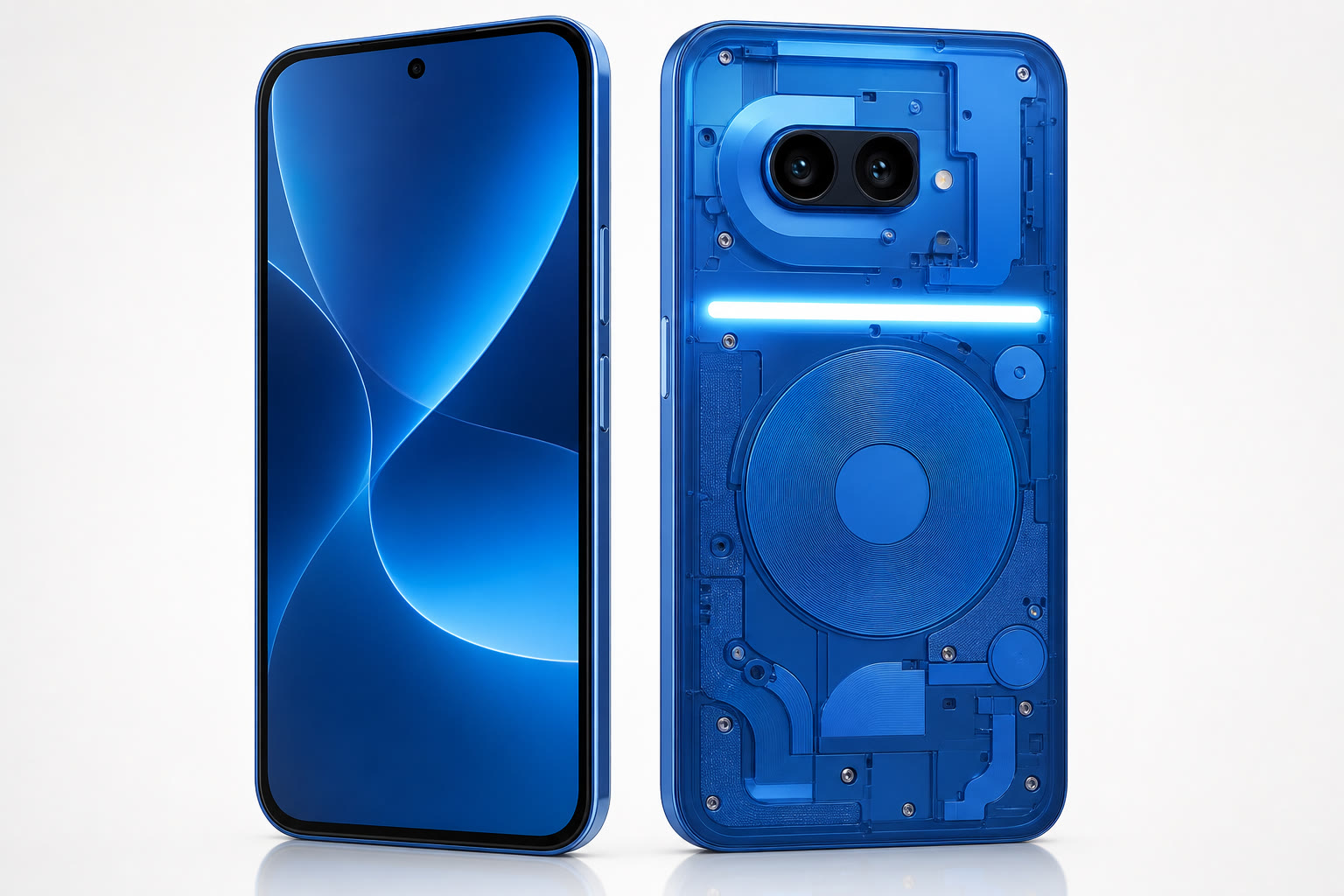
Nothing’s design language has always been their strongest card, and the Phone (4b) doesn’t disappoint. It borrows the polycarbonate unibody design from the Phone (4a) Pro, complete with the transparent back that lets you see the internal components and screws. It’s a conversation starter — the kind of phone people will notice when you pull it out at a coffee shop. The timing is interesting too; Samsung’s Unpacked event later this month will show how the other side of the smartphone design spectrum is evolving with foldables and Galaxy Glasses.
The big change is the Glyph Bar. Instead of the segmented Glyph Interface from earlier Nothing phones, the (4b) gets a slim horizontal LED strip across the upper back. It’s simpler, but it still works for notifications, charging status, and timer countdowns. The blue color variant is stunning — easily the best blue I’ve seen on a phone since Google’s “Really Blue” Pixel from 2016.
At 210 grams and 8.6mm thick, it’s not the lightest or slimmest phone out there, but the weight feels justified once you remember there’s a massive battery inside. The IP64 rating means it survives dust and splashes — not something you’d take swimming, but perfectly fine for Philippine rainy season commutes.
The power button and volume rocker are on the right side, providing satisfying tactile feedback. The USB-C port is at the bottom, flanked by the speaker grille and primary microphone. There’s no 3.5mm headphone jack, which is expected at this price point in 2026, and no expandable storage either — so choose your storage tier wisely.
Display — Bright Enough, Smooth Enough
The Phone (4b) packs a 6.77-inch FHD+ AMOLED panel with a 120Hz refresh rate and 2,000 nits peak brightness. On paper, that’s competitive with phones costing twice as much. In practice, it’s a good display — not great, but good.
Colors are vibrant with Nothing’s characteristic slightly desaturated aesthetic. The 120Hz refresh rate makes scrolling through social media feeds and the app drawer feel fluid. The 480Hz PWM dimming is a nice touch for people sensitive to screen flicker.
Where it falls short is outdoor visibility. Several reviewers note that at typical brightness (HBM maxes at 1,200 nits), the screen struggles under direct sunlight. You’ll find yourself squinting or cranking it to max brightness more often than you’d like. Beebom’s review called it out specifically: “Low outdoor brightness” is listed as a genuine con. If you spend a lot of time outdoors in the Philippine heat, this is worth noting.
The optical in-display fingerprint sensor worked reliably in hands-on tests — fast enough that you won’t notice it, which is the highest compliment you can give a fingerprint reader.
Performance — Snapdragon 6 Gen 4: Good Enough, Not Great
Under the hood, the Nothing Phone (4b) runs on Qualcomm’s Snapdragon 6 Gen 4 chipset, built on a 4nm process with an Adreno 810 GPU. This is a step down from the Phone (4a)’s Snapdragon 7s Gen 4, and it shows in benchmarks.
For everyday tasks — scrolling social media, messaging, email, YouTube, Google Maps — the phone feels perfectly snappy. The 8GB of LPDDR4X RAM is enough to keep a dozen apps in memory without reloading. Nothing’s software optimization is genuinely good here; the Phone (4b) doesn’t feel slow in day-to-day use.
Where you’ll feel the compromise is gaming. Light titles like Candy Crush and Clash Royale run fine, but demanding 3D games like Genshin Impact or Call of Duty Mobile will require lowering graphics settings significantly. The 4,400mm² vapor chamber helps with thermals — the phone doesn’t throttle as aggressively as some competitors — but you’re not buying this phone for flagship gaming performance.
Geekbench scores from pre-release listings show single-core results around 950 and multi-core around 2,800. That’s solid mid-range territory, comparable to the Dimensity 7300 in the older Phone (3a) Lite but behind the Snapdragon 7s Gen 4 in the Phone (4a).
Camera — A Story of Compromise
The camera system is where the “b” in Phone (4b) stands for “budget” most clearly. You get a dual rear setup: a 50MP main sensor (Samsung ISOCELL, 1/2.76-inch) with OIS, and an 8MP ultrawide with a 120-degree field of view. Up front, there’s a 16MP selfie shooter.
In good lighting, the main camera produces decent shots. Colors lean toward Nothing’s signature natural look — not oversaturated like some Chinese brands, not as flat as Pixel processing. The OIS helps with handheld shots, and 4K video at 30fps is serviceable for social media clips.
The problems start in low light. The small 1/2.76-inch sensor simply doesn’t capture enough light, and without a dedicated night mode lens, photos come out noisy and soft. The ultrawide is even more limited — the 8MP sensor is fine for well-lit landscapes but falls apart quickly indoors.
There’s no telephoto lens here, which is the biggest differentiator from the Phone (4a). The Phone (4a) gives you a 50MP telephoto for 2x optical zoom, and I genuinely miss it. Digital zoom on the (4b) gets ugly fast — anything beyond 2x is mostly unusable.
The selfie camera is a 16MP shooter that produces passable results for video calls but nothing you’d want to print. Portrait mode works reasonably well with good edge detection in favorable lighting.
Battery — The Hero Spec
This is where the Nothing Phone (4b) absolutely shines. The global version packs a 5,200mAh battery, while the Indian variant gets a massive 6,000mAh cell — the largest Nothing has ever put in a phone.
PCMag’s battery test, which loops a 1080p video over Wi-Fi at max brightness, recorded 16 hours and 49 minutes on the global model. That’s outstanding — it outlasts the Galaxy S25 series. In real-world use, multiple reviewers report easily getting through a full day of moderate to heavy use with 20-30% left by bedtime. The Indian variant with the larger cell likely stretches to two days for most users.
Charging is where the compromise hits. You get 33W wired charging with support for PPS, UFCS, and PD — but no wireless charging. A full 0-100% charge takes about 80 minutes, which is fine but not class-leading. There’s also 7.5W reverse wired charging for topping up your earbuds case.
Nothing’s battery health optimization claims the pack will retain 90% capacity after 1,200 cycles, which is better than the industry average of 800 cycles. For a budget phone that you’ll likely keep for 2-3 years, that’s reassuring.
Software — Nothing OS 4.1: Clean, Fast, and Actually Supported
The Nothing Phone (4b) ships with Nothing OS 4.1 based on Android 16, and it’s genuinely one of the best software experiences in the budget segment. Nothing’s take on Android is clean, fast, and distinctive — monochrome icon packs, dot-matrix widgets, and the Glyph Bar integration create a cohesive visual identity that iPhones and Samsung phones simply don’t offer.
The commitment to updates is impressive: 3 years of OS updates and 6 years of security patches. For a phone at this price point, that’s genuinely best-in-class. Most Android OEMs in this range offer 2+2 or 2+3 at best. Nothing is matching Google and Samsung on update policy, which should give buyers confidence.
Nothing OS 4.1 is based on Android 16, and it brings some genuinely useful features: improved multitasking, AI-powered “Essential Voice” for voice-to-text, and deeper widget customization. Bloatware is minimal — you get the standard Google apps and a few Nothing-exclusive utilities, nothing more.
The Price Problem — Nothing’s Biggest Challenge
Here’s where things get complicated. The Nothing Phone (4b) starts at €329 / £299 / ₹34,999. The Nothing Phone (4a), which launched earlier this year, starts at €349 / £349 / ₹31,999.
For roughly the same price — only €20-£50 less than the (4a) — you’re giving up:
- A telephoto camera (the (4a) has a 50MP telephoto)
- Higher-resolution 32MP selfie camera
- 50W fast charging vs 33W
- Up to 12GB RAM (vs 8GB max)
>A faster Snapdragon 7s Gen 4 chipset
What you gain is a larger battery (5,200mAh vs 5,080mAh, or 6,000mAh in India). That’s it.
As 9to5Google’s Ben Schoon put it: “It’s impossible to recommend buying Phone (4b) when Phone (4a) is better for basically the same price.” The “RAMageddon” component pricing crisis that has driven up the cost of memory chips is largely to blame — Nothing acknowledged this publicly when it canceled the CMF Phone 3 Pro. But that doesn’t change the fact that the Phone (4b) is priced uncomfortably close to its better-equipped sibling.
Should You Buy the Nothing Phone (4b)?
Buy it if:
- Design matters most — The transparent back, Glyph Bar, and blue colorway make this the best-looking phone in its price range, full stop.
- Battery life is your priority — If you want a phone that reliably gets you through a full day of heavy use without charging anxiety, this is it.
- You value long-term software support — Three years of OS updates and six years of security patches at this price is exceptional.
- You want clean Android — Nothing OS is close to a Pixel-like experience with added personality. No bloat, no duplicate apps, no ads.
Skip it if:
- You can stretch your budget — If you can find the Phone (4a) for €50 more, get that instead. Better cameras, faster chip, faster charging.
- Gaming performance matters — The Snapdragon 6 Gen 4 and 8GB RAM cap will leave you wanting more on demanding titles.
- You take a lot of photos — The small sensor and lack of telephoto make this a mediocre camera phone. Look at the Pixel 10a or Galaxy A56 instead.
- You need expandable storage — No microSD slot and limited to 256GB max. Think carefully about your storage needs before buying.
Nothing Phone (4b) Pros and Cons
| Pros | Cons |
|---|---|
| Stunning design with transparent back and Glyph Bar | Priced too close to the superior Phone (4a) |
| Excellent battery life (16+ hours in tests) | Small camera sensor struggles in low light |
| Clean, fast software with 3+6 year update commitment | No telephoto camera |
| Vivid 120Hz AMOLED display | Weak outdoor brightness |
| IP64 dust and splash resistance | 33W charging is behind competitors |
| Stereo speakers sound decent for the price | No expandable storage, no headphone jack |
| No bloatware, clean Android experience | Snapdragon 6 Gen 4 is only mid-range |
Nothing Phone (4b) Full Specifications
| Category | Specification |
|---|---|
| Display | 6.77-inch FHD+ AMOLED, 1080×2344, 120Hz, 2000 nits peak |
| Processor | Qualcomm Snapdragon 6 Gen 4 (4nm), Adreno 810 GPU |
| RAM & Storage | 8GB LPDDR4X RAM, 128GB/256GB UFS 2.2 (no microSD) |
| Rear Camera | 50MP f/1.8 (wide) with OIS + 8MP f/2.2 120° ultrawide |
| Front Camera | 16MP f/2.4 |
| Battery | 5,200mAh (global) / 6,000mAh (India) |
| Charging | 33W wired PD/PPS, 7.5W reverse wired |
| OS | Android 16, Nothing OS 4.1 (3 OS + 6 security updates) |
| Build | Glass front, plastic frame/back, IP64, 210g, 8.6mm |
| Connectivity | 5G, Wi-Fi 6, Bluetooth 6.0, NFC (market dependent), USB-C 2.0 |
| Colors | White, Black, Blue |
| Price | €329 / £299 / ₹34,999 |
Verdict — Style Over Substance, and That’s Okay
The Nothing Phone (4b) is a phone that asks you to make a choice. Do you want the most powerful hardware for your money, or do you want a phone that looks and feels different from everything else in your pocket?
If raw specs and camera performance are your priority, there are objectively better options at this price — the HONOR X7e gives you a 7,500mAh battery for under Php 10K, the Huawei Pura 90 delivers incredible camera hardware, and I recently reviewed the Motorola Edge 70 Pro which offers a compelling mid-range alternative with a 6,500mAh battery.
But if you value design — if you want a phone that sparks curiosity when you set it on the table, that runs clean software without bloat, that will get security updates for the next six years — the Nothing Phone (4b) delivers that in a way no other phone at this price can match.
The Phone (4a) remains the better value proposition for most people, especially since it’s only marginally more expensive. But if you’re in India getting that massive 6,000mAh battery, or if you find the (4b) on sale, it’s a genuinely good phone hidden behind an awkward pricing strategy.
Nothing built a beautiful budget phone. The 2026 component market just made it hard to price correctly. That’s not the phone’s fault — it’s the world we’re living in.