
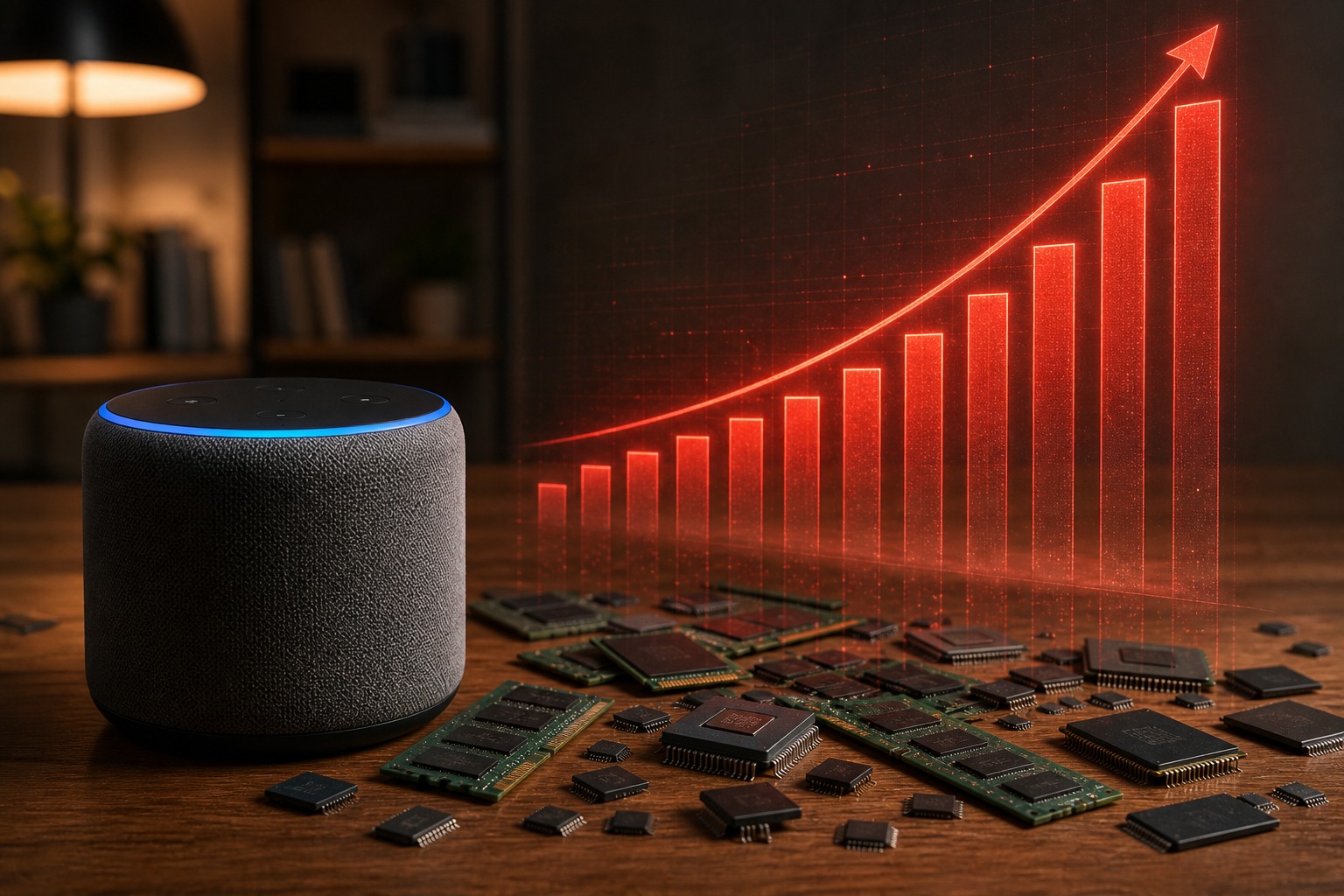
Amazon’s $49.99 Echo Dot just became a $79.99 Echo Dot. The cheapest smart speaker in its lineup jumped 60 percent overnight — and the blame has nothing to do with Alexa getting smarter or the hardware getting better. Amazon says the culprit is memory and storage component costs, the same AI-driven memory crunch that has been quietly remaking prices across the entire consumer electronics industry. This time, the mess finally reached your living room.
What actually got more expensive
Amazon quietly raised prices on its Echo speakers, Kindles, Fire TVs, and eero mesh routers — by as much as 60 percent, as Fortune first reported — without any big launch-day announcement. The Verge confirmed the increases and published the full list. The point is not just that prices went up; it’s which products got hit. The cheapest gear absorbed the biggest percentage jumps.
- Echo Dot: $49.99 to $79.99 (up 60%)
- Echo Show 11: $219.99 to $249.99
- Kindle (16GB): $109.99 to $149.99
- Kindle Paperwhite (16GB): $159.99 to $199.99
- Fire TV Stick HD: $34.99 to $39.99
- Fire TV Stick 4K Max: $59.99 to $84.99 (over 40%)
- eero 7: $349.99 to $399.99
- eero Pro 7: $699.99 to $799.99
Notably, Amazon’s Ring cameras and video doorbells did not see price increases. Neither did the flagship Echo Studio. In a statement to The Verge, Amazon’s Kristy Schmidt said the consumer electronics industry is “facing significant increases in memory and storage component costs,” and that after “absorbing these increases for as long as we could,” the company “recently adjusted pricing across our product lines.”
The irony you should sit with
Here is the part that keeps bugging me. A smart speaker does not need a state-of-the-art AI chip. The Echo Dot is a small device with modest memory and a tiny processor whose whole job is to play music, answer questions, and control your lights. And yet it is caught in a global memory shortage driven by the AI data-center buildout, because all those DRAM and NAND chips go into the same supply pool.
It’s the same story I wrote about when the memory shortage hit the MacBook Air — the AI-driven memory crunch is not staying in server rooms; it is leaking straight into your shopping cart.
This was always going to go from data centers to wallets
The pattern is unmistakable across the industry now. In June, Apple raised prices on Macs and iPads, and Tim Cook — in an interview with The Wall Street Journal — called the jump in memory costs a “hundred-year flood.” Apple has said it expects to pay even more for memory in the September quarter. Microsoft recently said it will raise Xbox console prices by $100 to $150 depending on the model and drop its highest-end 2TB configuration entirely. Roku bumped its streaming devices by up to $50 back in July. Dell, HP, Lenovo, and Asus have all raised prices or quietly cut the amount of memory in their products.
Every one of these companies is pointing at the same thing: the AI boom’s appetite for memory. The moment GPUs and AI accelerators started hoovering up every available DRAM module, the whole market repriced. Memory is a commodity with a finite supply and long lead times, so when tens of billions of dollars of new capacity rush in, prices spike across every product that touches a chip.
Where Amazon’s own money is going
Here is the part that ties it all together. Amazon is not hurting for cash to buy the memory it needs — it is just choosing to spend it elsewhere. In late July, CEO Andy Jassy told investors the company now expects to devote about $220 billion in capital expenditures this year, mostly to build and equip the data centers that power its AI services, up from a prior estimate of $200 billion. Even at that elevated level, Jassy said Amazon still won’t “have enough capacity to meet all the demand we have in 2026. And I believe this dynamic will also be true in 2027, too.”
So the same company planning to spend $220 billion on AI infrastructure is simultaneously raising the price of a $35 Fire TV Stick by five dollars. The expensive AI buildout has to be funded somehow — and a portion of it is being passed straight down to consumers who just want to read a book or play some music.
The end of the loss-leader
Behind the price list is a deeper business decision worth naming. Amazon has spent years selling its hardware cheaply — sometimes at cost, sometimes below it — because the real money lives in the ecosystem on top of the device. A cheap Kindle hooks you into buying books. A cheap Fire TV sells you Prime Video subscriptions. A cheap Echo plants Alexa in your living room, where it can push Amazon subscriptions and shopping. The hardware was the door; the services were the house.
That strategy only works while the hardware itself is cheap enough to subsidize. Raise the cost of entry by tens of dollars, and the math of the loss-leader starts to wobble. You can still convert subsidy dollars into subscriptions, but now the subsidy is smaller relative to the price you’re charging. Amazon is signaling that it is no longer willing to eat the memory bill just to plant a speaker on your counter.
That’s a real shift, not a rounding error. It means the “cheap gadget to own your attention” model is losing some of its fuel. The same logic that made streaming sticks and e-readers impulse buys is being pulled back by the one force tech companies can’t talk their way out of: the actual cost of the chips inside.
My take as someone who manages budgets
This one hits me twice. As an ICT division manager, I watch memory and storage costs eat procurement budgets every single quarter. I wrote about building my own model router with LiteLLM partly because renting and running AI infrastructure is becoming an expensive habit that needs a gatekeeper — the sort of pre-flight checks I built for rented GPU runs. When a company the size of Amazon — famous for selling hardware near cost to own your living room — starts charging more for its cheapest devices, it’s a signal that the era of “cheap tech as a loss leader” is ending for the consumer.
And here is the uncomfortable part for all of us in the Philippines. These global price hikes ripple straight into our market. When the US list price of a Kindle jumps by 40 percent, the gray-market and import pricing that many Filipinos rely on moves with it. The dollar conversion already hurts; multiply that by a memory shortage and you feel it even more at the counter. What used to be a budget-friendly upgrade is now a decision you budget for.
Is this a flood or a new tide?
The honest answer is nobody knows yet. Memory makers are adding capacity, but it takes years for new fabs to come online. Cook has said Apple expects higher memory costs in the near term, only partially offset by other savings. The Wall Street Journal’s reporting framed the price increases as “unavoidable” rather than temporary. Meanwhile the AI demand that started all this — the frantic buildout I covered when OpenAI hit the brakes on voluntary pacing — shows no sign of cooling — Amazon alone says it will not have enough capacity through 2027.
That suggests we should treat this less like a short-term supply glitch and more like a structural repricing of hardware. The cheap device era assumed memory would keep getting cheaper forever, the way it largely had for decades. That assumption is quietly being retired, and the price tags are reflecting it.
What to actually do about it
If you were already planning to buy an Echo, a Kindle, or a Fire TV, the key dates matter. Amazon says it will run promotions across its lineup through the year, so waiting for a sale beats buying at the new list price out of panic. And if you can hold off, holding off is reasonable — supply is eventually meant to recover, even if slowly.
For your next phone or laptop, the same logic applies. The memory shortage is a real reason to buy enough RAM now rather than trying to add it later, and to read the spec sheet carefully — because some makers are quietly shipping less memory at similar prices. As I’ve argued when covering the AI boom and its trust problems, it pays to stay skeptical about what you’re actually getting for your money these days.
The bottom line: Amazon just turned its cheapest Echo into a $79.99 product because the AI boom soaked up the world’s memory supply. That’s not a bug in your smart speaker — it’s the cost side of the AI era showing up in the one place companies hoped we wouldn’t look: our wallets. The question isn’t whether you’ll pay more for gadgets in 2027. It’s whether anyone is going to be honest about how much of the AI buildout ends up on your receipt.