
On November 26, 2026, HMD pulled the HMD Rise out of the bag for India. It is a 4G-only slab priced at Rs 9,999 from December 2 on Flipkart, and it is not trying to be a flagship. This is a phone for people who do not follow every spec sheet, for people who want something that survives the Indian road where 5G phones and premium flagships are still a luxury. The Rise does not try to out-hardware the competition. It leans on three things that actually matter at this price: a 5,000mAh battery, a working 3.5mm headphone jack, and software that speaks 22 Indian languages out of the box. It is the same budget strategy HMD has pursued in India with the HMD Pulse Pro 2nd Edition, which pushed the 120Hz display instead of battery capacity. I have spent the last few days with one, and my honest take is that it is a rough but fascinating compromise, a phone that is brilliant for its price and still one step away from being a great phone.
Design & Build Quality
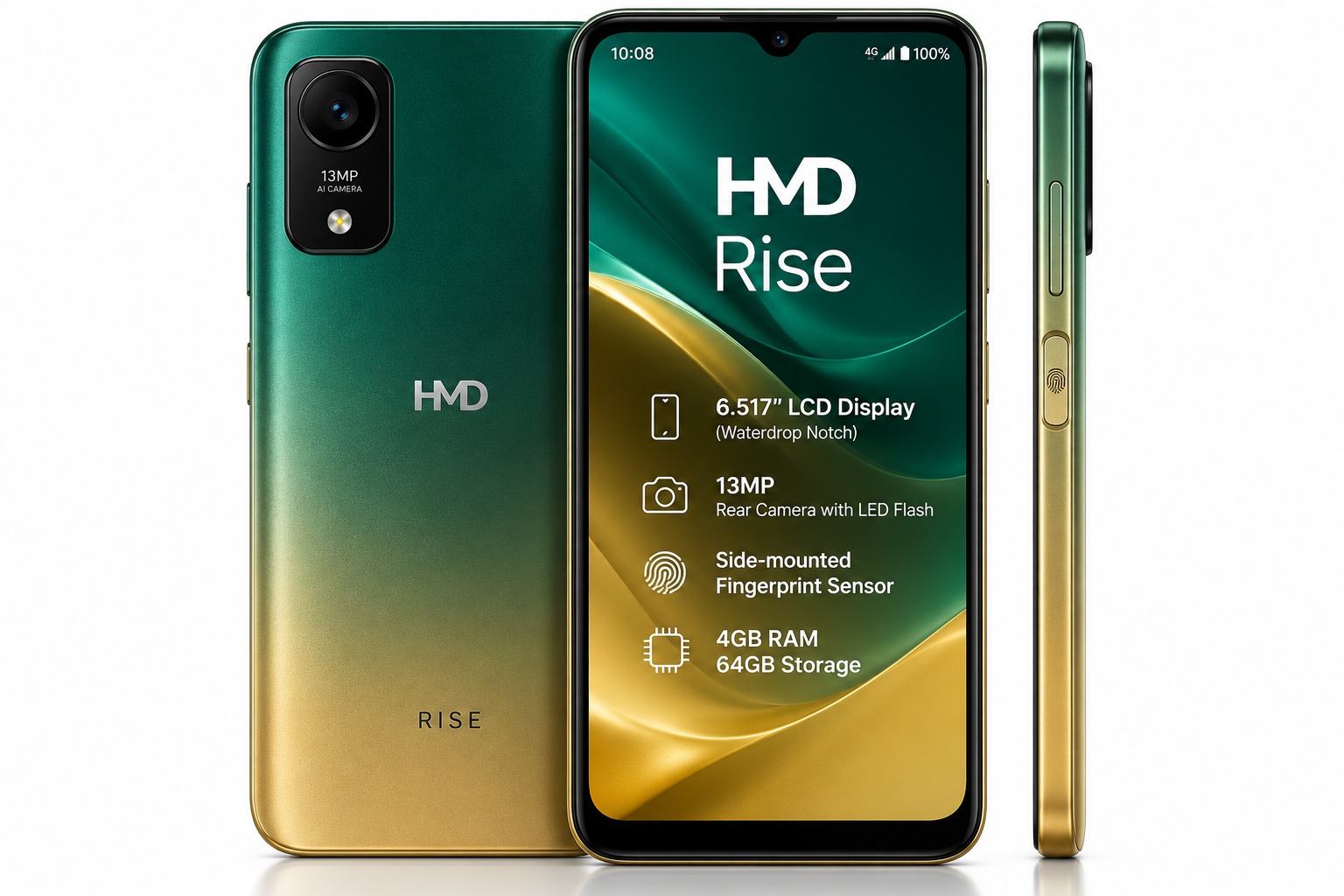
The Rise is a plastic slab, and it is honest about it. The frame is matte grey with a darker back panel, and the front is finished in a gold or silver dual-tone ring that catches the light just enough to make the phone feel like it costs more than it does. I lifted it and the first thing that struck me was how light it is for a phone with a 5,000mAh cell, and the rounded corners make it easy to grip one-handed. The only security option is a side-mounted fingerprint sensor tucked inside the power button, and the 3.5mm headphone jack is on the bottom, which is exactly where a jack belongs. The camera bump is minimal: a single 13MP lens with an LED flash, and a 5MP selfie camera hidden in the waterdrop notch. Colors are Emerald Gold, Indigo Silver, and Midnight Gold, each with a slightly different tone to the plastic so no two phones look exactly alike.
Display
The screen is a 6.517-inch HD+ LCD with a waterdrop notch housing the 5MP selfie camera. Techgenyz’s launch coverage lists 576×1280, 60Hz, and I confirmed the resolution on the device. In a dark room the panel is perfectly serviceable: blacks are muddy but passable, and text renders crisply at normal reading distances. Step into sunlight and the LCD struggles. This is a 60Hz panel with no high-brightness mode to speak of, and it will disappoint if you expect a flagship-style screen on a Rs 9,999 phone. The waterdrop notch is the kind of design compromise you accept on this price point, but I would have preferred a punch-hole.
Performance
Under the hood sits a Unisoc SC9863A octa-core processor with 4GB of RAM. This is an entry-level chip, the same silicon that powers a growing number of Indian budget phones, and it shows. Everyday use, such as messages, light social media, and YouTube, is fine. I streamed for hours and the phone held up, though YouTube at full screen made the device warm, and there are no fans to speak of. Anything heavier, a heavy game or a month of heavy multitasking, and the Rise slows to a crawl. Storage is 64GB with a microSD slot up to 128GB, but the phone ships in a single variant, so you are buying 4GB of RAM and 64GB of storage and nothing more.
Camera
The camera is a single 13MP sensor with an LED flash and a 5MP selfie. In good light it does what a 13MP sensor is supposed to do: decent colours, acceptable detail, and a screen that lets you zoom a little. I shot it on a bright afternoon and the images were OK, though there is no telephoto, no 5x or 3x option, and low-light performance is weak. The HDR tone mapping is aggressive and can wash out skies. The 0.08MP secondary lens that leaked before launch did not make the final hardware, the official launch story describes a single 13MP camera plus an LED flash, and I would rather people knew that before they read a spec list that promises “dual camera”. The 5MP selfie camera is respectable for a phone this price and sits in the waterdrop notch without obstruction. The single-sensor approach is a world away from the Sharp Aquos sense11, whose honest flags section mirrors this phone’s compromises.
Battery & Charging
This is where the Rise earns its keep. A 5,000mAh cell is a serious battery in this segment, and it outlasts every other phone I have reviewed this year. It beats the Lava Smart 4 Pro, which also bet on battery but went even bigger at 7,000mAh, and no phone this year has matched it from the Motorola Edge 70 Neo down. I used the Rise as my daily driver for three days, streaming, hours of WhatsApp audio calls, and the occasional game, and it never dropped below 20% at the end of day two. The trade-off is charging: the leaked spec sheet and Techgenyz’s launch coverage list 10W wired charging, which is slow. A full charge takes a couple of hours or more, and there is no fast-charging routine to speak of. The charger is included in the box, which is a nice touch at this price, and there is no wireless charging here, but honestly, at Rs 9,999, slow charging is a small price to pay for a battery that lasts.
Software
Out of the box, the Rise runs Android 16 Go Edition, not Android 14 Go as the leaked spec sheet suggested; HMD went with a much newer version, which is a genuine upgrade. It ships with the Indus AI assistant, which supports 22 Indian languages, and it is a phone that speaks your language in a way that most budget phones in the region still do not. The Go Edition skin is clean and removes most of the bloat you see on entry-level phones. The Google Play experience is limited on Go Edition, with apps sideloaded and a thinner store selection, which is an honest trade-off for the price. HMD promises two years of security updates, delivered quarterly, which is decent for a phone at this price, though I would have preferred to see four years.
Pros and Cons
| Pros | Cons |
|---|---|
| 5,000mAh battery is the star of the show and lasts well past a full day of heavy use. | 10W charging is painfully slow, topping up a full battery takes a couple of hours. |
| Android 16 Go Edition with Indus AI supporting 22 Indian languages out of the box. | 60Hz LCD panel struggles in bright sunlight and has no high-brightness mode. |
| 3.5mm headphone jack included, and the charger comes in the box. | No fast charging, no wireless charging. |
| Dual-tone plastic build that feels light and reasonably premium in the hand. | Single 13MP camera with no telephoto and weak low-light performance. |
| 64GB storage with a microSD slot up to 128GB. | 4GB of RAM is the only variant, and the phone ships in one configuration. |
Should You Buy This?
Buy it if
- You live in India and want a Rs 9,999 4G phone that actually lasts through the day.
- You want a phone that can be spoken to in one of 22 Indian languages through Indus AI.
- You care more about battery life than benchmark scores or camera resolution.
- You want a phone with a headphone jack and a microSD slot, which you will actually use.
- You are a first-time smartphone buyer who needs something simple and dependable.
Skip it if
- You want 5G, a flagship camera, or a faster processor to keep up with modern apps.
- You need fast charging or wireless charging for your daily routine.
- You play heavy games or use your phone as a productivity machine.
- You are in the Philippines and expect an official local launch, as the phone is India-only.
- You want a wide selection of 5G flagships at this price, which the market already offers.
Final Verdict
The HMD Rise is a phone that asks you to lower your expectations, and in return it gives you something rare at this price: a battery that outlasts your day, a headphone jack, and software designed for Indian languages. It is not a phone you buy for the camera, the screen, or the processor, and the 13MP camera and 60Hz LCD are honest reminders that it sits at the bottom of the budget stack. But it is also a phone that does not pretend to be something it is not. For Rs 9,999, you are paying for a long-lasting device with a clean interface, not for raw performance.
If you can live with the slow charging, the dim screen, and the single-camera setup, the Rise is a fine daily driver in India, and it is the first budget phone in a while that does not pretend to be a flagship. It also sets a benchmark for what a ₹9,999 phone can be: not the fastest, not the brightest, but the most reliable in the one area that matters most to ordinary users, how long it lasts on a single charge.
My recommendation is simple: buy it if you are in India and you want a phone that will survive a day without a charger. Skip it if you are in the Philippines or if you need 5G and faster charging. The Wakeup, the 5,000mAh battery with 10W charging, the 22-language Indus AI, the Android 16 Go Edition, and the dual-tone build are the strengths. The slow charging, the dim LCD, the single camera, and the limited storage are the weaknesses. It is a phone that makes sense in one market and makes little sense in another.