
Jetour has been the quiet winner of the Philippine electrified-vehicle race. The Chery-owned brand was the top-selling plug-in hybrid brand among CAMPI members in the first half of 2026, and its T1 Lightning i-DM was the best-selling PHEV model. Every one of those sales, though, came from a vehicle that still carries a petrol engine. That is about to change.
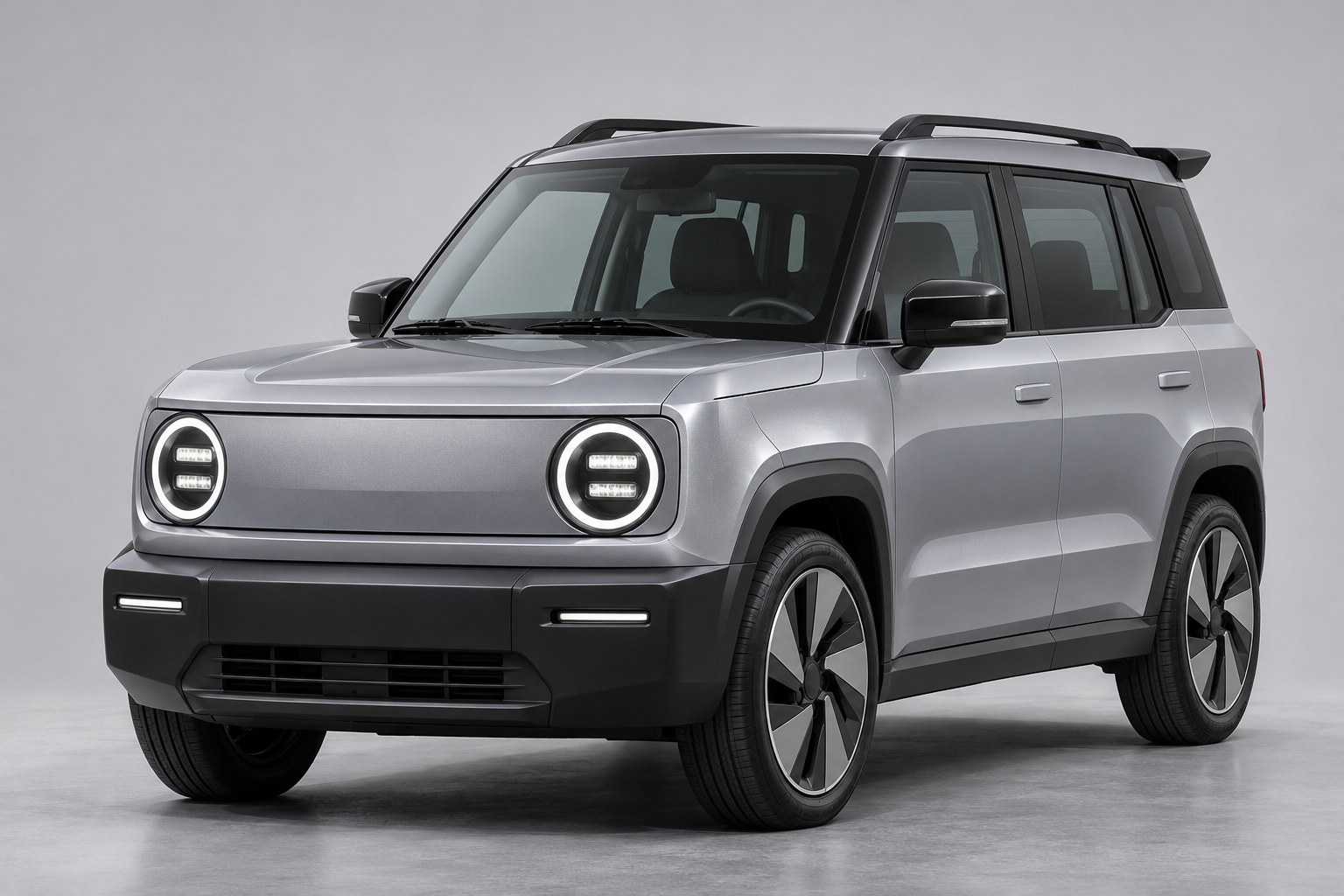
On November 16, Jetour opens pre-sales in China for the TX, its first-ever battery-electric SUV. It is a compact, boxy, retro-styled crossover with up to 550 km of range, a 374 PS dual-motor option, and a 500 mm wading depth. If Jetour’s global plans hold, the Philippines should be on the list.
What is the Jetour TX?
The TX is not a sudden surprise. It first appeared as the TX concept at the Beijing Auto Show in April, then in Chinese regulatory filings in August, before making its production debut at the Chengdu Auto Show on August 21. Blind pre-orders opened there, and the production car keeps the concept’s upright, squared-off stance almost intact.
Jetour calls it a compact electric SUV, and the numbers back that up: 4,605 mm long, 1,880 mm wide, 1,700 mm tall, on a 2,735 mm wheelbase. That puts it squarely in the fight with the BYD Atto 3 and the GAC Aion V, two of the most popular electric crossovers in the country.
Under the skin, the TX rides on a dedicated rear-drive electric platform with a MacPherson front and five-link rear suspension, tuned with help from the Spanish engineering firm IDIADA. A 150-litre frunk and 31 storage compartments fit the travel brief, and the cabin runs on a Snapdragon 8775 chip with a 15.6-inch 2.5K central screen.
It is a different bet from the range-extended approach Li Auto is taking in the Philippines, which I covered this morning. Jetour already sells the T2 Lightning i-DM 4×4 here, so the TX would be its first battery-electric model rather than its first electrified one.
Specs at a glance
| Specification | Jetour TX |
| Motor (2WD) | 200 kW (272 PS / 268 hp) rear PMSM |
| Motor (4WD) | 275 kW (374 PS / 369 hp) dual-motor AWD |
| 0-100 km/h (4WD) | About 5 seconds |
| Battery | 67.2 kWh LFP “Rhino” (65.4 kWh usable) |
| Range (2WD) | 550 km CLTC / about 446 km WLTP |
| Range (4WD) | 510 km CLTC |
| Energy consumption | 13.5 kWh/100 km |
| V2L output | 6.6 kW |
| Ground clearance | 200 mm |
| Wading depth | 500 mm |
| Approach / departure | 21 degrees / 26 degrees |
| Dimensions (L x W x H) | 4,605 x 1,880 x 1,700 mm |
| Wheelbase | 2,735 mm |
| Curb weight | 1,777 kg (2WD) / 1,875 kg (4WD) |
| Top speed | 180 km/h |
| AC / DC charging | Not yet announced |
| Driver assistance | Falcon 500 (highway + city NOA, automated parking) |
Three-currency pricing
No official price has been announced yet. Pre-sales open in China on November 16, and Jetour Philippines has said nothing about a local launch. Chinese reports project the TX at roughly 100,000 to 150,000 yuan, which works out to about P0.95-1.42 million, $14,900-22,400, or Rs 14-21 lakh at today’s rates (63.31 PHP/USD, 93.82 INR/USD).
If the TX reaches the Philippines, a realistic estimate is P1.6 to P1.9 million. That is anchored on the BYD Atto 3 (P1.598 million) and the GAC Aion V Premium (P1.598 million effective), with the Jetour S08 i-DM (P1.798 million) as the upper bound. Treat that as an estimate, not a quote — nothing is confirmed.
Philippine driving conditions
City driving
At 4,605 mm, the TX is compact enough for Makati side streets and mall parking. The 200 kW motor delivers its torque instantly, which makes merging out of a U-turn slot on EDSA far less stressful than in a turbo petrol crossover. The 550 km CLTC range is overkill for a daily commute — you would be charging once a week, not once a day.
Long-distance travel
The 2WD’s 550 km CLTC rating (about 446 km WLTP) clears a Manila-Baguio run without a charging stop, and the 4WD variant adds a second motor for the same battery. The catch is the provincial charging network. The Department of Energy counted 1,569 public charging points nationwide as of March 31, 2026, and most of them sit in Metro Manila and the big cities. Plan your stops on NLEX and SCTEX, and treat anything off the main tollways as uncharted territory.
Flooded situations
This is where the TX is genuinely interesting for the Philippines. Jetour quotes a 200 mm ground clearance and a 500 mm wading depth, with 21-degree approach and 26-degree departure angles. That is better than the Suzuki e-Vitara’s 180 mm and far better than the Deepal S07’s 145 mm. An EV has no air intake to hydrolock, which is a real advantage in a flooded underpass. Still, Jetour has not published a battery enclosure IP rating for the TX, so treat the 500 mm figure as a design target, not a license to wade into chest-deep water.
High temperature
The TX uses a 67.2 kWh LFP (lithium iron phosphate) pack from Chery-backed Anhui Deyi, with 65.4 kWh usable. LFP is the more thermally stable chemistry, which matters when the car sits in 36 to 38 degree heat with the air-conditioning running. It is the same trade-off I covered in my piece on battery thermal management and the AI power crunch. The 13.5 kWh/100 km consumption figure is competitive. Jetour has not published the cooling system, so I could not confirm whether the pack is liquid-cooled either way.
What others are saying
AutoIndustriya, which broke the story in the Philippines, called the TX Jetour’s first electric crossover and framed it as a direct rival to the BYD Atto 3. CarNewsChina reports the Falcon 500 system brings highway and city navigation assist plus automated parking. And paultan, writing in August, noted that Jetour has trademarked the TX name in Australia, which points to global sales beyond China.
The bottom line
Jetour Philippines already has the dealership network and the PHEV track record. The TX would give it a proper battery-electric model at exactly the moment the local EV market is moving from early adopters to mainstream buyers. There is no announcement yet, so watch the Department of Energy’s recognized EV list — the same filing that signalled the Kia EV3 and Jaecoo J8 before they launched.
If the TX lands at the estimated P1.6 to P1.9 million, it would slot between the BYD Atto 3 and the larger GAC Aion V, with more range and a better flood story than either. For a brand that has been winning on hybrids, that is a genuine threat.