
Oppo has done something it has never done before: it has confirmed that its next foldable is coming to Europe. The Find N7, the successor to the Find N6, will launch on the continent around March 2027, according to a regional product manager who spoke to Bulgarian publication Nixanbal. That single sentence is the only thing Oppo has actually said about the phone. Everything else — the 7.6-inch wide display, the 2nm chipset, the 6,500mAh battery, the 200MP Hasselblad camera array — comes from tipsters and leaked engineering samples.
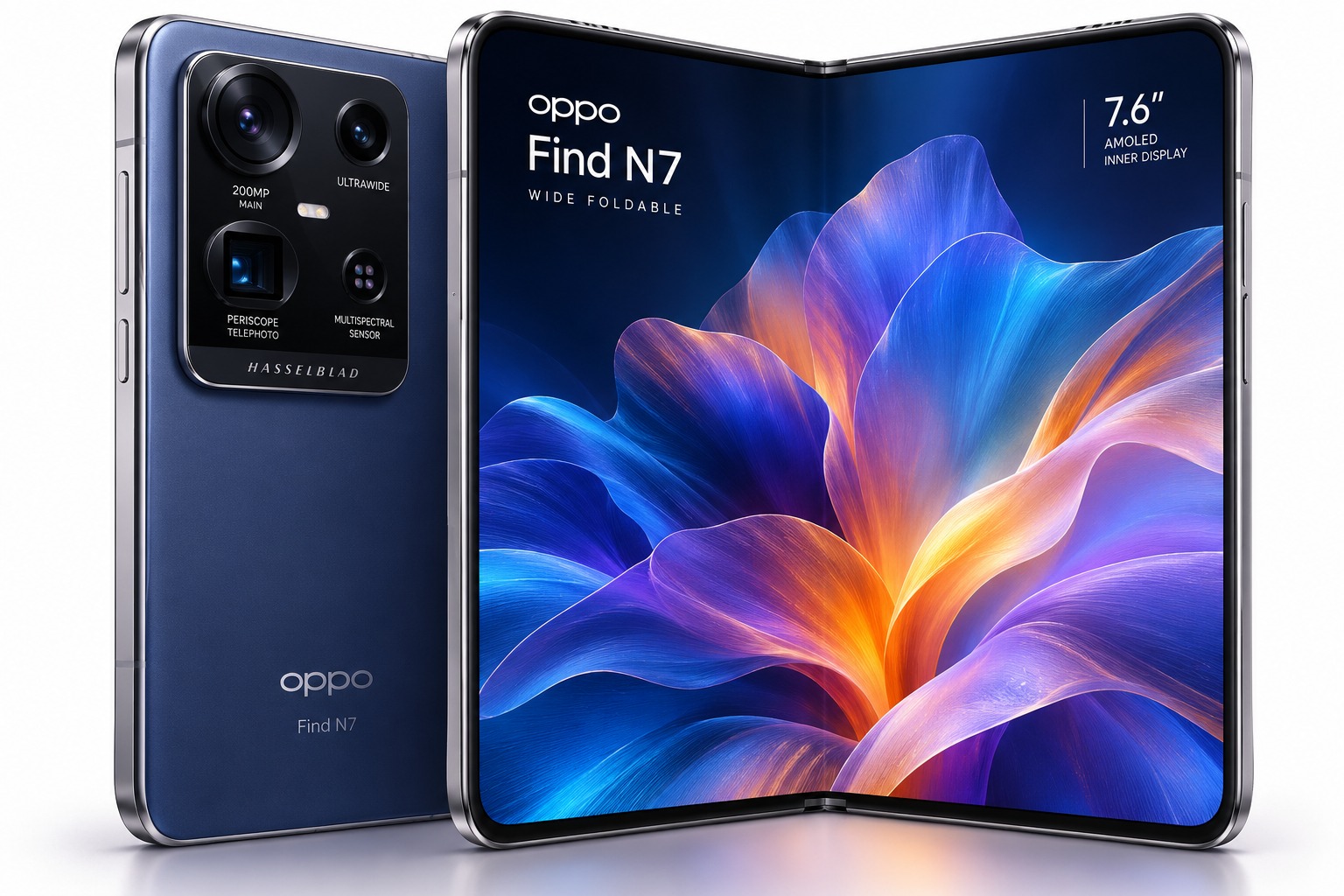
I have not held this phone. Nobody outside Oppo has. So this is not a hands-on review in the traditional sense; it is an honest accounting of what is confirmed, what is rumored, and what the move to a wide-format foldable actually means if you are shopping for one in 2027.
Confirmed vs. Unconfirmed
| Specification | Status |
|---|---|
| Europe launch | Confirmed — Oppo regional product manager, Nov 4 2026 |
| China launch | Expected Q1 2027 (rumored) |
| Europe launch timing | Around March 2027 (expected, not announced) |
| Inner display | 7.6" wide-format, creaseless (rumored) |
| Cover display | ~5.5" (rumored; one source says up to 6.68") |
| Chipset | Snapdragon 8 Elite Extreme Gen 6 / Gen 6 Pro, 2nm (rumored, sources conflict) |
| Main camera | 200MP (rumored) |
| Telephoto | 50MP periscope (rumored) |
| Ultrawide | 50MP (rumored) |
| Multispectral sensor | 3MP "Danxia" color lens (rumored) |
| Battery | 6,500mAh silicon-carbon (rumored) |
| Charging | Unconfirmed |
| Brightness, RAM, storage, IP rating, weight | Unconfirmed |
| Price | Unconfirmed |
| Update commitment | Unconfirmed |
| Philippines availability | Unconfirmed |
Design & Build Quality
The Find N7 represents a philosophical pivot for Oppo. The Find N6 was a large, tall foldable with an 8.12-inch inner screen that unfolded into something close to a small square tablet. The N7, based on every leak so far, goes the other way: a 7.6-inch inner panel with a wider aspect ratio, closer to the Samsung Galaxy Z Fold8 Ultra and the iPhone Duo than to its own predecessor.
The headline engineering claim is a "seamless hinge" that Oppo says will hide the crease. The crease is the single most persistent complaint about foldables — it is the line you feel under your thumb when you swipe across the middle of the screen, and it is the first thing every foldable reviewer mentions. If Oppo has genuinely engineered it away, that is a meaningful achievement. If it has merely reduced it, that is still progress. Either way, it is the right problem to attack.
Tipsters describe the N7 as light and thin, but no dimensions or weight have surfaced. The Find N6 weighed 225 grams and measured 4.2mm unfolded, which was already impressive for an 8.12-inch device. Whether Oppo can hold that weight while shrinking the panel and growing the battery is an open question. The N6 used a grade-5 titanium alloy hinge and an aircraft-grade 7000-series aluminum frame; I would expect both to carry over, but that is an expectation, not a fact.
Durability is another gap. The N6 carried an IP58/IP59 rating, which means dust protection plus resistance to high-pressure water jets and immersion up to 1 meter for 30 minutes. The N7’s rating has not been published. Colors are unknown too — the N6 came in Blossom Orange, Stellar Titanium, and Pearl Black.
Display
Here is the trade-off at the heart of the Find N7: the inner screen gets smaller in diagonal but wider in shape. The N6’s 8.12-inch panel ran at 2248 x 2480, a near-square 0.91 aspect ratio that made it excellent for documents and multitasking but awkward one-handed when folded. The N7’s 7.6-inch wide panel should unfold into a more landscape-friendly canvas — better for video, for split-screen apps, and for the kind of content people actually consume on a foldable.
The cover display is where the rumors get murky. Most sources say the N7 drops to a 5.5-inch cover screen, down from the N6’s 6.62-inch panel. One outlet, MyMobileIndia, says it could be anywhere from 5.5 to 6.68 inches. That is a meaningful spread. A 5.5-inch cover screen would be a genuine downgrade for folded use — narrower, taller, and less comfortable for typing. A 6.68-inch panel would essentially match the N6. Until Oppo publishes the number, treat the cover display as the biggest unresolved question on this phone.
Brightness is unconfirmed. The N6’s inner panel peaked at 2,500 nits on paper and measured 1,586 nits in GSMArena’s lab, with the cover display reaching 3,600 nits peak. The N7’s numbers should surface closer to launch.
Performance
This is the least controversial upgrade on the Find N7. The Find N6 ran a Snapdragon 8 Elite Gen 5 on a 3nm process. The N7 is expected to step up to a 2nm chipset — but which one? GSMArena’s tipster Smart Pikachu says Snapdragon 8 Elite Extreme Gen 6, while Gadgets360 and MyMobileIndia report Snapdragon 8 Elite Gen 6 Pro. Those are not the same chip. The "Extreme" branding has denoted Qualcomm’s top-tier binned parts, while the "Pro" variant sits a tier below. Oppo’s own Find X10 Pro Max uses a MediaTek Dimensity 9600 Pro, so the company is no stranger to shipping different silicon in different markets.
What matters is the process node. A move from 3nm to 2nm should bring meaningful efficiency gains, which matters more on a foldable than on a slate phone — foldables carry two screens, a hinge mechanism, and a battery split across two halves. The N6 posted an AnTuTu score of 2.63 million on v10 and 3.50 million on v11, with a Geekbench 6 single-core score of 6,538. The N7 should clear all of that comfortably if the 2nm part is real.
Camera
The Find N7’s camera system is the clearest example of Oppo refining rather than reinventing. The setup is expected to be a 200MP main sensor, a 50MP ultrawide, and a 50MP periscope telephoto — the same trio the Find N6 shipped with — plus a new 3MP multispectral sensor that tipster Digital Chat Station calls the "Danxia Color Restoration Lens."
Multispectral sensors are the quiet story in mobile imaging right now. They measure light across wavelengths the human eye cannot see, which lets the phone’s processor reconstruct colors more accurately under mixed or tricky lighting. Adding a dedicated 3MP multispectral unit suggests Oppo wants the N7 to be a color-accurate camera first and a spec-sheet camera second — a notable shift for a company whose recent flagships leaned on Hasselblad color science.
Hasselblad tuning is expected to carry over from the Find N6, which is good news for anyone who values natural color rendering. What nobody knows is whether the 200MP main sensor is new hardware or the same unit the N6 used. Gadgets360 explicitly notes the leak does not establish this. If it is the same sensor, the N7’s camera gains will come from processing rather than optics. If it is new, the N7 could be a genuine imaging step forward.
Battery & Charging
The battery is one of the few specs every source agrees on: 6,500mAh silicon-carbon, up 500mAh from the Find N6’s 6,000mAh cell. That is a meaningful bump on a device whose inner screen is getting smaller, which should translate directly into endurance. The N6 managed a 15-hour 45-minute active-use score in GSMArena’s battery test, which was already strong for a foldable. A 6,500mAh cell with a more efficient 2nm chipset should push the N7 comfortably past that.
Charging is the gap. No source has published a wattage for the N7. The N6 offered 80W wired, 50W wireless, and reverse charging in both directions. Some aggregator pages already list 100W wired for the N7, but those pages are carrying the N6’s spec sheet under the N7’s name — the same recycled data that plagues every unreleased phone. Treat any charging figure as fiction until Oppo says otherwise.
Software
The Find N7 is expected to ship with ColorOS based on Android 17, up from the N6’s Android 16 with ColorOS 16. That is a normal generational step. The more important question is the update commitment, which Oppo has not announced. The Find X10 Pro Max ships with a promise of four years of OS upgrades and six years of security patches, which is competitive. Whether the N7 matches that is unknown.
The software angle that actually matters for buyers in the Philippines and Europe is Google. Oppo’s global units ship with full Google Mobile Services — the Play Store, Gmail, Maps, and the local banking apps that depend on them. That is the single biggest practical advantage the Find N7 will have over a Huawei Mate 90 Pro Max, which ships without Google and requires workarounds for the apps most people actually use. If Oppo prices the N7 sensibly in Europe, it becomes the default recommendation for anyone who wants a foldable that works with their existing app library.
Pros and Cons
| Pros | Cons |
|---|---|
| First Find N foldable to launch in Europe | Inner display is smaller than the Find N6’s 8.12" |
| Seamless hinge promises a crease-free inner screen | Cover display may shrink to 5.5" (disputed) |
| 2nm chipset should deliver real efficiency gains | Chipset naming conflict — Extreme Gen 6 vs. Gen 6 Pro |
| 6,500mAh battery is 500mAh larger than the N6’s | Charging speed, IP rating, and weight all unconfirmed |
| Hasselblad tuning plus a dedicated multispectral color sensor | Months away from launch and unpriced |
| Full Google Mobile Services on global units | No Philippines availability or pricing confirmed |
| Wide-format inner screen is better for video and multitasking | 200MP main sensor may be carried over, not new |
| Oppo’s four-year OS update pledge on recent flagships | Update commitment for the N7 itself is unannounced |
Should You Buy This?
Buy it if
- You want a wide-format foldable with full Google app support.
- You have waited years for Oppo’s foldables to reach Europe or the Philippines.
- A crease-free inner display matters more to you than raw screen size.
- You value Hasselblad color tuning and a multispectral sensor over sheer megapixel count.
Skip it if
- You want the biggest inner canvas available — the Find N6’s 8.12-inch panel is larger.
- You need a phone today, not a rumor with a March 2027 launch window.
- You cannot live with unconfirmed charging, durability, and pricing.
- You dislike the wide-foldable trend and prefer a traditional tall foldable.
Final Verdict
The Find N7 is the most interesting foldable Oppo has announced, precisely because it is not really announced at all. The company has confirmed one thing — Europe is getting it — and left every other detail to the rumor mill. What the rumors describe is a phone that trades raw screen area for a more usable shape, attacks the crease with a new hinge, and steps up to a 2nm chipset with a bigger battery.
The wide-format foldable is where the industry is heading — Samsung went there with the Z Fold8, Apple went there with the iPhone Duo, and Xiaomi went there with the Xiaomi 18 Fold — and now Oppo is following. The N7 will not be the biggest foldable when it arrives, but it might be the most balanced.
The honest caveats are the ones that matter: the inner screen shrinks, the cover screen may shrink with it, the chipset name is inconsistent across sources, and nothing about charging, durability, weight, or price is confirmed. If you are shopping for a foldable in early 2027, put the Find N7 on your shortlist — but wait for Oppo to publish the spec sheet before you commit.
For buyers in the Philippines, the open question is availability. Oppo sells the Find X10 and Find X10 Pro Max globally, but the N7’s Philippine launch has not been announced. If it does arrive, expect pricing in the ₱90,000 to ₱110,000 range based on the Find N6’s 1,250 EUR European price and the usual import markup. That is a lot of money for a phone that does not yet officially exist — which is exactly why this review exists now, before the marketing begins.