
Xiaomi 18 Fold Review: Passport-Sized Folding, Xiaomi’s Own Chip, and a Whopping Price
Xiaomi just shook up the folding phone playbook. Its new 18 Fold, which launches in China today, is a “mid-fold” design — roughly the size of a passport when shut, yet it opens into a 7.58-inch display that’s wider than it is tall. And unlike every Xiaomi foldable before it, the 18 Fold doesn’t run a Qualcomm Snapdragon. It runs the XRing O3, Xiaomi’s own 3nm chip.
That’s a lot of firsts for one device — the first phone on Earth with next-gen LPDDR6 memory, the first Xiaomi foldable not branded “Mix Fold,” and arguably the company’s boldest hardware bet yet. But big firsts rarely come cheap, and the 18 Fold is expected to cross a price line Xiaomi has never crossed before. Here’s an honest look at what it is, what it trades away, and who it’s really for.
Design & Build Quality
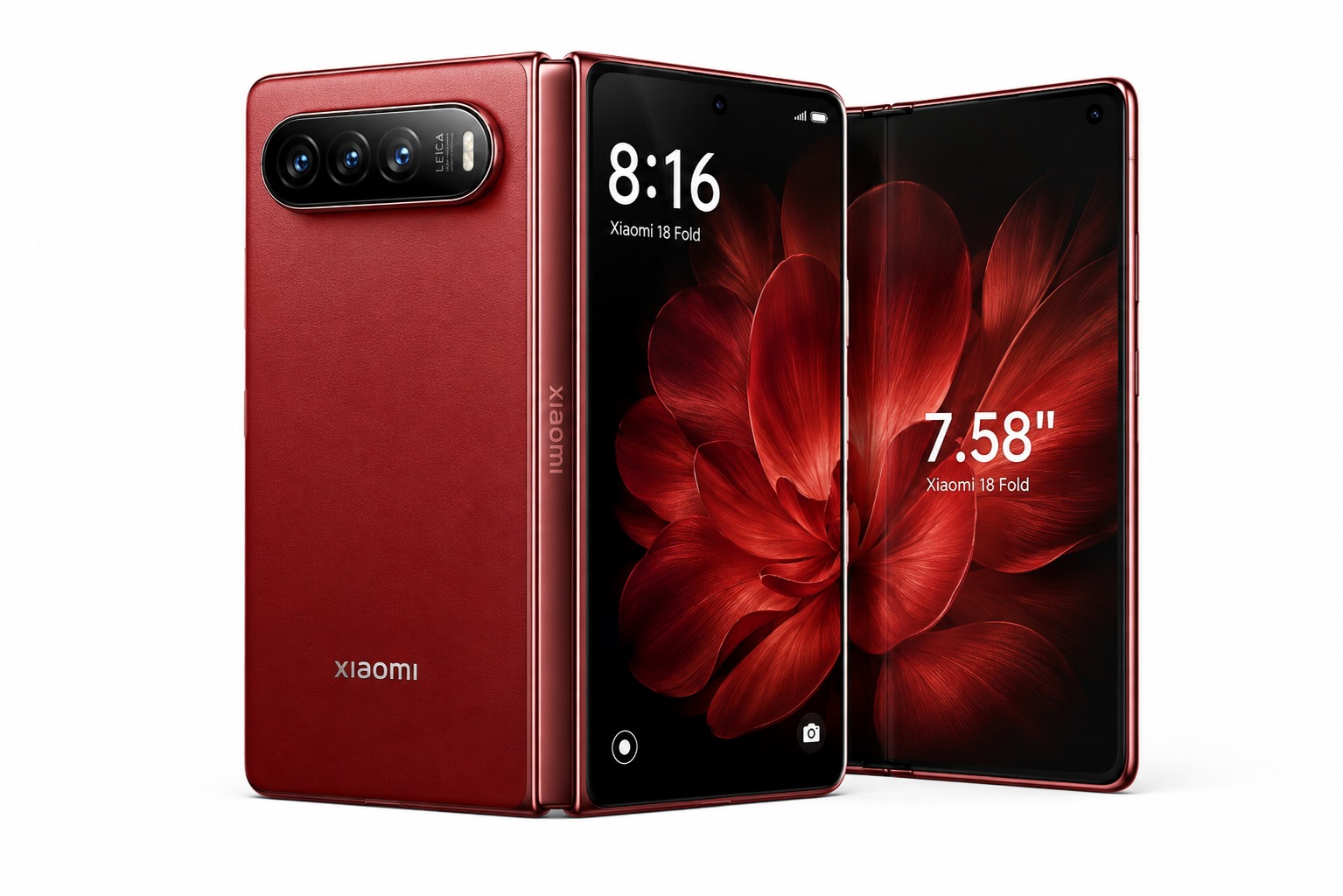
The headline design change is the shape. Most book-style foldables like the Samsung Galaxy Z Fold8 are tall candy bars when closed, opening into a tablet. Xiaomi went the opposite direction with a wider, shorter body — closer to a passport in hand, slim enough for easy one-handed use of the 5.38-inch cover display.
Open it up and you get a 7.58-inch inner panel oriented wider than tall, an aspect ratio built around split-screen multitasking rather than a long, narrow strip. Xiaomi pairs this with large rounded corners, thin bezels, and a horizontal pill-shaped camera module holding a triple Leica-tuned array plus the LED flash.
It ships in a single Nishino Red colorway, a deep crimson that stands out in a category dominated by blacks and grays. Xiaomi’s new “dragon-bone” hinge uses a multi-link mechanism meant to spread fold stress across the crease, and early reports point to an IP68 water-resistance rating (one source lists IPX8, so treat the exact grade as reported rather than final). Foldable durability claims deserve skepticism until teardowns land, but the structural package looks solid on paper. That drop of the “Mix Fold” name for the main numbered series is telling too — Xiaomi clearly wants foldables treated as a flagship mainstay, not an experimental side project.
Display
The inner display measures 7.58 inches — a flexible OLED panel with LTPO support for adaptive refresh, paired with a 5.38-inch cover OLED on the outside. Both handle HDR content, which matters for a device that’s half pocketable phone, half mini tablet.
I can’t confirm the peak brightness or exact refresh rates yet, since Xiaomi hasn’t published the full spec sheet at launch. What’s clear is the intended use: the wide inner screen is built for watching video with proper proportions and running two apps side by side without squinting. The passport form factor means the cover screen is smaller than what you get on big foldables, but that’s the trade-off for a phone that actually fits in a pocket comfortably. Whether the unfolded aspect ratio feels natural for reading and browsing is something you’ll want to check in person — it’s a genuinely different shape from the tall panels we’re used to.
Performance
This is the most interesting part of the 18 Fold. The XRing O3 is Xiaomi’s own 3nm processor — a 10-core chip with 2x C1-Ultra cores at 4.35 GHz, 4x C1-Premium cores at 3.68 GHz, and 4x C1-Pro efficiency cores at 3.15 GHz, paired with a 16-core G2-Ultra NX GPU.
It’s the same philosophy that worked for Apple and burned Samsung: control your own silicon to optimize software and hardware together. Early benchmark numbers aren’t public yet, but the core configuration looks competitive with the Snapdragon 8 Elite Gen 5. The real question is sustained performance — whether the XRing O3 can hold peak speeds through long gaming sessions without throttling. That’s a story only real-world testing can tell after launch.
Memory is where Xiaomi makes history. The 18 Fold is the first smartphone to ship with CXMT’s next-gen LPDDR6 RAM, hitting 12,800 Mbps bandwidth versus LPDDR5X’s 8,533 Mbps — roughly a 50-percent jump. That’s more bandwidth than any phone before it, at a moment when the global memory shortage is pushing up gadget prices. With up to 16GB on board, it’s designed for fast app switching and heavy on-device AI work through Xiaomi’s MiMo model. In day-to-day terms, the gains show up in heavy multitasking and local AI, not scrolling Instagram.
Camera
Xiaomi went all-in on Leica for the 18 Fold. The triple rear setup is reported to include a 200MP main sensor using Leica Summilux optics, a 50MP ultra-wide, and a 50MP periscope telephoto offering around 3.5x optical zoom.
That’s an unusually capable camera array for a wide foldable, which typically cuts telephoto to save internal space. Leica tuning earned Xiaomi consistent praise on the 14 Ultra and 15 Ultra for color accuracy and natural portraits — if the 18 Fold matches that standard, it could be the best camera on any foldable, period. But the full sensor breakdown wasn’t officially released at launch, so treat the exact telephoto and ultra-wide specs as reported rather than confirmed.
Battery & Charging
Inside sits a 6,000mAh cell, a solid bump over the 5,100mAh pack in last year’s Mix Fold 4, fitted without noticeably thickening the phone. Charging is rated at 67W wired and 50W wireless — respectable numbers, though reports at launch range 67-90W wired depending on the source.
I’d temper expectations on everyday endurance. That 6,000mAh has to power two displays plus a hungry LPDDR6 chip, and the larger inner panel draws more than a standard slab. The Z Fold8 Ultra packs 5,000mAh, so the 18 Fold has more raw capacity, but real-world battery life will be the make-or-break metric here alongside the usual silicon-carbon chemistry math.
Software
The 18 Fold runs Surge OS 4, Xiaomi’s new skin built on Android 17. That’s notable because it’s the first time Xiaomi is shipping its own operating layer tailored to its own silicon — the same Apple-style integration story as the chip. When your software talks to your own hardware, you can tune everything from thermal behavior to AI workloads in a way off-the-shelf parts never allow. Fixing the “great specs, janky software” reputation that’s dogged Xiaomi for years is exactly what this chip-and-OS pairing is meant to do.
Here’s the big caveat for Filipino buyers: this is a China-market launch, and the China HyperOS build does not include Google Play Services out of the box. That means GCash, Maya, and most local banking apps won’t run without workarounds. If you’re eyeing this phone, factor that in before you commit — it’s a bigger hurdle than the price tag for daily use here.
Pros and Cons
| Pros | Cons |
|---|---|
| Genuinely pocketable mid-fold design | China-only at launch, no PH availability |
| In-house XRing O3 chip, Apple-style integration | Sustained performance unproven without benchmarks |
| World’s first LPDDR6 phone — big bandwidth jump | Price expected above ¥12,000 (~$1,650), Xiaomi’s most expensive ever |
| Powerful Leica triple camera with 3.5x telephoto | No Google Play Services on the China build |
| 6,000mAh battery and reported IP68 rating | Real-world battery life unverified on a two-screen device |
| Compact cover display for one-handed use | Cover screen smaller than book-fold rivals like the Z Fold8 |
Should You Buy This?
Buy it if:
- You want a foldable that actually fits in a pocket and one hand
- You’re excited by first-gen LPDDR6 and Xiaomi’s own chips
- You want a Leica camera on a foldable
- You’re in China or willing to import and handle the GMS workaround
Skip it if:
- You need Google Play Services out of the box for banking or Play Store apps
- Your budget tops out well below $1,650
- You’d rather wait for verified reviews of battery life and performance over a launch-day spec sheet
Final Verdict
The Xiaomi 18 Fold is a statement, not a compromise. It’s Xiaomi telling the world it can design its own flagship chip, its own memory ecosystem, and its own foldable form factor — and charge flagship money for it. At an expected ¥12,000 (roughly $1,650), it undercuts Samsung’s Galaxy Z Fold8 and Honor’s Magic V6 while crossing Xiaomi’s own 10,000-yuan psychological barrier for the first time.
For comparison, the Galaxy Z Fold8 sells around the same ballpark with a 4,800mAh battery and a dual-camera setup, while the Z Fold8 Ultra pushes a 200MP main sensor and 5,000mAh for similar money. The 18 Fold fights back with more capacity, a full telephoto, and a dramatically more pocketable body. It’s also the priciest entry in a Xiaomi lineup that usually wins on value.
Who is it for? The early adopter who wants the newest silicon and isn’t fazed by a China-only launch, and the foldable fan tired of carrying a phone that feels like a fat slab. For most Filipinos, the missing Google services and the import friction make it a hard daily-driver recommendation — but as a statement of where Xiaomi is heading, the 18 Fold is impossible to ignore.
It’s Xiaomi’s boldest hardware yet, and the specs on paper are genuinely impressive. Just don’t buy one expecting it to work like any other phone you’ve owned. The XRing O3 and LPDDR6 are the future — but the 18 Fold is a China-first snapshot of that future, priced like the flagship it aspires to be. See where it lands among the best phones to buy in 2026.