
Li Auto’s Philippine operation just changed hands. On November 10, the Chinese premium EV maker signed Dangdang New Energy Auto Service as its new local distributor in Beijing, part of a five-market Asia-Pacific expansion covering Thailand, Hong Kong, Singapore, the Philippines, and Vietnam. The Philippines is the only one of the five where Li Auto is already on sale.

That last detail matters. This is not a market entry; it is a reset. Li Auto has been sold here since April 2025, when HomeAuto launched the L7 and L9 and opened a Bonifacio Global City showroom, followed by an Aseana City branch in April 2026. Now a new partner is taking over that existing operation, and the announcement does not mention HomeAuto at all.
Nestor Wu, vice president of Li Auto’s international business, called the five signings “an important milestone as Li Auto officially enters Asia-Pacific markets.” The company says it will adapt its products and services to local regulations and customer needs.
Who is Dangdang New Energy Auto Service?
Dangdang is not new to Philippine EV retail. It brought GAC’s Aion EVs here in September 2024 — including the GAC Aion V Premium we reviewed — before GAC took Aion in-house in October 2025. In China, Dangdang is an EV sales and service company backed by Hong Kong-listed dealer group China Harmony Auto; as far back as 2023, China Harmony said Dangdang was authorised by Li Auto, Nio, Xpeng, GAC Aion, and Voyah. The new showroom is reportedly along Chino Roces in Makati City.
The lineup: three range-extended SUVs and one electric flagship
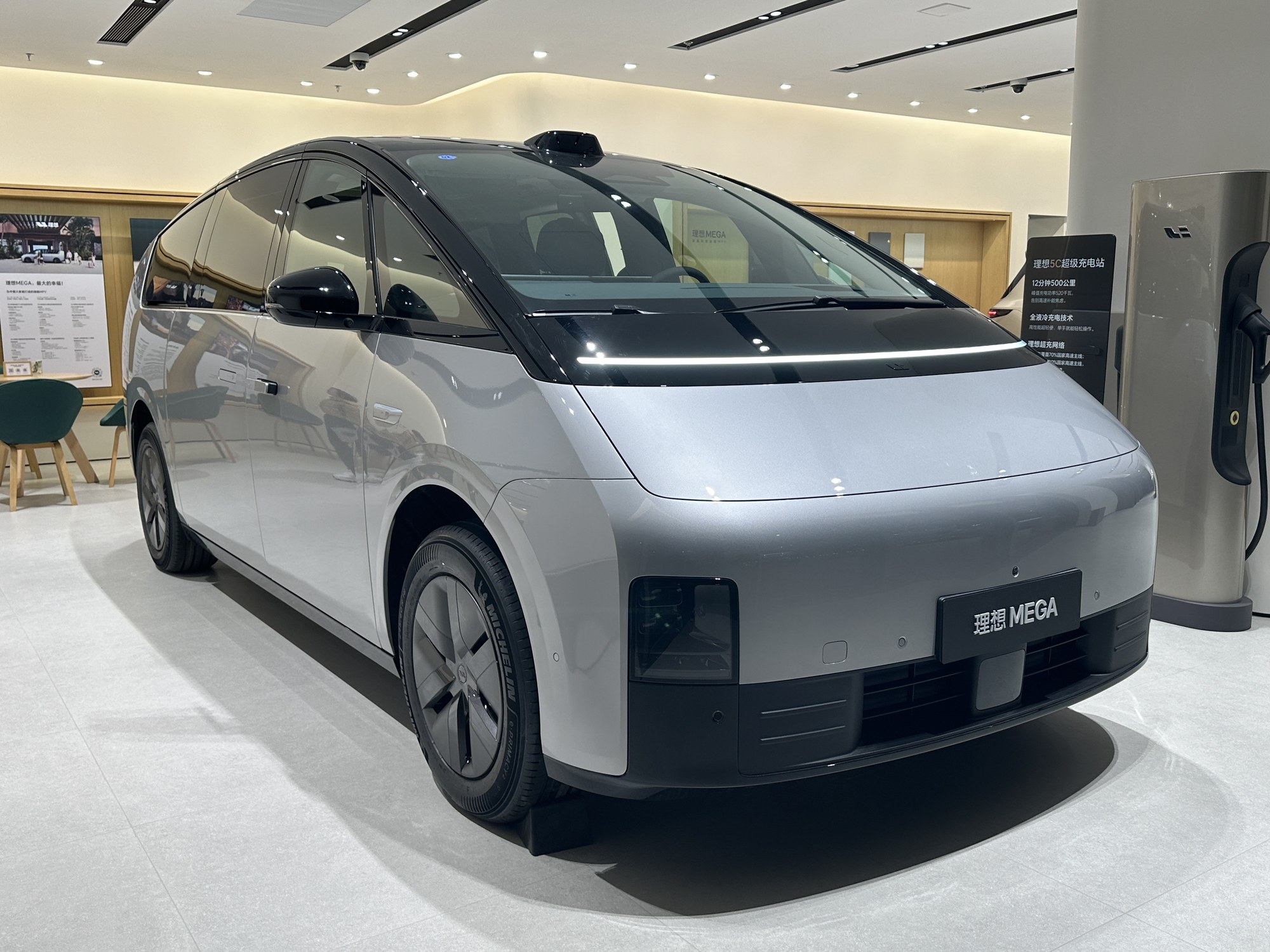
Li Auto’s Philippine range is built around a simple idea: drive on electricity every day, carry a petrol generator for the days you need it. The L6, L7, and L9 are range-extended electric vehicles (REEVs) — the engine never drives the wheels; it only generates electricity. The Mega is the brand’s sole battery-electric model.
The REEV platform pairs a 52.3 kWh ternary-lithium battery with a 1.5-litre turbocharged four-cylinder range extender making 113 kW. Combined output from the dual electric motors is 330 kW (449 PS) and 620 Nm, driving all four wheels. Li Auto quotes up to 1,421 km of combined range on the CLTC cycle and 286 km on electricity alone, with a 65-litre fuel tank. Base trims run a smaller 42.8 kWh pack with 225 km of electric range.
| Model | Type | Battery | EV Range (CLTC) | Combined Range | Power | 0–100 km/h | Price (PHP) |
|---|---|---|---|---|---|---|---|
| Li L6 Max | REEV SUV | 52.3 kWh platform | 286 km | 1,421 km | 330 kW (449 PS) | 5.3 s | P3,490,000 |
| Li L7 Pro | REEV SUV | 42.8 kWh | 225 km | ~1,315 km | 330 kW (449 PS) | 5.3 s | P3,890,000 |
| Li L7 Ultra | REEV SUV | 52.3 kWh | 286 km | 1,421 km | 330 kW (449 PS) | 5.3 s | P4,490,000 |
| Li L9 Pro | REEV SUV | 52.3 kWh | 286 km | 1,421 km | 330 kW (449 PS) | 5.3 s | P5,190,000 |
| Li L9 Ultra | REEV SUV | 52.3 kWh | 286 km | 1,421 km | 330 kW (449 PS) | 5.3 s | P5,490,000 |
| Li Mega Ultra | BEV MPV | 108 kWh | 710 km | 710 km | 400 kW (544 hp) | 5.5 s | P5,990,000 |
| Li Mega Home | BEV MPV | 108 kWh | 710 km | 710 km | 400 kW (544 hp) | 5.5 s | P6,490,000 |
The L9 is the largest SUV at 5,218 mm long on a 3,105 mm wheelbase with six seats; the L7 is 5,050 mm long with five. The Mega is the flagship: a 5,355 mm electric MPV with seven seats, a 108 kWh battery, and a claimed 710 km of CLTC range. All figures are manufacturer claims; real-world results will be lower. Battery sizes vary by trim — the L7 Pro uses a smaller 42.8 kWh pack — and the L6 received a 2026 update in China with a 51 kWh pack, though Philippine specifications have not been confirmed.
Three-currency pricing
At the rates I pulled on November 12, 2026 — 63.31 PHP/USD and 93.82 INR/USD — the range converts as follows:
| Model | PHP | USD | INR |
|---|---|---|---|
| Li L6 Max | P3,490,000 | ~$55,100 | ~Rs 51.7 lakh |
| Li L7 Pro | P3,890,000 | ~$61,400 | ~Rs 57.6 lakh |
| Li L7 Ultra | P4,490,000 | ~$70,900 | ~Rs 66.5 lakh |
| Li L9 Pro | P5,190,000 | ~$82,000 | ~Rs 76.9 lakh |
| Li L9 Ultra | P5,490,000 | ~$86,700 | ~Rs 81.4 lakh |
| Li Mega Ultra | P5,990,000 | ~$94,600 | ~Rs 88.8 lakh |
| Li Mega Home | P6,490,000 | ~$102,500 | ~Rs 96.2 lakh |
Those are the April 2026 launch figures. Li Auto has not announced any price change under the new distributor, so confirm with the showroom before budgeting.
Why a range extender makes sense in the Philippines
The Philippines had 1,941 registered commercial EV charging stations as of September 2026, and the Department of Energy says only 20 to 23 percent of its 7,000-station target for 2028 is in place. That is thin coverage for an archipelago, and it is the biggest reason range-extended vehicles make sense here.
With 286 km of electric range, a Li L7 or L9 covers a typical week of EDSA commuting on electricity alone — no charger at home or office, no planning around the nearest mall station. When the battery runs low, the range extender burns petrol and keeps going; you refuel at any gasoline station, like a Corolla.
This is the same logic that makes the self-charging hybrid Ford Territory Hybrid appealing to buyers without a home charger — except the Li runs 286 km on electricity before the engine starts, where a full hybrid manages a handful of kilometres. A pure BEV like the Nissan Primera EV is simpler still, but it needs a charger at the end of every long day. If your building and province have no charging, the range extender is the pragmatic choice.
City driving, long-distance travel, floods, and heat
City driving
Instant electric torque makes the L7 and L9 effortless in stop-and-go traffic, and the 286 km electric range means most city driving never touches the petrol tank. The trade-off is size: at over five metres long, the L9 is a handful in Makati side streets and tight BGC parking, which is why Li Auto fits a 360-degree camera and owners call it essential.
Long-distance travel
This is where the REEV layout shines. A 1,421 km combined range means Manila to Baguio and back, or Manila to Batangas and back, without a charging stop. You cover a long weekend on one tank and one charge; a 500 km BEV makes the same trip with a planned top-up.
Flooded situations
Li Auto has not published ground clearance for the Philippine-market vehicles. The Mega is a large MPV with a low-slung body, and the SUVs ride on air suspension that can raise the ride height. Treat wading depth as unknown and be conservative in flood water — the same advice I give for any EV. A range extender has no air intake to hydrolock, but the battery pack still sits low in the floor.
High temperature
The REEV battery is ternary lithium (NMC), less thermally stable than the lithium iron phosphate (LFP) packs used by BYD and several rivals. The pack is liquid-cooled, and the range extender can run the air conditioning without draining the traction battery. Even so, a 36 to 38 degree Philippine afternoon with the AC at full blast is the worst case for range and battery health. As I covered in my piece on batteries and thermal management, chemistry matters as much as capacity.
What others are saying
CarGuide Philippines drove the Mega in August 2025 and praised the second row as “sublime,” with abundant legroom and an Ottoman that lets a 5’7″ passenger recline fully while the third row still has space. It noted 544 hp and a 710 km range, and liked the air suspension; it criticized the “acquired taste” exterior and an awkward interior door handle.
Zigwheels Philippines called the L7 a “compelling balance between luxury, practicality, and innovation,” with an air suspension that absorbs bumps gracefully, but flagged tyre noise and the hybrid system’s complexity.
Chinese Cars Guide was more measured on the L9: the six-seat cabin and limousine-like second row are its strengths, but the size is “challenging in narrow city streets and tight parking garages,” and reliability data is limited for a brand this young.
What to watch next
Li Auto is preparing its first right-hand-drive model, the Mega, for a December 2 to 13 debut at the Thailand International Motor Expo, followed by a Hong Kong launch. More than one RHD model will follow within a year, and its chairman has said an RHD i6 SUV will complete the line-up. The Philippines already sells the Mega in left-hand drive, so a factory RHD version would remove the last practical objection to the flagship MPV. For existing HomeAuto customers, the priority is clarity on after-sales and servicing.
Whether you are shopping the L7 or eyeing the Mega, the calculation is straightforward: the car solves the charging problem, and the price buys space and range few battery-electric rivals can match. The premium EV market has been dominated by brands that ask you to wait for the charging network to catch up. Li Auto is betting you would rather carry your own generator — a bet that already worked for the VinFast VF 3 at the budget end of the market.