
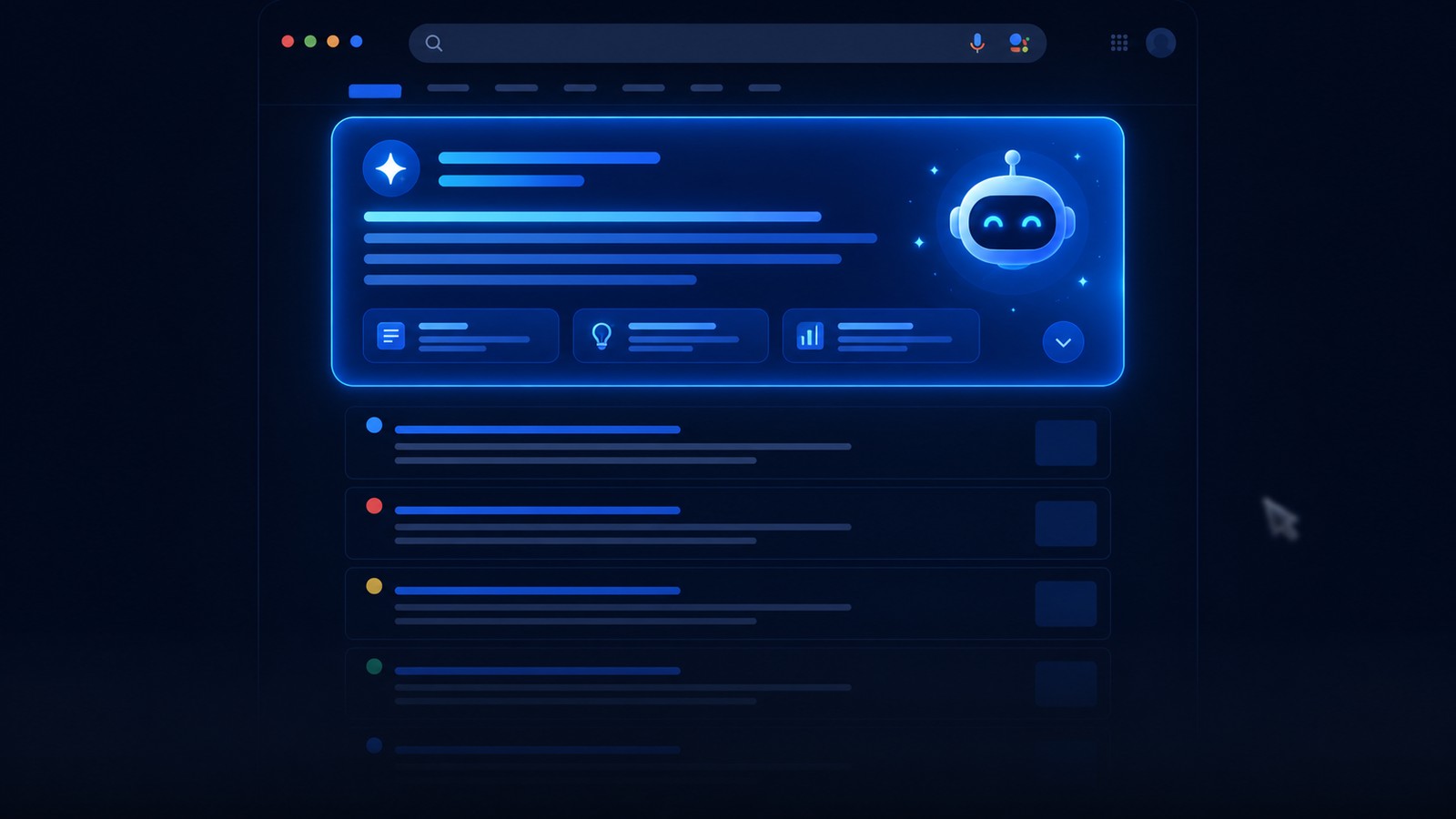
Here’s the thing that makes a food blogger and a car reviewer and a tutorial writer all share the same cold moment: the search page that used to feed our sites is now feeding itself. Over the last week Google has quietly started auto-expanding its AI Overviews for some queries. Instead of a teaser with a “Show more” button, you get the full AI answer at the top of the results, an “Ask anything” box underneath it, and only then, after a long scroll, the actual list of links.
If you publish anything on the open web, that’s not a cosmetic tweak. It’s Google deciding, query by query, that an answer it wrote is worth more than the pages it’s answering about. And for a blogger who lives on organic search, it’s a reminder that the real estate above the fold was never really ours.
What Google is actually doing
The Verge caught this rolling out around August 28, following a report from Search Engine Roundtable. For certain searches, Google now shows a full AI Overview by default — no user click, no collapsed preview. Underneath sits the persistent “Ask anything” prompt that pushes into a full AI Mode-style conversation. The ten blue links that used to define a search results page get shoved most of the way down the screen.
It’s inconsistent, which is almost worse for planning. The Verge’s Jay Peters noted the auto-expansion showed up on most of his test searches before he published, then got less consistent afterwards. His most reliable trigger was a query about the best game on a Nintendo Switch 2 — and even that didn’t behave the same across browsers.
Google is deliberately cagey about the trigger. A spokesperson told The Verge that “for some queries, AI Overviews may dynamically expand for topics where our systems determine it’s most useful for people.” Translation: Google decides, and it’s not telling you the formula.
Why this stings a lot more than it would have a year ago
I flagged the direction of all of this back in August when Google’s Preferred Sources button arrived and I argued it wouldn’t save publisher traffic. The button let people ask Google to lean on a chosen publisher, but it put the burden on the reader, not on the machine. The auto-expand change is the same philosophy, a step further: the answer is the product now, and the links are the afterthought.
Here’s the part that worries me most. Most of the queries that auto-expand are informational — the exact searches that used to be a tutorial blogger’s bread and butter. “What is the best X” is the shape of a question that used to route someone to a thoughtful review. Now it can be satisfied entirely by a summary Google wrote, with your careful comparison reduced to a citation nobody clicks.
The problem compounds itself
There’s a feedback loop building here that keeps me up more than the traffic numbers. Google is filling the top of its own results with synthesized answers at the same time the web is filling up with machine-written pages. Pew found that a third of new web pages now show signs of AI authorship. A search engine that trains its answers on a web it’s helping hollow out is basically chewing its own tail.
That’s why the open letter from more than 100 companies about the state of AI content resonated. The people building the web kept pointing out that the incentives are wrong: train on everything, summarize it yourself, and the original creators are the ones who starve. Every auto-expanded Overview is a small vote for that outcome.
There’s a copyright war underneath all of this
None of this happens in a vacuum. The same week, Sony Music and Warner Chappell filed suit against Anthropic over what they called pirated lyrics. You can disagree with the merits of any individual case, but together these fights are asking one question the search giants keep hoping will go away: if an AI answer replaces the thing a human made, who holds the right to that answer — and who gets paid?
Publishers and creators are realizing that optimization alone won’t fix a structural change. You can nail every SEO checkbox and still lose, because the seatbelt was never the problem — the highway changed.
What you can actually do about it
I don’t want to hand you a pep talk, so let’s keep this practical. Fighting an auto-expanding AI Overview is not a winning game. Working around it is.
- Stop writing for a search result, start writing for a person. The queries that auto-expand are the ones with a single syntactically neat answer. A post with a strong point of view, an original experience, or a real opinion is harder to summarize into irrelevance.
- Give readers a reason to come back on their own. A newsletter, a follow button, a series they’ll miss — anything that builds a direct relationship instead of routing through Google every time.
- Put first-hand detail on the page. Unique testing notes, prices I actually paid, screenshots of a real run — the kind of thing Google can’t comfortably synthesize without citing you. That’s your best shot at being the source inside the answer rather than the link under it.
- Diversify where the traffic comes from. I know it’s a lot of setup, but search portability is a real asset when one platform keeps moving the floor.
The bigger picture
Zoom out and this is part of a wider argument about who keeps the value of human work as machines get capable. Bill Gates floated a robot tax and a category of “human reserved” jobs, and a lot of people laughed, but the instinct behind it is sound: at some point you have to decide that certain things are worth doing by humans on purpose, even if a machine could do them cheaper. A search engine auto-writing the answer to every question is that same decision, being made quietly, in your favor or against it.
I don’t think Google is evil for doing this. I think it’s a company following what its research says users want: an answer, fast, with less scrolling. The problem is that the thing users skim past is where the people who actually make the web live.
So here’s where I land. I keep writing. I keep testing things with my own hands and telling you what I found. I keep building an audience that comes here because they trust the voice, not because a ranking algorithm said so. Google can bury a link, but it can’t bury a habit — and a reader who comes back on purpose is worth more than any ten blue links it decides to hide.