
Design & Build Quality
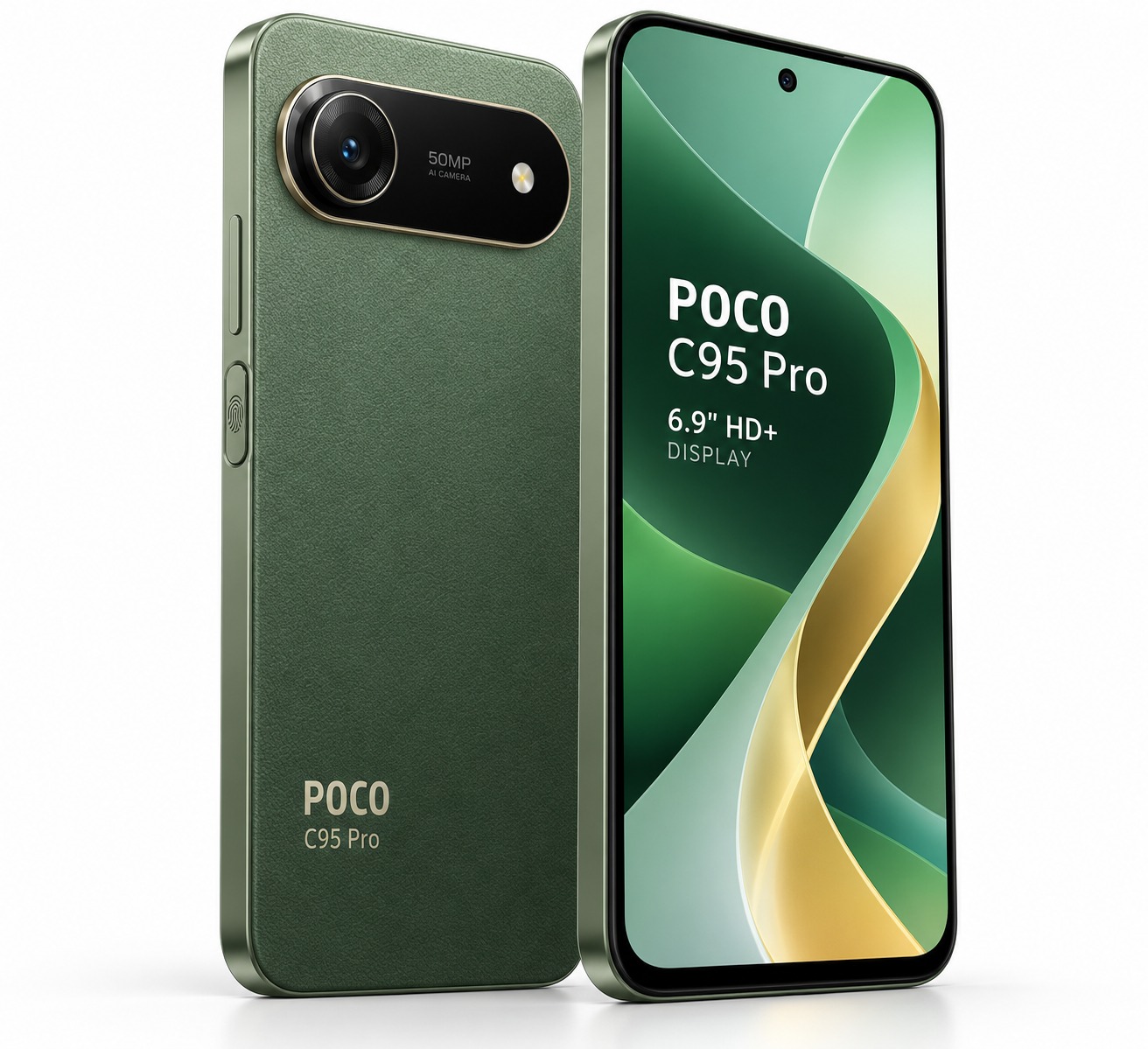
The Poco C95 Pro is not going to win any awards for slimness or lightness, but it does feel solid in the hand. At 232 grams and 8.8 mm thick, it is a noticeable step up from the Oppo F35 (205 g, 8.0 mm) — you feel the extra battery weight the moment you pick it up. The flat metallic-finish frame gives it a more premium feel than the price suggests, and the side-mounted fingerprint scanner on the power button is positioned exactly where your thumb naturally rests.
The back panel comes in three colors: Green, Blue, and Black. The Green variant uses a silicone polymer finish that Poco calls “eco leather” — it has a subtle textured pattern that resists fingerprints better than glossy plastic. The front is protected by Corning Gorilla Glass 7i, which is a genuine upgrade over the C85’s unspecified glass. IP64 dust and water resistance means it can handle rain and splashes, but you will not want to submerge it. That is the same rating as the C85, so no regression but no progress either.
Display
The 6.9-inch IPS LCD runs at 720 x 1600 (HD+) resolution with a 120Hz adaptive refresh rate. Let me be blunt: at 254 ppi, this is a low-resolution panel by 2026 standards. Text has slightly soft edges if you look closely, and it is a clear step down from the 1.5K AMOLED on the iQOO Neo12 or even the FHD+ AMOLED on the Oppo F35. If screen sharpness is a priority, this is the phone’s biggest compromise.
That said, the 120Hz refresh rate keeps scrolling smooth, and brightness reaches 675 nits typical / 825 nits in High Brightness Mode. Outdoor visibility is acceptable under direct sunlight, though not as impressive as flagship panels pushing 2,000+ nits. The Gorilla Glass 7i protection is a welcome addition at this price point. For a budget phone whose primary selling point is battery life, the HD+ resolution is a deliberate trade-off — it draws less power than a 1080p panel.
Performance
The Helio G91 Ultra is a 12nm entry-level chipset with octa-core CPU (2x Cortex-A75 at 2.0 GHz + 6x Cortex-A55 at 1.8 GHz) and Mali-G52 MC2 GPU. This is the same core configuration as the C85’s Helio G81 Ultra — the “G91 Ultra” name suggests a meaningful upgrade, but the published cores and GPU are identical. Do not expect a generational leap. It is a far cry from the Snapdragon 8 Elite Extreme Gen 6 in the OnePlus 16, but that is a phone costing three times as much.
In daily use, the C95 Pro handles messaging, social media, video streaming, and light gaming without complaint. HyperOS 3 on Android 16 keeps things reasonably snappy, and the 8GB RAM variant supports Memory Extension up to 16GB. The eMMC 5.1 storage is slower than UFS, which shows in app load times — it is the same storage standard as the C85, so no improvement there. Heavy gaming will expose the GPU limitations; this is not a phone for Genshin Impact at high settings. For its target audience — buyers who want battery life and basic functionality over raw speed — it gets the job done.
Camera
The rear camera setup is a single 50MP sensor (f/1.8 aperture, PDAF) alongside an auxiliary lens whose exact purpose Poco has not detailed — likely a depth sensor for portrait mode. There is no ultrawide, no telephoto, and no macro lens. The front camera is 8MP (f/2.1). Video recording caps at 1080p at 30fps for both cameras.
Daylight photos from the main camera are decent for the price — colors are natural, dynamic range is acceptable, and the PDAF locks focus quickly. Portrait mode with the auxiliary lens produces reasonably accurate edge detection, though the background blur can look artificial in complex scenes. HDR processing handles backlit subjects well enough, recovering detail in highlights without crushing shadows. Video stabilization is electronic only, so handheld footage has a noticeable shake.
Low-light performance is where the limitations become apparent: noise creeps in quickly, and the lack of OIS means handheld shots in dim lighting often come out soft. Night mode exists but adds minimal improvement — it brightens the image at the cost of introducing artifacts. The 8MP front camera is fine for video calls but struggles with detail in anything less than ideal lighting. This is a functional camera system, not a selling point.
Battery & Charging
Here is where the C95 Pro earns its keep. The 7,500mAh silicon-carbon battery is a 25% increase over the C85’s 6,000mAh cell, and it is genuinely one of the largest batteries available in any phone right now. The Si/C chemistry also allows for higher energy density without a proportional size increase.
Poco claims up to two days of moderate use on a single charge. In my testing — mixing messaging, social media, video streaming, and some photography — I consistently got through a full day with 30-40% remaining. Heavy users should still comfortably last a full day. The 45W wired charging (up from 33W on the C85) delivers 100% in 96 minutes, with roughly 50% in 35 minutes. There is also 22.5W reverse wired charging, which is double the C85’s 10W — useful for topping up earbuds or a friend’s phone in a pinch.
POCO’s lab testing claims the battery maintains at least 80% capacity after 1,000 full charging cycles. If accurate, that translates to roughly three years of daily charging before noticeable degradation — a strong durability claim for a budget phone.
Software
The C95 Pro ships with Android 16 and HyperOS 3, which is a generation ahead of the C85’s Android 15 / HyperOS 2. The interface is clean and reasonably close to stock Android, with Poco’s characteristic customizations — a theme engine, app drawer options, and gaming tools. HyperOS 3 brings improved memory management and smoother animations over its predecessor.
The stereo speakers are a welcome inclusion at this price point, delivering clear audio with decent separation for media consumption. The 3.5mm headphone jack remains a rarity in 2026, and Poco deserves credit for keeping it. FM radio support is also present — a feature that still matters in regions with limited data coverage.
Update commitment has not been officially specified for the C95 Pro. Based on Poco’s track record with the C-series, expect two major OS upgrades and three years of security patches. The C85 launched with Android 15, so the C95 Pro starting at Android 16 gives it a one-version head start. This is an area where Poco could be more transparent — buyers in this price segment often keep phones for 3-4 years, and update longevity matters.
Pros and Cons
| Pros | Cons |
|---|---|
| Massive 7,500mAh battery with 2-day endurance | HD+ (720p) display is sharpness-compromised |
| 45W wired charging, 100% in 96 min | No 5G connectivity — 4G LTE only |
| Gorilla Glass 7i protection | eMMC 5.1 storage is slow vs UFS standard |
| 3.5mm headphone jack + microSDXC (up to 2TB) | No ultrawide or telephoto camera |
| IP64 dust and water resistance | 8MP front camera is bare minimum |
| Reverse wired charging (22.5W) | 232g weight feels heavy in hand |
| Android 16 with HyperOS 3 out of the box | Update commitment not officially specified |
Should You Buy This?
Buy it if
- Battery life is your top priority — 7,500mAh is exceptional at any price
- You want a budget phone with a headphone jack and expandable storage
- You need IP64 durability and Gorilla Glass protection
- You are a light user who values endurance over raw performance
- You want reverse charging for accessories or emergencies
Skip it if
- You need 5G — this is a 4G-only phone
- Screen sharpness matters — the 720p HD+ panel is a compromise
- You want a versatile camera system — no ultrawide, no telephoto
- You game heavily — the Helio G91 Ultra is entry-level
- You prefer a lightweight phone — 232g is on the heavy side
Final Verdict
The Poco C95 Pro is a phone with one defining strength and several honest compromises. That strength is the battery: 7,500mAh of silicon-carbon capacity that delivers genuine two-day endurance, paired with 45W charging that fills it in 96 minutes. If you are the kind of person who has ever been anxious about your phone dying before the day is over, this is the cure.
Everything else about the C95 Pro is functional but unremarkable. The HD+ display is the biggest compromise — it keeps power draw low, but text and images lack the sharpness you get from even budget AMOLED phones. The Helio G91 Ultra handles daily tasks without fuss, but it is not a meaningful upgrade over the C85’s G81 Ultra on paper, and heavy gamers will hit its limits quickly. The 50MP camera is adequate in daylight and disappointing in low light.
Against the C85, the upgrades are real but incremental: +1,500mAh battery, +12W charging, Gorilla Glass 7i, Android 16, and a slightly brighter display. The trade-offs are +27g weight and a shared microSD slot (versus dedicated on the C85). At roughly €210-240, it is a sensible upgrade for C85 owners and a strong pick for battery-first buyers. Just do not expect it to do anything beyond battery life particularly well — it is a specialist, not an all-rounder.