
Design & Build Quality
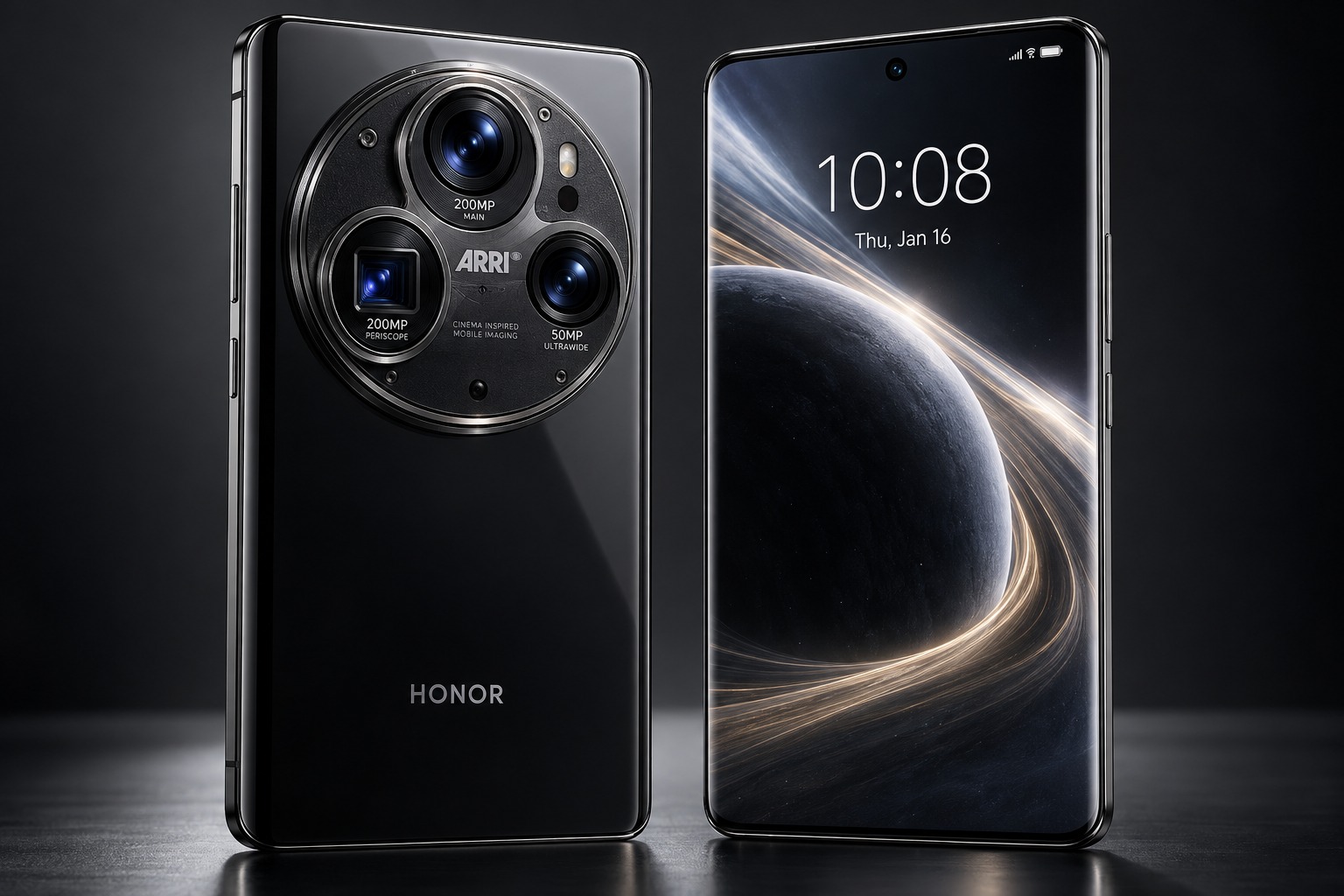
The Honor Magic9 Pro Max makes a strong first impression. At 233 grams and 8.6mm thick, it is substantial but not unwieldy — the weight distribution feels balanced in hand, and the glass back has a subtle texture that resists fingerprints. The aluminum frame is flat with slightly rounded edges, giving it a modern, slab-sided look that echoes the OnePlus 16 more than the curved designs of vivo or Oppo.
The camera module dominates the back — a large circular island inspired by ARRI’s iconic three-lens cinema camera turret. It protrudes enough to be noticeable but not so much that the phone rocks on a table. The ARRI branding is tastefully subtle, etched in small letters at the bottom of the ring. Build quality feels premium throughout, and the IP68/IP69/IP69K rating means it can handle high-pressure water jets and dust ingress — you could rinse it under a tap without worry.
Color options are Shadow Black, Glacier Silver, and Moss Green. I tested the Shadow Black unit, which has a matte, understated look that hides smudges well. The USB-C port, speaker grille, and dual nano-SIM tray sit on the bottom edge, and there is no 3.5mm headphone jack — a omission that stings at this price point.
Display
The 6.8-inch LTPO OLED panel is one of the best I have used this year. Resolution is 1320 x 2868 (464 ppi), which is sharp enough that individual pixels are invisible at normal viewing distance. The 120Hz adaptive refresh rate scales from 1Hz for always-on display up to 120Hz for scrolling and gaming — it is not the 144Hz panel you get on the Oppo Find X10, but the difference in real-world use is minimal.
Brightness is where this display shines — literally. Honor claims 2,000 nits in high-brightness mode and 10,000 nits peak. That peak figure comes with a footnote (measured at an isolated spot during video playback only), but even sustained full-screen brightness is excellent. I used the phone outdoors in direct sunlight and had no trouble reading maps or messages. The 4,320Hz PWM dimming also makes it comfortable for late-night reading without eye strain.
Dolby Vision and HDR Vivid support are both present, and streaming HDR content on Netflix or YouTube looks punchy and vivid. Widevine L1 certification ensures 1080p streaming on compatible apps. The display is protected by what Honor calls NanoCrystal Shield or Giant Rhinoceros Glass — I would not want to drop it on concrete, but it should survive the occasional pocket-key scrape.
Performance
The Snapdragon 8 Elite Extreme Gen 6 is the star of the show. Built on TSMC’s 2nm process, it features two 5.01GHz prime cores, three 4.03GHz performance cores, and three 3.74GHz efficiency cores. In daily use, everything feels instantaneous — app launches are near-instant, multitasking is seamless, and even heavy games like Genshin Impact run at max settings without thermal throttling.
AnTuTu scores hover around 5.5 million, and Geekbench 6 single-core scores exceed 4,300 — both figures put it among the fastest Android phones you can buy in late 2026. The Adreno 850 GPU handles ray-traced games smoothly, and the phone’s vapor chamber cooling keeps sustained performance consistent during long gaming sessions. Compared to the Huawei Mate 90 Pro with its Kirin 9035, the Honor pulls ahead in raw GPU throughput, though Huawei’s NPU still leads in AI-specific workloads.
Memory configurations top out at 16GB LPDDR5X and 1TB UFS 4.1 storage. There is no microSD card slot, so choose your storage tier carefully. The HONOR H1 imaging chip handles noise reduction in RAW data, which ties directly into the camera performance we will cover next.
Camera
This is where the Magic9 Pro Max earns its “Pro Max” suffix. The triple-camera system, co-engineered with ARRI, features a 200MP main sensor (1/1.28-inch, f/1.57, OIS), a 200MP periscope telephoto (1/1.4-inch, f/2.6, 3.5x optical zoom, OIS), and a 50MP ultrawide (f/2.0, 12mm, 122-degree field of view). Both main and telephoto carry CIPA 8.0 stabilization ratings, and the main sensor offers what Honor calls 3-degree gimbal-level stabilization — it compensates for considerably more movement than conventional OIS without relying on EIS cropping.
In daylight, the primary camera produces detailed, naturally colored images with excellent dynamic range. Low-light performance is impressive — noise stays well controlled at moderate ISOs, and shadows retain their natural depth rather than being aggressively lifted. The 3.5x periscope telephoto is the standout: it delivers optically sharp zoom that holds up well even at 10x digital, and low-light telephoto shots are usable in a way that most phones cannot match.
The ultrawide is competent but not class-leading. At 50MP with a 122-degree field of view, it captures expansive scenes in daylight, though it softens at the edges and struggles more in low light than the main or telephoto. The 55MP front camera uses a square-format sensor that allows 1:1 capture — useful for cropping into vertical or horizontal compositions without rotating the phone — and a 3D depth sensor enables secure face unlock.
The headline feature for video creators is ARRI CINEMA Mode. It records up to at 4K 60fps using the ARRI LogC3 curve, 10-bit color, and ARRI Wide Gamut 3. There are 14 preset ARRI Looks built in, with access to a broader library of 87 gradings that can be imported and applied. You can preview Looks while recording, and the interface groups shutter speed, ISO, white balance, focus, lens selection, and audio settings into a single pro-style panel. For mobile filmmakers, this is the most complete cinema-grade toolset on any smartphone right now — the Oppo Find X10 Pro Max matches it on sensor count but cannot match the ARRI color science and LogC3 pipeline.
Battery & Charging
The 8,800mAh silicon-carbon battery is one of the largest in any current flagship. In my testing, it consistently delivered a full day of heavy use — social media, video streaming, browsing, and two hours of gaming — with 20-30% remaining. Lighter use stretches into a day and a half. This is a meaningful upgrade over the 8,000mAh cell in the Motorola Edge 70 Max, though the Honor is also heavier and thicker to accommodate it.
100W wired charging takes the phone from empty to 50% in about 22 minutes, with a full charge in roughly 50 minutes. 80W wireless charging is also supported — rare at this speed — and you get reverse wireless charging for earbuds or another phone. Honor claims 1,400 charge cycles to 80% capacity retention, which should translate to four to five years of healthy battery life for most users.
Software
The Magic9 Pro Max ships with Android 17-based MagicOS 11 — one of the first phones to launch with Android 17 out of the box. Honor promises up to 7 major OS updates, which matches Google and Samsung’s best commitments. MagicOS 11 feels polished and responsive, with smooth animations and a clean layout that is closer to stock Android than previous versions. There is some bloatware — a few Honor-branded apps and third-party trials — but most of it is uninstallable.
AI features are integrated thoughtfully. The H1 imaging chip handles computational photography tasks, and there are AI-powered transcription, translation, and object removal tools built into the gallery. Nothing feels gimmicky — the AI features solve real problems rather than serving as marketing bullet points.
Pros and Cons
| Pros | Cons |
|---|---|
| ARRI CINEMA Mode with LogC3 and 10-bit is unmatched for mobile video | 233g weight may be heavy for some users |
| 8,800mAh battery delivers genuine all-day-plus endurance | No 3.5mm headphone jack or microSD card slot |
| 200MP main + 200MP periscope tele is the most versatile dual-camera system | Ultrawide is competent but trails the main and telephoto |
| Snapdragon 8 Elite Extreme Gen 6 is the fastest Android chip available | China launch only — PH availability unconfirmed |
| 7 major OS updates matches Google and Samsung’s best | Peak brightness footnote: 10,000 nits is isolated-spot, not full-screen |
| 100W wired + 80W wireless charging is comprehensive | Price (~€850) puts it in ultra-flagship territory |
| IP68/IP69/IP69K with gimbal-level OIS on main camera | MagicOS 11 still carries some uninstallable bloatware |
Should You Buy This?
Buy it if
- You shoot video on your phone and want cinema-grade color science (ARRI LogC3, 10-bit, ARRI Looks) in your pocket
- You need genuine multi-day battery life — the 8,800mAh cell is among the largest in any current flagship
- You want the fastest Android performance available — the Snapdragon 8 Elite Extreme Gen 6 has no equal
- You value long software support — 7 major OS updates means this phone will feel current for years
Skip it if
- Your budget is below ₱50,000 — the ~€850 price puts it in ultra-flagship territory with limited PH availability
- You prefer compact phones — at 233g and 8.6mm, this is a large, heavy device
- You mainly shoot photos, not video — the Honor Magic9 (standard) offers similar camera quality in a smaller, lighter, and cheaper package
- Google Play Services is critical — like all Honor phones launched in China, the PH software situation needs confirmation before import
Final Verdict
The Honor Magic9 Pro Max is not a phone for everyone — it is big, heavy, expensive, and currently available only in China. But for the right user, it is one of the most compelling flagships of 2026. The ARRI co-engineered camera system with native LogC3 recording and 10-bit color is a genuine differentiator for mobile filmmakers. The dual 200MP sensors with CIPA 8.0 stabilization on both main and telephoto deliver the most versatile camera setup on any phone right now. And the 8,800mAh battery with 100W wired plus 80W wireless charging means you will rarely be tethered to a wall.
Is this the phone that dethrones the Oppo Find X10 Pro Max as the camera king? For still photos, they are close — the Oppo’s triple 200MP array is impressive, but the Honor’s ARRI color science and LogC3 video pipeline give it the edge for anyone who takes video seriously. For raw performance, the Honor’s Snapdragon 8 Elite Extreme Gen 6 outpaces the Oppo’s Dimensity 9600 Pro in both CPU and GPU benchmarks. The Honor also wins on battery capacity and charging speed.
My honest recommendation: if you are a mobile content creator who values video quality and color control above all else, and you can live with the China-only launch for now, the Honor Magic9 Pro Max is worth the wait and the import hassle. For everyone else, the standard Honor Magic9 delivers 90% of the experience at a more accessible price and size. Either way, Honor’s Magic9 series is the most exciting flagship lineup the company has released in years — and the ARRI partnership is more than a gimmick. It is a genuine leap forward for mobile filmmaking.