
Huawei’s nova line has never been shy about cramming big batteries into slim bodies, and the new global nova 16s keeps that tradition alive. It lands alongside the pricier nova 16s Pro, but this vanilla model cuts the 200MP main down to a dual-50MP setup, swaps in a smaller 6.68-inch display, and shaves off a chunk of the asking price. What you’re left with is a 7,000mAh phone charging at 100W with a proper periscope zoom, wrapped in a 7.3mm body.
Design & Build Quality
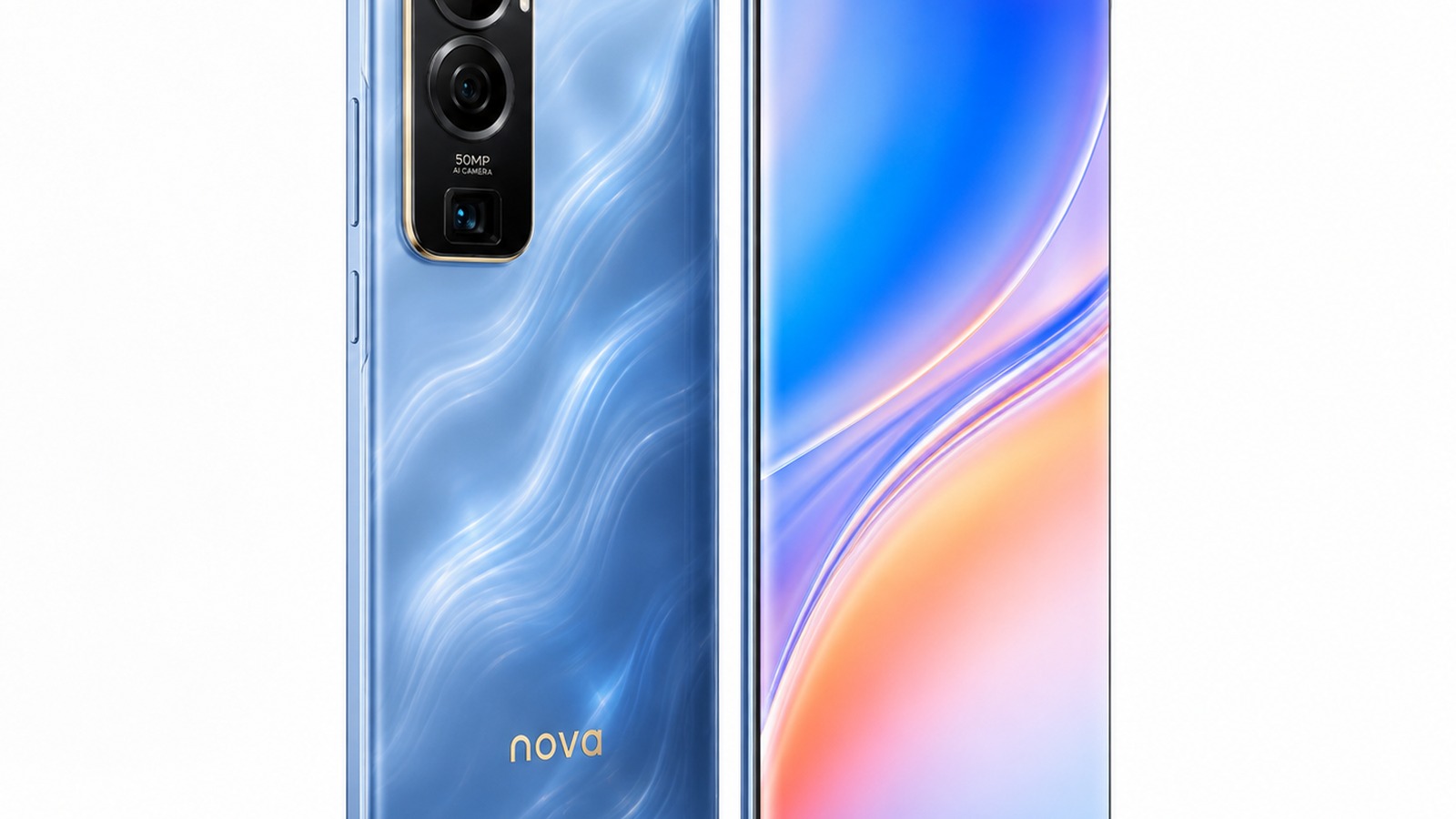
Hold the nova 16s and the first thing you notice is how thin it is. At 7.3mm and 199g, it’s noticeably slimmer than the Pro sibling and most phones in this class. The back carries that signature nova wave-like texture — Isle Blue and Breathing Crystal are the two that catch light nicely, while Sky White and Starry Black keep things understated.
The rear camera housing is a neat vertical pill in the corner that holds the main wide, the periscope telephoto, and a small multi-spectral sensor — a tidy arrangement that keeps the back looking clean instead of cluttered.
There’s no IP rating confirmed globally and no 3.5mm jack, so keep that in mind if you’re attached to wired audio. Bluetooth 6.0 covers your wireless earbuds, and the USB-C port here is a 2.0 spec — fine for charging and data, just not the fastest file transfer around.
Huawei says the back uses a wave-inspired textured finish that feels premium and hides fingerprints well, which is a small but real quality-of-life win. The phone isn’t a glass sandwich like some flagships, but for the price the materials feel a notch above typical budget polycarbonate. It’s comfortable to grip one-handed, and the 199g weight is easy to live with all day.
Around the edges sit the volume rocker, a power button, and an infrared blaster tucked in for controlling TVs and air conditioners — a feature that’s quietly handy in a place like the Philippines where IR remotes are everywhere. There’s also a fingerprint sensor; Huawei has it under the display here, and it reads quickly enough that you won’t think twice about it.
Display
Up front is a 6.68-inch OLED with a 2,800 × 1,280 resolution, a 120Hz refresh rate, and 2,160Hz high-frequency PWM dimming for people sensitive to screen flicker. Huawei lists a peak brightness of up to 5,500 nits — that’s local peak on a small patch of the panel, not a sustained full-screen figure, so real-world outdoor use will look great but won’t hit that theoretical number constantly.
Still, in practice the panel is vivid. Colour is rated for P3 wide gamut and 1.07 billion shades, and the 300Hz touch sampling keeps scrolling feeling snappy. The centered punch-hole holds the 50MP selfie camera and the module is small enough not to get in the way of video. The 120Hz refresh rate runs across the whole UI, which is what makes scrolling, app transitions, and even typing feel fluid rather than stuttery.
Performance
Inside sits the Kirin 8020 octa-core — a mid-range piece of silicon, not a flagship. The Pura 90s Pro Max runs on a similar-tier chip, so we know the pattern: everyday tasks, multitasking, and light games are smooth, but sustained heavy 3D will throttle it. This is a trade-off you accept to hit a lower price.
Memory comes in 12GB RAM with 256GB or 512GB of storage, matching the 2026 mid-range norm. There’s no microSD slot, so pick your storage level carefully. The 512GB tier is the safer buy if you shoot a lot of 4K video or store your media locally, because you can’t expand it later.
Day-to-day, the Kirin 8020 handles messaging, browsing, streaming, and split-screen multitasking without strain. Its energy efficiency is reasonable too — the pairing with that giant battery means you rarely chase a charger. Just don’t expect it to match a Snapdragon 8 Elite in a Genshin session at max settings; for sustained heavy 3D, fans of serious mobile gaming should look at the iQOO Z11 instead, which pairs a Dimensity 7500 Turbo with a 7,050mAh cell.
Thermal management is adequate for normal use; a long camera session in bright sun will warm it up but not to the point of throttling your shots. For the average person who checks social media, grabs photos, and streams video, this silicon is more than enough, and the 12GB of RAM keeps a dozen apps sitting in the background without reloading.
Camera
The camera is where the nova 16s makes its case. You get a 50MP Ultra Vision main (f/1.9) plus a 50MP RYYB periscope telephoto (f/2.6, OIS) with 3.3x optical zoom and up to 100x digital. There’s also a True-to-Colour multi-spectral sensor riding along to improve colour accuracy scene by scene.
Notice what’s missing: there’s no dedicated ultrawide lens on the base model, which is an odd omission. The Pro has one; this one relies on the main sensor’s field of view for wide shots. The periscope is the star — 3.3x optical is genuinely useful for travel and events, and the OIS steadies it well in decent light. You’ll reach for that zoom far more often than the 100x digital setting, which gets mushy past the 10x mark.
Because there’s no ultrawide, the main camera does double duty for wider shots — you get a slightly narrower field than you would from a dedicated 0.5x lens, and it requires stepping back. It’s a real compromise in a camera-first line, and one buyers should weigh against the saving versus the Pro.
Video tops out at 4K on both the rear and the 50MP front camera. The selfie camera benefits from a big 1/2.5-inch sensor with 0.7µm pixels, so low-light selfies come out brighter and less noisy than the usual mid-range fare. Portrait mode on the front uses the wide lens for a natural perspective rather than a fish-eye look.
AI tools like AI Composition, AI Move, AI Best Expression, and AI De-Glare are bundled. Some help — AI De-Glare is genuinely nice for shooting through shop windows or glass frames — while others lean gimmicky. The True-to-Colour multi-spectral sensor is the more interesting piece; it nudges white balance toward what your eye actually saw, which shows up in cleaner skin tones and less of that oversaturated phone-camera look.
Battery & Charging
Here’s the headline: a 7,000mAh cell (6,800mAh rated) with 100W Huawei SuperCharge Turbo over USB-C. That’s the same battery capacity as the Pro in a thinner phone, and it’s a monster. In real-world use you’ll comfortably clear a day and a half; heavy users make it through a full day with room to spare.
Charging at 100W means a near-empty battery goes to a healthy majority in about twenty-five minutes. That’s the kind of figure you stop noticing after a week — you just plug in for the time it takes to make coffee and the phone is back in business. There’s no wireless charging to speak of, which is a small letdown at this level, but the wired speed more than compensates for most people.
Software
This is the part that matters most for Philippine buyers. The nova 16s runs EMUI 16.0 on top of Android, and it does not ship with Google Play Services. Out of the box you get Huawei’s AppGallery and HMS ecosystem. That means GCash, Maya, and many local banking apps will not run immediately — the same limitation I flagged on the nova 16 SE and the nova 16s Pro.
You can side-load workarounds like GBox to get some Google-dependent apps running, but it’s an extra step and not every app cooperates. If your life runs on Google services or local e-wallets, factor this in carefully. Huawei hasn’t confirmed an official OS-update commitment for the global nova 16s yet, so treat the support window as an open question.
Pros and Cons
| Pros | Cons |
|---|---|
| 7,000mAh battery with class-leading endurance | No Google Play Services out of the box |
| 100W wired charging, fast top-ups | No dedicated ultrawide camera |
| 50MP periscope with 3.3x optical zoom and OIS | Mid-range Kirin 8020 throttles on heavy gaming |
| Thin 7.3mm, light 199g build | No wireless charging, no microSD |
| Bright 6.68" 120Hz OLED with PWM dimming | No 3.5mm jack |
| Large 50MP selfie camera | OS update commitment unconfirmed |
Should You Buy This?
Buy it if
- You want all-day-plus battery life from a phone that doesn’t feel like a brick.
- A periscope zoom camera at a mid-range price matters more to you than an ultrawide.
- You’re comfortable living inside Huawei’s app ecosystem without Google services.
- Fast 100W charging is a priority.
Skip it if
- You depend on GCash, Maya, banking apps, or Google Play daily — they won’t run out of the box.
- An ultrawide lens is essential for your photography.
- You want flagship-class gaming performance.
- A confirmed, multi-year update commitment matters to you.
Final Verdict
The nova 16s is a cleverly positioned value pick in Huawei’s newest global line. It takes the Pro’s enormous battery and fast charging, keeps a genuinely useful 50MP periscope zoom, and drops the price by pairing it with a smaller display and a mid-range chipset. For a huge segment of buyers, that trade honestly works.
The catch is a familiar one for recent Huawei phones: no Google services out of the box. That’s the single biggest hurdle for Philippine users specifically, bigger than the missing ultrawide or the mid-range silicon. If you’ve already adapted to the HMS ecosystem, this is an excellent battery-first phone for the money.
For everyone else, compare it honestly against Google-friendly rivals like the iQOO Z11 before committing. The hardware is genuinely strong — just make sure the software reality won’t trip you up later.