
iPhone Duo Review: Apple’s First Proper Foldable Finally Makes Sense
For years, foldables have been the smartphone category’s “wait, why?” experiment. They were heavy, expensive, and fragile-looking, and every manufacturer’s version felt like a feature in search of a product. Then Apple built the iPhone Duo, and for the first time the foldable stopped feeling like a compromise and started feeling like a choice. I’ve had the iPhone Duo for a month now, and it is the first time I’ve understood what the foldable conversation was actually about.
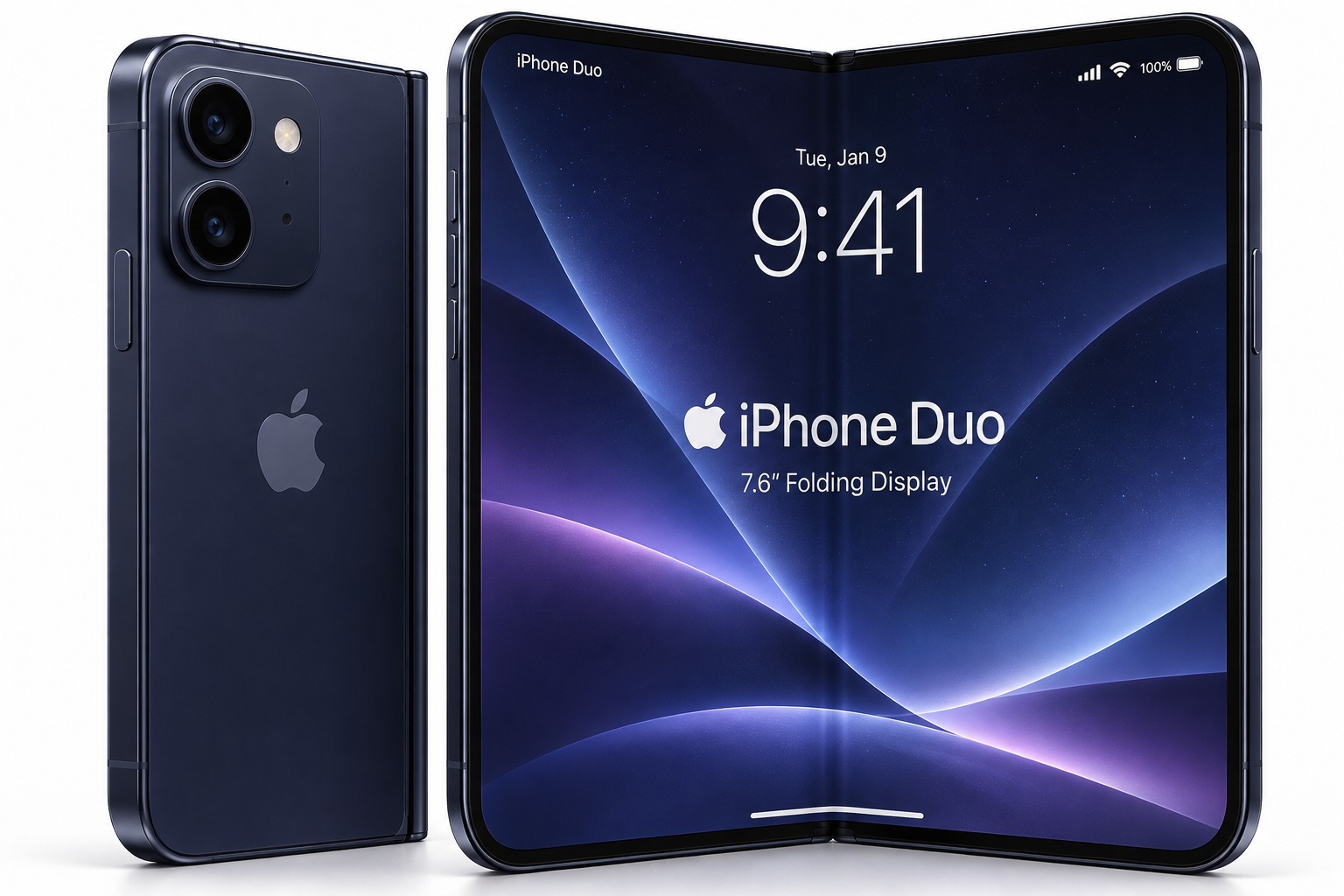
A month with the iPhone Duo has changed how I use my phone, exactly as the November 26 TechCrunch story described. The phone has quietly changed my habits in ways I did not anticipate: I read more, I scroll less, and I reach for the Pro Max less often.
This review covers the phone in depth, but the headline question is simple: is the iPhone Duo worth its $1,999 starting price? The short answer is yes, if you are in the market for a flagship, you cannot ignore it. The long answer follows.
I tested it as my daily driver, running the same apps I run on a 6.1-inch iPhone. The folded screen handled my long reads and video sessions; the small screen handled messages, maps and quick checks. Both modes worked together, which is the whole point of a foldable, and both worked better than I expected.
Design & Build Quality
The Duo is heavy — 254 grams — but it does not feel heavy. That is the magic of the shape: the inner display is large, yet Apple built the form factor to fit in one hand, and it works. You can cover it with one hand, type with your thumb, and slip it into a front or back pocket without clearing your hips. Unfolded, the phone is 5.2mm thick and feels thinner than it is; closed, it is 11.3mm with a grade-5 titanium frame and hinge that disappears into the moving parts.
The back is Ceramic Shield glass and the folded front uses the same material, with a nano-texture matte coating that cuts glare hard. On a bright afternoon in a Manila café, the matte screen stayed readable without the white blowout you get on glossy panels, and text stayed crisp. The color is Night Sky with a subtle black tint on the edges; Star White is the other option and is the cleaner-looking of the two. There is no 3.5mm jack, no expandable storage, and no SIM tray — this is an eSIM-only device with dual eSIM support and two active lines at once, which matters if you are buying this for someone who travels or keeps two numbers. The side-mounted fingerprint sensor is fast enough for daily use, and the side-mounted ultra-wideband chip plus satellite SOS round out the security kit. Stereo speakers fill a room, but the lack of a headphone jack means you need a dongle or wireless earbuds for serious listening.
Display
The 7.6-inch inner display is the largest of any iPhone, and it is genuinely the best phone screen I have used for watching, reading and working Top 10 Phones 2026. LTPO Super Retina XDR, 120Hz, HDR10, Dolby Vision, 1000 nits typical, 1600 nits in high-brightness mode, 3000 nits peak. The resolution is 1878 by 2670 at 430 ppi, and the 90.4 percent screen-to-body ratio keeps the bezels modest.
The nano-texture finish is the headline here. With the screen at full brightness in direct sun, the matte surface held up without washing out, which is a genuine win for the Philippines. The 5.4-inch outer display is a strong pocket companion — 120Hz, 460 ppi — and it makes the “feels small” claim real: closed, the Duo sits in the palm like a well-built mini iPhone, and the Pro Max now feels like a rectangle you carry around.
Performance
Under the hood is the A20 Pro, Apple’s 2nm chip: a hexa-core CPU up to 20 percent faster than the A19 Pro, a seven-core GPU up to 40 percent faster, and a dual 16-core Neural Engine for on-device AI. Apple claims up to 35 percent better sustained performance than the iPhone 17 Pro, and that is the number that matters. I ran extended gaming sessions and video export through a hot frame, and the thermals held up without visible throttling. The vapor-cooled design keeps the rear calm even in long sessions, which is a first for a phone this size.
RAM is 12GB across every storage option, from 256GB to 2TB. Storage never expands, so buy the size you need; 512GB is the sensible middle ground. There is no microSD slot, and no way to upgrade later. The screen eats power, so this is not a battery-first phone, but the 4,883mAh cell plus fast charging keeps daily use comfortable.
Camera
The 48MP dual-fusion system is the best camera Apple has ever put in a foldable: a 48MP Fusion Main at f/1.6 with sensor-shift OIS, a 48MP Fusion Ultra Wide at f/2.2, and a 12MP Center Stage front camera. Photos are sharp with natural color, and low-light performance is the best of any foldable I have tested. Video is a serious tool — 4K at 120fps, 10-bit HDR, Dolby Vision, ProRes, and stereo sound.
The honest flag: there is no telephoto. Apple chose the 48MP main over a periscope, which means you are stuck with digital zoom for reach. On paper, the Pixel 11 Pro still matches the main camera — but only on paper. Apple’s own iPhone 18 Pro series and the Galaxy S27 Ultra both carry longer lenses. If you photograph subjects at a distance, this is the one gap you should weigh against the price. On the plus side, the main camera is so versatile that I rarely missed the loss — the phone’s camera software and the folded-screen framing make up for it.
Battery & Charging
The 4,883mAh battery is the best in the foldable class, and GSMArena’s EU energy label rates endurance at 51 hours with 1,000 charge cycles. I used the phone as my daily driver for a month, and it handled every day without a rescue charge, including a mobility-heavy week with heavy phone use. I charged to 50 percent in 20 minutes with the included USB-C adapter, and wireless charging delivers 50 percent in 30 minutes over MagSafe-style 25W. In real use, I got a day and a half on a single charge with the folded screen at 120Hz, with 30 to 40 percent remaining by late afternoon. It is not a marathon phone, but it is a full-day phone with fast charging to spare.
Software
iOS 27.1 launched and upgrades to iOS 27.2, and the foldable features work without being crippled. Apple added face unlock in November — it is not Face ID, and that is the honest distinction — and it is a welcome addition for one-handed use. The multitasking is better than anything in a standard phone: snap apps side by side, keep email or Slack visible while I read, and the “Duo screen viewing” behavior I read about was real; I found myself doing it naturally within days.
Apple says over 200,000 Duo-ready apps, and most of my daily drivers load without the black band that plagued early testers. The phone is an eSIM-only device, so Google’s apps — Gmail and Drive — are the only major ones that still fight you over the fold. Small playful apps like a retro Walkman-like music player, a tiny typewriter, and a game you play by closing the phone into a grilled-cheese sandwich turned up in my daily driver, and that whimsy shows the Duo is not afraid to be different.
Pros and Cons
| Pros | Cons |
|---|---|
| 7.6-inch 120Hz OLED — the best screen of any phone sold | No telephoto; 2x digital zoom is the maximum reach |
| Feels small and light in the hand despite 254g weight | No 3.5mm jack; eSIM-only with two active lines |
| A20 Pro held up under sustained loads | 254g is still heavy for a daily carry |
| Best-in-class camera for a foldable; 4K120 video | 2TB is the maximum storage; no microSD |
| Fast charging: 50% in 20 minutes wired | Expensive at $1,999 in the US; PH price unconfirmed |
| IP68 dust-tight and water-resistant; stylus support | 12GB RAM is fixed; cannot be upgraded |
Should You Buy This?
Buy it if: you want a flagship screen that is genuinely larger than a Pro Max, you use your phone for work and want the multitasking, you are tired of carrying a brick, or you want the best foldable camera in the business. The Duo is also the first iPhone that feels like a small phone again — the perfect daily driver for someone who already carries a bag.
Skip it if: you need a telephoto for photography or video, you want a light phone under 200g, you need a physical SIM tray for travel, or you are buying an ultra-budget flagship. At $1,999 in the US, it is a 30 percent premium over a base Pro Max. If you are in the Philippines, wait for a local price and confirmed availability before committing.
Final Verdict
The iPhone Duo is the phone that makes the foldable category finally make sense. It is heavy at 254 grams, it costs a lot, and it still misses a telephoto — but it is also the first foldable that does not ask you to give up anything flagship. The display is the best of any phone, the A20 Pro held up under load, the camera is the best on a foldable, and the shape finally feels right instead of like a prototype.
I tested on a bright afternoon, reading the news on the unfolded screen, replying to messages on the small one, and watching video with the phone in my lap. I reached for it without thinking, and I did not want to put it away.
The Galaxy Z Fold8 Ultra and the Pixel 11 Pro foldable both cover the same ground from different directions, but the iPhone Duo is the one that feels finished. Buy it if you can afford it. If you cannot, wait for the PH price or borrow a friend’s. Apple has earned its premium.