
Here’s something you don’t see every day: a phone maker releasing a successor that’s actually worse on paper than the phone it replaces. That’s exactly what Xiaomi just did with the Redmi 17C.
The Redmi 17C launched in China on June 23, 2026 as the follow-up to the Redmi 15C — skipping the 16C entirely. But where the 15C boasted a 6,000mAh battery, 8GB of RAM, a 50MP camera, and IP64 water resistance, its successor dials nearly everything back. Smaller battery. Half the RAM. A single 13MP camera where there used to be a 50MP shooter. No dust or water protection at all.
What’s going on? The global semiconductor crunch has been squeezing budget phone makers for over a year now. RAM prices are up. Component costs are climbing. Something had to give — and for Xiaomi’s entry-level Redmi line, that “something” was the spec sheet.
But here’s the twist: the Redmi 17C actually costs less than its predecessor. The question is whether a lower price makes up for all those missing features. I’ve spent time poring over every spec, every comparison, and every early hands-on to figure out if this phone makes any sense — especially if you’re shopping in the Philippines, where budget phones under PHP 10,000 live or die by their value proposition.
Design & Build: Looks Can Be Deceiving
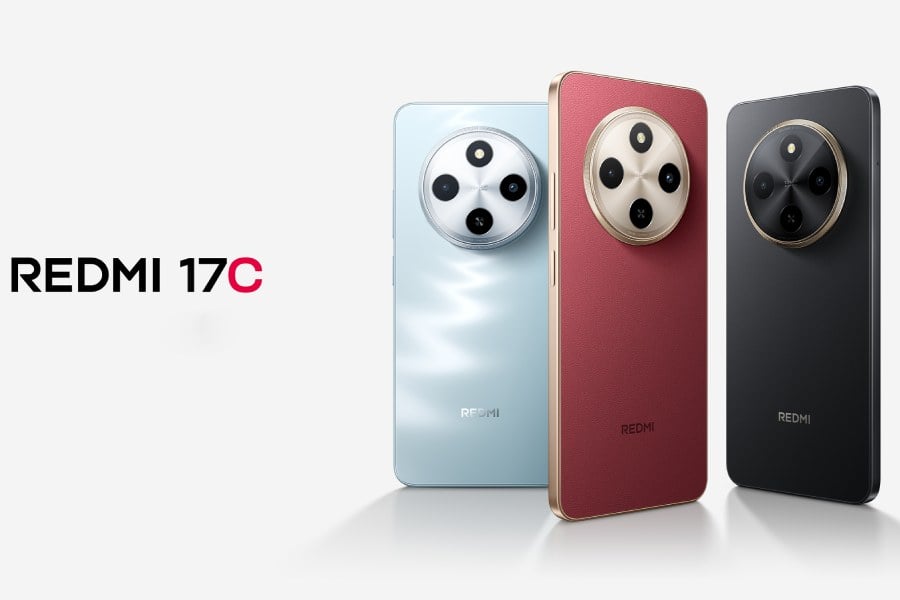
At first glance, the Redmi 17C doesn’t look like a downgrade. The back panel comes in three finishes: a glossy black, a glossy white (which Xiaomi calls Sea Breeze Blue, though it looks more pearl than blue), and a Danxia Red variant with a faux leather texture. The leather option is genuinely nice for a phone in this price bracket — it resists fingerprints and adds grip you won’t get from the glossy finishes.
The camera module might fool you into thinking you’re holding something more premium. Xiaomi slapped on a large circular camera island with four rings — quad-camera vibes, right? Wrong. Only one of those rings contains an actual lens (the 13MP main sensor). Another has the LED flash. The other two are purely decorative. It’s a design trick we’ve seen from budget phones for years, and it works from a distance, but up close it’s just fakery.
The phone is undeniably large. At 6.88 inches, you’re not going to use this one-handed unless you have basketball-player hands. The side-mounted fingerprint scanner sits where your thumb naturally rests — fast, reliable, and honestly better than any in-display sensor you’d get at twice the price. There’s also a 3.5mm headphone jack on the bottom, which is worth celebrating in 2026. Wired earbuds still work, and you don’t need a dongle.
But the build quality tells the real story of cost-cutting. The Redmi 15C had an IP64 rating — meaning it could handle splashes and dust without flinching. The 17C has no IP rating whatsoever. None. Get caught in a sudden Manila downpour with this phone in your pocket, and you’re on your own. The frame is plastic, the back is plastic, and while nothing flexes or creaks in a concerning way, the whole thing feels exactly like what it is: a phone built to a price.
Weight and dimensions: Xiaomi hasn’t published exact weight, but with a 5,160mAh battery and a plastic body, expect around 195-205 grams. That’s manageable given the screen size, though the thickness (around 8.5mm based on hands-on videos) makes it feel chunky in the pocket.
Display: Big Screen, Modest Resolution
The 6.88-inch LCD panel is the Redmi 17C’s best feature, but it comes with a caveat you’ll notice immediately: the resolution. At 720×1640 (HD+), text and icons aren’t as sharp as you’d get on a Full HD panel. On a screen this large, the pixel density works out to roughly 260 pixels per inch. That’s fine for watching YouTube videos or scrolling through TikTok, but if you read a lot of articles or e-books on your phone, the softness around text edges will bug you.
The bright spot — literally — is the 120Hz refresh rate. On a phone that costs around PHP 7,500, getting a display that refreshes 120 times per second is genuinely impressive. Scrolling through social feeds, switching between apps, and navigating the interface all feel smooth in a way that budget phones from just two years ago couldn’t touch. There’s also a 240Hz touch sampling rate, which makes the phone feel responsive to taps and swipes.
Xiaomi claims 600 nits of global brightness. In practical terms, that means the screen is readable outdoors on a cloudy day, but under direct Philippine sunlight, you’ll be cupping your hand around the display. The LCD panel does support DC dimming for flicker-free brightness adjustment, and it carries TÜV Rheinland certifications for low blue light and circadian-friendly viewing. Nice touches for anyone who doomscrolls before bed.
The waterdrop notch at the top houses the 5MP selfie camera. Not a punch-hole, not a pill — just a small teardrop. It’s dated, sure, but on a phone at this price, nobody’s complaining about bezel aesthetics.
Performance: The Helio G81 Ultra Returns
Under the hood is the MediaTek Helio G81 Ultra — the exact same chipset that powered the Redmi 15C. It’s a 12nm octa-core processor with two Cortex-A75 performance cores clocked at 2.0GHz and six Cortex-A55 efficiency cores. The GPU is an ARM Mali-G52 MC2.
This is not a fast chip. Let’s be clear about that. The Helio G81 Ultra handles basic tasks without drama — messaging apps, social media, web browsing, streaming video — but anything beyond that pushes it to its limits. Light gaming is possible: Mobile Legends and Call of Duty Mobile run at low-to-medium settings around 30-40fps. Genshin Impact? Forget about it. Even on the lowest settings, you’ll see frequent frame drops and stuttering.
The bigger concern is the RAM. Every Redmi 17C variant ships with 4GB — half the maximum of the Redmi 15C, which offered configurations up to 8GB. In 2026, 4GB is the absolute minimum for a functional Android experience. It’s enough to keep 3-4 lightweight apps in memory, but switching between a browser with multiple tabs, a messaging app, and a camera will trigger reloads. Xiaomi’s memory management in HyperOS 3 helps — the software is reasonably aggressive about killing background processes — but you’ll notice the limits during daily use.
Storage options are 64GB and 128GB. The 64GB base model is tight, especially since HyperOS 3 and pre-installed apps will eat up around 15-18GB of that. If you take photos, install games, or download Netflix shows for offline viewing, you’ll want the 128GB version.
For context: the Tecno Pova 8 5G at a slightly higher price gives you 5G connectivity and better gaming performance. And the realme P4 Power 5G crushes the Redmi 17C on battery life with its 10,001mAh cell. The Redmi’s chipset isn’t bad — it’s just not a reason to choose this phone over alternatives.
Camera: One Lens, Limited Ambition
The Redmi 17C has exactly one rear camera: a 13MP sensor with an LED flash. The other three circles in that quad-camera module are empty decoration.
In good light, the 13MP camera produces photos that are…fine. Colors are reasonably accurate, dynamic range is acceptable for social media, and the shutter is quick enough for still subjects. But “fine” is about as good as it gets. There’s no ultrawide lens for landscapes or group shots. No macro lens for close-ups. No depth sensor for portrait mode — though HyperOS 3 attempts software-based background blur with mediocre results.
Low-light performance is predictably weak. Without optical image stabilization or a large sensor, night shots come out soft and noisy. The LED flash helps in a pinch, but it produces that characteristic harsh, washed-out look that budget phone flashes are known for.
The 5MP front-facing camera is serviceable for video calls and the occasional selfie. Don’t expect much detail or dynamic range — it’s a functional sensor, nothing more.
If photography matters to you at all, this is the Redmi 17C’s weakest link. The Redmi 15C’s 50MP main camera was a genuine standout at its price. Going from 50MP to 13MP is the single biggest downgrade here, and it’s the one you’ll feel most acutely if you’re upgrading from an older budget phone that had better camera hardware.
Battery Life: Smaller Tank, Slower Fill
The Redmi 17C packs a 5,160mAh battery — a step down from the 15C’s 6,000mAh cell. In real-world terms, that roughly 14% capacity reduction translates to about one less hour of screen-on time. Most users will still get through a full day: 6-7 hours of screen time with mixed use (social media, streaming, messaging, some camera use). Heavy users who game or use GPS navigation extensively will need a top-up by early evening.
What really stings is the charging situation. The phone supports 18W wired charging, which is already slow by 2026 standards. But Xiaomi only includes a 10W charger in the box. With the included brick, charging from empty to full takes roughly 2 hours and 45 minutes. Even if you buy an 18W charger separately — which you should — you’re still looking at around 2 hours for a full charge. Compare that to phones like the Honor X80 Pro Max, where fast charging is a headlining feature, and you start to wonder why Xiaomi cheaped out on the bundled adapter.
There’s no wireless charging — expected at this price — and no reverse wired charging to top up accessories. The USB-C port handles data transfer at USB 2.0 speeds.
Software: HyperOS 3 Brings Modern Android to Budget Hardware
The Redmi 17C ships with HyperOS 3, Xiaomi’s custom Android skin built on top of Android 16. This is actually one of the phone’s strongest points — getting Android 16 out of the box on a sub-PHP 8,000 phone is unusual, and HyperOS 3 is a meaningful step forward from the MIUI days.
HyperOS 3 introduces a cleaner visual language, improved animations, and better memory management compared to previous versions. The control center has been redesigned with larger toggles and smarter grouping. Xiaomi’s “Interconnect” features — which let you share clipboard, notifications, and files between Xiaomi devices — are present, though their usefulness depends on whether you own other Xiaomi ecosystem products.
There are caveats. Xiaomi still ships its phones with pre-installed apps — games, shopping apps, and “recommended” shortcuts. Not as many as the MIUI era, but you’ll spend the first 10 minutes uninstalling bloatware. The 4GB RAM cap also limits how well HyperOS 3’s multitasking features work in practice. You’re not going to run floating windows or split-screen apps comfortably.
Xiaomi hasn’t published an official update commitment for the Redmi 17C, but based on Redmi’s track record with entry-level devices, expect one major Android version update and two years of security patches. That’s the bare minimum, and it’s worth factoring into your purchase decision.
Competitors: What Else Can You Get for the Money?
Assuming the Redmi 17C lands in the Philippines at roughly PHP 7,500 (we’ll break down pricing below), here’s what it’s up against:
Samsung Galaxy A06 — Usually priced around PHP 6,500-7,500. Samsung’s One UI is more polished than HyperOS, and Samsung promises four years of security updates on even its cheapest phones. The spec sheet (HD+ LCD, MediaTek chip, similar cameras) is comparable, but Samsung’s software support and brand trust give it an edge for long-term users.
realme C67 — Around PHP 7,000-8,000. The C67 offers a 108MP main camera at the top end of this range, which is comically better than the 17C’s 13MP unit. Battery and display specs are similar, but realme’s camera processing is more aggressive and arguably more social-media-friendly.
TECNO Spark 20 Pro — Around PHP 6,500-7,500. TECNO’s budget phones often include features that Xiaomi reserves for higher tiers, like stereo speakers and faster charging. The Spark series also tends to feel more premium in hand, with better build materials.
The Redmi 17C’s main argument against all of these is the 120Hz display at a lower price. But that alone might not be enough.
Pros and Cons
✅ Pros
- 120Hz refresh rate on a big 6.88-inch display — rare at this price
- Android 16 with HyperOS 3 right out of the box
- 3.5mm headphone jack (yes, in 2026)
- Side-mounted fingerprint scanner is fast and reliable
- Faux leather finish on the red variant looks and feels premium
- Lower price than the Redmi 15C at launch
❌ Cons
- Downgraded in almost every spec compared to the Redmi 15C
- Only 4GB RAM — half the maximum of its predecessor
- Single 13MP camera where the 15C had a 50MP shooter
- No IP rating (15C had IP64 water and dust resistance)
- 10W charger in box despite 18W support — painfully slow
- HD+ resolution on a 6.88-inch screen means visible pixelation
- 4G only — no 5G connectivity
- Four-camera module is decorative fakery — only one lens actually works
Verdict: Should You Buy the Redmi 17C?
The Redmi 17C is a strange phone. It’s cheaper than its predecessor, which is good. It has a 120Hz display, which is rare at this price. And it ships with Android 16, which is genuinely forward-looking for a budget device.
But it’s worse than the phone it replaces in nearly every measurable way. Smaller battery. Less RAM. Worse camera. No water resistance. Slower charging. If you own a Redmi 15C, upgrading to the 17C would be a mistake — you’d be paying to downgrade.
Buy the Redmi 17C if:
- You’re on an extremely tight budget and need a large, smooth-scrolling display for media consumption
- You’re coming from a phone that’s 3+ years old and anything modern feels like an upgrade
- You want Android 16 without spending more than PHP 8,000
- You need a secondary phone for media, navigation, or as a backup — the 120Hz display and headphone jack make it a solid secondary device
Skip the Redmi 17C if:
- You care about camera quality — the single 13MP lens is the weakest part of this phone
- You multitask heavily — 4GB of RAM will frustrate you
- You need water resistance — this phone has none
- You already own a Redmi 15C — this is a downgrade, not an upgrade
- You can stretch your budget to PHP 9,000-10,000 — much better phones exist in that range
The Redmi 17C is not a bad phone. It’s a phone that makes sense in a very specific scenario: you need a big, smooth screen, you mostly consume content rather than create it, and every peso counts. For that person — the student who watches lectures on their phone, the delivery rider who needs a reliable navigation device, the parent who just wants a big screen for YouTube and Facebook — the Redmi 17C does the job.
But if you can wait, wait. Budget phone competition in the Philippines is fierce, and at PHP 7,500, you can often find last year’s midrange phones on sale that outperform the Redmi 17C in every category. The global RAM shortage won’t last forever, and when it eases, entry-level phones will get their RAM back. The Redmi 17C is a product of its time — a snapshot of what happens when component costs force impossible compromises.
Xiaomi made a bet that a lower price would make up for lower specs. For some buyers, it will. For everyone else, there are better options already on the shelf.
Frequently Asked Questions
Does the Redmi 17C support 5G?
No. The Redmi 17C is a 4G-only device. The Helio G81 Ultra chipset does not include a 5G modem. If 5G connectivity is important to you, consider the Tecno Pova 8 5G or similar options in the PHP 8,000-10,000 range.
When will the Redmi 17C be available in the Philippines?
Xiaomi Philippines has not announced an official release date yet. Based on past Redmi C-series launches, expect Philippine availability 4-8 weeks after the China launch — likely late July or August 2026. The phone will likely be sold through Xiaomi’s official stores on Lazada, Shopee, and authorized physical retailers nationwide.
How much will the Redmi 17C cost in the Philippines?
The China pricing is CNY 799 (~PHP 6,300) for the 4GB/64GB variant and CNY 899 (~PHP 7,100) for the 4GB/128GB variant. After import duties, logistics, and local warranty costs, expect Philippine SRP of roughly PHP 7,499 for the base model and PHP 8,499 for the 128GB variant. These are estimates — official PH pricing has not been confirmed.
Is the Redmi 17C better than the Redmi 15C?
In most ways, no. The Redmi 17C has a smaller battery (5,160mAh vs 6,000mAh), less maximum RAM (4GB vs 8GB), a lower-resolution main camera (13MP vs 50MP), and no IP rating (vs IP64 on the 15C). The 17C’s advantages are a lower launch price and Android 16 with HyperOS 3 out of the box. If you already own a 15C, stick with it.
Can the Redmi 17C run Mobile Legends or Call of Duty Mobile?
Yes, but with limitations. Mobile Legends runs smoothly at medium settings. Call of Duty Mobile is playable at low settings. Don’t expect high frame rates or maxed-out graphics. The 4GB RAM means you’ll want to close background apps before launching games for the smoothest experience.