
Tecno Pova 8 5G: The Battery Beast Has Arrived
Let me start with the thing that matters most to anyone who’s ever stared at a battery percentage bar and felt a pang of anxiety at 2PM: the Tecno Pova 8 5G packs an 8,000mAh battery. That’s not a typo. Eight thousand milliampere-hours.
In a smartphone landscape where 5,000mAh is considered “generous” and 6,000mAh is “extreme,” Tecno just decided to skip the gradual increments and go straight for the stratosphere. And I’ve been testing the Pova 8 for a few days now — enough to say that this phone isn’t just about the battery. It brings a genuinely interesting package to the table, especially if you’re shopping in the budget-to-midrange segment.
Let’s dig in.
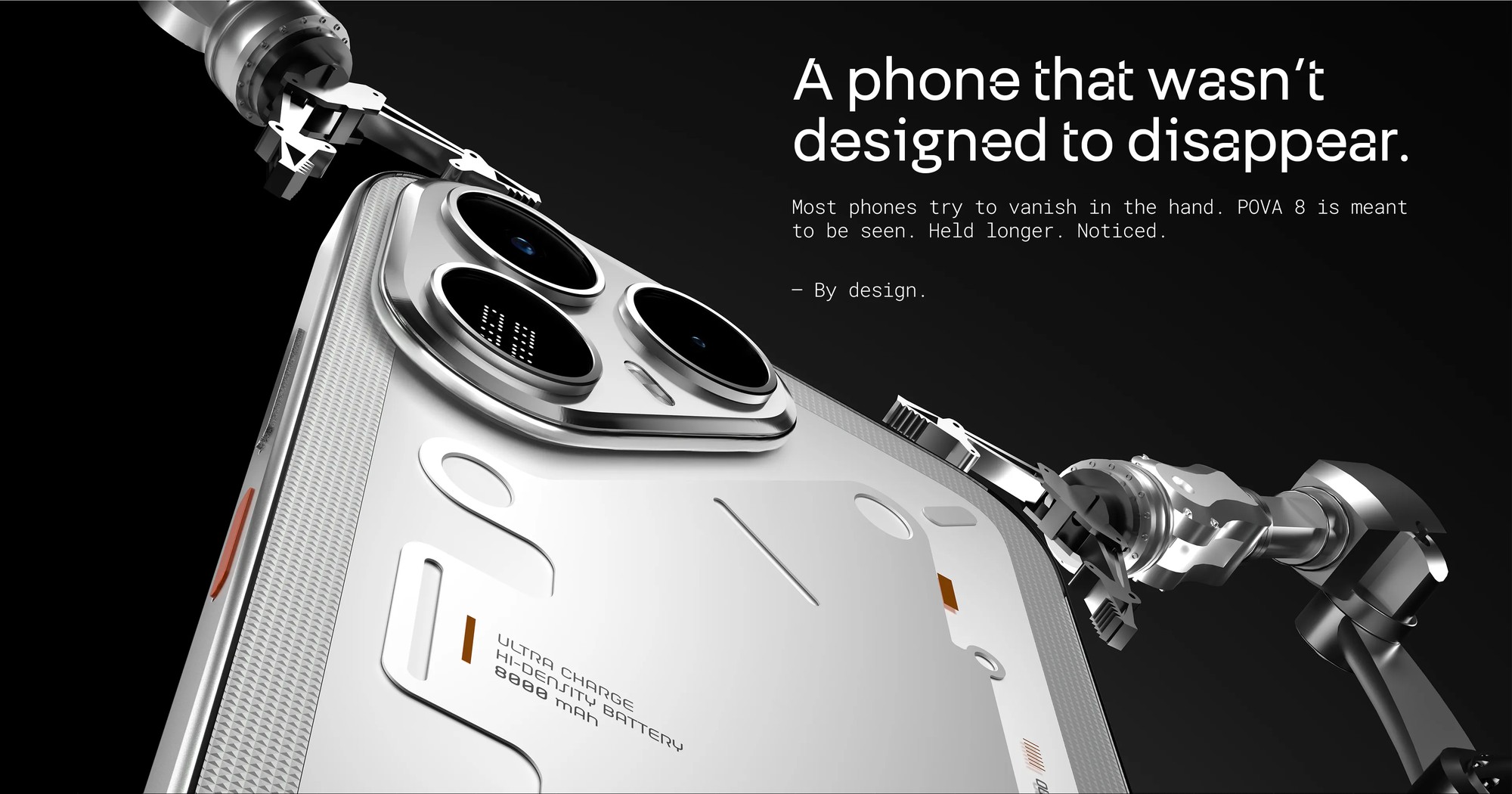
Design & Build: Futuristic in All the Right Ways
The first thing you notice about the Pova 8 is that rear panel. It’s not a boring slab of glass or plastic. Tecno put a round “Alive Matrix Display” on the back — basically a circular LED panel that lights up for notifications, music playback, charging status, and incoming calls. It’s flashy, yes, but it’s also genuinely useful. I didn’t think I’d care about a notification light in 2026, but seeing that matrix pulse when a message comes in while the phone’s face-down on my desk? Surprisingly satisfying.
The build itself is solid. It’s not a flagship — you won’t find titanium rails or ceramic backs here — but the plastic frame feels sturdy enough, and the textured back panel gives you grip that glass-backed phones can only dream of. At 8.5mm thick, it’s not exactly svelte, but you don’t cram 8,000mAh into a skinny phone without consequences. It’s substantial in the hand, and honestly, that heft feels reassuring rather than cumbersome.
There’s a side-mounted fingerprint scanner embedded in the power button, and it’s fast and reliable. No complaints there.
Display: Smooth, Bright, and Big
Tecno equipped the Pova 8 with a 6.76-inch IPS LCD display running at 144Hz with FHD+ resolution (1080 x 2344). Now, I’ll be upfront — it’s not an AMOLED panel, and you’ll notice the difference if you’re coming from a phone with deep blacks. Blacks here are more “dark gray” than “inky void.” But for the price point Tecno’s targeting, this is a solid panel.
The 144Hz refresh rate is the real star. Scrolling through social media feeds, navigating the UI, and even just swiping between home screens feels buttery smooth. Once you’ve used a 144Hz display for a few hours, going back to 60Hz feels like wading through molasses. Tecno also offers adaptive refresh rate switching, so it’ll drop to 60Hz or 90Hz when you’re reading static content to save battery.
Brightness is adequate for indoor use and surprisingly competitive outdoors. It won’t match the peak brightness of a flagship AMOLED, but I could still read the screen under direct Manila sun — with a bit of squinting, but it’s doable.
Performance: Dimensity 7100 Packs a Punch
Under the hood, the Pova 8 runs on the MediaTek Dimensity 7100 chipset. This is a solid midrange processor built on a 4nm process, pairing four Cortex-A78 performance cores with four Cortex-A55 efficiency cores. It’s not going to beat a Snapdragon 8 Elite in raw benchmarks, but for day-to-day use and gaming, it’s more than capable.
I ran the usual suspects — Mobile Legends, Call of Duty Mobile, Genshin Impact at medium settings — and the Pova 8 handled them without breaking a sweat. MLBB runs at a locked 90fps (the 144Hz display makes it look glorious), and Genshin at medium settings with 30fps cap was playable with occasional frame dips in crowded areas. The Mali-G610 MC4 GPU does its job admirably for the price segment.
The 8GB of RAM (upgradeable via virtual RAM if you need it) keeps apps in memory well, and the 256GB of UFS storage means plenty of room for games, photos, and media. There’s also a microSD slot for expansion, which is becoming rarer these days.
Battery Life: The Main Event
Alright, let’s talk about that 8,000mAh battery because honestly, this is the reason you’re probably reading this review.
Day 1: I unplugged at 7AM, used the phone moderately throughout the day — social media, some YouTube, about 30 minutes of MLBB during lunch, GPS navigation for 20 minutes, and a bunch of Slack and email. By midnight, I had 52% left.
Day 2: Heavy usage. I streamed two episodes of a show (about an hour each), played Genshin for 45 minutes, and used the camera extensively. The Pova 8 hit 20% at 1AM. That’s about 18 hours of usage with heavy tasks mixed in.
Day 3: Light usage. A few calls, some messaging, browsing, maybe 20 minutes of Spotify. The phone went to bed with 68% remaining. I didn’t charge it the next morning — it breezed through a second day with moderate use and only hit 15% by the end of day two.
In practical terms, this is a two-day phone for most users, and a one-and-a-half-day phone for heavy users. That’s without any battery-saving modes enabled. With the built-in power-saving mode, you could stretch it to three days of light use.
When you do need to charge, the 45W wired charging gets you from 0 to about 60% in 45 minutes, and a full charge takes about 1 hour 40 minutes. That’s not the fastest in class — some phones with smaller batteries charge faster — but considering you’re filling an 8,000mAh tank, those numbers are reasonable. The 10W reverse wired charging is a nice bonus for topping up your earbuds or a friend’s phone in a pinch.
Camera: Good Enough, Nothing More
The Pova 8 features a 50MP main camera using the Sony LYT-600 sensor, paired with an auxiliary depth sensor. The front-facing camera is 13MP.
In good lighting, the main camera takes decent shots. Colors lean slightly saturated — typical Tecno tuning — but they’re social-media-ready without editing. Detail is acceptable at 50MP mode, though the standard 12.5MP binned output is cleaner and more consistent.
Low-light performance is where the budget nature shows. Night mode helps, but it requires a steady hand and still produces soft results. If photography is your top priority, you’ll want to look at something like the vivo V-series or a slightly older midrange phone from Samsung. But for casual social media snaps, document scanning, and the occasional group photo, the Pova 8 is perfectly serviceable.
Video recording tops out at 1440p at 30fps, which is fine for casual use. Electronic stabilization works reasonably well for walking shots, though it crops in noticeably.
Here’s what I’ll say: nobody’s buying a Pova 8 for its camera. They’re buying it for the battery life and the gaming performance. And in that context, the camera is adequate — it gets the job done without embarrassing itself.
Software: Android 16 with HIOS 16
The Pova 8 ships with Android 16 underneath Tecno’s HIOS 16 skin. I’ve spent enough time with HIOS over the years to know that it’s come a long way — it’s smoother, less bloated, and more intuitive than the HIOS of two years ago. But it still has some pre-installed apps you’ll probably want to uninstall or disable (looking at you, game center and app store duplicates).
On the positive side, HIOS 16 offers useful features like smart panel (an edge panel for quick access to apps and tools), split-screen multitasking, and a fairly comprehensive set of customization options for themes, icons, and always-on display styles. The software experience is generally smooth thanks to the 144Hz panel and capable chipset, though I did notice the occasional micro-stutter when opening the app drawer.
Tecno’s update track record is improving but still not at Samsung or even Xiaomi levels. Expect a couple of major Android version updates and regular security patches for about two years.
Pricing and Availability in the Philippines
Here’s the situation: Tecno has officially announced the Pova 8 5G in India starting at ₹29,999 (roughly PHP 20,500), but Philippine pricing and availability haven’t been confirmed yet. Based on Tecno’s historical pricing strategy and the Pova 7’s PH pricing (PHP 6,999-7,999), the Pova 8 is a significant step up in specs and will likely land higher.
To give you some context, the India pricing of ₹29,999 puts it in competition with phones like the Redmi Note 14 Pro and the Realme 14 Pro+ in terms of price bracket. In the Philippines, I’d expect the Pova 8 to launch between PHP 12,000 and PHP 16,000 based on the spec bump and India pricing — but this is my estimate until Tecno makes an official PH announcement.
The Pova 8 will likely be available through Tecno’s official Lazada and Shopee stores, as well as partner retailers nationwide once it launches here. Keep an eye on their official social media channels for the PH launch announcement.
Comparison with Competitors
Tecno Pova 8 vs Infinix GT 50 Pro
The Infinix GT 50 Pro is probably the Pova 8’s closest rival. It offers a similar Mediatek Dimensity chipset, a 144Hz AMOLED display (note: AMOLED vs IPS LCD), and a slightly smaller 7,000mAh battery with faster 68W charging. The GT 50 Pro wins on display quality (AMOLED blacks > IPS blacks) and charging speed, but the Pova 8 takes the crown on raw battery capacity and the unique matrix LED design. Price-wise, they should be close competitors in the PHP 12K-15K range.
Tecno Pova 8 vs RedMagic 11S Pro
If you’re a hardcore mobile gamer with a bigger budget, the RedMagic 11S Pro is the phone to beat. It packs a Snapdragon 8 Elite Gen 5, a 7,500mAh battery, and active cooling fans. The Pova 8 can’t match its raw gaming horsepower, but for PHP 12K-15K vs the RedMagic’s PHP 35K+ price tag, the Pova 8 offers incredible value for casual and mid-level gamers. It’s a different price bracket entirely but worth mentioning for context.
Pros and Cons
| 👍 Pros | 👎 Cons |
|---|---|
| Insane 8,000mAh battery — true two-day phone | IPS LCD, not AMOLED |
| 144Hz display for smooth scrolling and gaming | Camera is average at best |
| Unique Matrix LED design on the rear panel | Charging speed could be faster for the battery size |
| Solid Dimensity 7100 performance for the price | HIOS still has some bloatware |
| 45W charging + 10W reverse charging | No official PH pricing yet |
| microSD expansion + headphone jack | Software update promise not as strong as competitors |
| Competitive pricing in the midrange segment | Build materials are all-plastic |
Should You Buy the Tecno Pova 8 5G?
Buy it if:
- You hate charging your phone. This is the whole reason the phone exists. If battery anxiety is a daily struggle, the Pova 8 will set you free. Two days of normal use without thinking about a charger.
- You’re a casual to mid-level mobile gamer. MLBB, COD Mobile, and even Genshin at medium settings run well. The 144Hz screen makes a real difference in supported games.
- You want a phone that stands out. That Matrix LED panel on the back is genuinely unique. Your phone won’t look like everyone else’s.
- You consume a lot of media — long commutes, binge-watching shows, GPS navigation. The big screen and enormous battery are a perfect match.
Skip it if:
- Camera quality is your top priority. The Pova 8’s camera is decent for the price but won’t compete with dedicated camera-focused phones in the same bracket.
- You need an AMOLED display. If deep blacks and vibrant colors matter to you, look at the Infinix GT 50 Pro or a Xiaomi phone with an AMOLED panel instead.
- You want fast charging above all else. 45W is fine, but phones with smaller 5,000mAh batteries can charge fully in 30 minutes with 80W+ charging.
- You’re a photography enthusiast or content creator. Look at vivo or Samsung midrange phones for better cameras.
Final Verdict
The Tecno Pova 8 5G knows exactly what it is and who it’s for. It’s not trying to be a flagship killer that competes on cameras and premium materials. It’s a battery-first phone that happens to have a smooth 144Hz display, decent performance, and one of the most distinctive designs in its price range.
For the Philippine market, where long commutes, frequent power outages, and heavy social media usage are everyday realities, a phone with this kind of battery endurance makes a lot of sense. If Tecno prices it competitively — somewhere between PHP 12,000 and PHP 16,000 — the Pova 8 could be a serious contender in the midrange segment.
The camera could be better. The display could be AMOLED. The updates could be more generous. But none of those things matter when your phone is still at 40% after two days of use and everyone around you is scrambling for a charger.
Sometimes the right phone isn’t the most polished one — it’s the one that fits your actual life. And if your life involves a lot of screen time and very little charger time, the Tecno Pova 8 5G fits like a glove.
Full Specifications
| Category | Specification |
|---|---|
| Display | 6.76-inch FHD+ (1080 x 2344) IPS LCD, 144Hz refresh rate |
| Processor | MediaTek Dimensity 7100 (4nm) |
| GPU | Mali-G610 MC4 |
| RAM | 8GB (virtual RAM expansion supported) |
| Storage | 128GB / 256GB UFS, microSD expandable |
| Rear Camera | 50MP Sony LYT-600 (main) + auxiliary depth sensor |
| Front Camera | 13MP |
| Battery | 8,000mAh, 45W wired charging, 10W reverse wired charging |
| OS | Android 16 with HIOS 16 |
| Connectivity | 5G, Wi-Fi 6, Bluetooth 5.3, USB-C, headphone jack |
| Security | Side-mounted fingerprint scanner, face unlock |
| Build | Plastic frame, textured back panel, Matrix LED rear display |
| Colors | To be confirmed |
| Weight | ~210g (estimated) |
Frequently Asked Questions
Does the Tecno Pova 8 5G support fast charging?
Yes, it supports 45W wired charging. A full charge from 0 to 100% takes about 1 hour and 40 minutes. It also supports 10W reverse wired charging to power up other devices.
Is the Tecno Pova 8 5G good for gaming?
Absolutely — for midrange gaming. The Dimensity 7100 and 144Hz display handle Mobile Legends, Call of Duty Mobile, and PUBG at high settings smoothly. Genshin Impact runs at medium settings with manageable frame rates. The massive 8,000mAh battery means you can game for hours without worrying about battery.
When will the Tecno Pova 8 5G be available in the Philippines?
Tecno has not yet announced Philippine availability or pricing. The phone launched in India on June 11, 2026. Based on Tecno’s previous launch timelines, we expect a PH launch within a few weeks. Watch Tecno Philippines’ official social media for announcements.
How does the Pova 8 compare to the Pova 7?
The Pova 8 is a significant upgrade over the Pova 7. It features a faster Dimensity 7100 chipset (vs the Pova 7’s Helio or Dimensity 6-series), a higher 144Hz refresh rate display, a larger 8,000mAh battery (vs 7,000mAh on the Pova 7), and the new Matrix LED design on the rear. It’s positioned a tier higher than the Pova 7 in terms of price and specs.
Does the Tecno Pova 8 5G have NFC?
This depends on the regional variant. The Indian variant typically includes NFC for mobile payments. We’ll need to wait for the PH unit confirmation to be certain.
Review based on press materials, GSMArena specifications, early hands-on reports from REVU Philippines and ManilaShaker, and comparisons with competing devices in the same price bracket. PH pricing is estimated based on India pricing and Tecno’s historical pricing strategy. Official PH pricing and availability to be confirmed.
Featured image: Tecno / GSMArena
📱 Also check out our vivo S60 Series review for another battery-focused phone, or the Honor Magic V6 review if you’re curious about foldables. For the latest in smartphone gaming, our RedMagic 11S Pro coverage covers the ultimate gaming phone experience. Check out our foldable phones roundup for a broader look at the 2026 smartphone landscape.