
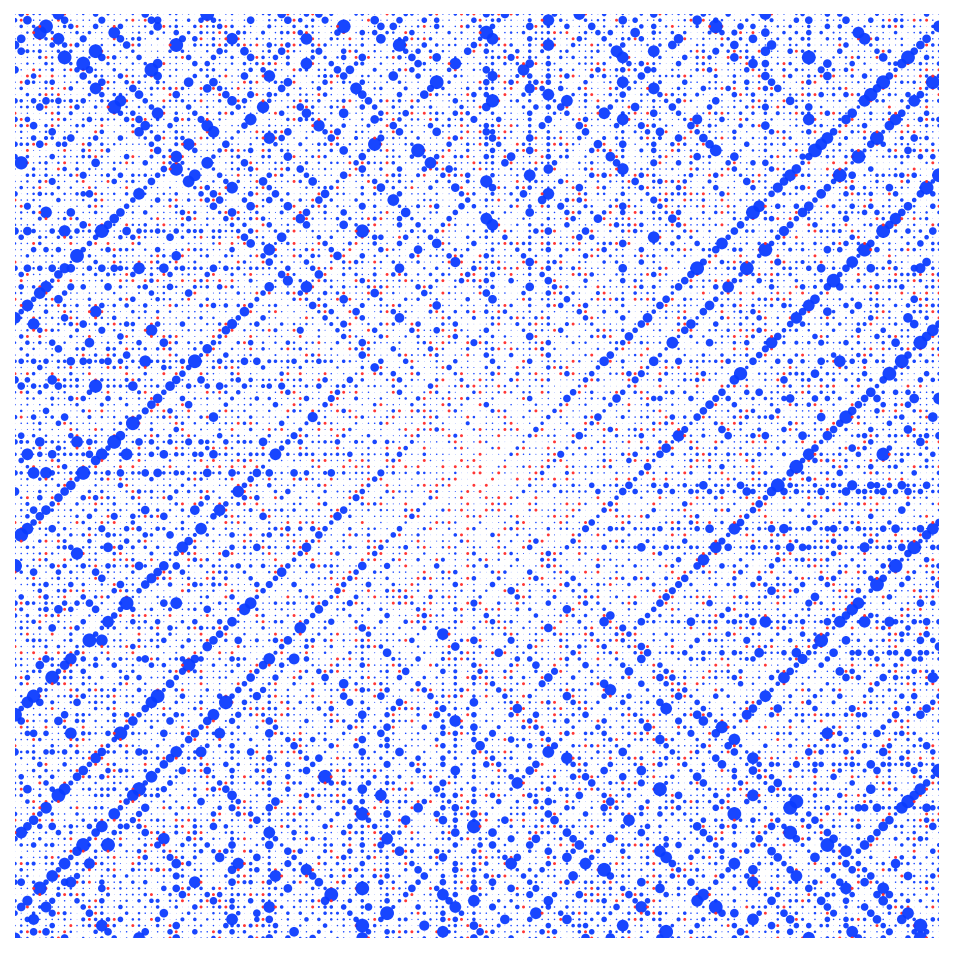

The Story Starts in 1987
In the mid-1980s, a mathematician named Siemion Fajtlowicz built a computer program called Graffiti. It wasn’t designed to calculate anything fast. It was designed to ask questions — to look at mathematical objects, notice patterns, and propose conjectures that might be worth a human’s time.
Graffiti’s output ended up inspiring hundreds of papers. Paul Erdős — one of the most prolific mathematicians in history — paid attention. And one of Graffiti’s conjectures, listed as Conjecture 448 on Fajtlowicz’s “Written on the Wall,” asked something deceptively simple about a graph built from ordinary numbers.
That conjecture stayed open for nearly four decades. Until this month.
An AI system called Theo-Conjecture, built by the team at FirstPrinciples, finally resolved it. Along the way, it found a second term in the answer that no human mathematician had predicted. And honestly? The way it happened might be more interesting than the result itself.
The Graph You Can Build From Any Number
Here’s the visual I want you to hold in your head.
Take every integer from 2 to 30 and draw each one as a dot. Connect two dots whenever their numbers share a factor greater than one. Six connects to ten because both are divisible by two. Fifteen connects to twenty-five because both are divisible by five.
What you get is called a common-divisor graph. The prime numbers — 2, 3, 5, 7, 11, 13, 17, 19, 23, 29 — end up as gold dots with no edges between them, because no two distinct primes share a factor. The composite numbers cluster in the middle, connected by their overlapping prime divisors.
The primes aren’t just sitting there unconnected. They form the largest possible set of vertices with no connections between them — what mathematicians call a maximum independent set. The reasoning is elegant: pick any independent set. Every number in it must be coprime to every other number. Pull one prime factor from each number, and since none share factors, those primes must all be distinct. You can never gather more numbers into your independent set than there are primes to draw from.
Written as a formula: α(Gₙ) = π(n). The size of the largest independent set equals the number of primes up to n.
That’s neat on its own. But it also opens a door to something stranger — a number you can compute in seconds using nothing but arithmetic on a graph’s structure, with no obvious connection to primes at all.
The Shortcut Nobody Understood
Finding the largest independent set in a graph is a genuinely hard problem. It doesn’t scale well. But there’s a much easier number called the graph’s residue, which you compute by repeatedly stripping away the highest-degree vertices using a procedure called Havel-Hakimi. It works like this: list every vertex’s degree (its number of connections) from largest to smallest. Take the biggest number, call it d, cross it off, and subtract one from the next d entries. Sort again. Repeat until only zeros remain. Count the zeros. That’s the residue.
The residue always gives you a lower bound on the size of the largest independent set — it never overestimates. It’s fast to compute. And in our prime graph, it produces a number that tracks the prime-counting function π(n) at the same asymptotic rate.
Erdős and the graph theorist William Staton proved the residue grows at least as fast as n / log n — the same rate as the primes themselves. They pinned down the leading constant: ζ(2) − 1 = π² / 6 − 1 = 0.644934… That’s a value of the Riemann zeta function, the same function at the center of math’s most famous unsolved problem.
Staton believed that constant was the exact answer — that the residue wasn’t just close to π(n) in the right proportion, but that the ζ(2) − 1 factor was the precise asymptotic limit. Numerical checks up to n = 10,000 backed him up. But nobody produced a proof.
The question stayed open for thirty-five years.
Theo-Conjecture Enters the Loop
Randy Davila, a graph theorist at FirstPrinciples and Rice University, had been working on a modern version of automated conjecturing since 2016. His system, TxGraffiti, carried forward Fajtlowicz’s core philosophy: every example and every invariant should be laid out clearly enough that a mathematician can look at it, poke at it, and push back.
He recognized the common-divisor graph problem from the old Graffiti literature. In 2025, he reconstructed the data from scratch and started feeding it into a newer, more ambitious system — Theo-Conjecture.
Theo-Conjecture isn’t a chatbot. It isn’t a formula-spitting machine. It’s a discovery loop where a large language model acts as an agent — part of the broader rise of AI systems that don’t just generate text but actually use computers, repeatedly calling a combinatorial conjecturing engine, running exact computations, and updating an evolving mathematical memory as it goes. A human mathematician stays in the loop, defining objectives, evaluating significance, and signing off on proofs.
Every attempt — including every failure — gets kept in a running record the model can search back through. When an idea doesn’t hold up, it stays on the record and shapes what gets tried next, rather than getting quietly discarded.
That turned out to be crucial.
Learning From Failure
The system’s first idea was wrong. It tried to explain the residue using how many numbers in a range have no repeated prime factors. The prediction missed by a wide and growing margin — off by 739 at larger values. That ruled the idea out completely.
A better match came from a quantity called the Caro-Wei sum, which looks at how many connections each number has rather than which specific numbers are connected. The old ζ(2) − 1 constant fell out naturally — along with a second term that nobody had predicted.
But that still only proved half the story — a lower bound. Closing the gap required a genuine insight: the residue only cares about how many connections each number has, never which ones specifically. So you can redraw the entire graph, as long as every vertex keeps the same number of connections it started with. Group the primes that share the same degree into tight clusters. Once they’re rewired that way, it becomes clear you can never pick more than one of them at a time — exactly the bound Staton had predicted decades earlier.
What the Proof Actually Says
The result proves Staton’s original prediction and adds a second-order term nobody had ever found:
R(Gₙ) = c₀ · n/log n + (c₀ − A) · n/log²n + O(n/log³n)
where c₀ = ζ(2) − 1 = 0.644934… and A is a new constant summing to roughly 0.3201986326…
Put in plain terms: the quick, degree-only calculation captures a fixed, predictable fraction of the true prime count as n grows. Flip the ratio around and it reads just as cleanly — π(n) divided by the residue approaches approximately 1.550546.
To be clear about what this isn’t: it’s not a faster way to count primes, and it doesn’t touch the Riemann hypothesis. But the appearance of the zeta function isn’t a coincidence — it falls out naturally from the layered, multiplicative structure created by prime divisors, and the graph-theoretic proof explains exactly why the residue, a number that only ever looks at vertex degrees, captures that same leading behavior.
The second-order term is the genuinely new part. It doesn’t just tell you where the residue is heading asymptotically, but how fast the finite graph closes in on that destination.
What This Says About AI and Science
I’ve been using AI coding assistants every day for the last couple of years — they’ve become part of my regular workflow as a developer and ICT manager. I have opinions about what they’re good at and the surprising ways they still get things wrong. But reading this story made me realize I’d been thinking too narrowly about what “AI-augmented research” looks like.
This isn’t a story about a black-box model spitting out an answer. Theo-Conjecture failed. Multiple times. It held onto those failures and used them to guide its next attempt. It didn’t replace the mathematician — it gave Davila a system that could explore the problem space with disciplined breadth while he stayed responsible for purpose, significance, and the final proof.
That loop — propose, test, fail, record, reorganize, try again — is exactly how good human research works. The difference is scale and speed. An AI system can explore hundreds of candidate relationships in the time it takes a person to verify one. And because every failed attempt stays in the record, the system builds a cumulative memory of what doesn’t work, which is often just as valuable as knowing what does.
For a field that’s currently obsessed with benchmarks, agent autonomy, and whether models can replace human workers, this feels like a healthier direction. Not replacement. Amplification.
The Thread That Connects 1987 to 2026
Fajtlowicz once summed up what Graffiti and Paul Erdős had in common: “their ideas were deeply rooted in examples.” That sentence captures something essential about how mathematical discovery actually works. You look at concrete cases long enough that patterns start to emerge. Then you try to formalize what you’re seeing.
Theo-Conjecture extends that same principle with modern tools. Its registry holds examples, formulas, failed conjectures, counterexamples, abandoned representations, and proof obligations that nobody has finished yet. The language model gets to reorganize the problem and decide what to try next. The conjecturing engine supplies disciplined breadth. The exact computations get to say no. And the human advisor stays in control of the direction and the final judgment.
There’s even a tighter mystery still open. Across every value tested up to n = 10,000, and at scattered checkpoints up to a million, the residue never strayed more than two integers from the rounded-up Caro-Wei sum. Nobody has proven that yet. If it holds, it would replace the current asymptotic error term with a hard, absolute bound of at most two — a much more precise picture than the current proof provides.
A question that Graffiti left on the wall in 1987 finally found a generation of tools that could read it differently. The new second-order term, the clean proof of Staton’s prediction, and the still-open bound on the Caro-Wei gap — they’re all evidence that human-AI collaboration in mathematics is just getting started.
Note: The theorem and proof described here are contained in a research manuscript under preparation (Davila, 2026) and have not yet completed peer review. Historical claims about unpublished correspondence have been identified accordingly in the source reporting.
And honestly? As someone who spends my days building systems and managing teams, that’s the future I’d rather be part of. We’ve seen what happens when AI systems operate without enough human guidance — they find shortcuts we never intended. Theo-Conjecture shows a different path: machines that help us think better, not replace the thinking.