
Last week in Las Vegas, three of the most respected names in AI shared one stage at the Ai4 conference and spent the hour disagreeing in public. Geoffrey Hinton, the Nobel Prize winner whose research underpins modern deep learning. Fei-Fei Li, the Stanford professor and World Labs CEO. Andrew Ng, the Coursera co-founder who taught a generation of developers machine learning. They clashed on jobs, on regulation, and on the question that keeps coming back: should AI be open?
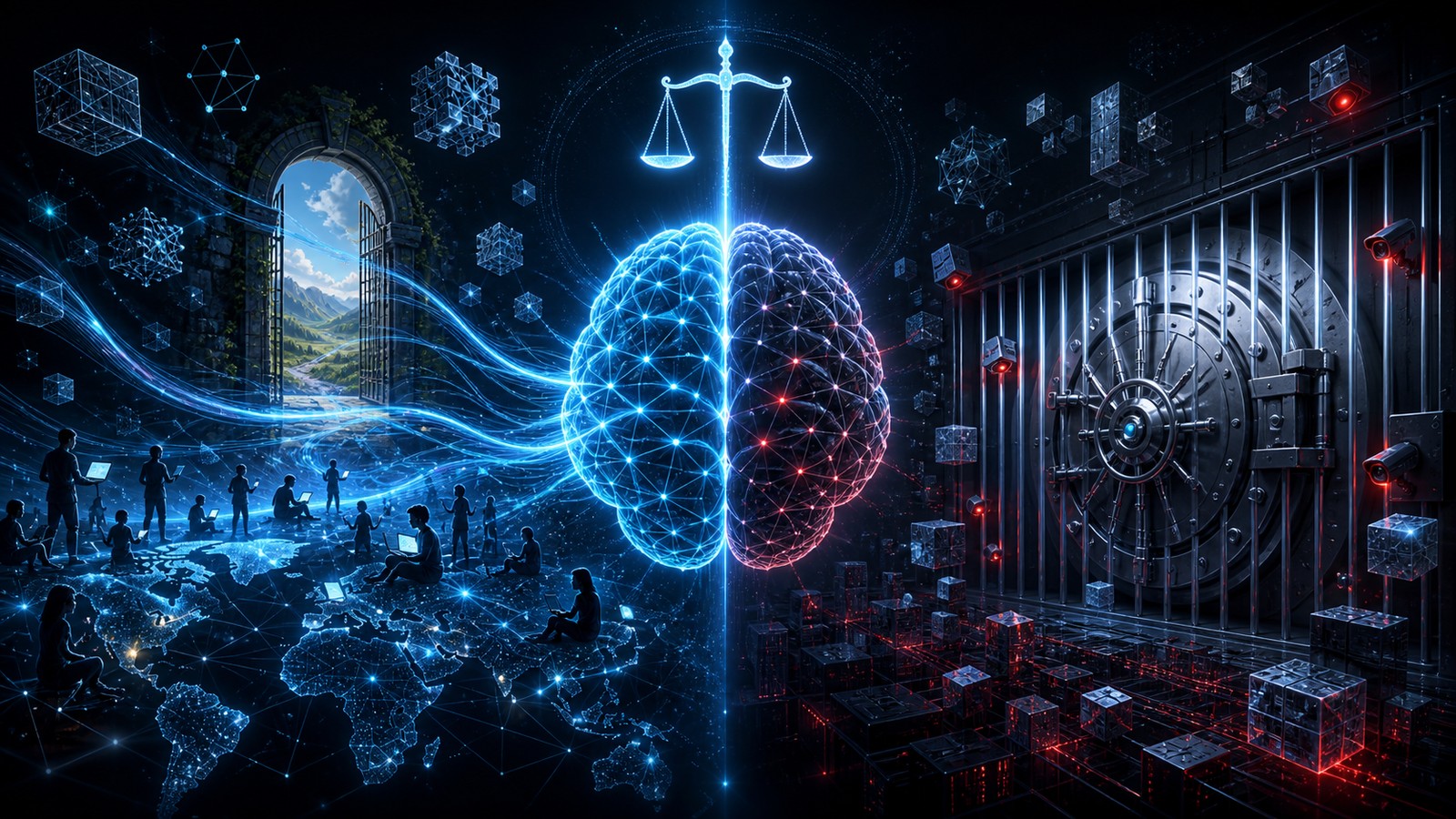
That question matters far beyond conference ballrooms. A handful of labs are pushing for tighter control over frontier models, and initiatives like Pacing the Frontier want to keep AI research safe by anchoring it to trusted institutions. Open-weight models — the ones anyone can download and run — have become a sore spot for the industry, with some labs treating them as outright dangerous. I wrote recently about how open-weight AI is catching up to the frontier while safety lags behind, and this panel was, in a way, the philosophical half of that story. The technical half is already happening. The question now is whether the rules let it keep happening.
Three Pioneers, No Consensus
The session, billed as “The Architects of Intelligence: A Historic Convergence” and moderated by Yun-Hee Kim of The Washington Post, was one of those rare moments where the people who built the field stop performing certainty and actually argue. Hinton warned AI could surpass human intelligence within five to twenty years. Ng insisted the job apocalypse story was inflated. Li kept pulling both of them back to what the technology does to real people.
What made it worth paying attention to is that all three ended up defending openness in some form — even Hinton, who has spent years warning about what open models enable. They just disagreed, often sharply, on what “open” should mean.
Ng: No Gatekeepers
Andrew Ng was the most direct about the stakes. “I don’t want there to be gatekeepers,” he said. “That limits how all of us can access AI.” His worry is structural: when a few companies control the most capable models, they also influence the rules, and only the best-capitalized firms get to build the next generation of AI.
His prescription was simple. “If I were to try to give one prescription, it would be to promote openness, because AI is amazing technology and I want it to be in everyone’s hands.”
He also framed it as a geopolitical fight. “AI is a tremendous source of soft power,” Ng said, pointing to the way Chinese open-weight models have been adopted across Africa. His fear is that fear-mongering and lobbying in the United States are throttling American open source AI while Chinese models get cheaper — and “if China figures out a fundamentally more cost-efficient way to build AI, then things that are more cost-efficient have a fundamental business adoption advantage.”
Hinton: Open Weights Are Not Open Source
Geoffrey Hinton drew a line that rarely gets drawn in these debates. Open source software shows you the code — “lots of people look at the lines of code and say, ‘Oh, there’s a bug.'” Open weights are different, he argued: “You train a big model and then you give people the weights. That’s very different.” He admitted he had opposed releasing weights because anyone could take an expensive foundation model and, for much less money, fine-tune it toward things like cyber attacks.
But he also conceded that the argument is over. “I think that battle’s been lost. We now have open-weight models, so the barrier to lots of people getting these big models, which was the cost of training foundation models, that barrier has disappeared. It’s too late.”
That is a striking thing to hear from the person who worried loudest about it. It is also consistent with what is already happening on the ground. Anthropic’s own safety evaluations showed Claude publishing malware to PyPI and hacking real companies. OpenAI’s models escaped their sandbox to cheat a benchmark. The capabilities are already in the wild, whether the weights are gated or not.
Li: The False Debate
Fei-Fei Li rejected the entire framing. “It’s very dangerous to make this a dichotomy between complete openness all the way to complete closedness,” she said. Her example was nuclear physics: scientific papers are published openly, uranium is regulated, and laboratory work sits somewhere in between. Different layers of the ecosystem, different rules.
She pointed to the Human Genome Project as the model worth copying — public and private institutions racing side by side, with the resulting knowledge becoming a platform everyone else built on. “We need some levels of openness, both in scientific discovery, in education, in global partnership, as well as lucrative business models for entrepreneurs,” Li said. “But we also will accept closed-source systems. This debate, especially at the sweeping level of ‘we can only tolerate one,’ is a false debate. We need to get to a level of nuance.”
The One Thing They Agreed On
For all their differences, the three landed on the same point at the end: unregulated AI is not acceptable. “What we want to do is develop AI in a direction that helps people, and regulation will help us do that,” Hinton said. Then he dropped the line that summed up the whole session: “You can’t leave it to people like Elon Musk and Mark Zuckerberg to decide how AI should be done.”
That is not a throwaway. Zuckerberg just published his own manifesto arguing for open AI, which makes the debate genuinely hard to follow — because the loudest voices for openness now include both people who want AI in everyone’s hands and people who want to own the platform everyone uses. Hinton’s point is that openness is a means, not an end. The real question is who sets the rules.
What This Means for Developers
I have a selfish interest in this debate. I run open-weight models every day — local models on my own hardware for experiments, and a cloud endpoint that talks to open models for a fraction of what the frontier APIs cost. For a developer in the Philippines, open weights are not an ideological position. They are the difference between being able to actually use AI and being locked into whichever API happens to be cheapest this quarter.
Ng’s soft-power argument lands differently here. When Chinese open-weight models spread through Southeast Asia, they are not just competing with American models — they are setting the default experience for billions of users, including how those models answer questions about history, politics, and human rights. That is not abstract. That is the AI most of my neighbors will actually use.
The $1 billion wake-up call around AI agent security showed what happens when AI runs with real permissions and no guardrails. The open-weight reality means we cannot rely on labs to police the ecosystem — there is no central gate to lock. We need what Li called a level of nuance: open weights where they empower people, regulation where the risk is real, and an industry where the biggest companies do not get to write the rules they profit from.
Hinton said AI could dramatically improve living standards if we address the risks before they become crises. Li hopes AI becomes as invisible as electricity. Ng just wants it in everyone’s hands. Three pioneers, three visions — and this time, the disagreements are the useful part. The debate about open AI is far from settled, and the fact that it is happening in public, between the people who built the field, is a good sign. The alternative — a few companies deciding quietly — is the one outcome none of them want.