
XPeng just gave Filipino buyers a date to circle. The Chinese brand behind some of the most talked-about EV tech is officially launching in the Philippines on September 25, and it’s bringing two cars with it: the L03 crossover and the X9 seven-seat MPV.
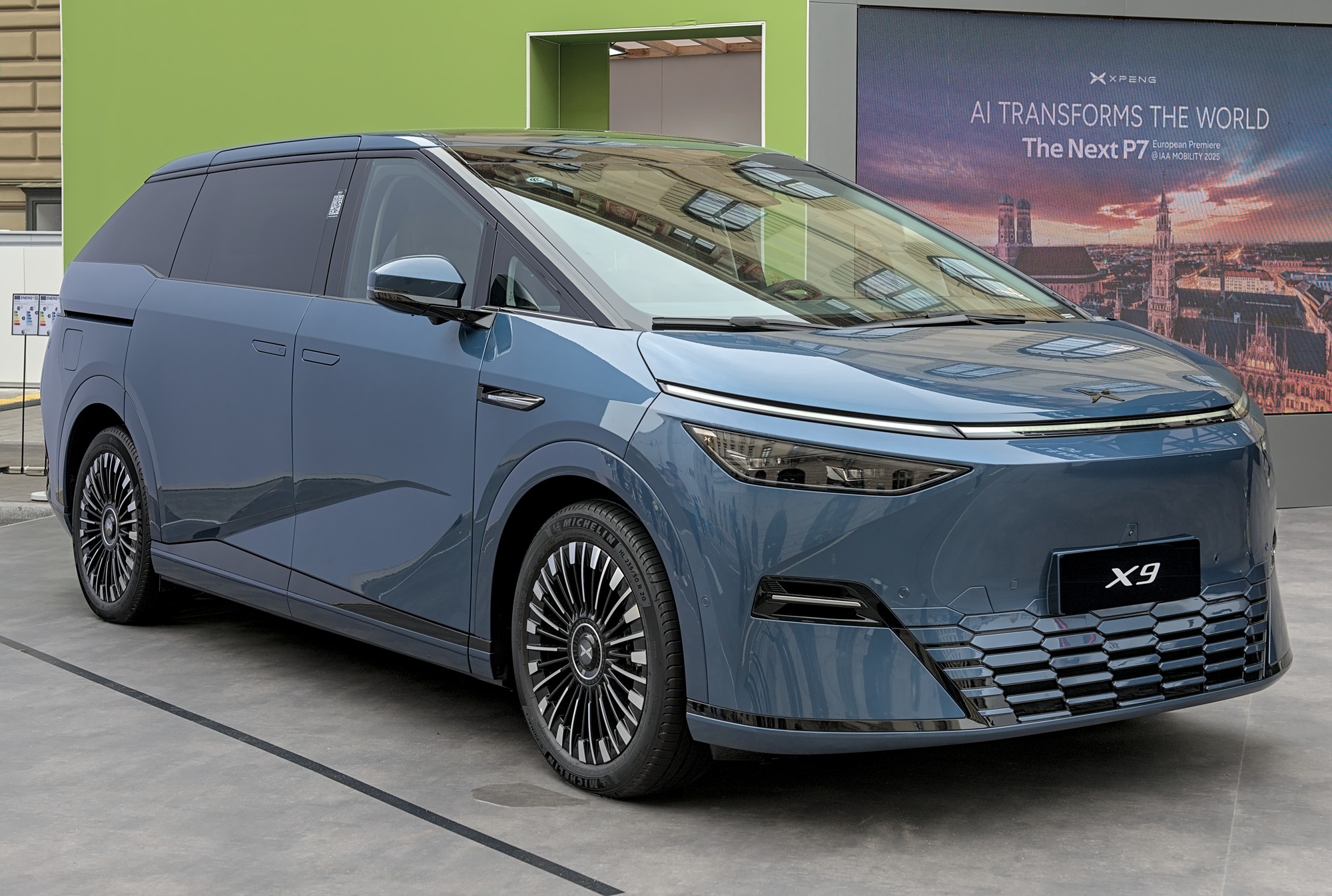

I flagged back in August that XPeng was lining up for a Philippine entry. Now it’s real — a public launch event, a direct national subsidiary, and the first local test drives of the self-driving technology are all locked in. Here’s what’s coming.
XPeng L03: The Tesla Model Y Rival
The L03 is a coupe-styled crossover, a bit longer than a Toyota RAV4 but shorter than a Model Y — 4,650 mm long and 1,920 mm wide. It was designed as a global car from the start, not a China-market model that got exported later, which is why it’s a strong candidate for our roads.
Per the DOE listing, the Philippines is set to get two fully electric variants of the L03, plus a range-extended version. The REEV option is the interesting one for long-distance Filipino drivers, because it pairs a battery with a small engine generator and reads ~1,300 km combined.
XPeng L03 key specs (DOE PH listing)
| Spec | L03 EV Standard | L03 EV Long Range | L03 REEV |
|---|---|---|---|
| Motor | Single rear, 245 PS / 264 Nm | Single rear, 245 PS / 264 Nm | Single motor, 245 PS / 264 Nm |
| Battery | 69 kWh LFP | 71.2 kWh LFP | 37.2 kWh LFP + 1.5L generator |
| Range | Up to 530 km (NEDC) | Up to 600 km (NEDC) | 315 km EV / 1,300+ km combined (CLTC) |
| Max DC charging | 193 kW | 236 kW | 236 kW |
| 10-80% time | ~20 min | ~20 min | ~20 min |
| Drivetrain | RWD | RWD | RWD |
| 0-100 km/h | ~7.5 sec | ~6.6 sec | Not published |
| Seats | 5 | 5 | 5 |
A quick note on the numbers: the DOE figures use NEDC, which is more generous than the WLTP cycle used in Europe, where the Long Range is rated at 520 km. Either way, this is comfortably enough for a full week of Metro Manila commuting on a single charge.
XPeng X9: The Premium People Mover
The X9 is the other half of the launch pair — a full-size, seven-seat electric MPV aimed squarely at the luxury people-mover crowd. It’s the kind of car you’d cross-shop against a GAC GN8 PHEV, a Denza, a Zeekr, or a premium petrol van, if you were moving a family or a business around in comfort.
It rides on air suspension with a height range of roughly 130 to 220 mm, has rear-wheel steering to tighten the turning circle, and in Long Range FWD form carries up to 95 kWh usable of a 110 kWh NMC pack, good for about 600 km on the WLTP cycle. There’s also an AWD Performance version rated near 370 kW with a faster sprint.
XPeng X9 key specs (EVKX / Xpeng data)
| Spec | X9 FWD Long Range | X9 AWD Performance |
|---|---|---|
| Drivetrain | FWD, one motor | AWD, dual motor |
| Power | 235 kW / 320 hp | ~370 kW |
| Battery | 110 kWh gross / 95 kWh usable NMC | 110 kWh gross |
| Range | Up to 600 km WLTP | ~580 km WLTP |
| Max DC charging | ~300 kW+ | ~300 kW+ |
| Seats | 7 (captain’s chairs 2nd row) | 7 |
| Suspension | Air, 130-220 mm adjustable | Air |
| Rear-wheel steering | Standard | Standard |
I’m being careful with the X9 charging and range figures here because official PH specs haven’t been locked yet — those are international figures (EVKX database and Xpeng’s own EU data) that the local launch should confirm. What’s clear is the positioning: an AI-heavy, tech-forward electric MPV with serious range.
The real story: this is a self-driving tech company
Here’s where XPeng separates itself from the growing crowd of Chinese EVs. It doesn’t want to be known as just another car brand — it wants to own the “AI mobility” conversation. Its in-house Turing AI chip, cameras, radar, and heavy visual-perception software add up to a driver-assistance system called NGP (Next Generation Pilot).
Philippine motoring journalists actually drove this before the launch. The Manila Times took the L03 through busy Guangzhou traffic and came away genuinely impressed — the car handled motorcycles squeezing into the lane with smooth, early braking instead of reacting like a startled student driver. Top Gear PH called XPeng’s self-driving tech “scarily impressive,” noting acceleration was prompt, the ride well-supported, and the autonomous braking “almost elegant.”
One honest caveat, repeated by every outlet that drove it: at launch, the L03 and X9 will only offer Level 2 driver assistance — adaptive cruise control, lane centering, auto lane change, parking assist, and the usual active safety kit. No full autonomous motoring on EDSA, and nobody should expect the car to drive itself. The higher-tier NGP functions are planned to roll out later through over-the-air updates, subject to Philippine regulations and road testing. But because the hardware — cameras, radar, processors — is already in the cars, the capability can improve through software rather than making you buy another vehicle.
XPeng X9 and L03 price in the Philippines
Final Philippine pricing lands at the September 25 launch, but indicative figures have already floated out. The L03 is expected at under P2 million, and the X9 around P4.5 million. Here’s what that looks like across currencies, using roughly 61.7 PHP/USD and 95.5 INR/USD:
| Model | PHP (est) | USD (est) | INR (est) |
|---|---|---|---|
| XPeng L03 | ~P1,900,000 (est, under P2M) | ~$30,800 | ~Rs 29.4 lakh |
| XPeng X9 | ~P4,500,000 | ~$72,900 | ~Rs 69.6 lakh |
An exchange-rate sanity check is worth it before you make any buying plans — I used the BSP-area rate for the conversion. The L03 under P2M puts it in direct competition with the Tesla Model Y L and mid-market Chinese SUVs like the Denza B5, while the X9 at P4.5M goes after the premium electric MPV and luxury van space.
Is the L03 right for Filipino driving?
City driving
This is where the L03 shines. Instant torque, a smooth ride, and light steering make stop-and-go EDSA traffic far less tiring. Its size is manageable in Metro Manila — slightly shorter than a Model Y — and 530 km of NEDC range means a week of commutes on one charge, even with aircon running in summer.
Long-distance travel
The pure EV versions will do Manila to Baguio and back on a single charge with margin. But the REEV variant is the real long-distance answer — with a combined range past 1,300 km, range anxiety basically disappears on Baguio, Batangas, or Bicol runs, and the ~20 minute 10-80% DC stops on NLEX/SCTEX keep the pure EVs practical too.
Flooded streets
Here’s the honest weak spot. An EV has no hydrolock risk, but ground clearance is the limiting factor. The L03 sits lower than your typical SUV — that’s the tradeoff of a coupe crossover — so you should treat deep floodwater the same way you would in any sedan: don’t attempt it. The X9’s air suspension can raise itself, but I’d still be cautious in Marikina- or Taguig-style floods. No EV is a submarine.
High temperatures
XPeng uses LFP chemistry on the L03 variants, which is more thermally stable in hot climates, and NMC on the X9’s big pack. Battery thermal management matters more than ever in Philippine 35°C-plus weather, and the liquid-cooled systems here handle it — but the REEV and fast-charging do add heat, so it’s worth parking in shade and not hammering DC charging back-to-back. It’s the same discipline as any modern EV.
XPeng Philippines: direct subsidiary, no franchise partner
One thing that sets XPeng apart from most Chinese brands arriving here: it’s coming in through a direct national subsidiary — XPeng Philippines — handling sales, marketing, distribution, and retail itself, rather than through a local franchise partner. That’s a real signal of long-term commitment — a path the Electric Vehicle Industry Development Act opened for fully foreign-owned EV distribution, the same structure I walked through in my XPeng G9L deep dive. Expect a proper retail presence rather than a fly-by-night import operation.
Bottom line
XPeng is arriving late to a very crowded Philippine EV party — BYD, Geely, MG, GAC, Jaecoo, VinFast, and the established Japanese and Korean names are all fighting for the same buyers. Its edge isn’t a cheaper badge; it’s the software. The L03 and X9 are handsome, well-built, competitively priced cars that happen to sit on properly impressive self-driving foundations.
If you’re the kind of buyer who’s been watching the electric wave and wanting something that feels a generation ahead on tech, September 25 is worth waiting for. Just remember the Level 2 caveat — the fancy autonomous stuff will taste better once local regulators and the OTA updates catch up, which is the same rollout story I traced in the XPeng G9L coverage. For battery chemistry in hot climates, my LFP-versus-NMC batteries explainer is a good companion read.