
XPENG, the Chinese AI mobility company, officially entered the Philippine market on September 25, 2026, with a six-variant lineup spanning two models: the flagship X9 seven-seat MPV and the L03 SUV coupe. The launch at the SM Mall of Asia Arena marked the most aggressive single-brand EV entry into the country yet — with prices starting at P1,548,000 and deliveries expected to begin in the fourth quarter of this year.

I have been watching XPENG’s global expansion for a while now, and the Philippine debut feels like a watershed moment. This is not another Chinese EV brand testing the waters with a single model. XPENG brought a complete lineup, a clear pricing strategy, and a technology story that directly challenges the Korean and Japanese brands that have been dominating our EV conversation.
The X9: A Seven-Seat MPV With Supercar Charging
The X9 is XPENG’s flagship — a seven-seat electric MPV that competes directly with the likes of the GAC GN8 PHEV and the Hyundai Ioniq 9. Both Philippine variants use a 110 kWh NCM battery paired with a front-mounted electric motor producing 235 kW (315 hp) and 450 Nm of torque. The claimed WLTP range is up to 615 kilometers, which would make it one of the longest-range EVs available in the country.
But the headline number is the charging speed. The X9 sits on an 800-volt silicon carbide platform that accepts peak DC charging of 542 kW. XPENG claims a 10-to-80 percent charge in about 12 minutes under optimal conditions. To put that in perspective, that is faster than any EV currently on sale in the Philippines — the Kia EV3, which I covered earlier, peaks at around 128 kW on its 400V platform.
The X9 also gets active rear-wheel steering, which gives it a 5.4-meter turning radius — remarkable for a vehicle that measures over 5.3 meters long. Dual-chamber air suspension, a powered third row that folds into the floor, and cargo space that expands from 721 liters to 2,554 liters round out the practicality story.
X9 Specifications
| Motor | Front electric motor |
| Power | 235 kW (315 hp) |
| Torque | 450 Nm |
| Battery | 110 kWh NCM |
| Range | Up to 615 km WLTP |
| DC Charging | Up to 542 kW, 10-80% in ~12 min |
| AC Charging | 7 kW wall charger (included) |
| Drive | Front-wheel drive |
| Length | 5,300+ mm |
| Wheelbase | 2,850 mm |
| Turning Radius | 5.4 m (active rear-wheel steering) |
| Cargo | 721 L (all seats up) / 2,554 L (3rd row folded) |
| Seating | 7 seats |
| Warranty | 5-year bumper-to-bumper, 8-year battery/motor |
The L03: An SUV Coupe With Range Options
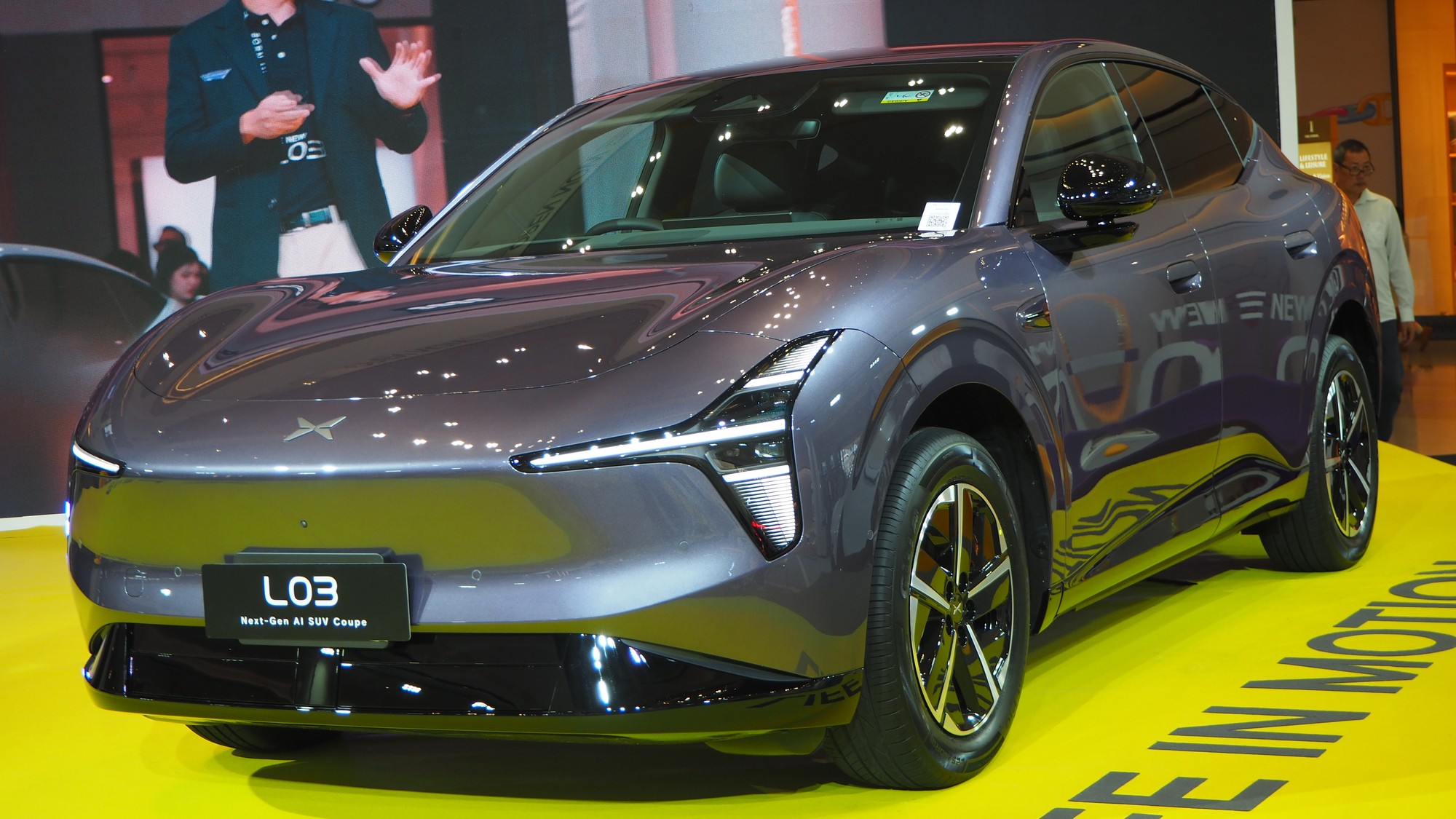
The L03 is the more accessible model — a five-seat SUV coupe with a drag coefficient of 0.228. It comes in four variants: three battery-electric and one range-extended (REEV). The entry-level EV Standard Range uses a 58.3 kWh LFP battery for up to 445 km of WLTP range, while the Long Range steps up to 71.1 kWh for 520 km. The range-topping Long Range Ultra uses the same 71.1 kWh pack but is rated at 480 km — likely due to additional equipment and weight.
All L03 variants drive the rear wheels and support DC fast charging from 10 to 80 percent in about 20 minutes. The REEV variant is the interesting one: it pairs a 37.2 kWh battery with a 1.5-liter gasoline engine that acts purely as a generator, giving 215 km of electric-only range and a combined WLTP range of up to 1,017 km. That is a compelling option for buyers who are not ready to go fully electric but want the EV driving experience for daily commutes.
L03 Specifications
| Motor | Rear electric motor (RWD) |
| Power (Standard Range) | 222 hp (166 kW) |
| Power (Long Range/Ultra) | 249 hp (186 kW) |
| Torque | 280 Nm |
| Battery (Standard Range) | 58.3 kWh LFP |
| Battery (Long Range/Ultra) | 71.1 kWh LFP |
| Battery (REEV) | 37.2 kWh + 1.5L generator |
| Range (Standard Range) | Up to 445 km WLTP |
| Range (Long Range) | Up to 520 km WLTP |
| Range (Ultra) | Up to 480 km WLTP |
| Range (REEV combined) | Up to 1,017 km WLTP |
| DC Charging | 10-80% in ~20 min |
| AC Charging | 7 kW wall charger (included) |
| Drive | Rear-wheel drive |
| Length | 4,650 mm |
| Wheelbase | 2,850 mm |
| Cargo | 539 L |
| Seating | 5 seats |
| Warranty | 5-year bumper-to-bumper, 8-year battery/motor |
Pricing and Variants
XPENG’s Philippine pricing is aggressive. The L03 starts at P1,548,000 for the EV Standard Range, which undercuts the Kia EV3’s P1,898,000 price tag by P350,000. Here is the full lineup:
- L03 EV Standard Range: P1,548,000
- L03 REEV: P1,598,000
- L03 EV Long Range: P1,698,000
- L03 EV RWD Long Range Ultra: P2,058,000
- X9 Long Range: P3,858,000
- X9 with Second Row Premium Seat Package: P4,058,000
All variants come with a five-year bumper-to-bumper warranty, an eight-year warranty for the battery and electric motor, and a free 7 kW wall charger. X9 buyers also get five years of free preventive maintenance and roadside assistance. Reservations are open now — P25,000 for the X9 and P10,000 for the L03 — through XPENG’s four dealerships in Greenhills, Makati, North EDSA, and Cebu.
3-Currency Pricing
| Variant | PHP | USD | INR |
|---|---|---|---|
| L03 EV Standard Range | P1,548,000 | ~$24,700 | ~Rs 23.8 lakh |
| L03 REEV | P1,598,000 | ~$25,500 | ~Rs 24.6 lakh |
| L03 EV Long Range | P1,698,000 | ~$27,100 | ~Rs 26.1 lakh |
| L03 EV RWD Long Range Ultra | P2,058,000 | ~$32,900 | ~Rs 31.7 lakh |
| X9 Long Range | P3,858,000 | ~$61,600 | ~Rs 59.4 lakh |
| X9 Premium Seat Package | P4,058,000 | ~$64,800 | ~Rs 62.5 lakh |
Exchange rates: 62.64 PHP/USD, 96.41 INR/USD (open.er-api.com, October 6, 2026). USD and INR figures are approximate conversions.
Philippine Driving Analysis
City driving: The L03’s compact dimensions (4,650 mm long, 2,850 mm wheelbase) make it well-suited for EDSA traffic and tight Makati parking. The REEV variant is particularly interesting for Manila — 215 km of electric range covers a full workweek of commuting, and the generator eliminates range anxiety for longer trips. The X9, despite its size, benefits from rear-wheel steering that makes U-turns and tight parking less stressful than its dimensions suggest.
Long-distance travel: The X9’s 615 km range easily covers Manila to Baguio (250 km) with room to spare. The L03 Long Range’s 520 km is similarly comfortable. For provincial trips where charging infrastructure is still thin, the L03 REEV’s 1,017 km combined range is the safest bet — you can drive the entire way on gasoline if needed, while still enjoying electric propulsion for the city portions.
Flooded situations: Neither model has published ground clearance figures or wading depths for the Philippine market. The X9’s air suspension may allow for increased ride height, but this is speculation. As with any EV, the battery pack is sealed and there is no engine intake to hydrolock — but wading through deep floodwaters is never advisable. The L03’s lower ground clearance (typical for a coupe-SUV) is a concern during typhoon season.
High temperature: The X9 uses an NCM battery, which is more thermally sensitive than LFP. The L03’s LFP chemistry is inherently more stable in the Philippines’ 36-38°C heat. Both vehicles have liquid-cooled battery systems, but the air conditioning load in our climate will reduce real-world range by 10-15 percent. The X9’s 800V platform is more efficient at managing heat during fast charging, which is a real advantage during long drives.
What Others Are Saying
International reviews have been positive. CarsGuide in Australia called the L03 “one of the strongest cars in the mid-priced small to medium SUV segment for range and charging.” The X9 has been praised for its charging speed and interior technology, though some reviewers note that the third row is tighter than in conventional MPVs. The L03’s REEV variant has been highlighted as a smart offering for markets where charging infrastructure is still developing — which sounds exactly like the Philippines.
The Bigger Picture
XPENG’s entry is part of a broader wave of Chinese EV brands entering the Philippines. The MG S5 EV launched in August, the GAC GN8 PHEV arrived in July, the Kia EV3 just landed in September, and the Geely Monjaro EM-i is coming in October. But XPENG is different — it is not just selling cars, it is selling an AI-driven mobility ecosystem. The brand’s focus on intelligent driving, over-the-air updates, and its own charging network sets it apart from the more traditional manufacturers.
The L03 REEV, in particular, might be the smartest choice for Filipino buyers. It offers the EV driving experience without the charging anxiety, at a price point that undercuts most competitors. If XPENG can deliver on its promise of 12-minute charging for the X9 and 20-minute charging for the L03, it will set a new benchmark for EV ownership in the Philippines.
Deliveries begin in the fourth quarter of 2026. If you are in the market for an EV this year — whether it is the Mazda CX-80 PHEV or the new XPENG lineup — there has never been a better time to go electric — especially the L03 REEV at P1,598,000. It might just be the most practical electric vehicle to hit our shores yet.