
Kia’s smallest electric crossover just got one step closer to Philippine showrooms. The Kia EV3 has appeared on the Department of Energy’s list of recognized EVs, with two variants listed — a strong sign that a local launch is coming before the year ends. That’s a bigger deal than it sounds, because this is the EV that took home the 2025 Electrifying Car of the Year award in Europe and a 10/10 score from one of the UK’s most respected EV reviewers.
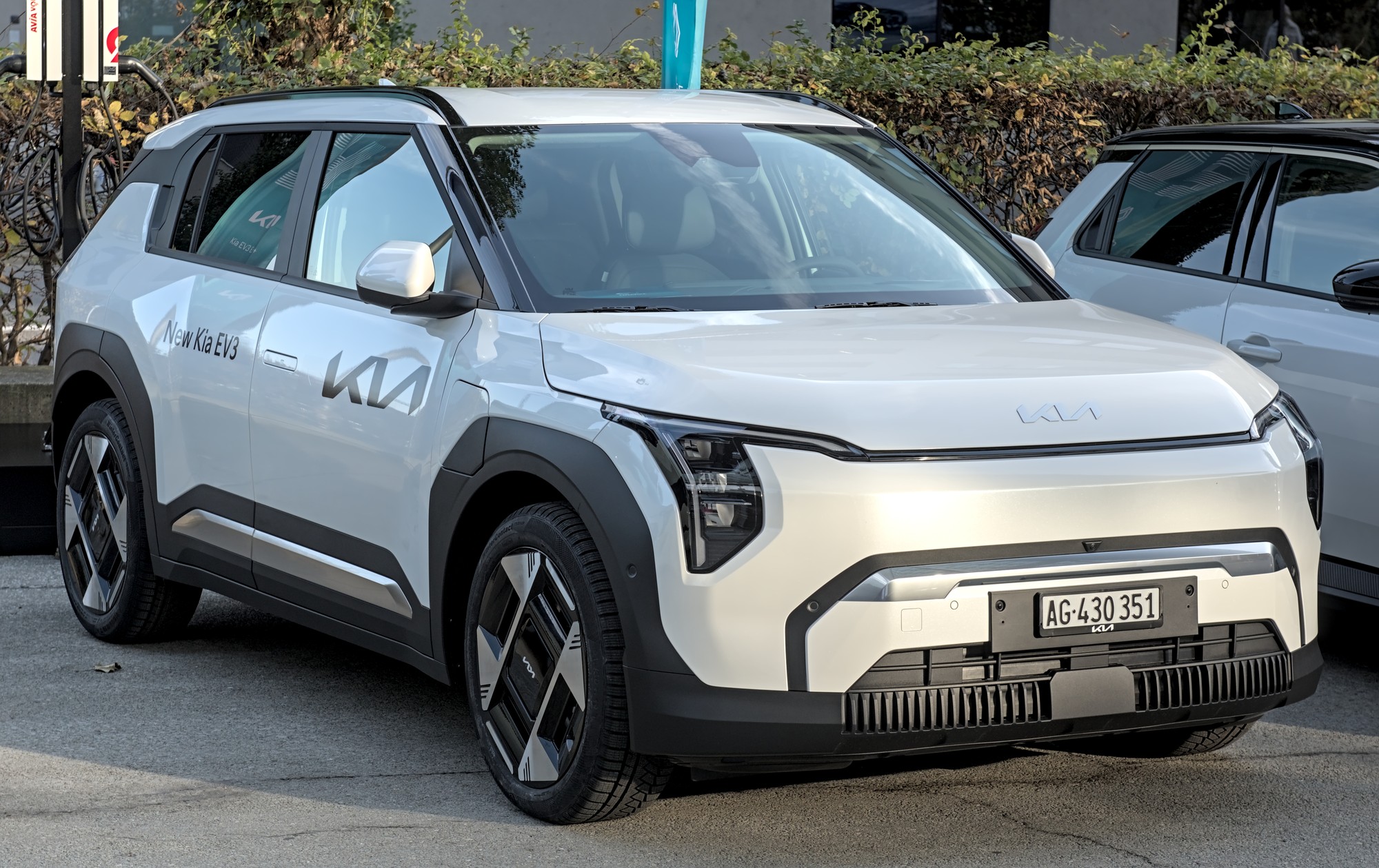

So what do we actually know about the EV3’s Philippine specs, how much it might cost, and — the question every Filipino driver cares about — how will it handle EDSA traffic, provincial roads, floods, and 36-degree heat? Let’s dig in.
What’s the news? DOE recognition signals an EV3 launch
Back in June, Kia Philippines (under ACMobility) confirmed at the 2026 Philippine International Motor Show that the EV3 and the PV5 electric van would arrive locally before the end of 2026. The Sportage Turbo Hybrid kicked things off in July. Now, the EV3 has popped up on the DOE’s list of recognized EVs — the same regulatory step every compliant EV passes before hitting the market.
The DOE listing confirms two variants for the Philippines: GL and GLS. Both use a 58.3 kWh battery pack with a single front-mounted motor producing 150 kW (204 PS) and 283 Nm of torque. That’s the same powertrain found in the EV3 Standard Range sold in other markets, which achieves up to 436 km of WLTP range.
Kia EV3 Philippine specs at a glance
| Spec | Value |
|---|---|
| Variant | GL, GLS (DOE-listed) |
| Motor | Single permanent-magnet synchronous, front-wheel drive |
| Power | 150 kW / 204 PS |
| Torque | 283 Nm |
| Battery | 58.3 kWh lithium-ion (NMC), 400V architecture |
| Range (WLTP) | Up to 436 km |
| 0-100 km/h | 7.5 seconds |
| Top speed | 170 km/h |
| AC charging | 11 kW (10-100% in about 5 hours) |
| DC fast charging | Up to ~128 kW (10-80% in roughly 29-31 minutes) |
| Vehicle-to-Load | Yes, up to 3.6 kW |
| Length / Width / Height | 4,300 / 1,850 / 1,560 mm |
| Wheelbase | 2,680 mm |
| Ground clearance | 140 mm |
| Approach / Departure angle | 17.2 / 22.2 degrees |
| Infotainment | Dual 12.3-inch displays, Kia Assistant voice, wireless Apple CarPlay & Android Auto |
One note on that charging figure: some local articles mention 350 kW DC capability, but the EV3 is a 400V-platform car — real-world fast charging tops out around 128 kW, per Kia’s own specs and independent tests from EV Database and Autocar. Still, 10-80% in about half an hour is perfectly usable here.
What the international reviewers say
The EV3 didn’t just get good reviews — it swept awards. Auto Express gave it 4.5 out of 5 and named it their 2025 Small Company Car of the Year, praising the long range, practical boot, and comfortable ride. What Car? crowned it Best Small Electric SUV at the 2026 awards and gave it a perfect 100% reliability score in their survey. Autocar called it “hugely competent” and made it Best Electric Car at the 2025 Autocar Awards.
Even the toughest critics found little to fault. Top Gear’s UK team wrote that the EV3 is “roundly, crushingly competent in the same way a Golf used to be,” and Electrifying.com — which gave it a 10/10 — said it remains their favorite compact family EV even a year after winning their Car of the Year award. The common thread in every review: strong range, sharp pricing, and interior space that feels bigger than the footprint suggests.
Reviewers do flag a few things: it’s not the most exciting car to drive hard, rear-seat comfort is average, and the heat pump is reserved for the top trim in Europe. For Philippine buyers, those are minor concerns compared to the range and tech on offer.
Price: what will the Kia EV3 cost in the Philippines?
Official local pricing hasn’t been announced yet, so let’s be straight about that — everything below is an estimate based on how Kia prices its EVs here. The EV5, Kia’s larger compact SUV, launched in April at P2,298,000 for the GL and P2,698,000 for the GLS. The EV3 sits one class below the EV5 and uses a smaller 58.3 kWh pack, so a realistic local price lands around P1.9 million to P2.15 million.
| Variant (est.) | PHP | USD (approx.) | INR (approx.) |
|---|---|---|---|
| Kia EV3 GL (estimated) | ~P1,950,000 | ~$31,760 | ~Rs 30.4 lakh |
| Kia EV3 GLS (estimated) | ~P2,150,000 | ~$35,020 | ~Rs 33.5 lakh |
| Kia EV5 GL (official SRP) | P2,298,000 | ~$37,430 | ~Rs 35.8 lakh |
Conversions at ~61.4 PHP/USD and ~95.7 INR/USD (early August 2026). Estimates are ours, not official SRP.
That positions the EV3 right in the middle of a very competitive segment — cheaper than the EV5, but pricier than the value-driven Chinese EVs that have been flooding the market. It’s the classic trade-off: the Chinese options like the Geely EX2 and the BYD Seal 5 DM-i undercut it on price, while the Kia brings a Korean brand’s reputation, a rock-solid warranty, and that European-tested refinement.
How it compares to the current EV field
| Model | Type | Price | Range |
|---|---|---|---|
| Kia EV3 (est.) | BEV compact crossover | ~P1.95M-2.15M | 436 km WLTP |
| Geely EX2 Pro | BEV hatchback | P938k | 395 km |
| BYD Atto 2 DM-i | PHEV SUV | P998k (intro) | 1,340 km combined |
| MG S5 EV | BEV SUV | ~P1.3M | 415 km |
| JAECOO J5 EV | BEV SUV | P1.399M | 461 km |
| BYD Atto 3 | BEV SUV | P1.598M | 480 km |
| Kia EV5 GL | BEV compact SUV | P2.298M | ~400 km |
The EV3’s real competition is probably the BYD Atto 3 and the MG S5 EV rather than the sub-million-peso crowd. Those two undercut it by a few hundred thousand pesos, but the Kia fights back with a bigger brand footprint, dealership network, and the EV5’s success locally showing that ACMobility knows how to price and support Kia EVs.
Kia EV3 for Filipino driving conditions
City driving: near-perfect
This is where the EV3 shines. At 4.3 meters long, it’s compact enough for Makati parking and BGC’s tight basement ramps, and the instant torque means you’ll be first off the line at every EDSA stoplight. The 436 km WLTP range translates to well over 300 km in real city traffic with stop-and-go driving — that’s easily two weeks of commuting between charges for most people. The dual 12.3-inch displays and wireless CarPlay make daily use genuinely pleasant. One-pedal driving with adjustable regen is great for bumper-to-bumper conditions, which EV reviewers consistently highlight.
Long-distance travel: doable with planning
Manila to Baguio is about 250 km — the EV3 can do that run on a single charge with margin to spare, even with the elevation climb. Manila to Batangas, Subic, or even Tagaytay round trips are all comfortably within range. The honest caveat is DC fast charging infrastructure: chargers exist along the major expressway corridors now, but they’re still concentrated in Metro Manila and key provincial cities. For the occasional long provincial trip, plan a 30-minute charging stop — the EV3’s ~128 kW peak means you’ll be back on the road quickly.
Flooded situations: the usual EV caution
Here’s the honest part. The EV3 has 140 mm of ground clearance — that’s actually higher than the BYD Seal 5 DM-i’s 120 mm, but it’s still sedan-ish territory. Like any low EV, you don’t want to be wading through flooded EDSA underpasses or those notorious Quezon City streets after heavy rain. The upside of electric is there’s no intake to hydrolock and no exhaust to clog — but ground clearance, not the battery, is your limiting factor. If flood-prone areas are a daily reality for you, this isn’t the vehicle for it; a taller SUV would be wiser.
High-temperature conditions: battery tech matters
The Philippines is hot, and EV batteries care about heat. The EV3 uses an NMC battery with active liquid thermal management — the same chemistry and cooling strategy Kia has proven across the EV6 and EV9 in hotter markets. NMC packs deliver better energy density than LFP, which is why Kia squeezes 436 km from a relatively small pack. The trade-off is that NMC is more sensitive to extreme heat than LFP — the packs in the BYD Seal 5 DM-i and other Chinese EVs. That said, Kia’s thermal management is mature, and the fact that the EV3 topped What Car?’s reliability survey with zero reported faults says a lot about long-term durability. The liquid cooling also keeps DC fast charging fast even on a hot afternoon — something I look at closely whenever I’m evaluating an EV for Philippine conditions, and it’s the same reason battery tech is such a huge piece of the EV conversation in general.
Bottom line: should you wait for the Kia EV3?
If you’re shopping for a compact EV and you value brand confidence, interior quality, and proven reliability over the absolute lowest price — yes, it’s worth waiting for the official launch. The EV3 is the rare EV that won European Car of the Year-style awards and backed it up with a 100% reliability score. If your budget is strictly under P1.5 million, the BYD Atto 2 and MG S5 EV remain the pragmatic picks.
It’s also nice timing for the segment itself. The government’s EV Incentive Strategy, signed in late July, signals that electrification is a national priority now, not a niche. Watching ACMobility roll out the EV3 — right after proving itself with the EV5 — feels like watching a boxer move up a weight class: methodical, well-executed, and hard to bet against. Even more exciting is seeing Filipino brands step into the same ring, like Francisco Motors’ first electric SUV, the Elektron. Competition at every price point is good news for anyone planning to go electric.
I’ll update this post the moment Kia Philippines announces official EV3 pricing and the launch date. Until then, the EV3 is one of the most compelling “coming soon” EVs on the Philippine market — and the DOE listing tells us it’s a lot closer than “soon.”