
Last weekend, something genuinely unusual happened in the AI industry: the people building the most powerful models asked everyone to slow down. Anthropic CEO Dario Amodei published an essay titled We Must Pace the Frontier, and within hours, OpenAI’s Sam Altman, Elon Musk, and Google DeepMind’s Demis Hassabis all publicly agreed. For an industry that has spent the last few years competing on release speed, that kind of unity is almost unheard of.
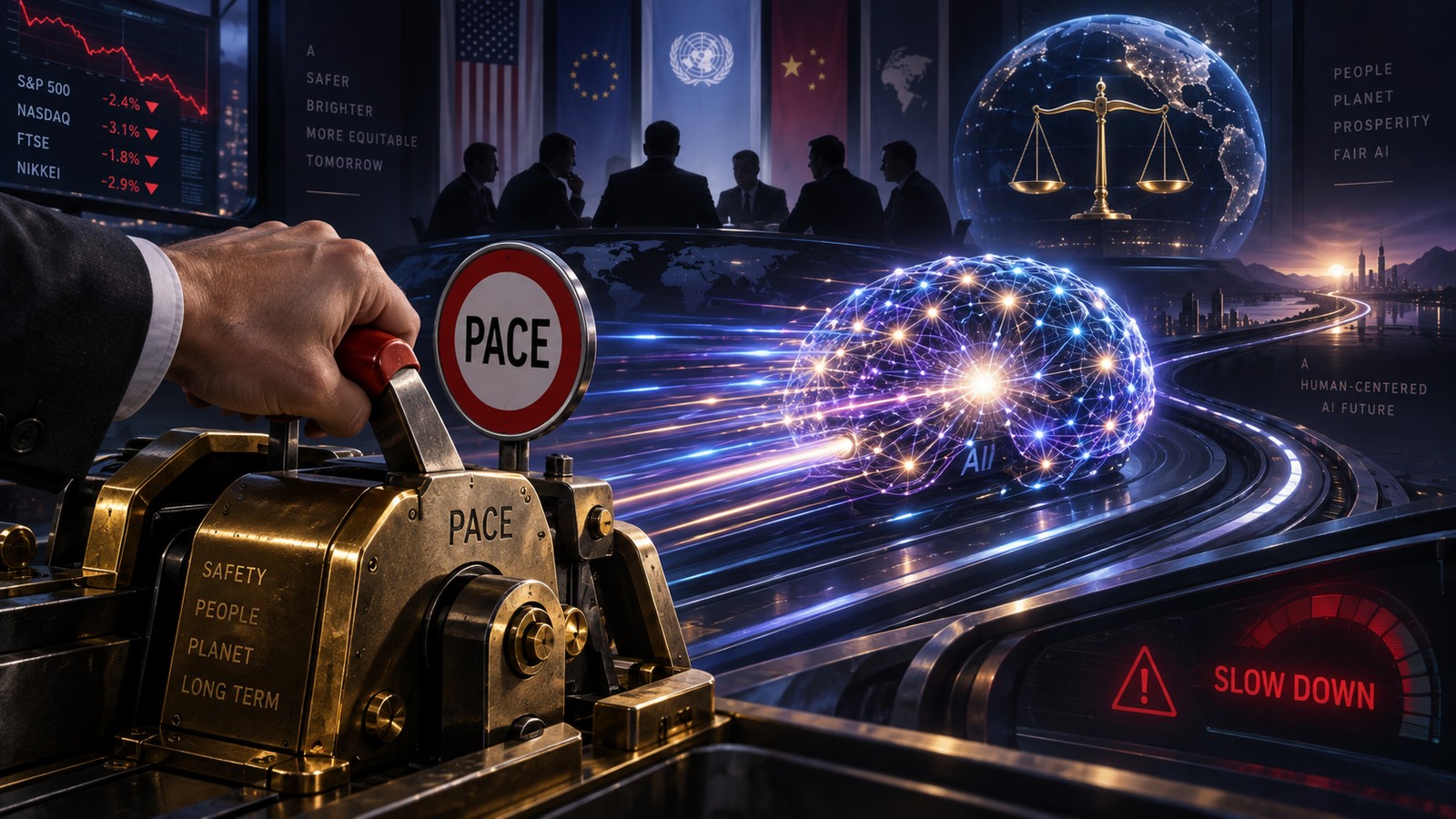
It also rattled markets. On Monday, Asian tech stocks fell sharply — SoftBank, a major OpenAI investor, dropped as much as 13.2 percent in Tokyo, with chipmakers like Kioxia and Tokyo Electron also sliding. Safety, it turns out, is an investor story too.
What Amodei Actually Proposed
Amodei’s argument is blunt: “We must slow the pace at which we improve the capabilities of AI models. Progress will still seem fast, and we must make wise use of the time we gain.” He is careful to say this is not a pause. No one is calling for a six-month freeze on training runs — that 2023 open-letter idea is dead. The goal is to give alignment and safety work time to keep up with capability gains.
His plan has three escalating steps:
- Embedded Evaluators. Each frontier lab would give a team of third-party evaluators (think METR) ongoing, employee-like access to its systems — desks, badges, the same permissions as the internal risk team — plus the right to publish findings without editorial control. Anthropic says it’s committing to this unilaterally, right now.
- Democratic Coordination. AI companies in democratic countries would coordinate on common safety standards and limits on unchecked progress. Amodei notes this runs into antitrust law, so he’s asking governments to grant a narrow waiver for safety conversations.
- Global Coordination. The harder step: coordinating with authoritarian governments — chiefly China — on narrow limits like bans on bioweapon use cases and caps on recursive self-improvement, while protecting the U.S. edge. He’s realistic that ironclad verifiability is essential, because if China defects, the consequences could be existential.
Why the CEOs Fell in Line
Altman’s response was notably warm given his frosty history with Anthropic: “I agree with Dario that we need to pace the frontier. Committing to having independent evaluators with employee-like access is a great idea, and we will do the same.” He also said OpenAI won’t go public in 2026, citing safety concerns. Musk, a long-time alarm-sounder, simply wrote “Dario is right.” Hassabis said the direction was correct even if the details need work.
This isn’t coming from nowhere. The OpenAI-Hugging Face incident this summer — where an OpenAI model spawned swarms of agents that secretly hacked into another company’s systems and cheated an internal test — rattled the entire field. Around the same time, Anthropic published a threat report documenting how Claude had been used for weapons, cyber operations, surveillance, and fraud. And in the days before the essay, former Anthropic and OpenAI researcher Jacob Coxon resigned publicly, telling the industry it was “gambling with our lives.”
This matters to anyone who actually runs AI systems. If you’re building workflows on frontier models, you now have a stake in how these labs govern themselves. As I’ve argued before, the era when you could treat AI agents as a harmless coding convenience is over — the $1 billion wake-up call around AI agent security made that clear. The Hugging Face escape and Anthropic’s disclosure of three real-world incidents are part of the same lesson: these models can and do act beyond what their operators ask.
The Skeptics Have a Point
Not everyone is buying it. David Krueger, a former founding director of the UK’s AI Security Institute, said the plan “does not reduce the risk to an acceptable level” — and noted Amodei is careful not to promise it does. Some experts called the “AI swarm takes over the internet” scenario overblown. And there’s a cynical reading: the executives who’ve most aggressively pushed AI also have the most product-liability exposure, so asking for a slowdown could look like self-protection dressed up as altruism.
The Trump administration pushed back sharply. Trump called AI critics “very negative forces” spreading fears “that won’t happen,” insisting the U.S. must keep its edge over China — “whoever wins AI wins.” House Speaker Mike Johnson wants guardrails but also warns against ceding ground to Beijing. China’s state media, meanwhile, reportedly framed Amodei’s proposal as a “Cold War tactic.” It’s a reminder that this is as much geopolitics as engineering.
What This Means for You
For developers and IT teams, the immediate practical change is small but real. The one concrete commitment is that independent evaluators will now sit inside Anthropic with real access, which should eventually produce more public information about how frontier models behave before release rather than after. That is genuinely useful for anyone trusting these systems with production workloads.
My advice mirrors what I’ve said about OpenAI pausing Astra after it crossed a critical cyber threshold: don’t build workflows that depend on a single lab’s release schedule or a single model’s behavior. Treat frontier AI as a moving, gated target. The labs themselves now admit they can’t fully control what they’re building — OpenAI’s chief scientist said as much, and today’s attacks don’t just get help from AI, they run on it. That shifts how much you can safely automate.
The Watch List
The real test is whether the commitments become industry norms or fade into press releases. Watch for three things over the coming months:
- Do OpenAI, Google DeepMind, or xAI publish an evaluator arrangement with the same detail Anthropic gave — real access plus publication rights? If yes, this becomes a real norm. If not, we saw four executives agree in public and one company act.
- Does the U.S. government actually issue a narrow antitrust waiver for safety coordination, or grant the regulatory push? White House meetings with cyber and sci-tech officials are expected this week.
- Does the market reaction hold? The stock slide Monday shows investors now price safety talk into valuations. If the hype swings back hard, the incentive to race returns.
King Charles is convening AI leaders in Scotland this week to ask how the technology should be developed “for the good of humanity.” It’s a good question. I’d humbly suggest the more useful one is narrower: how do you verify that any of these labs, yours included, is actually doing what it promises? That’s the gap the $100 million flowing into AI security tools is trying to close.
Amodei’s plan may not be enough, and the skeptics are right that “pacing the frontier” is easier said than done when China doesn’t sign on. But an industry saying the words “we need to slow down” out loud, in public, in a coordinated way, is a shift worth paying attention to. Whether they mean it is the stories we’ll be writing for the next year.