
Oppo K14 Lite Review: A 7,000mAh Battery Is the Entire Pitch
Oppo’s K series in India is turning into a crowded shelf. You’ve got the Oppo A7 Pro and the K14 on the Dimensity 6300, the K14x below it, and now the K14 Lite joining the family on September 16. On paper it looks like another budget mid-ranger with a giant battery — 7,000mAh inside a body Oppo promises will stay smooth for three years and hold its charge for six. But here’s the twist worth knowing before you get excited: the K14 Lite is essentially the Oppo A6c wearing a K-series name.
I’ll unpack what that actually means, because a rebrand isn’t automatically a bad buy — it can be a good value if the price lands right, or a confusing duplicate if Oppo asks too much. Let me walk through the K14 Lite piece by piece and settle where it belongs.
Design & Build Quality
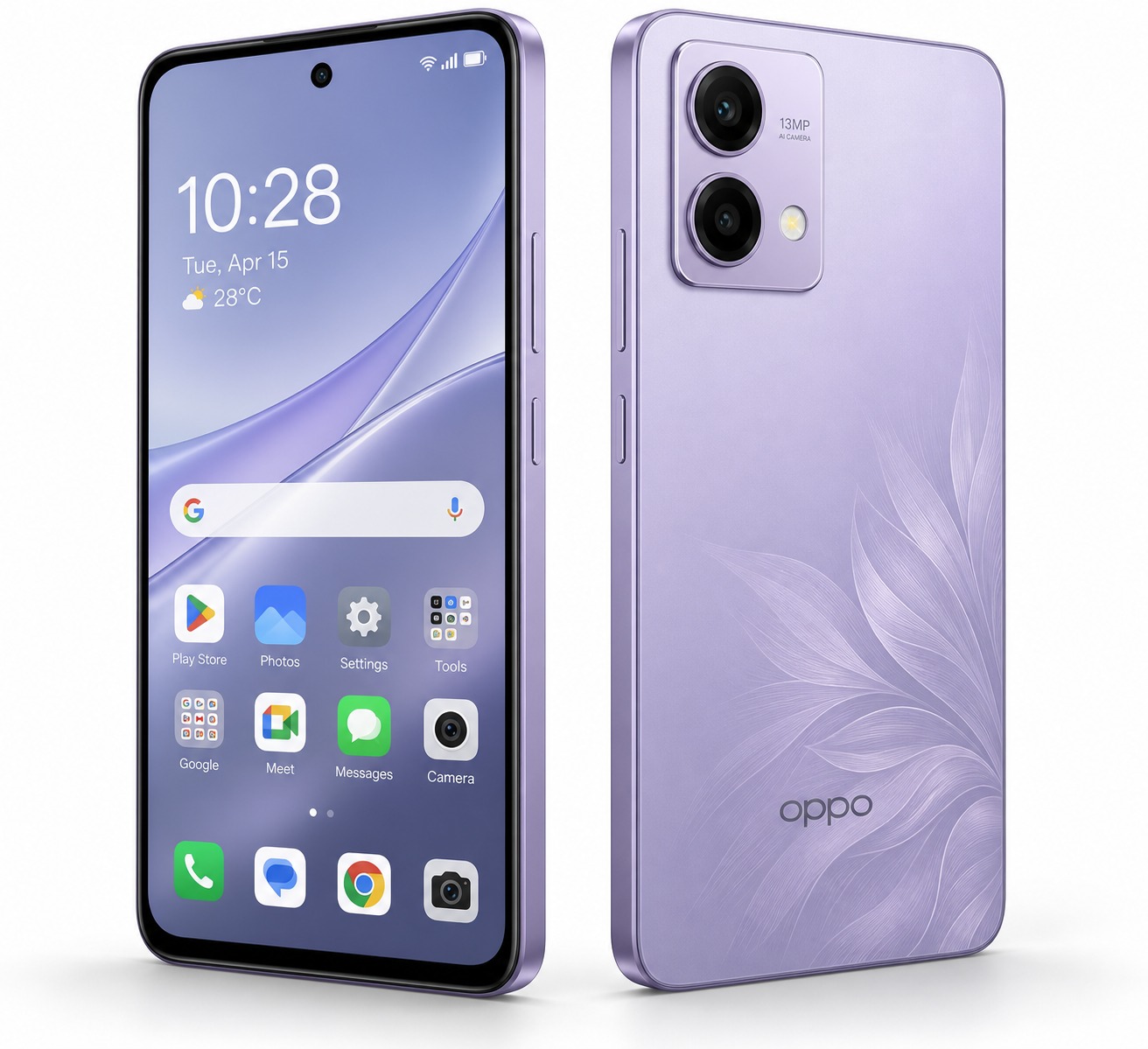
The K14 Lite is a flat-slab budget phone, and it doesn’t pretend otherwise. You get a 6.75-inch LCD with a punch-hole selfie camera, a frame that’s clearly built to a budget, and a plastic back available in Feather Purple or Stone Brown. The purple finish has that subtle flowing leaf motif on the lower half that gives it a little personality in an otherwise ordinary silhouette. In the hand it’s light-ish and easy to grip one-handed, no precious-metal build here — but for the asking price range you’re not expecting any.
The durability story is the real highlight. Oppo rates the phone IP64 for dust and splash resistance, which is more than most phones at this price, and it adds a “Splash Touch” mode so the screen stays responsive when your fingers are wet or oily — handy if you use your phone in the kitchen or get caught in a downpour. It’s a modest step up from phones that give you nothing here, and it fits the endurance-first positioning. The two colorways, Feather Purple and Stone Brown, are simple but the purple’s leaf-like detailing keeps it from being anonymous.
Display
You’re looking at a 6.75-inch HD+ LCD running at 720 x 1570 pixels with a 120Hz refresh rate. The 120Hz panel is genuinely nice to have at this price — scrolling through social feeds and menus feels noticeably smoother than the 60Hz screens on older budget rivals.
The honest caveats: it’s an LCD, so black levels and contrast don’t match AMOLED panels, and the HD+ resolution comes in well below the FHD/1.5K screens you’ll find on pricier mid-rangers. Fine for reading, messaging, and video at arm’s length; not the panel you want if crisp text and vivid color are your priority.
Performance
Under the hood is a Unisoc T7250 octa-core chipset paired with 4GB of LPDDR4X RAM, expandable to 8GB via Oppo’s virtual RAM feature. Storage runs to 64GB or 128GB of UFS 2.2 with a microSD card slot for more. In day-to-day terms, this is entry-level silicon — fine for messaging, browsing, camera apps, and light games, but not a phone for heavy multitasking or demanding titles. This is the same class of hardware powering other budget endurance phones we’ve covered, and it behaves exactly as you’d expect for the money.
Oppo backs the phone with a three-year smoothness protection promise, which is a softer way of saying “we’ll try to keep it feeling fast for three years.” Treat that as a manufacturer claim rather than a guarantee. The 4GB physical RAM is the thing to watch — even with virtual RAM, you’ll feel app reloads if you bounce between several heavyweight apps. Budget buyers who want smoother multitasking should be ready to manage their app habits, or stretch to a higher-RAM model. For the core use case of one or two light apps at a time, it copes.
Camera
Around the back there’s a 13MP main camera with an f/2.2 aperture plus a secondary depth sensor, and a 5MP front camera for selfies. Software additions include AI Eraser, Face Retouch, Night Mode, and Portrait Mode. In good light the main sensor captures serviceable, colorful shots for the price — fine for WhatsApp, social uploads, and casual snaps.
Set expectations low for anything else. Low-light shots will lean on Night Mode and still show noise, there’s no ultra-wide camera, and video quality is basic. The 13MP main is the whole imaging story, and that’s acceptable at a budget price but not a selling point. If the camera matters to you, shop a tier up. The depth sensor mostly helps lock the border in portrait mode; there’s no real separation capability beyond that.
Battery & Charging
This is the headline, and it’s a monster: a 7,000mAh cell with a six-year battery durability claim. Oppo quotes roughly 26.8 hours of video playback and a huge standby figure, and the big capacity means real-world multi-day endurance for moderate users. For a battery-first buyer, this is the K14 Lite’s entire reason to exist, and it slots into the same endurance-first camp as phones like the Poco M8 Power that built a whole argument around battery over everything else.
The flip side is charging: just 15W. That’s slow — a full refill on a 7,000mAh battery will take a while, and it’s a real letdown compared to the 33W-45W and up you’ll find on battery-focused rivals like the vivo Y31t or Redmi Note 17 Pro Max. The philosophy seems to be “charge rarely because the battery is huge,” and if you plug in overnight that’s workable. But if you regularly need a fast top-up mid-day, the 15W cap will frustrate.
Software
The K14 Lite runs ColorOS 16 on Android 16. That’s the current Oppo skin, and it brings the usual suite of customization options, app cloning, and Oppo’s own tools. Navigation is the familiar three-button or gesture system, and ColorOS keeps things clean out of the box — no aggressive bloatware at this tier, just Oppo’s own apps you can mostly set aside.
Oppo’s commitment here is the standard “three years smoothness” phrasing rather than a firm OS-upgrade count, which is modest next to the 4-6 year promises Samsung and Realme make on budget phones. If long-term Android updates are a deciding factor for you, the K14 Lite’s transparency about that is worth weighing against rivals that commit to more.
It’s worth noting which Oppo family this actually sits in. The K14 and K14x are 5G phones on MediaTek Dimensity silicon. The K14 Lite is a different class — a 4G-only handset on a Unisoc chip — which Oppo is slotting into the K lineup for battery-first buyers who don’t need 5G. That’s fine, but it means the “Lite” name is doing more work than the hardware suggests.
Pros and Cons
| Pros | Cons |
|---|---|
| Enormous 7,000mAh battery for multi-day endurance | 15W charging is slow for a battery this size |
| 120Hz display makes the UI feel smooth | HD+ LCD lacks the sharpness and contrast of AMOLED |
| IP64 dust/splash resistance plus wet-touch support | 4GB base RAM and entry-level Unisoc chip limit multitasking |
| MicroSD expansion for storage | No 5G support in a year where it’s becoming standard |
| Honest budget value against the A6c baseline | 13MP camera only, no ultra-wide |
Should You Buy This?
Buy it if
- You want a multi-day battery life first and everything else second.
- You need a reliable, splash-resistant budget phone for everyday use and don’t care about 5G.
- You’re fine with entry-level performance and light camera use.
Skip it if
- You need fast charging — 15W on a 7,000mAh cell is slow to refill.
- You want a sharp AMOLED screen, an ultra-wide camera, or heavier multitasking.
- You’re on a 5G plan and want a future-proof phone.
Final Verdict
The Oppo K14 Lite is a phone with one dominant strength and a checklist of compromises around it. The 7,000mAh battery is genuinely class-leading for the price and, paired with IP64 durability and a smooth 120Hz display, makes this a solid pick for anyone who mainly wants a phone that lasts all day and then some without asking for much else.
The hardware being a rebrand of the Oppo A6c is the key thing to know before you pay. If Oppo prices the K14 Lite in line with — or below — the A6c’s ~₹13,999-16,999 range, the rebrand is basically a free refresh you can enjoy in Feather Purple. If it lands meaningfully higher, you’re paying a premium for a different name on the same chassis, and you’d be better off grabbing the A6c itself or a battery rival like the Oppo A7 Pro.
As long as Oppo sells it at a sensible budget price, the K14 Lite earns its place for battery-first buyers who don’t need 5G. Everyone else — anyone wanting faster charging, a better screen, or real camera depth — is better served a tier up, and you can see how it stacks against the rest of the budget field in our Top 10 Phones to Buy in 2026 guide.