
This is about as incremental as a phone refresh gets. The Samsung Galaxy A08 4G is starting to appear at retailers, and against the A07 it replaced, almost nothing has changed except the size of the battery and the durability rating. If you follow budget phones closely, the A07 4G already told you most of this story. The A08 takes the same well-worn recipe and makes it last longer between charges.
Early retail listings put the A08 at around AED 625 to AED 659 in the UAE, or roughly $170 to $180. That a big-footprint device with a 6.7-inch screen, 6,000mAh battery, and a six-year update promise lands at this price is what makes it interesting. As a point of reference, the Galaxy A07 5G launched locally at around ₱8,290 in the Philippines, so the A08 4G should land in a similar entry-level bracket wherever it rolls out. Samsung hasn’t set official pricing yet, so treat those figures as ballpark — but the intent is clear.
I got hands-on time with the A08 ahead of its wider rollout, and I’ll be honest up front: if you were hoping for a leap forward from Samsung’s cheapest A-series phone, this isn’t it. But if “a phone that just works, for several days, for not much money” is the goal, the A08 hits the mark. It ships with Android 17 and One UI 9 out of the box — current-generation software on a budget phone, the same One UI 9 Samsung is rolling out across the Galaxy S26 family — which is genuinely remarkable for a device at this price.
Design & Build Quality
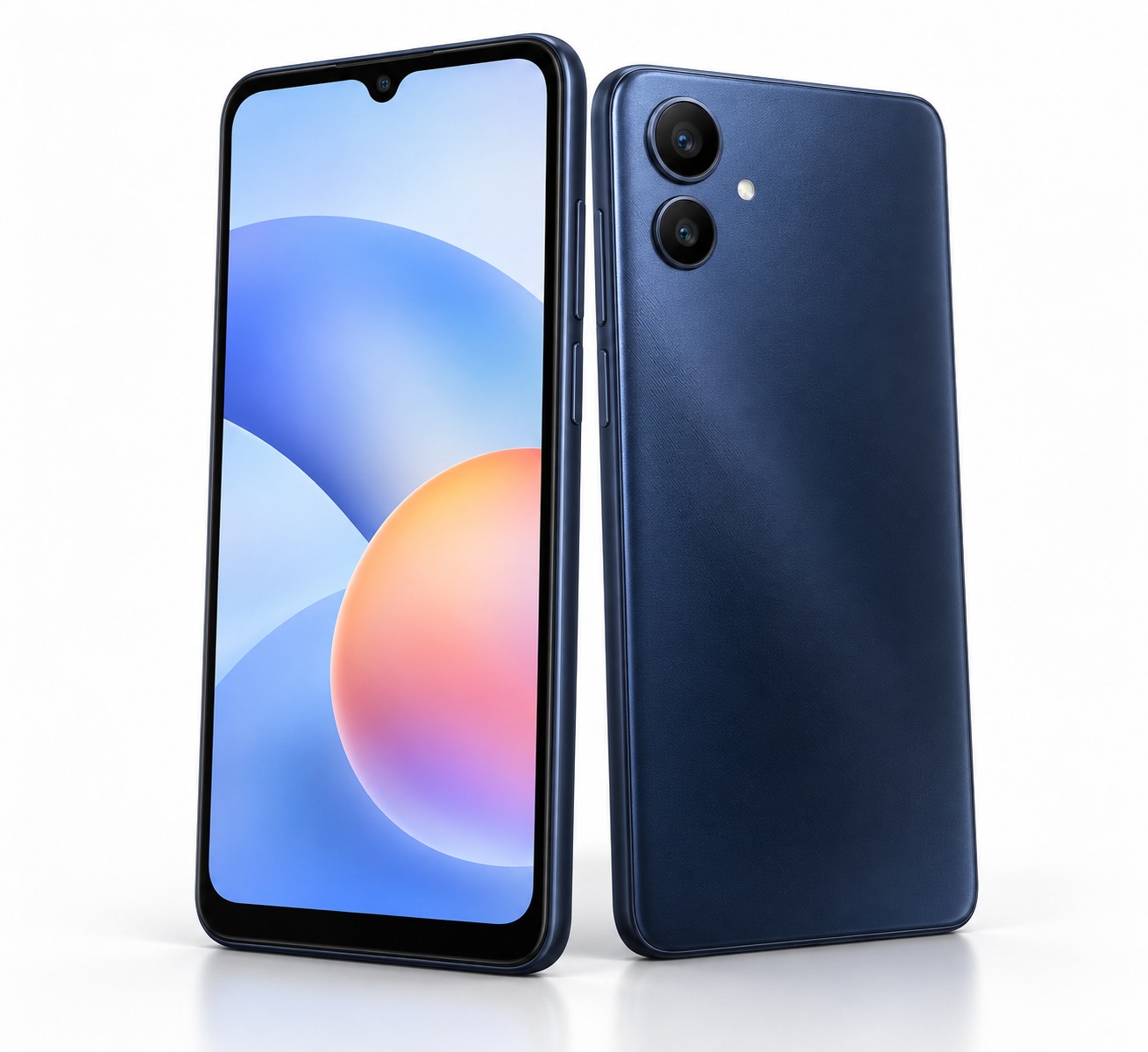
The Galaxy A08 looks like the Galaxy A07 because, structurally, it is one. Samsung has kept the same plastic frame, plastic back, and glass front, with the thick bezels and chunky bottom chin that define this entry tier. In hand it’s a touch chunkier than before — 8mm thick and 197g now, up from 7.6mm and 184g — because there’s a bigger cell inside.
The big change is the rating. The A07 was IP54, splash-resistant. The A08 steps up to IP64, which adds protection against dust particles getting in. Samsung also kept the dual-SIM setup with a hybrid slot, so you can use two SIMs or one SIM plus a microSD card. A side-mounted fingerprint reader, a 3.5mm headphone jack, and an FM radio are all present, which the ultra-thin flagships dropped years ago.
It comes in Navy Blue, Silver, and Green. All three are understated, no gradient tricks or flashy finishes — this is a phone that’s happy to be boring in the best way.
One thing worth calling out on durability: IP64 covers dust ingress and splash protection, but it’s not water-resistant enough to survive a drop in a pool. Rain and an accidental glass of water are fine; full submersion is not. Samsung has reserved proper IP68/69 waterproofing for its pricier A-series models, which is reasonable for the price point but worth knowing before you trust the rating.
Display
There’s a 6.7-inch PLS LCD panel at 720×1600 with a 90Hz refresh rate. That’s the same HD+ resolution and the same refresh rate as the A07, right down to the waterdrop notch that houses the front camera.
It’s not bright, and it’s not sharp by modern standards — 262ppi means you can see pixels if you look closely. But for the money, a 6.7-inch 90Hz screen is a real quality-of-life upgrade you simply didn’t get in this price bracket a few years ago. Notification scrolling and swiping through apps feel smooth enough, even if the low resolution shows up in fine text and small icons.
Outdoors under direct sunlight, the LCD does get washed out. You’ll be angling the phone to read it on a bright afternoon. That’s expected at this price, but worth knowing before you buy.
There is no always-on display and no always-on tap-to-wake shortcut that relies on an OLED — everything here is lit by the whole backlight, the same way budget LCD phones have always worked. It’s not a complaint so much as a reminder of where this screen sits in the pecking order. If you’ve only ever used a mid-range AMOLED, the A08’s panel will feel noticeably more basic.
For a secondary phone, a work device, or a phone for a kid or a relative, the display is perfectly acceptable. It’s large, smooth enough at 90Hz, and does the job. Just don’t expect flagship-grade brightness or contrast at this price.
Performance
Powering the Galaxy A08 is the MediaTek Helio G99, a 6nm chip with an octa-core CPU (two Cortex-A76 cores at 2.2GHz and six Cortex-A55 cores at 2.0GHz) and a Mali-G57 GPU. Yes, it’s the exact same chipset Samsung used in the A07 4G.
For everyday use — messaging, social media, banking apps, video, the odd bit of light gaming — the G99 is fine. It’s a proven, dependable chip that doesn’t struggle with the basics. But it’s not fast, and it won’t age gracefully under heavy multitasking. Expect some stutter switching between demanding apps, and moderate games will run but with frame drops at high settings.
Avoid the base 4GB/64GB config if you can. The 6GB/128GB version is the one that’ll stay comfortable under Android 17’s memory appetite. Both expand via microSD, so storage rarely feels like a wall.
What you’re really getting here is predictability. The Helio G99 has now become a familiar sight across Samsung’s budget range, which means the kinks are long ironed out on this silicon. No surprise thermal issues, no mystery battery drains, no early bugs on day one. In the budget world, that boring stability is worth more than a spec-sheet that looks impressive on paper but runs hot in practice.
If gaming is a serious part of how you use a phone, this isn’t the one. The Mali-G57 handles casual titles like Candy Crush or Clash Royale without complaint, but anything heavier — think Genshin Impact or Call of Duty Mobile on higher settings — will chug. For the price, that’s the expected trade-off.
Camera
On the back there’s a 50MP main sensor at f/1.8 with a 2MP depth helper, and an 8MP front camera up top. Same trio as the A07, same expectations.
In good light, the 50MP main camera produces shots that are more than good enough for social media — decent detail, acceptable dynamic range, natural-enough colors. In low light, the lack of a dedicated night mode push means images get soft and noisy fast. There’s no ultrawide, and there’s no telephoto; this is strictly a point-and-shoot setup.
Video tops out at 1080p, which is fine for casual clips. If you mainly use your phone camera to capture quick moments and don’t mind the occasional grainy night shot, the A08 won’t disappoint. If photography is a priority, look further up the lineup.
There’s no dedicated night mode to speak of beyond what One UI 9’s auto scene optimizer does under the hood, and even then it leans on software rather than a dedicated larger sensor. The depth sensor on the back doesn’t add real bokeh quality — it’s the kind of auxiliary sensor budget phones use to fill out the spec sheet. Portrait mode exists and can blur backgrounds convincingly in good light, but edge detection shows its rough spots around hair and fine detail.
Front camera is an 8MP shooter, fine for video calls and decently lit selfies, nothing more. Video calling on GCash verification, Messenger, Zoom, or Google Meet will all look perfectly usable.
Battery & Charging
The headline change. The Galaxy A08 packs a 6,000mAh battery, up 20% from the A07 4G’s 5,000mAh (Samsung’s rated capacity is 5,830mAh, marketed as 6,000). That’s the single biggest upgrade here, and it pushes the A08 into true two-day territory.
Realistically, this phone will comfortably stretch into two full days of normal use — more if you’re a light user. That’s the strongest argument for buying it. The raw capacity puts it in the same conversation as the 10,000mAh monsters like the Redmi Note 17 Pro Max, though those chase even bigger numbers. Charging stays at a middling 25W, and there’s no wireless charging.
Software
This is where the Galaxy A08 actually surprises. It launches with Android 17 and One UI 9 out of the box — current-generation software on a truly budget device. Samsung is rolling One UI 9 out to the Galaxy S26 family around the same time, and having the latest OS on an entry-level A-series phone on day one is a rarity.
Samsung promises six years of OS upgrades and six years of security patches — the same six-year update commitment we praised on the Galaxy A27 5G. That turns a ₱9K-class phone into a real long-term investment. Buy it today and it’ll receive updates into 2032, which is remarkable in a bracket where some rivals ship with zero upgrade promises.
One UI 9 on a Helio G99 is not going to feel snappy. There will be bloatware and the occasional lag as animations run on a budget chip. But the software commitment alone justifies serious consideration.
Pros and Cons
| Pros | Cons |
|---|---|
| Big 6,000mAh battery, 2-day endurance | Same Helio G99, same performance as the A07 |
| Android 17 + One UI 9 on day one | Low-res HD+ LCD, not bright outdoors |
| Six years of OS and security updates | 25W charging, no wireless charging |
| IP64 dust protection (up from IP54) | No ultrawide or telephoto camera |
| 3.5mm jack, FM radio, microSD | Base 4GB RAM config feels light |
Should You Buy This?
Buy it if
- You want a cheap Samsung that keeps getting updates for the next six years.
- Battery life matters more to you than camera quality or raw speed.
- You value the 3.5mm jack, FM radio, and expandable storage that flagships dropped.
Skip it if
- You already own a Galaxy A07 4G — this isn’t a meaningful upgrade.
- You take a lot of low-light photos.
- You want a sharp, bright display or a 5G connection.
Final Verdict
The Samsung Galaxy A08 4G is a phone for a specific kind of buyer: someone who wants a dependable, budget Samsung with the longest possible software lifespan, and who plans to keep it for years. For that person, the bigger battery and the day-one Android 17/One UI 9 pairing are genuinely valuable, and the six-year update promise makes the base price easy to justify.
But there’s no escaping that this is a conservative refresh. The display, chipset, and cameras are identical to the A07, so if you already own last year’s phone, there’s no reason to upgrade. The A08 simply does the same job the A07 did, just for longer between charges.
If you’re out for the absolute best value at pocket-money prices and don’t care about the Samsung logo, the Infinix Hot 70 Pro 5G throws in 5G and a stronger durability rating for similar money, while the budget battle below is fierce. But if you want a no-fuss Samsung that will quietly outlast a phone twice its price, the Galaxy A08 is hard to argue with.