
Infinix rarely does boring phones. The Hot series has always been the brand’s loudest, cheekiest budget lineup, and the new Hot 70 Pro 5G leans all the way into that personality. It swaps last year’s AMOLED for a tougher, larger slab, adds 5G and IP68 water resistance, and throws in a rear LED “Cube” display that blinks messages and plays mini-games. It’s genuinely unusual. The question is whether the fun is worth what Infinix took away to pay for it.
Design & Build Quality
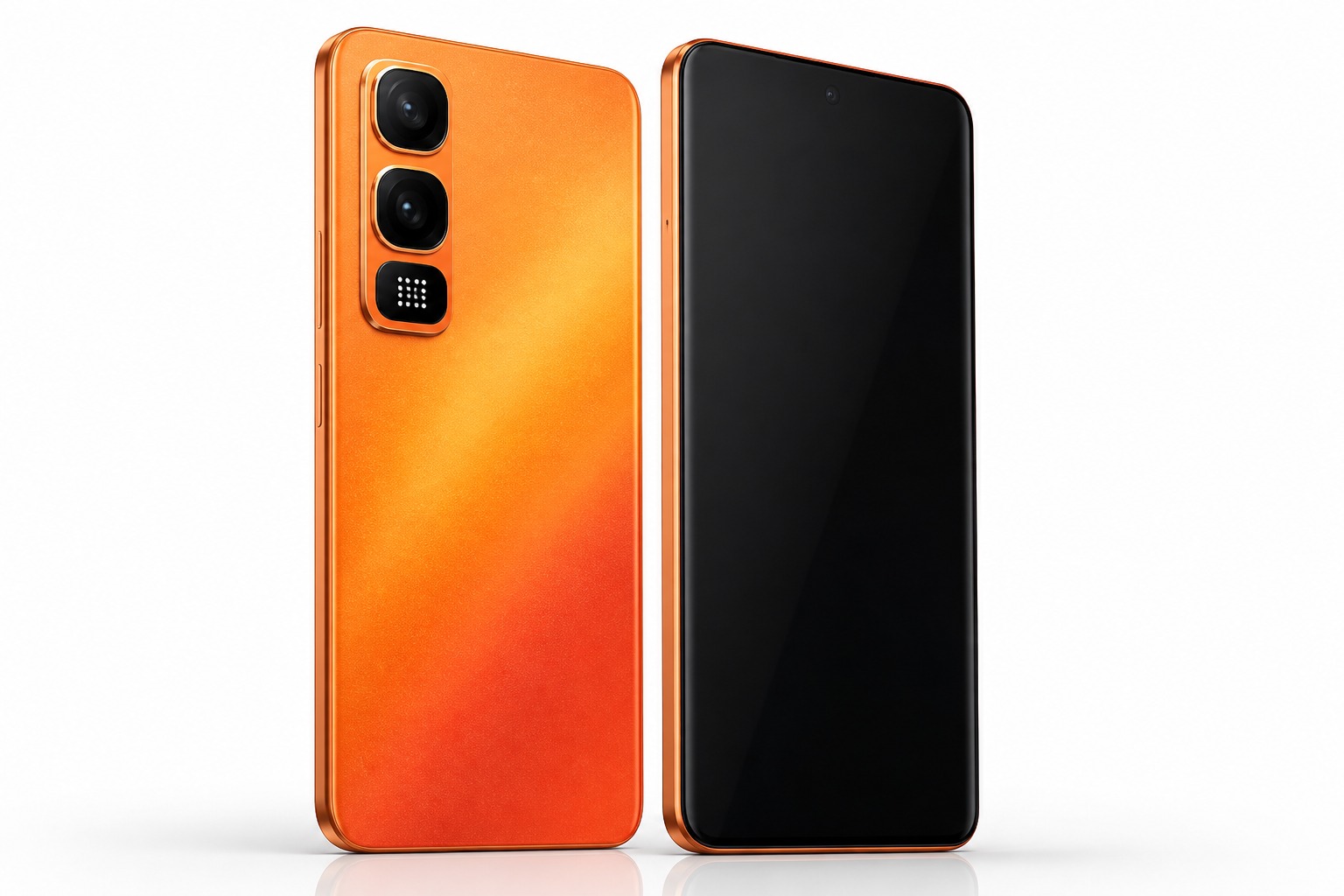
The Hot 70 Pro is where this phone earns its keep. The 6.76-inch screen sits in a 7.9mm-thick, 204g body that feels heavier than the specs suggest, but in a solid, reassuring way rather than a cheap one. The flat frame and slim profile give it a modern look that hides the budget price.
What really sets it apart is the back panel. There are six finishes, and three of them are borderline magic tricks. The showpiece Thermo Orange changes how deep its orange hue gets depending on temperature. Mirage Green is a vegan-leather finish with UV-reactive particles that light up like a night sky when you shine a light on it. Silk Glow Purple shifts texture as you tilt it. These are the kind of gimmicks you’d expect at double the price, and they’re the whole reason some people will buy this over a more boring spec sheet.
Durability is a real upgrade. The Hot 60 Pro managed IP64, which is splash-resistance at best. The Hot 70 Pro jumps to IP68 — dunkable up to 2 metres for 30 minutes — alongside a MIL-STD-810H compliance rating. Infinix isn’t specific about which MIL-STD conditions it tested, and a military rating is no guarantee of day-to-day shatterproofing, but for a budget phone to shrug off rain and drops this confidently is a genuine plus. It’s a more mainstream take on the ruggedness angle than the HONOR Turbo 5G pushes with its IP69K rating.
There’s even an AI button on the side. A short press can save a contact, create a calendar event, or fire off a Gmail. A long press summons Folax, Infinix’s assistant. It’s a welcome physical shortcut in a world where every budget phone has buried everything behind gesture swipes.
Display
Here’s the trade-off. The Hot 70 Pro ships a 6.76-inch IPS LCD at 1080×2344 with a 144Hz refresh rate and 950 nits peak brightness — while the Hot 60 Pro it replaces had a 1.5K AMOLED. That’s a visible step down in the thing you look at for hours every day, and owners of last year’s model have already called it out. An IPS LCD can’t match an AMOLED’s inky blacks, contrast, or punchy colours no matter how good it is.
In isolation, though, the panel is fine for the class. 144Hz keeps scrolling and animations smooth, the FHD+ resolution stays sharp enough on a 6.76-inch screen, and 950 nits is plenty bright to read outdoors. In my testing on a bright afternoon, the screen stayed legible in direct sunlight with the brightness pinned. It’s a competent LCD — it’s just a clear regression versus what the Pro tier used to offer. If you’re coming from an AMOLED phone, you’ll notice. If you’re coming from anything worse, you won’t.
There’s also no mention of a protective glass layer on the spec sheet, which is worth a note — last year’s model used Gorilla Glass 7i on the front, and the Hot 70 Pro doesn’t advertise any branded protection. Flag that as unconfirmed rather than a confirmed downgrade, but it’s worth a screen protector.
Performance
Under the hood is a MediaTek Dimensity 7100 (6nm), an octa-core chip with two Cortex-A78 cores at 2.4GHz and four A55 at 2.0GHz, paired with a Mali-G610 MC2 GPU. Infinix rates it around 780,000 in AnTuTu and claims up to 90fps in supported titles. This is a mid-range chip, not a gaming flagship — I’d temper the 90fps claim down to “smooth in lighter games, playable but not maxed in heavy ones.”
The bigger news is 5G made the leap into the Hot Pro series. The Dimensity 7100 has an integrated 5G modem, which is a meaningful step up from the LTE-only Helio G200 in the Hot 60 Pro. For a budget phone in 2026, having the modern network standard on board matters even in markets where coverage is still rolling out.
You get 6GB or 8GB of LPDDR4X RAM and 128GB or 256GB of UFS 2.2 storage, plus a dedicated microSD slot that doesn’t eat a SIM slot. UFS 2.2 is dated — rivals like the Redmi M100 have moved to faster storage — but the dedicated card slot is a small win for people who hoard offline content.
Camera
The rear setup is a 50MP IMX882 main (f/1.8, PDAF) with a secondary “aux” lens that Infinix doesn’t spend much time explaining, and an 8MP selfie shooter. The 8MP front camera is another visible cut from the Hot 60 Pro’s 13MP unit.
The main camera is the workhorse. In good light it produces sharp, punchy shots with Infinix’s typically aggressive colour processing — skies get bluer, greens get greener. There’s a 2x digital mode that’s really a crop of the 50MP sensor, and it’s usable if you’re not pixel-peeping. Low-light performance is respectable for the tier but nothing special; expect noise in dim corners and softer detail.
The 8MP front camera is the weakest link. It’s fine for video calls and social media selfies in good light, but it’s a clear downgrade versus last year and shows in soft skin detail. The second rear lens is the mystery box — it’s an auxiliary sensor of unspecified use, which is budget-phone code for “there for the looks” more than for photographic contribution. If camera quality is your priority, this tier has better options.
Battery & Charging
Battery is a strength. The Hot 70 Pro ships with either a 6,000mAh or 5,600mAh cell depending on the market, both with 45W wired charging. Infinix quotes 50% in 25 minutes and a full charge in 53 minutes for the 5,600mAh version. There’s also 10W reverse wired charging and a bypass-charging feature that lets you game while plugged in without roasting the battery. It’s not the tallest mountain in this corner of the market — the Poco M8 Power and Redmi Note 17 Pro Max chase bigger numbers — but it comfortably beats a full day, which is what most people actually need.
Day-to-day, a 6,000mAh cell in a mid-range phone easily clears a full day of heavy use and stretches past 1.5-2 days with moderate usage. The 45W charging is middle-of-the-road — it’s not the 67W/100W numbers some rivals are throwing around, but it’s fast enough to top up over a meal. The reverse wired charging is a useful party trick for topping up earbuds or a friend’s phone.
Software
It runs Android 16 with XOS 16 out of the box, and here’s a pleasant surprise: Infinix is promising 3 major Android updates and 5 years of security patches. For a budget phone that’s a genuinely generous commitment, the kind of thing that makes a ₱12,000 phone feel like a smarter long-term buy than it used to be.
XOS 16 is feature-heavy and sometimes cluttered, with Infinix’s usual army of pre-installed apps and a marketing push for a three-month Google AI Plus trial. The AMC rear display ties into the software: the mini-LED dot-matrix lights up for calls, messages, and charging, and you can draw custom animations or play its two bundled games, Lucky Wheel and Lucky Numbers. It’s a fun, differentiating touch that other brands simply don’t have at this price.
Pros and Cons
| Pros | Cons |
|---|---|
| IP68 + MIL-STD-810H durability at a budget price | Display regressed from AMOLED to IPS LCD versus the Hot 60 Pro |
| Fun, unique finishes (Thermo Orange, Mirage Green UV glow) | Front camera cut from 13MP to 8MP |
| Rear AMC LED display adds genuine personality | UFS 2.2 storage is dated |
| First Hot Pro with 5G via Dimensity 7100 | No branded screen protection confirmed on the front |
| 6,000mAh battery with 45W wired + 10W reverse charging | Auxiliary second lens is basically for looks |
| Dedicated microSD slot that doesn’t sacrifice a SIM | 6nm chip is mid-range, not a gamer |
| 3 major OS updates + 5 years of security patches |
Should You Buy This?
This phone is a statement, and whether it’s for you depends on what you actually value.
Buy it if you want a budget phone that doesn’t look or feel like everyone else’s, if you’re constantly in rain or dropping your phone and want IP68 peace of mind for under ₱15,000, or if a battery that clears two days matters more to you than the rawest panel quality. The 3-year OS commitment makes it a smarter long-term pick than many rivals.
Skip it if you spend a lot of nights scrolling — the LCD is a real step down from AMOLED, and once you’ve used one, an IPS screen feels flat in dark rooms. Skip it if selfie quality or serious low-light photography is a priority, or if you want the fastest charging and storage in the class; the 45W charging and UFS 2.2 trail the spec monsters.
Final Verdict
The Infinix Hot 70 Pro 5G is a personality device first and a spec sheet second. Infinix took real, visible shortcuts — the AMOLED-to-LCD swap, the lower-res front camera, the dated UFS — to fund the things that make this phone impossible to ignore: genuine IP68 ruggedness, the first 5G chipset in the Hot Pro line, a battery that laughs at a full day, and a back panel that changes color and blinks messages at you. That’s an honest trade, and for a lot of buyers it’s the right one.
It’s the rare budget phone that feels designed to be noticed. If the name of your game is durability plus personality plus all-day battery, and you’re happy to forgive a screen that isn’t AMOLED, this is an easy recommendation in the sub-₱15,000 tier — it earns a spot among the best budget phones in 2026. If you live on your screen at night or shoot a lot of selfies, look elsewhere — this one’s for the people who want their phone to feel fun again.