
Redmi keeps doing the same thing, and honestly I don’t mind. The new Redmi M100, which quietly went on sale in China on August 19, is another battery-first budget phone: a huge 7,900mAh silicon-carbon cell, a Snapdragon 4 Gen 5 chip, and an asking price that starts around CNY 1,799 (roughly $266). It is the kind of phone that scores well in “how long will this last me” conversations and less well in “show me the photo you just took” ones.
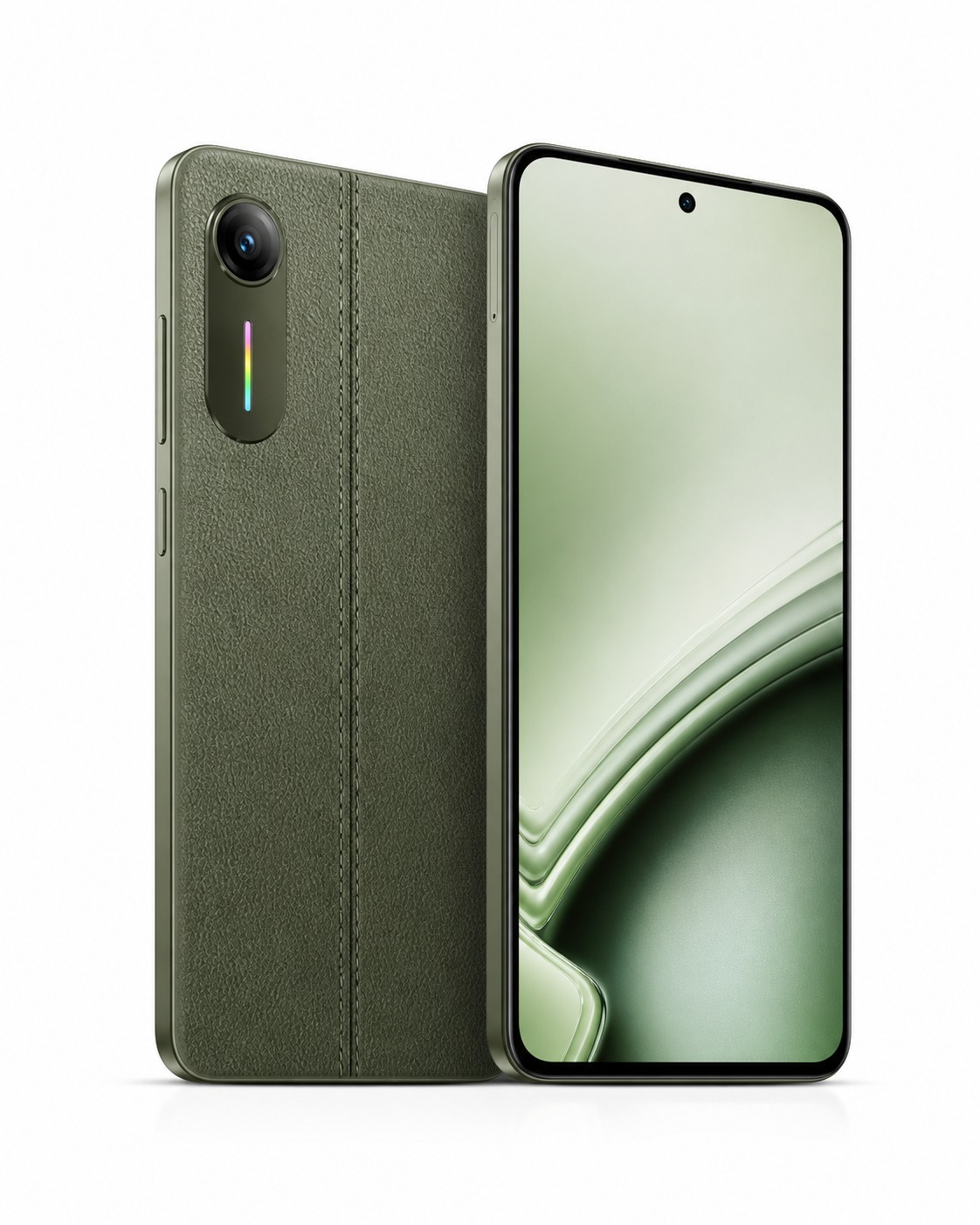
Because that is the M100’s real story. Xiaomi gave it an even bigger battery than the Redmi 17 5G I reviewed a week ago, then quietly cut the camera down to a single 13MP sensor. This is a trade-off review, so let me walk through what you actually get.
Design & Build Quality
The M100 is a big, thick phone in the hand. It measures 170.1 x 78.4 x 8.8mm and tips the scales at 232g, which is right in line with every other 7,000mAh-plus battery champion I’ve tested this year. You will feel it in your pocket, and you’ll be glad of the weight the first time you forget to charge it.
The frame is plastic, and the back is either plastic or a silicone-polymer “eco leather” finish depending on the colorway. Redmi calls it a four-dimensional micro-curved design, and it does sit more comfortably than a flat slab. My favorite touch is the RGB dynamic lighting around the camera area, the same playful bit we saw on the Redmi 17 5G. It flashes for notifications and calls, and it’s the kind of small thing that makes a budget phone feel less plain.
There’s dust and splash resistance rated at IP64. That’s not enough to go swimming, but it handles the rain during a jeepney ride. Redmi also rates the fingerprint sensor for up to 500,000 touches, which is a durable-enough claim on paper. The side-mounted scanner is fast and easy to reach, and there’s still a 3.5mm headphone jack up top — a welcome survival in 2026.
Display
You get a 6.9-inch IPS LCD with a 720 x 1600 resolution, a 120Hz refresh rate, and up to 825 nits of brightness. Let me be direct about the resolution: at 254 pixels per inch, this is the same HD+ compromise I flagged on the Redmi 17 5G. Text and icons are perfectly readable, but the moment you hold it next to a 1080p panel, you’ll notice the softer edges.
On the bright side, the 120Hz panel makes day-to-day scrolling feel smooth, and the 240Hz touch sampling keeps things responsive. Xiaomi’s display also carries TÜV Rheinland certification for low blue light and flicker-free performance, which matters if you use your phone before bed. This is a usable display, just not a sharp one. If you stream a lot of video on your commute, weigh that 720p ceiling before you buy.
Performance
Inside, the M100 runs the Snapdragon 4 Gen 5, a 4nm octa-core chip with the Adreno GPU — the same platform that powers the Redmi 17 5G. Xiaomi pairs it with 6GB or 8GB of LPDDR4X RAM and 128GB or 256GB of UFS 2.2 storage. This is entry-level silicon, and it knows its limits.
For everyday tasks — messaging, social apps, video, web browsing — it’s smooth enough, and the 120Hz screen hides most of the effort. Budget gaming like Mobile Legends runs fine. Push something heavier and the frame drops, because this is not a gaming phone. If you want to sanity-check numbers on your own, the Geekbench 7 guide I wrote walks through benchmarking a phone like this at home.
One real annoyance: there is no microSD card slot. On a budget phone where the camera files add up, being locked to whatever internal storage you buy is a genuine shortcoming. Go for the 256GB variant if you plan to keep this phone for a while.
Camera
Here’s the big trade-off. The M100 ships with a single 13MP rear camera and a 5MP front camera. There’s no ultrawide, no macro, and no telephoto — just one main lens that shoots 1080p video at 30fps.
That is a sharp step down from the Redmi 17 5G, which carries a 50MP main camera. In good light, the 13MP sensor is fine for sharing to social media. In low light, it struggles, and the lack of an ultrawide means you won’t fit the whole group into a shot without backing up. Portrait mode, night mode, and a document scanner are all here to stretch what the tiny sensor can do, and they help, but they can’t add hardware that isn’t there.
The front-facing 5MP camera is similarly basic. Video calls look acceptable; selfies at night look rough. For a phone that costs about $266, that’s the honest reality of the single-lens compromise. If the camera is even slightly important to you, this is the wrong Redmi.
Battery & Charging
This is where the M100 earns its keep. The 7,900mAh silicon-carbon battery is one of the biggest I’ve reviewed this year, and with 45W wired charging via the PPS protocol, it refills quickly. There’s also 22.5W reverse wired charging, so you can top up earbuds or even another phone in a pinch.
In practical terms, you’re looking at an easy day and a half of heavy use, and two days or more if you’re a moderate user. It comfortably outlasts today’s vivo Y31t with its 7,200mAh cell, and it’s in the same league as battery champions like the Poco M8 Power. One note on silicon-carbon cells: the rated capacity is the headline number, and real-world usable capacity is often a bit less — expect excellent endurance, just with that caveat. Charging is also honest: a real 45W, not the inflated marketing numbers some budget phones print on the box.
Price and Availability
Redmi launched the M100 quietly in China with three configurations: the 8GB/128GB at CNY 1,799 (about $266), the 6GB/256GB at CNY 1,999 (about $296), and the 8GB/256GB at CNY 2,199 (about $325). It comes in Midnight Black, Starry White, and the standout Wilderness Green with the eco-leather back.
There’s no official Philippines launch yet, which is the big question mark. Gray-market units converted from the China pricing would land somewhere around PHP 14,000 to 18,000 depending on the variant — a tempting price for a 7,900mAh phone, but you take on the usual import risks: no local warranty and a China-market firmware build unless a global variant shows up. GSMArena notes the upcoming Poco M8x looks nearly identical, which strongly suggests the M100 will eventually be rebranded for international markets. If you can wait a few weeks, that could bring an official PH path and a cleaner software build.
Software
The M100 runs Android 16 with Xiaomi’s HyperOS 3 out of the box. The interface carries the usual Redmi bloatware — you’ll spend a few minutes uninstalling the pre-loaded apps — but HyperOS is smooth and customizable on this hardware.
Two things stand out. First, there’s a dedicated senior care mode with larger icons and fonts, a 300% media and ringtone volume boost, and an option to block unwanted calls. That’s a genuinely thoughtful inclusion for the older family member a phone like this is often bought for. Second, the update commitment for the M100 isn’t officially spelled out yet, so I’ll flag it as unconfirmed rather than guess. As with other Redmi lines, existing precedent suggests a couple of OS updates, but don’t buy on that promise until Redmi says so.
Pros and Cons
| Pros | Cons |
|---|---|
| Massive 7,900mAh battery with real 45W charging | Single 13MP camera — no ultrawide or telephoto |
| Snappy 120Hz display with TÜV eye-protection certs | 720p resolution on a 6.9-inch panel looks soft |
| 22.5W reverse wired charging to top up other devices | No microSD expansion on a budget phone |
| IP64 dust and splash resistance | Entry-level chip struggles with heavy gaming |
| 3.5mm headphone jack and stereo speakers survive | Update commitment not yet confirmed |
| Senior care mode with giant icons and loud volume | No official Philippines launch yet |
Should You Buy This?
Buy it if…
- Battery life is your number-one priority and you hate charging daily.
- You want a cheap phone that handles messaging, video, and social apps without fuss.
- You’re buying for a parent or grandparent and value the senior care mode.
- You’re comfortable importing and don’t need a local warranty.
Skip it if…
- The camera matters to you — the 13MP main is the M100’s weak spot.
- You stream a lot of Full HD video and want a sharper screen.
- You need expandable storage for lots of photos and files.
- You want to play heavy games at high frame rates.
Final Verdict
The Redmi M100 is a purpose-built phone with a clear job: last as long as possible and cost as little as possible. At CNY 1,799 (about $266) for the 8GB/128GB model, it delivers on endurance better than most budget phones I’ve tested, and the 45W charging makes that big battery practical rather than just impressive.
But Xiaomi made a deliberate cut to get there. The single 13MP camera is a real step back from the Redmi 17 5G, and the 720p panel on a phone this big will bother anyone who watches a lot of video. If you mostly text, stream over Wi-Fi, and need something that won’t die by 3pm, this is an easy recommendation.
For buyers in the Philippines, there’s no official launch yet, so expect gray-market listings around PHP 14,000 to 18,000 converted from the China pricing, with the usual import caveats: no local warranty and a China firmware build unless a global variant appears. There’s a decent chance the international version of this lands as the Poco M8x, which GSMArena notes looks nearly identical. If you can wait, that’s worth watching. If you can’t, and you value stamina above all else, the M100 is a solid, honest buy.