
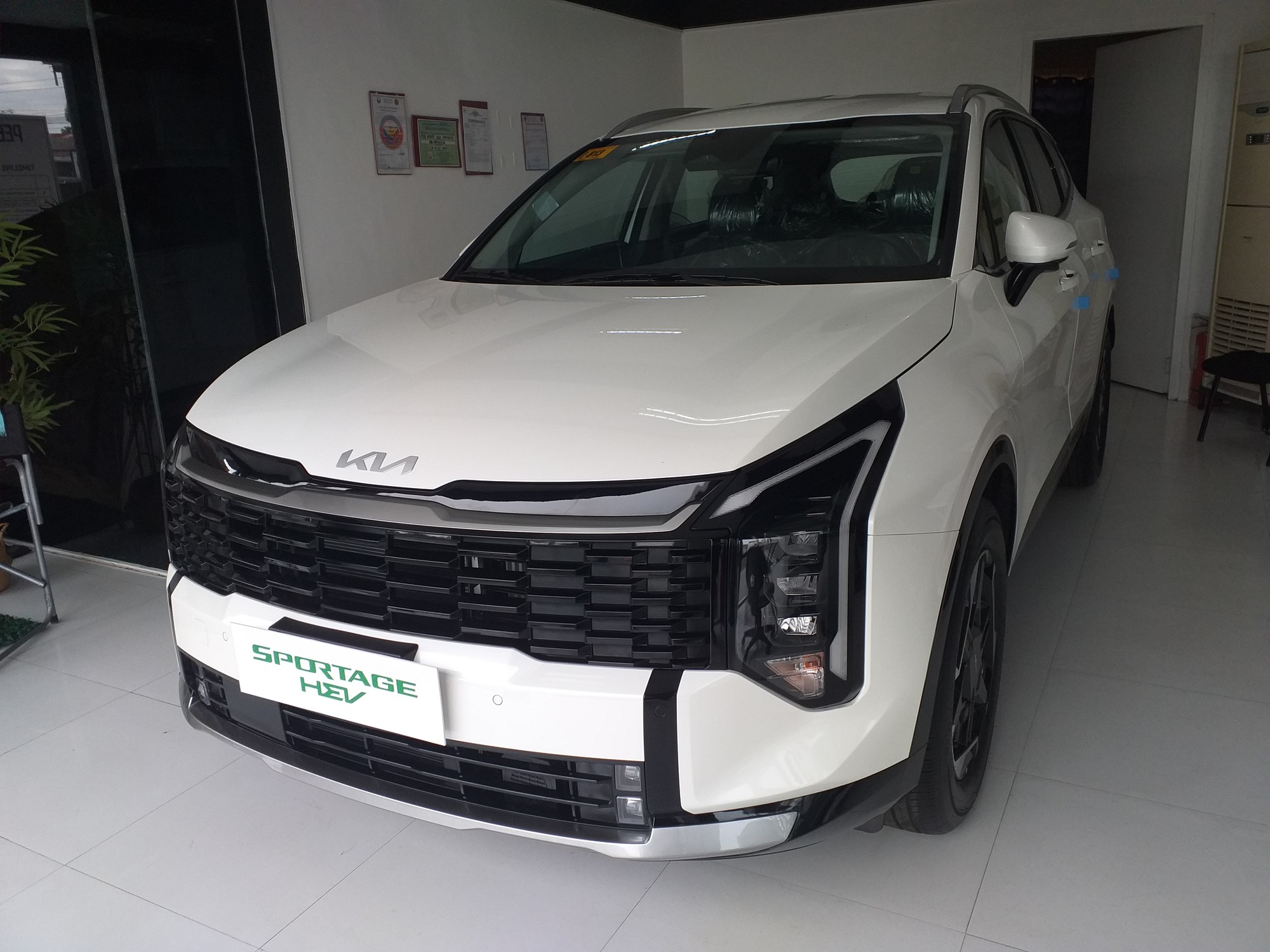
Kia’s most famous crossover just came back to the Philippines, and it brought a hybrid powertrain we haven’t seen here before. After a multi-year absence, the fifth-generation Sportage has officially returned under ACMobility’s distributor network, wearing the same turbo-hybrid system that turned the Sorento into a fuel-sipping surprise.
.jpg)
It’s landing at a telling moment in the local market. Mazda just confirmed plug-in hybrids are on the way, while established self-charging hybrids and new Chinese EVs keep splitting the attention of Filipino buyers. The Sportage, priced at ₱1.978 million for the EX and ₱2.098 million for the SX, sits right in the middle of that battle. I spent some time digging through what reviewers are saying, and there’s a lot to unpack.
Why the Sportage name matters here
Before you dismiss this as just another compact crossover, know that the Sportage was a pioneer. Kia actually released it in 1993, a year before the Toyota RAV4 and two years before the Honda CR-V. It carved out the compact SUV segment we take for granted today, and it became a familiar nameplate on Philippine roads over its first four generations.
Then it quietly disappeared. For years, Kia’s local lineup had a noticeable gap where the Sportage used to be. Now it’s back in its fifth-generation form, facelifted with Kia’s “Opposites United” design language and the same turbo-hybrid drivetrain the brand has been rolling out across its midsize range.
Kia Sportage Turbo Hybrid specifications
| Spec | Details |
|---|---|
| Engine | 1.6L Smartstream T-GDi turbo hybrid |
| Electric motor | 66.9 kW permanent magnet motor |
| Combined output | 235 hp / 367 Nm |
| Battery | 1.49 kWh 270V lithium-polymer (LiPo) |
| Transmission | 6-speed automatic |
| Drivetrain | Front-wheel drive |
| Curb weight | ∼1,685 kg |
| Length | 4,660 mm |
| Width | 1,865 mm |
| Height | 1,650–1,660 mm |
| Wheelbase | 2,755 mm |
| Wheels | 18-inch two-tone alloys |
| Display | Twin 12.3-inch screens (cluster + touchscreen) |
| Connectivity | Wireless CarPlay & Android Auto |
Ground clearance and a few full-dimension details haven’t been published in PH spec sheets yet — I’m flagging those rather than guessing. The battery size, weight, and powertrain figures above are verified across AutoIndustriya, CarGuide, and Kia’s global documentation.
Price in PHP, USD, and INR
Two trims are on offer. Using the ECB reference rates from August 21, 2026 (₱61.66 per USD, Rs 95.7 per USD), here’s how the pricing breaks down in three currencies.
| Trim | Philippine peso | US dollars | Indian rupees |
|---|---|---|---|
| Sportage Turbo Hybrid EX | ₱1,978,000 | $32,080 | ₹30.7 lakh |
| Sportage Turbo Hybrid SX | ₱2,098,000 | $34,030 | ₹32.6 lakh |
That pricing undercuts its obvious rivals. A Toyota RAV4 HEV starts at ₱2.227 million, while the Nissan X-Trail e-Power and Hyundai Tucson HEV both hover near the ₱2.098-million mark. Kia’s front-wheel-drive turbo hybrid undercuts the RAV4 by roughly a quarter-million pesos while bringing more power to the table.
What reviewers are saying
AutoIndustriya drove it extensively at the launch, and the standout claim is real-world fuel economy. On city streets, the Sportage Turbo Hybrid returned up to 18 km/L; on the highway, reviewers managed up to 25 km/L by easing off the throttle at 100 km/h to let the engine shut off and run on battery. They called it “quite the bargain” next to the RAV4 HEV.
CarGuide’s verdict leaned on the same theme. Editor Ulysses Ang and his team took it from Manila Bay up through Cavite to Tagaytay and consumed only one of twelve fuel bars across 21.27 km/L of mixed driving — and one convoy car used none of its twelve. The takeaway both outlets kept circling back to: hybrid efficiency doesn’t have to be boring.
The powertrain, shared with the Sorento, delivers 235 hp and 367 Nm. In a lighter Sportage body, that makes it genuinely sprightly. Put it in Sport mode and the paddles shift the transmission; drop to Eco and they control regenerative braking instead. It’s a clever dual-function setup that rewards drivers who learn it.
How it fits Filipino driving
City driving
This is where the Sportage Turbo Hybrid shines. On EDSA or in Makati’s stop-and-go rush, the hybrid system does its best work — it cuts the engine at low speeds and coasts on electric power, which is exactly how it returned 18 km/L in town. The compact crossover footprint (4,660 mm long) splits the difference between a sedan’s nimbleness and the taller stance SUV buyers want.
There’s a bigger practical bonus: because it’s a self-charging hybrid, you never have to think about plugging it in. That matters if you’re parking in a condo tower without a charger, the same reason self-charging hybrids like the Ford Territory Hybrid have found an audience here. No charging anxiety, no six-hour waits at a public station.
Long-distance travel
The Manila–Baguio run at about 250 km is no sweat. With 18–25 km/L real-world economy and a fuel tank that keeps those twelve bars honest, you can do a round trip without a refill, let alone a charge. On the SLEX/NLEX stretch, the turbo hybrid cruises comfortably, and the engine shutting off at highway speed on a light throttle cuts fuel bills even more.
The 367 Nm of torque also makes overtaking trucks on provincial roads a quick, confident affair. This is a hybrid built for Philippine long-haul conditions, not a token city toy.
Flood-prone situations
Here’s my honest caveat. The battery pack sits low in a self-charging hybrid, and we haven’t seen official wading-depth or ground clearance figures for the PH variant. That’s not the same kind of risk as a high-voltage battery in a standstill flood, since the Sportage’s pack is small — but I wouldn’t treat this as a vehicle built for deep floodwater.
For the typical monsoon street where water is up to the wheel hubs, you’re likely fine. For flooded underpasses like the ones that back up EDSA and Quezon Avenue after heavy rain, the rule stays the same as any crossover: turn around, don’t risk it. The advantage of a hybrid here is that a self-charging system has no high-voltage charging port to worry about — but ground clearance is what keeps you dry, and that figure still needs confirmation.
High temperature conditions
Our 36–38°C heat hits battery chemistry hard, but the Sportage’s small 1.49 kWh pack generates comparatively little heat, and Kia uses a lithium-polymer chemistry that handles thermal stress well. The bigger load is the air conditioning, and with physical temperature dials instead of a buried touchscreen menu, you can adjust it without hunting through pages — a small thing that feels huge when you’re parked under the noontime sun.
Kia’s broader approach to sustainability — and the battery chemistry underneath its electrified range — is something the industry is still wrestling with globally. It’s worth reading more on why batteries are becoming the hidden battleground of clean tech.
The bigger picture for Filipino EV buyers
The Sportage Turbo Hybrid lands as the Philippines juggles several electrification paths at once. Plug-in hybrids like the Mitsubishi Outlander GT PHEV are claiming the premium segment, self-charging hybrids like the GAC GS4 Max HEV serve buyers who can’t easily charge at home, and full EVs keep getting cheaper.
For many Filipino families, a self-charging turbo hybrid at ₱1.978 million is the most practical electrified step right now. It delivers real fuel savings without plug-in dependency, keeps the power you want for Baguio or Tagaytay weekends, and undercuts the Japanese hybrid establishment. Whether that’s smarter than betting on a fully electric crossover depends on your parking, your commute, and whether you have access to a charger at all.
The Sportage’s return is a strong sign of how the local hybrid market is maturing. If you’re comparison shopping, it deserves a test drive — especially in Eco mode with those paddles.