
BYD keeps finding its way into my drafts. Every few weeks there’s a new model, a new price, or a new milestone worth talking about — and this week it’s both a high-profile visit and a mountain of sales numbers. Let me break down what’s happening and what it actually means if you’re shopping for your next car.

BYD is paying attention to the Philippines now — and that says a lot
When the chairman of the world’s biggest plug-in car maker flies to Manila, you notice. BYD Chairman Wang Chuanfu recently toured the Philippines, meeting dealers, checking out Denza showrooms in Alabang and Cebu, and dropping by charging stations. For anyone tracking the local EV scene, that visit was a quiet but loud signal: this market is no longer a side note in BYD’s regional plans.
Wang put it plainly: “The Philippines has become one of the most exciting and promising markets for new energy vehicles in the region.” That’s not just flattery — the numbers back it up.
An EV market that stopped being a novelty
We keep hearing how small the Philippine EV market is compared to China or parts of Southeast Asia, and that’s true. But the direction of travel has changed fast.
Industry data cited by The Manila Times shows Philippine EV sales jumped about 36 percent year on year in the first quarter of 2026, with roughly 14,000 units sold — nearly half of the roughly 32,000 recorded for all of 2025. The full first half is even more striking: BusinessWorld reports EV sales rose 132.7 percent to 31,381 units from 13,488 a year earlier.
A lot of the spark came from the Middle East crisis sending fuel prices soaring in March. When you watch the numbers on a gasoline pump climb faster than the numbers on the fuel gauge, a calculator starts doing the talking for you. That’s the moment a lot of Filipino drivers began taking hybrids and EVs seriously.
What BYD has done on the ground here
BYD’s commitment to the Philippines isn’t just talk. Its local dealer network has grown to 81 locations, while the premium Denza sub-brand now runs four outlets. ACMobility, the Ayala-led distributor, says the brand’s Philippine lineup is expanding to cover every rung of the market.
And the sales numbers justify the push. BYD Cars Philippines closed 2025 with 26,122 units in retail sales — a 446 percent year-on-year jump that made it the fastest-growing automotive brand in the country. The company renewed its distributorship with ACMobility in early 2026, signaling a long-term bet.
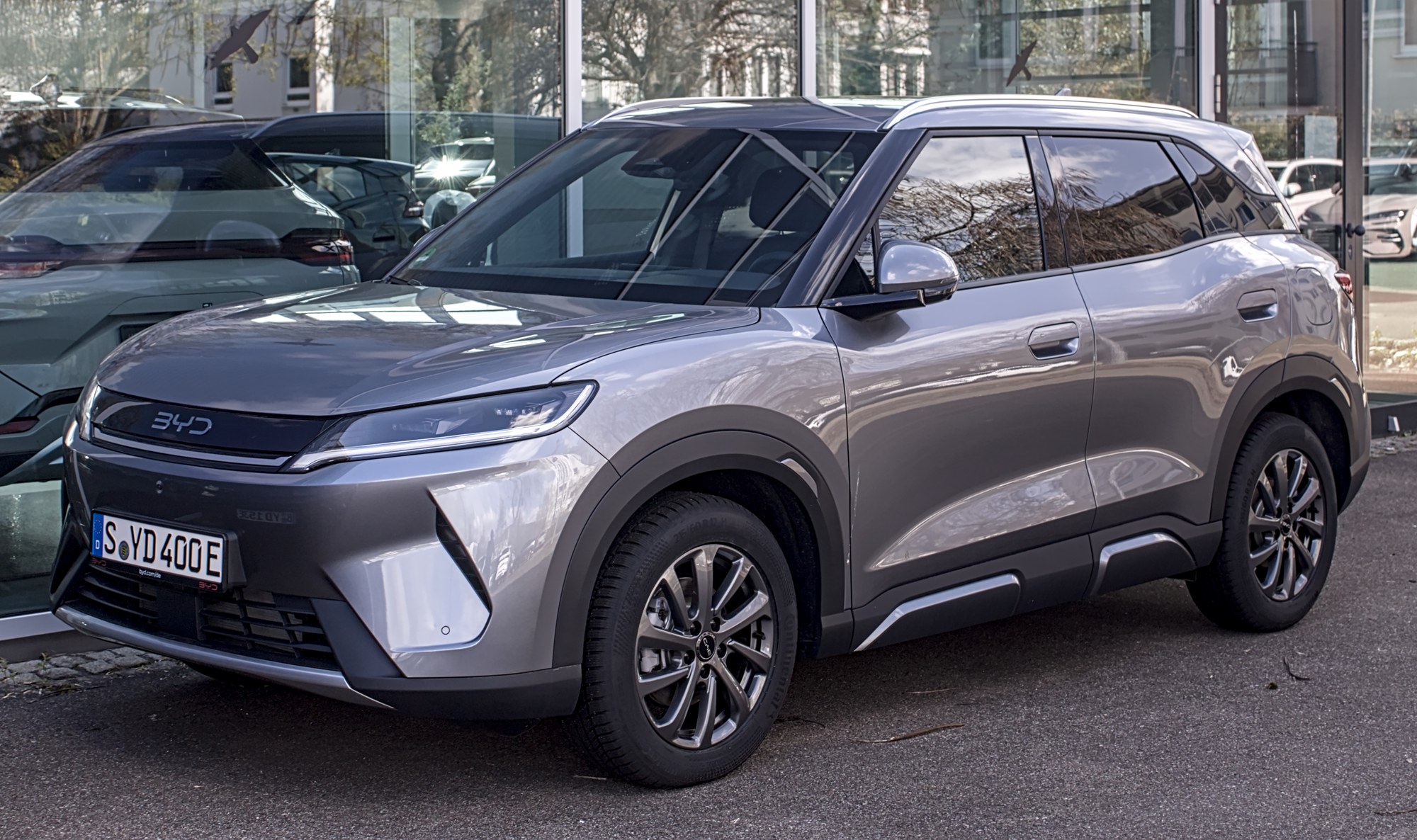
The crossover doing a lot of the work: BYD Atto 2 DM-i
Central to that growth is a pair of launches from late July: the BYD Atto 2 and the updated Seal 5 DM-i, both offered as plug-in hybrids.
The Atto 2 DM-i is the subcompact crossover that’s been drawing the most attention. It’s technically a plug-in hybrid, but it drives like an EV most of the time, with a gasoline engine in reserve for longer trips.
BYD Atto 2 DM-i specs at a glance
| Spec | Atto 2 DM-i |
|---|---|
| Body style | Subcompact 5-seat crossover |
| Powertrain | 1.5L gasoline engine + electric motor (Super DM-i PHEV) |
| Power / torque | 162 hp / 300 Nm |
| Drivetrain | Front-wheel drive |
| Battery | BYD Blade Battery |
| EV-only range | Up to 45 km (approx.) |
| Combined range | 1,045 km on paper; 1,340.1 km per AAP test |
| AC charging | 15-100% in about 2 hours |
| Dimensions (LxWxH) | 4,330 x 1,830 x 1,675 mm |
| Wheelbase | 2,620 mm |
| Ground clearance | 150 mm |
| Cargo | 433 L (up to 1,335 L folded) |
| Infotainment | 12.8-inch touchscreen w/ Apple CarPlay + Android Auto |
| Safety | DiPilot ADAS (Premium): AEB, adaptive cruise, lane assist, 360 camera |
Two trims are offered. The Dynamic starts at around P1.05 million, while the Premium carries the full DiPilot driver-assist suite and 12.8-inch screen at P1.258 million.
What others are saying about it
Zigwheels Philippines called the Atto 2 DM-i “great value for the money,” highlighting its peppy 162-hp powertrain and the efficiency proven by the Automobile Association of the Philippines, which squeezed 1,340.1 km from a single tank — about 28 percent more than the on-paper figure. The dedicated physical AC controls and the DiPilot safety suite on the Premium trim were both called out as rare, welcome touches.
BusinessWorld framed the launch in the context of the Marcos administration’s push for EV adoption, quoting BYD Cars Philippines Managing Director Bob Palanca: “BYD has the units. All the customers have to do is decide on what car they will get.”
Price in PHP, USD, and INR
Using mid-market rates as of August 24, 2026 (P61.7 per US dollar, US$1 = about Rs 95.8), here’s how the BYD PHEV lineup breaks down across markets. The pesos are your real-world local price; the dollar and rupee figures give an idea of regional positioning for Filipino comparison shoppers.
| Model | PHP | USD | INR |
|---|---|---|---|
| Seal 5 DM-i Essential | P948,000 | ~$15,400 | ~Rs 14.7 lakh |
| Atto 2 DM-i Dynamic | P1,048,000 | ~$17,000 | ~Rs 16.3 lakh |
| Atto 2 DM-i Premium | P1,258,000 | ~$20,400 | ~Rs 19.5 lakh |
| Atto 2 EV (full BEV) | P1,338,000 | ~$21,700 | ~Rs 20.8 lakh |
How it stacks up for Filipino driving conditions
City driving
This is where the Atto 2 DM-i shines. On EDSA or through Makati stop-and-go, you’re mostly running on battery with the gasoline engine asleep. The 45-km EV range covers a typical daily Metro Manila commute, so charging overnight at home — if you can — means weeks without a fuel stop. Its compact 4.33-meter body and tight turning make squeezing into BGC or SM parking a lot less stressful than in a full-size SUV.
Long-distance travel
Here’s the DM-i trick. When you point it at Manila to Baguio or a long NLEX run, the gasoline engine takes over and you simply keep driving — no charging anxiety. That’s the whole point of a range extender: EV manners in the city, gas-station convenience on the highway. The 150 mm ground clearance keeps it comfortable on decent provincial roads, though rough gravel is best avoided.
Flooded / flood-prone situations
This is the honest warning. At 150 mm of ground clearance, the Atto 2 DM-i is not a flood-wading vehicle. It’s fine for the moist road spray of a quick shower, but if you’re in an area where streets routinely turn into rivers during typhoon season — think Marikina, parts of Taguig, low-lying Cavite — you treat this car like any low crossover: avoid deep water. Blade Battery packs are well-sealed, but the rule of “don’t push past the bottom of the doors” applies to every EV here.
High-temperature conditions
Philippine heat is a real factor. The Blade Battery uses LFP chemistry, which is thermally stable and degrades slower than older NMC packs in hot climates — good news for a country where the dash reads 38 degrees by noon. The Atto 2’s physical AC controls and PM2.5 cabin filter are genuinely useful touches in our polluted, humid stop-go. The trade-off is that heavy AC use eats into the EV-only range in extreme heat, but the gasoline reserve means you never lose the car over it. Battery tech is becoming a bigger part of how we power things in general, and it’s a trend I talked about in my AI-battery deep dive.
The market is getting crowded — and that’s good for buyers
BYD isn’t alone at this party anymore. More brands are piling in with aggressively priced EVs and hybrids — MG with its three-row PHEV family hauler, plus Geely, GAC, Jaecoo, VinFast, GWM, and the Korean and Japanese players all want a slice of a market that just shook off its novelty label.
For shoppers, that’s a good problem to have. Instead of asking whether an EV is “practical,” Filipino buyers are now comparing price, range, equipment, charging speed, warranty, and after-sales service — the same way they’ve shopped for gasoline cars for decades.
Bottom line
Wang Chuanfu’s visit, the record sales, the expanding dealer network — they all paint the same picture. BYD sees the Philippines the way it saw other emerging markets right before they took off: as a place where a strong-enough push at the right price can shift a whole industry. The Atto 2 DM-i at just over a million pesos is a pretty direct argument for that bet.
If you’re weighing the plug-in against the pure-electric versions of BYD’s crossover, my Atto 2 launch breakdown and my Seal 5 DM-i read are worth a look. And with the Jaecoo J5 EV now in the picture, the local competition is only making buy-or-wait decisions better.
Whether this momentum holds comes down to charging infrastructure and price. The cars, at least, have clearly stopped being the bottleneck.