
Motorola has been making some of the most user-friendly clamshell foldables for years now, and the new Razr 70 — or Razr 2026 as it’s called in the US — keeps that reputation mostly intact. But here’s the thing: not much has actually changed from last year’s model. And when the price tag still hovers around the ₱47,000 mark, “not much has changed” becomes a problem.
I’ve been following Motorola’s foldable lineup since the Razr reboot, and the Razr 70 feels like the company hit a plateau. It’s still a very good phone. But in 2026, with Samsung’s Z Flip7 getting more aggressive and Honor’s Magic V6 pushing foldable cameras to new heights, being “very good” might not be enough anymore. If you’re curious about where foldables stand in 2026, I covered that recently — the short version is that they’ve finally crossed the “good enough” line, but value is still the biggest question mark.
Let me walk you through what the Razr 70 actually brings to the table — what’s new, what isn’t, and most importantly, whether you should spend your hard-earned pesos on it.
Design and Build: If It Ain’t Broke, Don’t Fix It
Motorola clearly subscribes to this philosophy. The Razr 70 looks nearly identical to the Razr 60 from last year. That’s not necessarily a bad thing — the design was already one of the best in the clamshell category.
Unfolded, you’re looking at a slim 171.3 x 74.0 x 7.3mm device that weighs just 188 grams. Fold it shut and it becomes a compact square that slips into pockets without that awkward bulge you get with book-style foldables. The aluminum frame feels premium, and the titanium hinge continues to be one of the smoothest in the business.
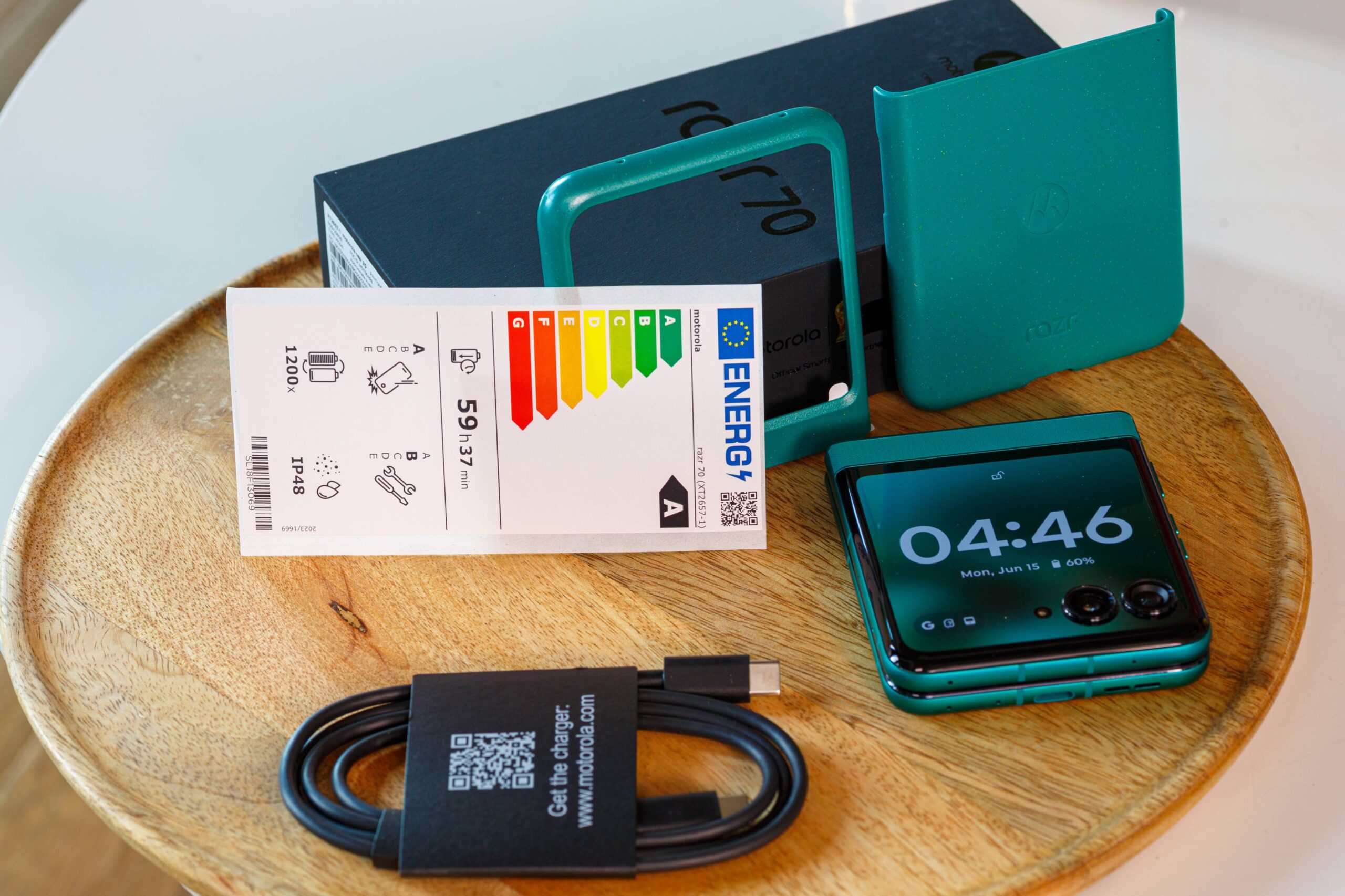
Motorola bumped the durability credentials slightly — you now get IP48 water resistance (up to 1.5 meters for 30 minutes) and MIL-STD-810H compliance. That military-grade toughness rating isn’t just marketing fluff; it means the phone has survived a battery of torture tests for temperature extremes, drops, and vibration. For a foldable, that’s genuinely reassuring.
The Dark Green color I’ve been looking at is understated and classy. Motorola even throws in a color-matched two-piece bumper case in the box — a nice touch that most manufacturers have abandoned. Though, in classic 2026 fashion, you don’t get a charging brick. Just a USB-C to USB-C cable and the bumper.
One small but meaningful detail: the front of the phone (when unfolded) is plastic, not glass. The glass is on the folded exterior — where it actually matters for protection. It’s a practical trade-off that keeps weight down without sacrificing protection where it counts.
Display: Bright, Smooth, and Finally Dolby Vision
The Razr 70 packs a 6.9-inch foldable LTPO AMOLED panel on the inside and a 3.6-inch AMOLED cover display on the outside. Both are excellent, and both support 1 billion colors, HDR10+, and impressive peak brightness — 3000 nits on the main display and 1700 nits on the cover.
The headline upgrade this year is Dolby Vision support on the main screen. Whether Motorola actually swapped in a better panel or just paid for the certification this time around is debatable, but the result is the same: HDR content looks stunning. Netflix, YouTube, and local streaming apps with Dolby Vision content pop with rich contrast and vivid colors.
The 120Hz adaptive refresh rate keeps everything silky smooth, and the 1080 x 2640 resolution at 413 pixels per inch is sharp enough that you won’t notice any pixelation at normal viewing distances. The crease is still there — it’s a foldable, after all — but Motorola’s hinge design keeps it less pronounced than Samsung’s Z Flip series.
The cover display remains one of my favorite things about Motorola’s Razr line. At 3.6 inches with a 90Hz refresh rate, it’s actually usable, not just a notification ticker. You can run full apps on it (with a bit of tweaking), reply to messages, check maps, control music, and even take selfies using the main cameras. It’s the best cover screen implementation on any clamshell foldable right now, and nothing else comes close.
Performance: The Dimensity Dilemma
Here’s where things get tricky. The Razr 70 runs on MediaTek’s Dimensity 7450X, built on a 4nm process. On paper, it’s an upgrade from last year’s Dimensity 7400X. In reality, it’s essentially the same chip with a different name — same CPU core configuration, same GPU, same fabrication node.
For everyday tasks — messaging, social media, web browsing, YouTube — the Dimensity 7450X is perfectly adequate. Apps open quickly, multitasking with the 8GB of RAM is smooth, and the UFS 3.1 storage (available in 128GB or 256GB) keeps read/write speeds snappy.
But here’s the problem: at this price point, “adequate” isn’t what you expect. Samsung’s Galaxy Z Flip7 comes with a more powerful chipset and 12GB of RAM even in its base configuration. Motorola capping the Razr 70 at 8GB of RAM with no 512GB storage option feels restrictive — especially since the company’s own last-gen Razr Ultra can now be found for around the same price with flagship-grade internals.
Gaming performance is fine for casual titles, but if you’re into Genshin Impact or demanding emulators, the Dimensity 7450X will show its limits at higher settings. This isn’t a gaming phone, and it doesn’t pretend to be one — but competitors at this price tier are offering more headroom.
Camera: One Step Forward, Half a Step Back
The camera system is a mixed bag that actually tells you a lot about Motorola’s priorities for this generation.
The main 50MP sensor (f/1.7, 1/1.95-inch, OIS) is genuinely good. Photos come out sharp, colors are natural without being overly saturated, and the optical image stabilization keeps things steady in low light. Portrait mode does a decent job with edge detection, and the overall processing is tasteful — not the over-sharpened mess you sometimes get from midrange Chinese brands.
The ultrawide camera got an upgrade in resolution, jumping from 13MP to 50MP (f/2.0, 122-degree field of view). But — and this is a big but — it lost autofocus in the process. That means no macro shots using the ultrawide, which was actually one of the neat tricks the Razr 60 could pull off. The wider field of view is nice for landscapes and group shots, but the lack of autofocus limits versatility. It’s the kind of spec-sheet upgrade that doesn’t translate to a real-world improvement.
Video recording tops out at 4K 30fps on the main camera, with gyro-EIS keeping things stable. 1080p goes up to 120fps for slow-motion. It’s capable, but not class-leading.
Where the Razr 70 really shines is selfies. Because it’s a clamshell foldable, you can close the phone and use the main 50MP cameras as your selfie shooters, with the cover display acting as your viewfinder. The result is selfie quality that no conventional phone can match — detailed, well-exposed, and with natural bokeh from the larger sensor. It’s still the Razr’s killer feature, and it works as well as ever.
Battery Life: Small Bump, Welcome Improvement
Motorola squeezed a 4800mAh battery into the Razr 70 — up from 4700mAh last year — without changing the phone’s physical dimensions. It’s a modest increase, but foldables live and die by their battery life, so every mAh counts.
In real-world use, the Razr 70 easily gets through a full day. With mixed usage — some social media, an hour of YouTube, messaging throughout the day, and a few calls — I’d end the day with about 15-20% remaining. The Dimensity 7450X’s efficiency helps here; it sips power when you’re not pushing it hard.
Charging is where things feel dated. The 30W wired charging and 15W wireless charging are unchanged from last year. A full charge takes about an hour and 15 minutes — perfectly usable, but when phones from realme and Tecno are pushing 80W and beyond at half the price, 30W feels conservative. You’re not getting the charging brick in the box either, so factor in a compatible charger if you don’t already have one.
Software: Clean Android, Genuinely Useful AI
This is where Motorola consistently punches above its weight. The Razr 70 ships with Android 16 and Motorola’s near-stock software experience — no heavy skins, no duplicate apps, no bloatware. It’s clean, fast, and gets out of your way.
The Moto AI features are actually useful, not gimmicky. Smart summaries of notifications, contextual actions based on what’s on your screen, and the always-handy chop-twist gestures for the flashlight and camera are still here. Motorola’s approach to AI is understated — it enhances the experience without demanding your attention.
Software update commitments from Motorola have been improving. You can expect at least three major OS updates and four years of security patches — not quite Samsung’s promise, but more than enough for most people’s upgrade cycles.
The cover screen software deserves special mention. Motorola has refined the cover display experience over several generations, and it shows. Apps scale properly, notifications are glanceable, and the panel-based widget system is intuitive. You genuinely find yourself using the phone folded more often than you’d expect.
Should You Buy the Motorola Razr 70?
This is the question that matters. And the answer depends entirely on when you’re reading this.
If you’re buying at launch price — roughly ₱47,000 to ₱50,000 in the Philippines based on the US$800 MSRP — the Razr 70 is a tough sell. Last year’s Razr 60 is already selling for significantly less (around $550-565 in the US, or roughly ₱32,000-35,000 converted) and delivers nearly the same experience. The Razr 60 Ultra, with its flagship chipset and faster charging, can be found for around $800 now. Samsung’s Galaxy Z Flip7 gives you more RAM, a more powerful processor, and better long-term software support at a similar price point.
But here’s the thing about Motorola phones: they don’t stay at launch price for long. Give it three to four months, and the Razr 70 will likely drop to the ₱35,000-40,000 range. At that price, the value proposition flips completely. You’re getting one of the most user-friendly foldables on the market with excellent displays, clean software, great selfie capabilities, and solid battery life.
If you’re considering alternatives, the Honor Magic V6 is worth a serious look — it’s a book-style foldable rather than a clamshell, but it’s the most polished foldable Honor has ever made. And while it’s a different category entirely, I’ve been daily-driving the Samsung Galaxy Z Fold 7 for nearly a year now, and the durability has genuinely impressed me.
Buy the Razr 70 if:
- You want the best cover screen experience on any foldable
- You value clean, bloat-free Android software
- You take a lot of selfies and want the best possible quality
- You find it at a discounted price (₱40,000 or below)
- You’re upgrading from a non-foldable and want the most user-friendly entry point
Skip the Razr 70 if:
- You need the best possible performance for gaming or heavy multitasking
- You’re paying full launch price — wait for the inevitable price drop
- You want the best camera system in a foldable — look at the Honor Magic V6
- You need more than 256GB of storage or 8GB of RAM
- You can find a discounted Razr 60 or Razr 60 Ultra for a better deal
Pros and Cons
Strengths
- Best-in-class cover screen with full app support and 90Hz refresh
- Bright, vibrant 6.9-inch foldable display with Dolby Vision and 3000 nits peak brightness
- Clean Android 16 with genuinely useful Moto AI features
- Excellent selfie quality using the main 50MP cameras on the cover
- Solid battery life for a clamshell foldable (4800mAh)
- Premium build with titanium hinge and MIL-STD-810H durability rating
- Compact, pocketable design at just 188g
Weaknesses
- Dimensity 7450X performance feels underwhelming at this price point
- Capped at 8GB RAM with no 12GB or 512GB storage option available
- 30W wired charging feels outdated for 2026
- Ultrawide camera lost autofocus despite the 50MP resolution bump
- Plastic inner display front (when unfolded)
- Launch pricing puts it directly against more capable rivals
- No charger included in the box
Full Specifications
| Main Display | 6.9″ Foldable LTPO AMOLED, 1080×2640, 120Hz, Dolby Vision, HDR10+, 3000 nits peak |
| Cover Display | 3.6″ AMOLED, 1056×1066, 90Hz, HDR10+, 1700 nits peak, Gorilla Glass Victus |
| Chipset | MediaTek Dimensity 7450X (4nm) |
| RAM / Storage | 8GB RAM / 128GB or 256GB UFS 3.1 (no microSD) |
| Main Camera | 50MP, f/1.7, 1/1.95″, OIS, PDAF |
| Ultrawide Camera | 50MP, f/2.0, 122-degree FOV (no autofocus) |
| Selfie Camera | Uses main 50MP cameras via cover display; 32MP inner selfie camera |
| Video | 4K@30fps, 1080p@30/60/120fps, gyro-EIS |
| Battery | 4800mAh, 30W wired, 15W wireless |
| OS | Android 16 with Moto AI (3 OS updates, 4 years security) |
| Build | 171.3×74.0x7.3mm, 188g; aluminum frame, titanium hinge, IP48, MIL-STD-810H |
| Audio | Stereo speakers with Dolby Atmos |
| Security | Side-mounted fingerprint reader |
| Connectivity | 5G, Wi-Fi 6E, Bluetooth 5.4, NFC, USB-C |
| PH Price (est.) | ₱47,000 – ₱50,000 (based on $800 US MSRP) |
The Bottom Line
The Motorola Razr 70 is a frustratingly good phone at a frustratingly high price. Everything that made previous Razr models great is still here — the compact design, the excellent cover screen, the clean software, the clever selfie capabilities. The small improvements (Dolby Vision, slightly larger battery, IP48 rating) are welcome but incremental.
The problem isn’t the phone itself. It’s the positioning. At launch, Motorola is asking flagship money for what is essentially a refined mid-cycle refresh. When the price inevitably drops — and it will — the Razr 70 becomes one of the easiest foldable recommendations on the market. Until then, patience is your best accessory.
Verdict: Great phone, wrong price. Wait for the discount.
Rating: 7.5/10 (at launch price) | 8.5/10 (at discounted price)
Image: GSMArena