
OPPO’s Reno series has been on a quiet winning streak. The Reno15 Pro earned solid marks for its build quality and camera chops, and now the Reno16 Pro arrives less than a year later asking the same question its predecessor faced: can a “premium mid-ranger” justify a price tag that nudges uncomfortably close to true flagship territory?
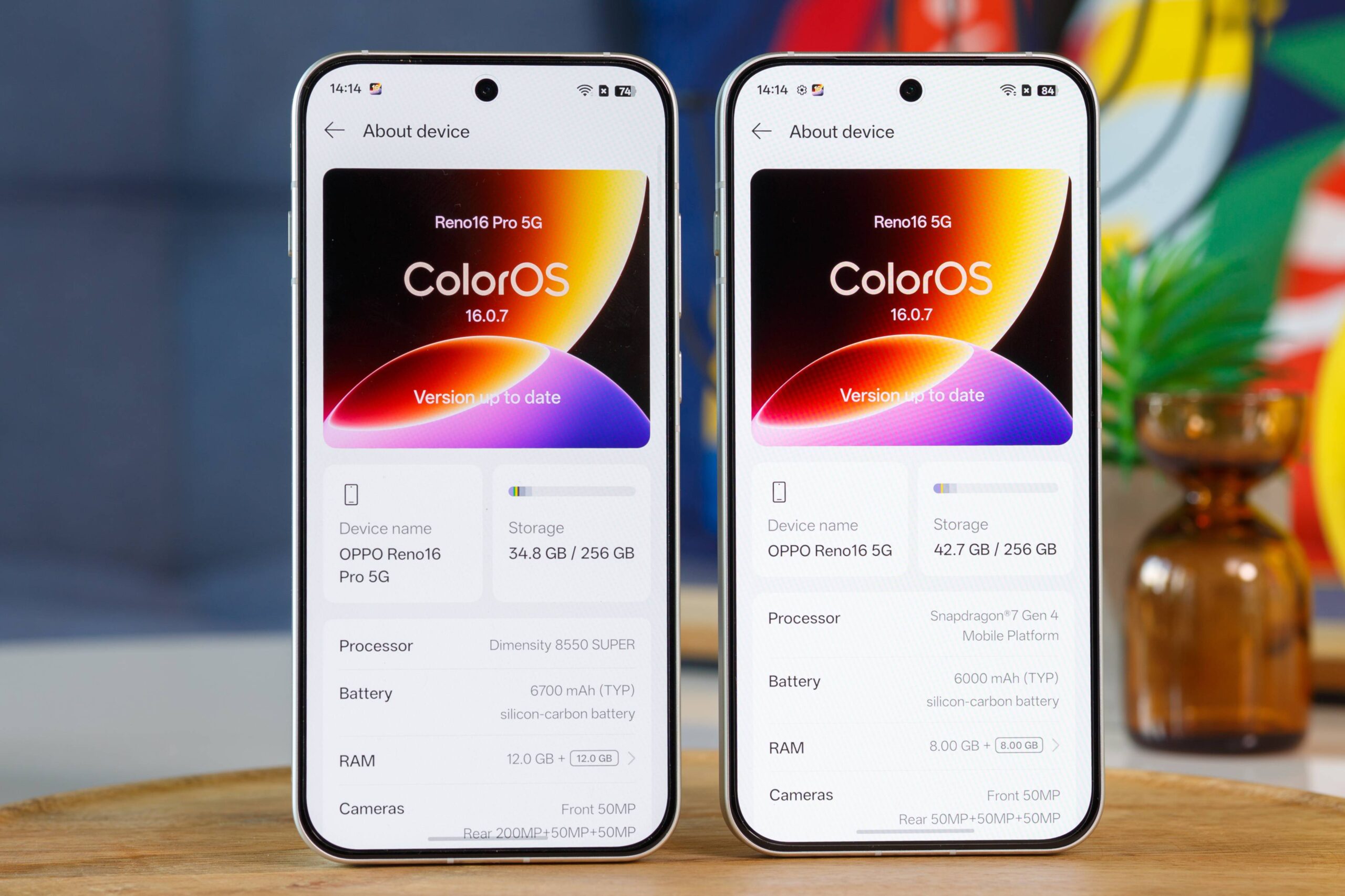
The short answer is complicated. The Reno16 Pro is a genuinely excellent phone in a vacuum — compact, beautifully built, with a battery that laughs at the concept of a charger and a selfie camera that might be the best in its class. But the spec bumps over the Reno15 Pro are modest, the European model actually lost battery capacity, and competitors are circling with faster chips and lower prices.
OPPO Philippines is teasing local availability imminently, so let’s break down what you’re actually getting — and whether it’s worth the pesos.
What’s in the Box and First Impressions
OPPO sent the global kit with the full package — 80W SuperVOOC charger, USB-A to USB-C cable, a transparent silicone case, and the usual paperwork. No corners cut here, which is refreshing when half the industry has decided chargers are optional accessories.
Picking up the Reno16 Pro for the first time, two things hit you immediately: the weight (or lack of it — 188 grams is almost unsettling for a phone packing a 6,700mAh battery) and the build quality. The aerospace-grade aluminum frame and Gorilla Glass 7i up front give it a genuinely premium hand feel. It’s compact at 151.2 x 72.4 x 8.2mm — smaller than most modern flagships — and that makes one-handed use actually comfortable, not just theoretically possible.
The Pop White colorway has this 3D planet-like effect on the back glass that shifts under light. It’s subtle, not gaudy. The Starlight Black version keeps things understated if that’s more your speed.
On the left edge, there’s a new addition: the AI Snap Key, a remappable hardware button. By default it launches OPPO’s AI Mind Space, but you can set it to anything — camera shutter, flashlight, mute toggle, your favorite app. I mapped it to the camera and it genuinely changed how quickly I could grab a shot. More phones should have this.
The in-display fingerprint reader works reliably, though it sits a little too close to the bottom edge for my liking. A minor gripe on an otherwise excellent hardware package. The phone carries an IP66/IP68/IP69/IP69K certification — four separate ingress ratings — which puts it among the most water-resistant phones you can buy. If you’ve read about the vivo S60 Series and its IP69 rating, know that OPPO went even further here.
Display: Compact Canvas, Bright Enough
The Reno16 Pro sports a 6.32-inch AMOLED panel at 1216 x 2640 resolution, packing 10-bit color depth and HDR10+. Peak brightness hits 3,600 nits — on paper. In real-world testing, manual brightness tops out shy of 600 nits, with auto-brightness pushing to around 1,200 nits. That’s lower than the spec sheet suggests, though GSMArena noted their review unit’s brightness may have been an outlier — retail units are reportedly brighter.
The 144Hz refresh rate is a nice spec, but here’s the catch: it only kicks in for Mobile Legends: Bang Bang. Everywhere else, you’re getting 60Hz (idle, video, camera), 90Hz (browsers), or 120Hz (UI, games, benchmarks). It’s not a dealbreaker — 120Hz is buttery smooth — but the 144Hz number is more marketing than practical reality.
Colors are vibrant without being cartoonish. The panel handles sunlight reasonably well even if it’s not class-leading. For media consumption, the compact size works surprisingly well — the 19.5:9 aspect ratio gives you a clean, immersive view without the letterboxing extremes.
Performance: Good, Not Groundbreaking
Under the hood, the global Reno16 Pro runs on the MediaTek Dimensity 8550 Super — a 4nm chip that’s essentially a tweaked version of the Dimensity 8450 from the Reno15 Pro. In plain terms: don’t expect a generational leap.
Geekbench 6 scores land around 1,560 single-core and 6,208 multi-core. AnTuTu 11 hits about 2.3 million. Those are solid mid-premium numbers, but when phones in this price bracket are running true flagship silicon, the Dimensity 8550 feels like it’s punching a weight class below where the price tag sits.
Day-to-day use is smooth. Apps open quickly, multitasking with 12GB of RAM is effortless, and ColorOS 16 does a good job keeping things fluid. Gaming at medium-to-high settings handles fine for 30-45 minutes. Push it harder with sustained heavy loads, though, and the thermal throttling becomes noticeable. GSMArena’s stress tests showed the Reno16 Pro throttles more aggressively than its predecessor — and the GPU stress test results were, in their words, “unexpectedly bad” compared to phones with similar chips.
If you’re a casual gamer or a productivity user, you’ll probably never notice. If you’re the type who runs benchmarks for fun or plays Genshin Impact on max settings for two hours straight, this isn’t your phone. For gaming-focused buyers, something like the RedMagic 11S Pro with its Snapdragon 8 Elite Gen 5 would be a far better fit.
Camera System: The Selfie King and a Capable Trio
OPPO packed four 50MP-capable cameras into the Reno16 Pro — and the star of the show is the one you’ll use on yourself.
The 50MP ultrawide front camera with autofocus is outstanding. Wide enough for group selfies, sharp enough to crop, and with colors that look natural rather than overprocessed. Low-light selfies hold up surprisingly well too. If you’re the type who takes a lot of selfies or does video calls regularly, this alone could sell you on the phone.
Around the back, you get:
- 200MP main camera (Samsung ISOCELL HP5, f/1.8, OIS) — Great dynamic range in daylight, pleasing skin tones, reliable white balance. The default 26MP mode adds aggressive sharpening that sometimes defeats the purpose. Stick to 12MP for cleaner shots. Low-light performance is good-to-very-good, though there’s a touch of softness at the pixel level.
- 50MP 3.5x telephoto (Samsung JN5, f/2.8, OIS) — Excellent for portraits with tight framing. Slightly soft at 7x zoom but usable for social media. Same 26MP sharpening quirk applies. Minimum focusing distance of 32cm means you can’t use it as a macro lens.
- 50MP ultrawide (GalaxyCore GC50F6, f/2.0, autofocus) — Solid performance in daylight. Low-light lags behind the main and telephoto with soft, noisy shadows. Autofocus is a nice touch for creative ultrawide shots.
Video recording supports 4K at 60fps from all four cameras — including the front. Stabilization is where the Reno16 Pro really shines: near tripod-level steadiness with no jello effect, even walking. The lack of a 24fps mode and a Pro video mode locked to 1080p30 are the only real video shortcomings.
Battery Life: All-Day and Then Some
The 6,700mAh silicon-carbon battery is the Reno16 Pro’s quiet superpower. GSMArena’s Active Use Score clocked in at 19 hours and 28 minutes — one of the longest in its class. In practical terms, that’s two full days of moderate use without reaching for a charger. Heavy users (gaming, GPS navigation, video streaming) will still get a comfortable day and a half.
If you’ve been following the big-battery trend, you’ll know that phones like the realme P4 Power 5G and its 10,001mAh battery or the Honor X80 Pro Max with its staggering 11,000mAh cell push endurance even further — but those phones are significantly bulkier. The Reno16 Pro delivers exceptional battery life in a body that doesn’t feel like you’re carrying a power bank.
A quick note for anyone importing: the European model ships with a smaller 6,000mAh battery, while the China version has 7,000mAh. The global model we’re looking at here gets the 6,700mAh unit.
Charging is via 80W SuperVOOC wired. Here’s the less impressive part: 0-100% takes about 63 minutes, with 29% at 15 minutes and 50% at 30 minutes. That’s noticeably slower than the Reno15 Pro, the Xiaomi 17T Pro, and the Honor 600 Pro. It’s not slow — but it’s no longer class-leading. OPPO includes bypass charging for gaming (power goes directly to the board, not through the battery), which helps manage heat during long sessions.
Software: ColorOS 16 and the AI Toolkit
ColorOS 16 on Android 16 is clean, responsive, and mercifully light on bloatware compared to older OPPO phones. The visual design is consistent, animations are smooth, and the customization options go deep without being overwhelming.
OPPO’s update promise is solid: 5 years of major OS updates and 6 years of security patches. That puts it on par with Samsung’s commitment and ahead of most Chinese brands.
The AI features are genuinely useful, not gimmicky. AI Mind Space integrates Google Gemini, Perplexity AI, and DeepSeek into a single interface — you can query multiple AI chatbots simultaneously and compare answers. It’s the kind of feature that sounds like a demo until you use it to cross-check something and realize you just saved 10 minutes of tab-switching.
The AI Snap Key (that remappable hardware button) ties into this ecosystem naturally. Press it to launch AI Mind Space, or remap it entirely. It’s your call.
Competition: Who’s the Reno16 Pro Up Against?
At its expected price point — likely hovering around ₱30,000-38,000 in the Philippines based on global pricing — the Reno16 Pro competes with some serious hardware:
- Samsung Galaxy S26: Better software support, more powerful chipset, but smaller battery and slower charging. If you value long-term updates and raw performance over battery endurance, Samsung takes it.
- Google Pixel 10 Pro: Cleaner software experience, better computational photography. But the battery life gap is enormous — the Pixel can’t touch the Reno’s endurance.
- Honor X80 Pro Max: That 11,000mAh battery is in another league entirely, but it’s a much bulkier phone. The Reno16 Pro wins on portability and refinement.
- Xiaomi 17T Pro: Faster chipset, faster charging, premium camera experience. If you can find it at a similar price, it’s the stronger overall package.
- OPPO Reno15 Pro: Honestly, if you can still find one, it’s the smarter buy right now — similar experience, bigger battery in Europe, and significantly cheaper.
Pros and Cons
Pros
- Compact, premium build with IP66/IP68/IP69/IP69K certification
- Outstanding battery life — two full days on a single charge
- Excellent selfie camera, arguably best-in-class
- Capable triple rear camera system with stabilized 3.5x telephoto
- Remappable hardware button (AI Snap Key) is genuinely useful
- Clean software with 5-year OS update promise
- Near tripod-level video stabilization
Cons
- Dimensity 8550 throttles under heavy sustained load
- Charging speed is a downgrade from the Reno15 Pro
- European model gets a smaller battery than the predecessor
- 144Hz refresh rate locked to a single game
- Launch price feels steep for the performance on offer
- Telephoto can’t double as a macro lens (32cm minimum focus)
Verdict: Should You Buy the Oppo Reno16 Pro?
The Oppo Reno16 Pro is a phone that knows exactly what it wants to be: a premium-feeling compact flagship alternative that prioritizes build quality, battery life, and camera versatility over raw benchmark numbers. For the right person, it nails that brief.
Buy the Reno16 Pro if:
- You want a compact phone that doesn’t compromise on battery — two full days is real, not marketing
- Selfies and video calls matter to you — the front camera is genuinely excellent
- Build quality and water resistance are high priorities — IP69K rating is rare at any price
- You want a phone that feels premium in hand without going full flagship pricing
- You’re coming from an older mid-range phone and want a substantial upgrade in cameras and battery
Skip the Reno16 Pro if:
- You’re a heavy gamer — the Dimensity 8550 throttles under sustained load and there are faster chips at this price
- Pure performance-per-peso is your metric — the Xiaomi 17T Pro and Honor 600 Pro offer more horsepower
- You already own a Reno15 Pro — the upgrades are incremental and the price hike is hard to justify
- You’re in Europe — the smaller 6,000mAh battery misses the point of what makes this phone special
- You can wait 3-4 months — OPPO phones tend to drop in price quickly after launch
At launch pricing, the Reno16 Pro is a harder recommendation than it should be. It’s a genuinely good phone held back by a price tag that puts it uncomfortably close to true flagships. Wait for the first price drop, and it becomes one of the most compelling compact phones on the market. Pay full price at launch, and you’re betting heavily on that compact premium feel and two-day battery — which, to be fair, might be exactly what you’ve been looking for.