
Design & Build Quality
Here’s the honest way to introduce the HONOR Robot Phone: it is not a robot, and it is not a phone you will find on any Philippine store shelf. It’s a 6.3-inch Android flagship with a motorized gimbal camera arm that unfolds from the top of the chassis — the kind of idea that sounded like a marketing stunt until HONOR actually shipped it.
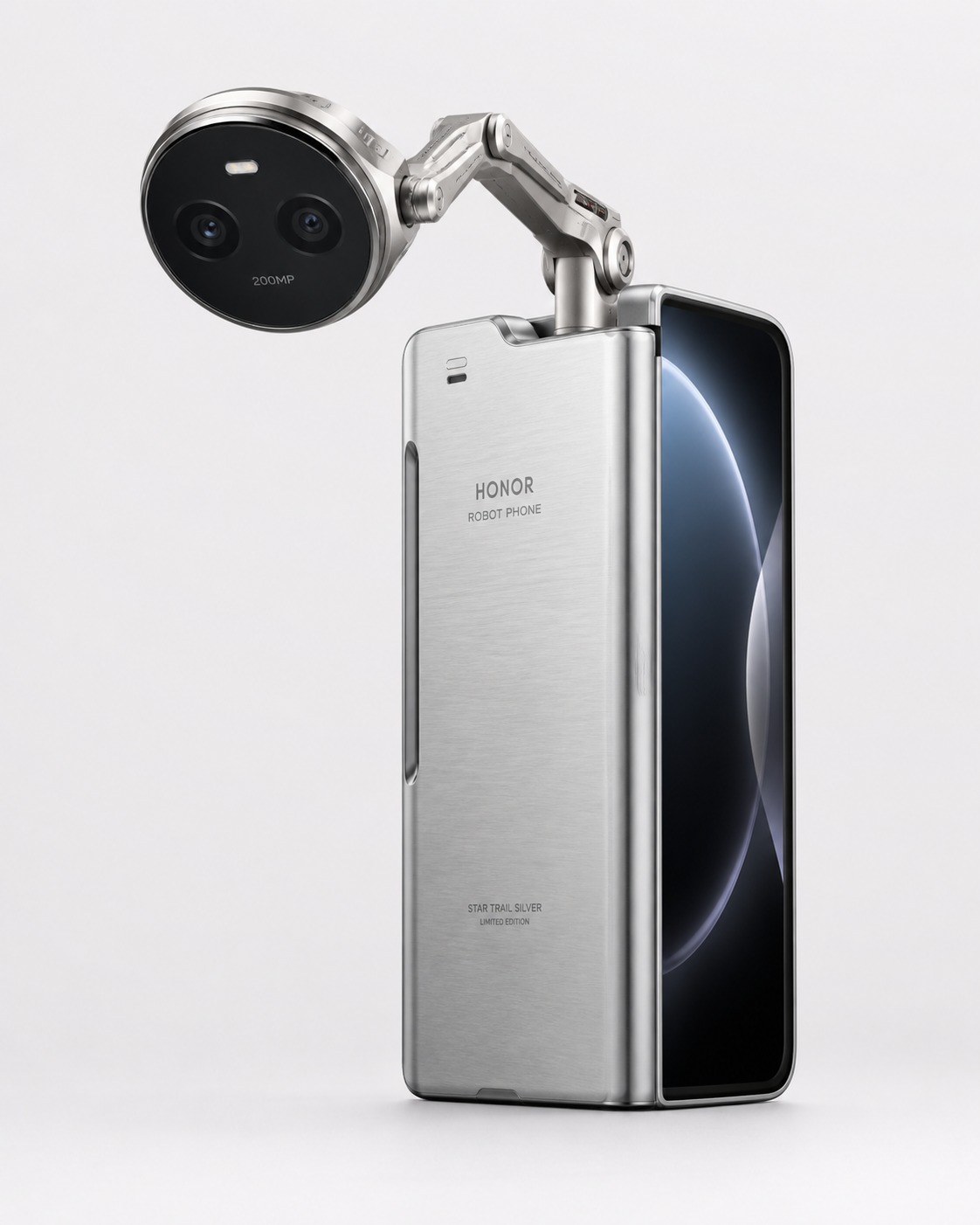
The hardware underneath is serious. There’s an aluminum frame, a glass front, and a titanium-alloy gimbal arm that HONOR calls the Titanium Agile Gimbal. The company says the mechanism is built from more than 100 precision components, goes through 60 manufacturing processes, and is covered by over 100 patents. The arm itself is the world’s smallest gimbal, weighing just 2.6g and measuring 6mm thin — about 65% smaller than the DJI Osmo Pocket line, with a motor rated at 360 degrees per second.
The trade-off is weight. At 248g, this is one of the heaviest non-folding phones you can buy, and it’s noticeably thick at 9.59mm. The Verge’s Dominic Preston said his first impression was that the phone “felt oddly dated” despite the flagship camera hardware inside. I get it — holding it, you feel the extra machinery. It’s balanced enough that it doesn’t feel top-heavy, but you won’t forget it’s in your pocket.
Durability is the bigger concern. The phone is rated IP54, which means it can survive dust and water splashes, but only when the camera is stowed. HONOR says you shouldn’t expect the same protection when the gimbal is deployed, so filming in the rain is out. And unlike foldables, which are lab-tested for hundreds of thousands of folds, HONOR won’t publish a cycle rating for the gimbal motor — a spokesperson told WIRED it “has undergone rigorous reliability testing,” which is corporate-speak for “we’re not giving you a number.” The plastic cover that protects the gimbal when folded is also easy to nudge, and if you push on it, the gimbal refuses to retract until you stop. It shows a warning on screen, so it’s a nuisance rather than a bug, but it’s worth knowing.
The Robot Phone comes in two colors — Moon Shadow Grey and Star Trail Silver — and ships with a case and a magnetic stand in the box, which is a nice touch for a phone built around filming. There’s no 3.5mm headphone jack and no microSD slot, which at this price feels like a deliberate choice to keep the chassis intact.
Display
The display is a 6.31-inch LTPO OLED with a 1,216 x 2,640 resolution, roughly 461 ppi, and a 1-120Hz adaptive refresh rate. It supports HDR and Ultra HDR, and HONOR touts a peak brightness of 6,800 nits — a figure worth reading the fine print on. That’s a local peak during video playback, not full-screen sustained brightness; the real-world HBM number is 2,000 nits, which is still very good for outdoor visibility.
HONOR also throws in 4,320Hz PWM dimming, which should be easier on sensitive eyes than lower-frequency PWM displays, plus an anti-reflective coating that genuinely helps under bright light. Screen protection is where the spec sheets disagree: GSMArena lists Giant Rhinoceros Glass while RedShark mentions HONOR’s NanoCrystal Shield. This may just be naming differences across regions, but I’m flagging it rather than picking one.
The panel itself is bright, punchy, and perfectly usable in direct sunlight. The 6.31-inch size is compact by 2026 flagship standards — the kind of form factor that’s getting rare as everyone pushes toward 6.7 inches and beyond.
Performance
Under the hood sits the Snapdragon 8 Elite Gen 5, Qualcomm’s top-tier chip built on a 3nm process, with an octa-core CPU (2x 4.6GHz Oryon V3 Phoenix L + 6x 3.62GHz Oryon V3 Phoenix M) and an Adreno 840 GPU. That’s the same class of silicon powering the best Androids of the year — the kind of hardware that makes heavy gaming and 4K video editing feel effortless — the same silicon that powers the vivo X300 E we reviewed earlier this summer.
Memory is flagship-grade too: 12GB or 16GB of LPDDR5X RAM with 512GB or 1TB of UFS storage, and no card slot. HONOR pairs the chip with a custom cooling system, which matters here because the gimbal camera generates its own heat on top of the SoC. Early hands-ons didn’t report thermal issues in normal use, but sustained 4K recording with the arm deployed is exactly the kind of workload that will push it.
Day-to-day, there’s nothing to complain about. This is a properly fast phone — the gimbal is the headline, but the silicon underneath is no compromise.
Camera
This is the section you came for, so let’s take it seriously. The gimbal arm carries a 200MP main camera with a 1/1.28-inch sensor, f/1.6 aperture, PDAF, and OIS. It’s joined on the back by a 200MP periscope telephoto with a 1/1.4-inch sensor and 2.7x optical zoom (up to 200x digital), plus a 50MP ultrawide with a 122-degree field of view and macro-level capabilities. The selfie camera is a 50MP shooter with a 90-degree field of view.
The gimbal has four degrees of freedom and can rotate 300 degrees, which means the main camera can double as a selfie camera when the arm is deployed. You can trigger it in the camera app or with a palm gesture on the front camera. There are preset motion modes — Tilt Lock, FPV, FPV Vertical, AI SpinShot — and automatic 180-degree pans. Subject tracking follows a person and keeps them centered as they move, though GSMArena noted it only works with people and can lose track in crowds.
How does it actually shoot? GSMArena, which has now handled the device, says it “easily offers the best stabilization on a phone ever” — smoothing out not just walking but running. WIRED’s Julian Chokkattu found the stabilization made action shots “amazingly smooth” and used the tracking mode to film himself hands-free by propping the phone on the included stand. Group selfies get a clever trick: the gimbal takes three shots — left, center, right — and stitches them into a wide panorama in one motion.
Video is the real story, though. HONOR partnered with ARRI, the cinema camera maker, and the Robot Phone is the first smartphone with ARRI color science in its imaging pipeline. You get 10-bit ARRI Log-C3 recording, ARRI Wide Gamut 3, and real-time-previewable ARRI Looks in a dedicated Cinema Mode. Footage can go straight into DaVinci Resolve with ARRI LUTs applied — a genuine mobile capture-to-post workflow. ARRI’s director of image science says the phone was calibrated to use the same LUTs as an ALEXA and produce “very similar” images. HONOR claims 14 stops of dynamic range; measured numbers aren’t out yet, so treat that as a claim.
The rear camera records 4K at up to 120fps and 10-bit Log-C3 at up to 60fps, with the front camera doing 4K at 60fps. There’s a color spectrum sensor, laser AF, and 3D automated subject tracking in the mix. The one thing nobody has stress-tested yet is long-term durability of those moving parts, and RedShark notes early reviews say the stabilization is close to — but not quite as steady as — a dedicated DJI Osmo Pocket 4. Also worth noting: Gadgets360 describes the gimbal as 3-axis while GSMArena, WIRED, and RedShark call it 4-DoF; the manufacturer’s own material says 4 degrees of freedom, so I’m going with that.
There’s also the gimmick side, and I’d be doing you a disservice not to mention it. The gimbal camera doubles as the “eyes” of HONOR’s YoYo AI assistant — it can dance to music, make faces on the screen, and pretend to be happy or angry. It’s charming for about five minutes, then you move on. WIRED called it “less effective and quite gimmicky,” which is fair.
Battery & Charging
The battery is a 7,060mAh silicon-carbon cell — huge for a 6.3-inch phone, and the main reason the Robot Phone weighs what it does. WIRED was surprised the phone isn’t top-heavy given the camera machinery and the big battery, and called it “decently balanced.”
Charging is 120W wired and 50W wireless, with wireless reverse charging for topping up earbuds. One spec discrepancy worth flagging: GSMArena’s spec page and RedShark both list 50W wireless, but GSMArena’s hands-on article mentions 90W. The spec page is the authoritative figure, so I’m treating 50W as correct with the 90W mention noted as an error.
Real-world endurance numbers aren’t published yet, but a 7,060mAh cell with an efficient LTPO panel should comfortably clear a full day of heavy camera use — and the 120W wired charging gets you back to full fast when you do drain it. If you’re chasing pure battery life, the 8,000mAh Realme C100x we reviewed earlier this month still holds the endurance crown, but it trades away 5G and flagship-class performance to get there.
Software
The Robot Phone runs Android 16 with HONOR’s MagicOS 10 on top, featuring the YoYo AI assistant with the Robot Mode personality features described above. Here’s the critical part for Filipino readers: this is a China-only device, and China-market units ship without Google Play Services out of the box. GCash, Maya, and most local banking apps won’t run natively — the same caveat we flagged on China-market Huawei devices like the nova 16 SE. HONOR uses Google’s Gemini assistant in markets outside China, but this phone isn’t sold there, so you’d be relying on sideloading and workarounds.
HONOR also hasn’t announced how many years of OS updates the Robot Phone will get. Given that the company positions it as a tech showcase — and GSMArena doubts we’ll ever see a sequel — long-term software support is an open question. Buy it for the hardware; don’t assume years of updates.
Pros and Cons
| Pros | Cons |
|---|---|
| Genuinely best-in-class gimbal stabilization — smooths walking and running | 248g and 9.59mm thick — heavy for a 6.3-inch phone |
| First smartphone with ARRI color science: Log-C3, ARRI Looks, Cinema Mode | IP54 only when the gimbal is stowed — no rain filming |
| Dual 200MP cameras (main + 2.7x tele) with 50MP ultrawide | China-only, small production run, no international release planned |
| 7,060mAh battery with 120W wired charging | Gimbal durability unquantified — no published cycle rating |
| Snapdragon 8 Elite Gen 5 — true flagship performance | No Google Play Services out of the box — biggest PH caveat |
| Group selfie panorama stitching and hands-free subject tracking | Plastic cover over the gimbal is flimsy and easy to nudge |
| Case and magnetic stand included in the box | No 3.5mm jack, no microSD, no confirmed update commitment |
Should You Buy This?
Buy it if
- You vlog or film constantly and want DJI Osmo Pocket-level stabilization built into your phone
- You’re a mobile filmmaker who wants ARRI Log-C3 and LUT workflows without carrying a dedicated camera
- You’re an enthusiast willing to import from China, sideload your apps, and accept gray-market risk for a genuinely unique device
- You want flagship performance and a 7,060mAh battery in a compact 6.3-inch body
Skip it if
- You live in the Philippines and rely on GCash, Maya, or local banking apps — no Google services out of the box is a dealbreaker
- You need a daily driver you can use in the rain or in dusty environments
- You’re worried about long-term reliability of a phone with 100+ moving parts
- You just want the best camera phone you can buy with a warranty — the HUAWEI Pura 90s Pro Max, for example, delivers a 200MP telephoto with official PH pricing and support
Final Verdict
The HONOR Robot Phone is the most interesting smartphone of 2026, and possibly the most interesting since the first foldables — including the Pixel 11 Pro Fold we reviewed this week. HONOR didn’t just slap a gimbal on a flagship — it engineered a 2.6g motor, miniaturized it below anything DJI sells, paired it with dual 200MP sensors, and convinced ARRI to bring its cinema color science to a phone. The stabilization genuinely changes what you can shoot without extra gear, and the Log-C3 workflow is a real tool for mobile filmmakers, not a spec-sheet fantasy.
But “interesting” is not the same as “buy this.” The Robot Phone is China-only, produced in small quantities, priced at CNY 9,999 (about $1,482, roughly ₱90,800 by direct conversion — no official PH pricing exists), and ships without Google services. The gimbal’s long-term durability is unproven, the plastic cover feels fragile, and HONOR itself treats the device as a showcase rather than a product line. GSMArena doubts we’ll see a sequel — and at this price, with this much machinery, that’s a reasonable read.
So who is this phone for? Honestly, almost nobody in the Philippines should make it their main phone. But everyone who cares about where smartphones are going should pay attention. HONOR is using the Robot Phone as an open-world test bed for ARRI color science before bringing it to the Magic9 series — which is exactly the kind of “we’ll fix it in the mainstream product” roadmap that makes this weird gadget more than a museum piece. If the gimbal concept survives contact with real buyers, we could see a more practical version in the Magic9 or beyond.
Until then, treat the Robot Phone as the industry’s proof of concept: smartphones haven’t plateaued as much as we thought — they just needed someone to try something genuinely different. The price of admission is steep and the caveats are real, but as a signal of where mobile cameras are heading, this is the most exciting launch of the year.