
Another big and boxy PHEV is knocking on the Philippine market’s door — and this time it’s from BYD, the brand that basically owns the local EV conversation right now.
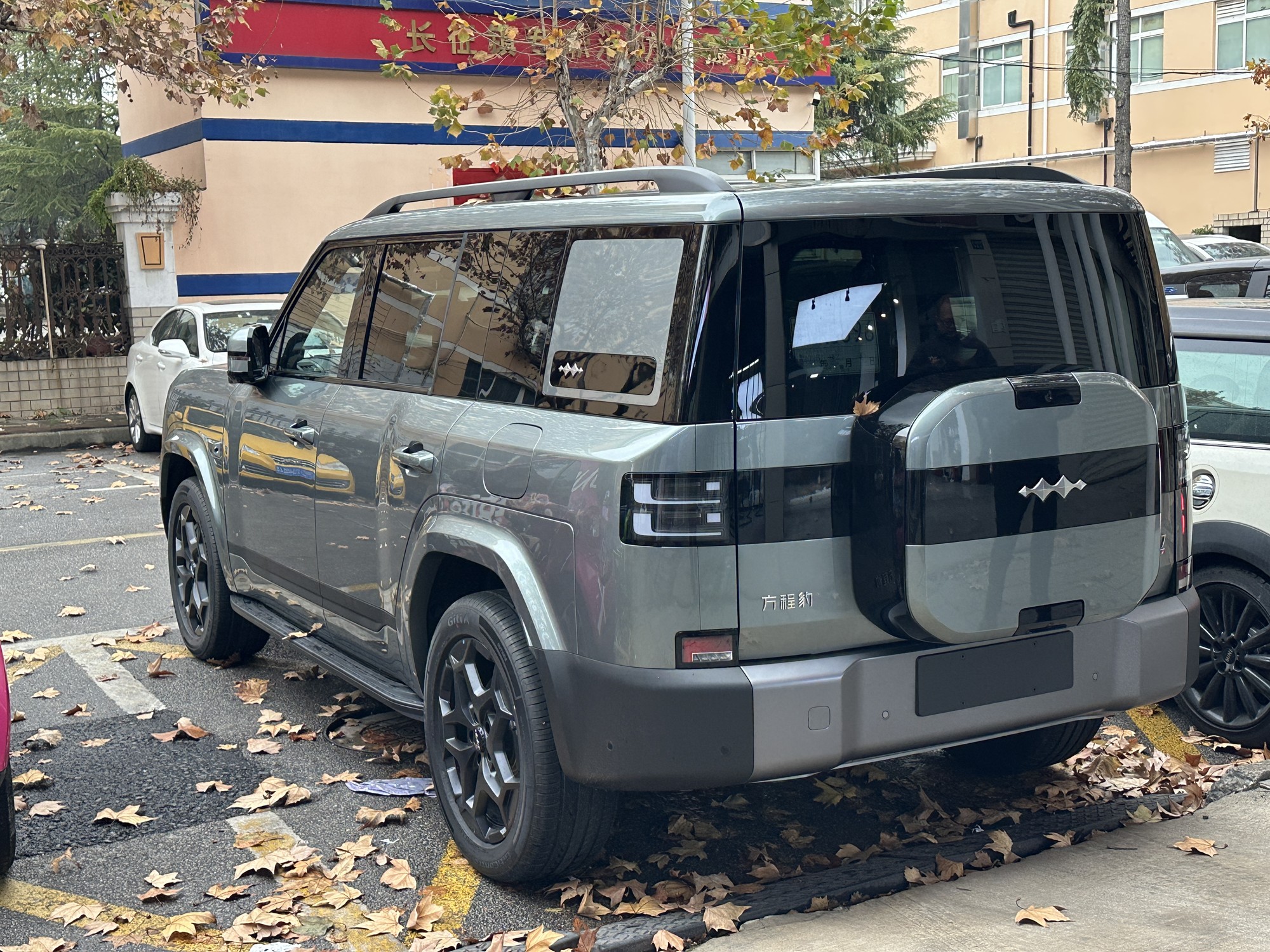

Top Gear PH spotted the BYD Ti 7 on the Department of Energy’s list of recognized EVs earlier this week. If that sounds familiar, it’s the same pattern we saw with the Jaecoo J8 and the VinFast VF 8: a model gets DOE recognition first, and a launch usually follows within months. For a seven-seat plug-in hybrid SUV with Land Rover Defender ambitions, that’s worth paying attention to.
BYD Ti 7 Philippines: What Is It?
In China, the Ti 7 wears the badge of BYD’s premium off-road sub-brand, Fangchengbao (Formula Leopard). It’s sold there as the Tai 7, and international markets are getting it as a BYD — the UK is already taking orders at £47,995, and now, per the DOE listing, the Philippines could be next.
Two variants appear on the DOE list: the 2WD Pro and the 4WD Ultra. Both share a 1.5-liter turbocharged engine, but the electric side of the story is where they split.
BYD Ti 7 Key Specs
| Spec | Ti 7 2WD Pro | Ti 7 4WD Ultra |
|---|---|---|
| Engine | 1.5L turbo, 154 hp / 225 Nm | 1.5L turbo, 154 hp / 225 Nm |
| Electric motor | Single, 268 hp / 315 Nm | Dual, 483 hp / 620 Nm combined |
| Drive type | Front-wheel drive | All-wheel drive |
| Battery | 26.6 kWh LFP | 35.6 kWh LFP |
| EV range | 105 km (DOE listing) | 130 km (DOE listing) |
| Combined range | Up to 1,300 km (CLTC, with 60L tank) | |
| 0-100 km/h | ~7.5-7.9 sec | ~4.5 sec |
| Charging | DC 30-80% in ~17.5 min (35.6 kWh, per CAR) | |
| Dimensions | 4,999 x 1,995 x 1,865 mm | |
| Wheelbase | 2,920 mm | |
| Approach / departure | 24° / 25° | |
| Wading depth | Up to 600 mm | |
| Towing | Up to 2,000 kg | |
| Cargo | ~970 L with 3rd row folded (UK spec) | |
EV range figures come from the DOE listing as reported by Top Gear PH. China-market CLTC figures are more generous (135 km entry, 170-200 km for the 35.6 kWh pack) — different measurement, same battery. Ground clearance isn’t published yet; don’t let anyone invent one.
What Others Are Saying
The Ti 7 has been on sale in China since September 2025, so the early reviews are already in — and they’re unusually good for a budget Defender wannabe.
CAR Magazine (UK) drove it and came away impressed: solid looks, a well-put-together interior, loads of kit, and way more electric-only miles than the Land Rover Defender 110 — at far less money. Their only real complaints: the design is derivative, and residual values are an unknown.
What Car? notes the 35.6 kWh battery manages an official 74-mile (119 km) EV range, and at 0-62 mph in 4.8 seconds it’s quicker than both the Defender PHEV and the Volvo XC90. It also undercuts the Defender 110 by about £15,000.
CnEVPost and CarNewsChina report the sales numbers, which tell their own story: more than 50,000 units in its first 80 days in China, and roughly 94,000 sold overall. That’s not a niche car — that’s a segment shift.
BYD Ti 7 Price in the Philippines
There’s no official Philippine SRP yet — the DOE listing is a strong signal, not a price tag. For context, here’s the China pricing converted:
| Variant | China price | USD | PHP (est.) | INR |
|---|---|---|---|---|
| Ti 7 2WD Pro | ¥179,800 | ~$25,250 | ~P1.55M | ~Rs 24.1 lakh |
| Ti 7 4WD Ultra | ¥219,800 | ~$30,900 | ~P1.90M | ~Rs 29.5 lakh |
Conversions at ~61.4 PHP/USD and ~95.4 INR/USD (mid-August 2026). Top Gear PH pegs the same prices at roughly P1.63M and P1.99M using its own rate. BYD PH doesn’t price cars at straight conversions, though — the Sealion 7 landed at P2.588M, so a realistic estimate for a Ti 7 Ultra lands somewhere in the P2.1M to P2.4M range. Treat that as an estimate, not a promise.
Is the BYD Ti 7 Right for the Philippines?
This is where the Ti 7 gets genuinely interesting for Filipino buyers, because it was designed for exactly the conditions we deal with.
City Driving
On EDSA, this thing is overkill in the best way. Instant torque from the electric motors makes merging and lane-changing effortless, and the 105-130 km EV range covers a full week of stop-and-go commutes without touching the engine. The boxy shape isn’t the most aerodynamic thing on the road, but in traffic you’re not paying an aero penalty anyway. The 360-degree camera and ADAS suite handle the tight stuff in Makati and BGC parking.
Long-Distance Travel
This is the Ti 7’s party trick. With a 60-liter tank plus the battery, BYD claims up to 1,300 km of combined range (CLTC). Manila to Baguio is roughly 250 km — you’d do that round trip twice, plus a full week of city driving, on one tank and a full charge. For provincial trips to Bicol or Ilocos, the PHEV setup means no range anxiety and no charging-station roulette. It can also tow up to 2,000 kg, which matters if you’re hauling a trailer or a boat.
Flooded and Flood-Prone Areas
Here’s the spec I kept coming back to: 600 mm of wading depth. That’s deeper than most rivals can manage, and it’s backed by a 24-degree approach angle that handles those sudden submerged potholes. The LFP battery sits low and sealed, and unlike a gas car, there’s no air intake to hydrolock. Still, 600 mm is a limit, not a license — flash floods on Marcos Highway or EDSA can go far deeper than that, and wading should stay a last resort.
High Temperatures
LFP chemistry is the right call for a 36°C Manila afternoon. It’s thermally stable, degrades slower in heat, and BYD’s DiSus-C body control keeps the cabin stable while the dual-zone climate control does its job. The panoramic sunroof is nice, but CarNewsChina has flagged quality complaints about the glass roof on Chinese-market units — worth checking the glass in person before you commit.
Other Things to Consider
- Seven seats that actually fit humans — the export model gets three rows, which the China-market five-seat version doesn’t.
- God’s Eye B ADAS on the top trim — BYD’s LiDAR-equipped driver-assist system, the same family of tech the brand is pushing across its lineup.
- No official PH launch date yet — the DOE listing pattern suggests we’ll hear something in the next few months, not years.
How It Stacks Up
If the Ti 7 lands around P2.1-2.4M, it walks into a crowded but interesting spot. The GAC GN8 PHEV starts at P3.338M, the Jaecoo J8 PHEV is estimated at P2.4M and up, and BYD’s own Sealion 7 BEV sits at P2.588M. Against those, a seven-seat, 1,300 km-range, Defender-styled PHEV at the lower end of that band would be a serious value argument — especially for provincial families who can’t rely on charging infrastructure.
On the affordable side, the Geely EX2 and BYD’s smaller models handle the city-only crowd. The Ti 7 is aimed one tier up, at people who need one car for everything: school runs, EDSA commutes, and the occasional long haul to the province.
Should You Wait for It?
If you’re shopping for a seven-seat SUV and you don’t need one this quarter, the Ti 7 is worth the wait. It checks the boxes that matter here — range, wading depth, heat-proof batteries, and a price that should undercut the Japanese and European alternatives by a lot.
And if you’re wondering whether BYD’s battery tech actually holds up in our climate, I dug into that in my piece on why AI’s power hunger might be batteries’ big moment. For the Toyota Fortuner and Ford Everest crowd, this is the first PHEV that genuinely competes on capability, not just on fuel savings.
The DOE listing is up. The launch is the next step. Watch this space.