
The Realme P4s 5G is official. It launched in India today, August 26, at a ₹23,999 starting price, and it sits right in a slot that’s hard to ignore: an 8,000mAh battery, a bright 144Hz AMOLED, and a rugged IP69 body in a mid-range package. Realme has been quietly building a name for itself in the Philippines with the P-series’s battery-first approach, and the P4s is the model that leans hardest into gaming on top of that endurance. Here’s my honest read after digging through the specs.
Design & Build Quality
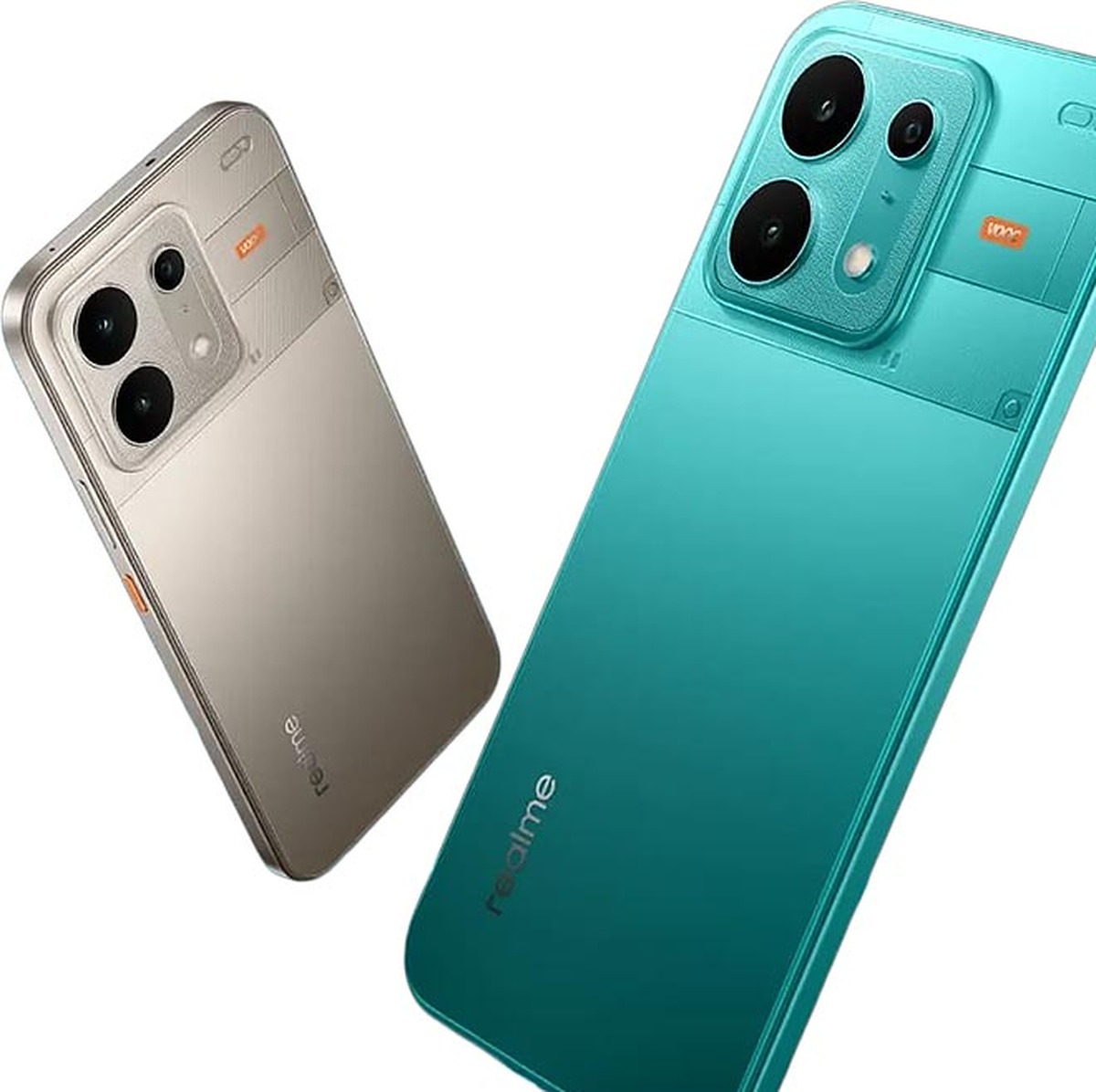
Realme kept the P4s flat and angular, with a squared-off aluminum-look frame and a big, rounded-square camera island that takes up the top-left corner of the back. It’s a confident, modern look, and the two finish options — a metallic turquoise/teal and a softer beige-gold — give it more personality than the usual black slab. Realme co-designed the rear panel with Pearl Academy in India, which shows in the subtle textured back that hides fingerprints reasonably well.
At 7.6mm thick, the P4s is genuinely slim for a phone packing an 8,000mAh cell — that’s part of what makes it impressive on paper. It’s glass-fronted with a plastic frame and back, which keeps weight and cost down even if it doesn’t feel as premium as a metal-and-glass flagship. Don’t mistake the plastic for fragility: the P4s carries IP66, IP68 and IP69 ratings, meaning it shrugs off dust, full immersion, and high-pressure water jets. For anyone who carries a phone through a Philippine downpour or near a pool, that’s a real selling point — not just a spec-sheet boast.
There’s no 3.5mm headphone jack here, and no microSD slot either, both of which sting a little on a mid-ranger. You do get stereo speakers and 24-bit/192kHz Hi-Res audio for wired USB-C listening. Full dimensions and exact weight weren’t published at launch, so I’m treating the “thin and light” claim with some caution until retail units confirm it.
Display
This is where the P4s earns its “gaming” tag. It’s a 6.78-inch Samsung M14 LTPS AMOLED panel running at 1.5K resolution (1272×2772, around 454ppi), with a 144Hz refresh rate, HDR10+, and support for Netflix HDR. Realme quotes a headline 6,500-nit peak brightness, but don’t take that number literally everywhere — that figure is a local peak measured in specific conditions, not sustained full-screen brightness. Still, with a 2,000-nit high-brightness mode and 3,840Hz PWM dimming, this panel should handle bright outdoor afternoon sun far better than most budget LCDs, and it should be gentler on the eyes for flicker-sensitive users.
Realme also claims a 26% boost in luminous efficiency and a longer panel lifespan over earlier displays. Marketing-to-taste, sure, but the M14 OLED hardware is a genuine step above what you’d expect at this price — it’s the same panel-generation family used in more expensive phones, and 144Hz on a 1.5K OLED in this segment is a strong headliner. Watching video with HDR10+ and Netflix HDR support should look rich, and the high refresh rate is a real comfort during long scrolling sessions.
Performance
Under the hood sits the MediaTek Dimensity 7400 Ultra, a 4nm mid-range chip with four Cortex-A78 and four Cortex-A55 cores and a Mali-G615 MC2 GPU. And here’s the twist: Realme pairs it with a dedicated HyperVision+ AI chip, so the P4s runs a dual-chip setup where the secondary chip handles graphics and frame pacing. Realme claims up to 144fps in supported games, backed by a 7,000mm² vapor chamber to keep things cool during long sessions.
Let me be clear about what this is and isn’t. The Dimensity 7400 Ultra is a well-regarded mid-range chip, not a flagship, and no amount of marketing makes it a gaming monster on the level of an 8 Elite or Dimensity 9500. The dual-chip trick is mostly about stabilizing frame rates in supported titles and adding gaming extras like the “AI Gaming Partner” — it won’t transform the phone into a gaming rig. Real-world thermals and sustained frame rates are genuinely unverified until retail reviews land, so treat the 144fps claim as a capability, not a guarantee.
Memory and storage are respectable: up to 12GB of RAM and up to 256GB of fast UFS storage, though the full variant lineup and the exact price per model weren’t fully confirmed at launch. The lack of a microSD slot means you’re stuck with whatever you buy, so size up if you hoard games. No card slot and no headphone jack both nag, but for the price the core performance package is solid.
Camera
Realme kept the rear camera clean: a 50MP main sensor with f/1.8 aperture and optical image stabilization, joined by an 8MP 112° ultrawide. No telephoto, no gimmick macro lens — just a sensible dual setup. That OIS on the main sensor is a notable inclusion for the price; it helps with sharper handheld shots and steadier video, and the phone records up to 4K at 30fps and 1080p at up to 120fps with gyro-based stabilization.
The honest caveats: there’s no dedicated telephoto, so “zoom” is digital and 2x is an in-sensor crop that drops detail. The 8MP ultrawide is functional but modest, and the 16MP selfie camera is a step down from the more ambitious front cameras Realme has used on other lines. Camera quality is still unverified until review units ship — the hardware looks capable, but I’d want real-world shots before judging low-light performance, where a mid-range sensor with OIS can go either way. It’s a good, no-nonsense camera setup that’s clearly secondary to the battery and display story.
Battery & Charging
Here’s the headline. The P4s packs a huge 8,000mAh silicon-carbon cell, and Realme claims up to three days of use on a single charge. Charging is 80W wired — enough for a 50% top-up in around 28 minutes per Realme’s claim — plus 10W reverse wired charging and bypass charging, which lets the phone draw power directly from the wall adapter during gaming instead of cycling the battery. Bypass charging is a smart, genuinely useful feature for anyone who plays for long stints plugged in.
Two honest flags. First, silicon-carbon batteries like this 8,000mAh cell trade a little advertised capacity for the ultra-thin frame — the “usable” capacity can be slightly below the marketing number, an industry-wide quirk I’d note on any Si/C phone. Second, Realme’s “three days” figure assumes modest use; with gaming and bright screen it’ll be much less. Even being conservative, an 8,000mAh Si/C cell should easily outlast the 6,000mAh budget phones I’ve tested recently, and in the Philippines we’re spoiled for battery-first mid-rangers — this morning I reviewed the Redmi 17C 5G, another big-battery budget 5G, and the P4s comfortably tops it. It also squares off nicely against the 10,000mAh champion in this space, the Oppo A7 Pro Max, giving up some capacity for a thinner, nimbler gaming package.
Software
The P4s ships with Android 16 running Realme UI 7.0. And that brings up the biggest open question with any new Realme right now: what happens to the software skin. Realme confirmed earlier this year that it’s retiring Realme UI, with newer devices set to launch on Oppo’s ColorOS 17 as part of a broader pivot — including a pause in China operations. I dug into exactly this transition in my Realme 16x 5G review, and it applies here too.
The P4s launches on Realme UI 7.0, so that’s what you get out of the box — familiar, clean, and reasonably close to stock Android with a few Realme tweaks. But whether the P4s ends up among the early devices receiving a ColorOS 17 update is genuinely unconfirmed. If you plan to keep this phone for years, that transition could be either a nice refresh or a mild source of uncertainty, and I’d want Realme to spell out the update path for the P-series before banking on it. Realme hasn’t published a firm multi-year update commitment for the P-series, so longevity-minded buyers should keep that in mind.
Pros and Cons
| Pros | Cons |
|---|---|
| Massive 8,000mAh silicon-carbon battery | Mid-range chipset, not a true flagship gaming SoC |
| Bright 1.5K 144Hz Samsung M14 AMOLED | No telephoto camera — zoom is digital |
| IP66/IP68/IP69 durability for PH weather | No microSD slot |
| Clean 50MP OIS main + ultrawide, no gimmick lenses | No 3.5mm headphone jack |
| 80W charging with bypass charging for gaming | Full variant lineup and PH price still unconfirmed |
| Dual-chip HyperVision+ gaming tuning | Realme UI to ColorOS 17 transition is an open question |
Should You Buy This?
Buy it if
- You want a phone that comfortably lasts a full day-plus of heavy use — the 8,000mAh cell is the headliner.
- You game on your phone and value a smooth 144Hz OLED and battery-focused tuning in the mid-range.
- You need rugged IP69 durability for outdoor or rainy PH conditions and don’t want to baby your phone.
- You prioritize battery and display over camera flexibility.
Skip it if
- Photography is your priority — with no telephoto and a modest ultrawide, camera is clearly not the focus.
- You rely on expandable storage or a wired headphone jack.
- You want a confirmed Philippine launch price and local warranty before committing.
- You’d rather have the absolute top-end 10,000mAh battery class — the Oppo A7 Pro Max is the direction to look.
Final Verdict
The Realme P4s 5G knows exactly what it is: a gaming-and-endurance phone that spends its money on a huge battery, a bright high-refresh OLED, and rugged build, and mostly skips the bells and whistles elsewhere. In the Indian market it starts at ₹23,999, which undercuts its own P4 Pro sibling and lands it competitively among sub-₹25,000 battery-first 5G phones.
For the Philippines specifically, the timing is worth watching. Realme brought the P-series over locally with the P4 Power 5G, a 10,001mAh phone that launched with a ₱19,999 promo price — that’s the realistic benchmark for where Realme pitches P-series endurance at home, and it’s a strong reference point if the P4s follows. There’s no confirmed Philippine launch or price for the P4s yet, so Pinoy buyers are largely looking at import pricing for now, and the ongoing global memory shortage has been putting upward pressure on phone prices across the board — context I covered in the Sony Xperia 10 VIII review.
Who is this for? It’s for the mobile gamer who wants a big battery and a smooth, bright display without paying flagship money, and for anyone in the tropical-and-rainy part of the world who values a phone that survives daily life. It’s not the phone for you if photos are your main concern, or if you want the reassurance of a confirmed local price and a long spelled-out software commitment.
If Realme can deliver on that 8,000mAh endurance, the bright M14 panel, and a sensible price, the P4s is one of the more interesting mid-range 5G phones of late 2026 — provided the software transition gets handled cleanly. It earns a place on our list of Top 10 Phones for 2026 for the battery-first crowd, and it’s a genuinely smart pick for the right buyer.