
Reservations for the second-generation Tesla Roadster officially opened in the Philippines on October 17, 2026 — just two days after the car’s headline-grabbing global reveal in Texas. Tesla Philippines is offering three variants, with the entry-level Performance trim carrying a sticker price of P3,500,000.
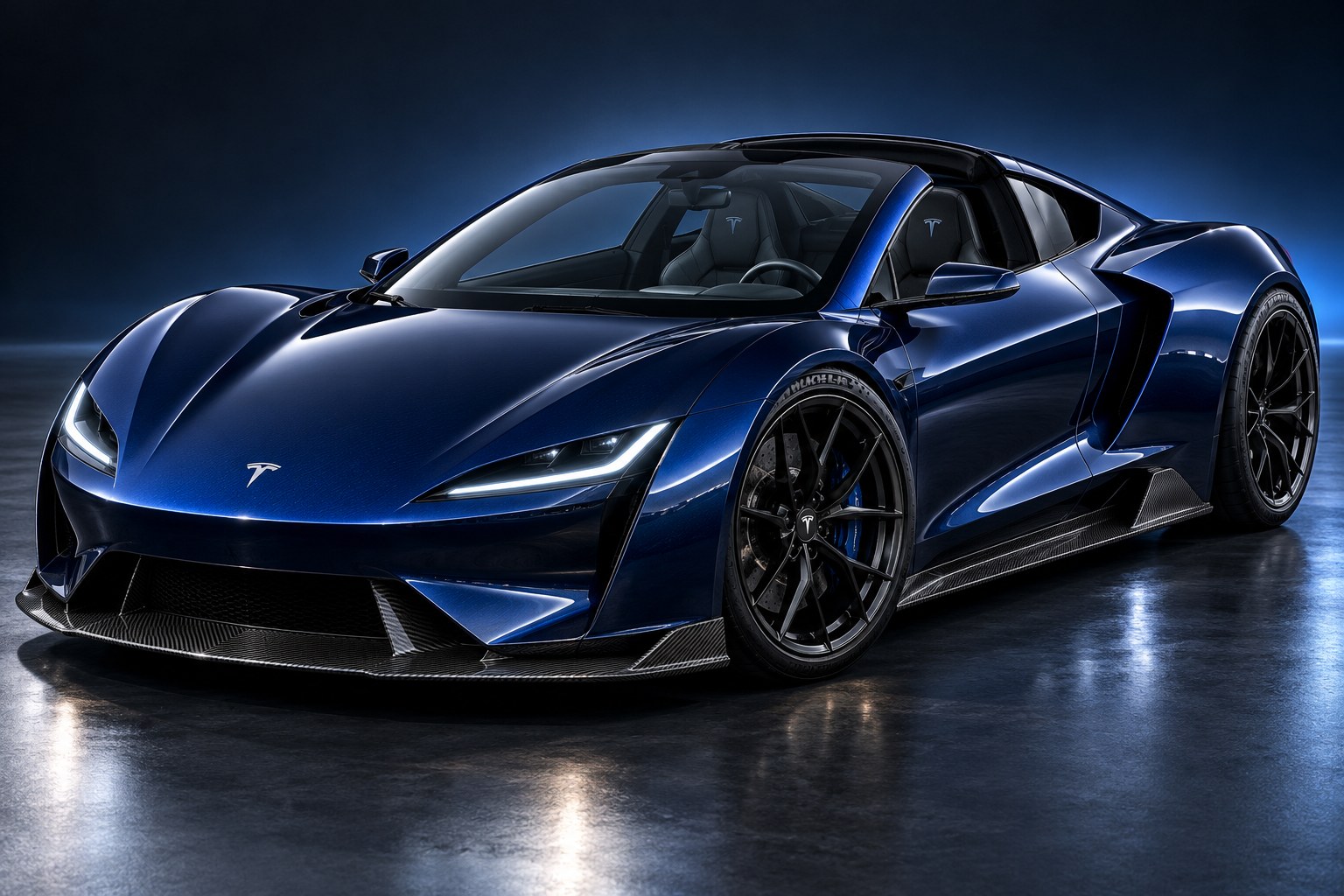
The Roadster needs no introduction. The original, launched in 2008, was the first highway-legal production EV to prove electric cars could be desirable. This sequel has been nearly a decade in the making, and when CEO Elon Musk finally pulled the covers off on October 15, it did so by flying over a row of cars using cold-gas thrusters. Whether that translates to a production car you can drive to SLEX by 2028 — well, let’s separate the physics demo from the spec sheet.
Three Variants, One Very Expensive Reservation Slip
Tesla Philippines is accepting reservations for three Roadster variants. The Performance trim requires a P350,000 deposit with P3,150,000 due within 10 days of reserving — totaling P3,500,000. The Thrust adds rear-mounted cold-gas thrusters and costs P17,500,000 (same P350K deposit plus P17,150,000 within 10 days). The single-seat Rocket trim, which adds a full flight system with thrusters positioned around the vehicle for forward, upward, and lateral movement, is available by invitation only with no published price.
A few things to keep in mind: the reservation does not guarantee final pricing, delivery date, or specifications. Tesla has historically revised pricing and configurations between reservation and production. Production is targeted for 2028, and no Philippine delivery timeline has been announced.
What the Spec Sheet Actually Says
Tesla has been unusually stingy with final specifications, but what’s been revealed is staggering. Every variant uses a dual-motor rear-wheel-drive layout on an 800- to 1,000-volt architecture, with each motor getting its own inverter for torque vectoring between the rear wheels. The combined output exceeds 1 megawatt — roughly 1,340 horsepower — with over 1,400 Nm of torque at the wheels.
| Specification | Performance | Thrust | Rocket |
|---|---|---|---|
| 0-60 mph (no thrusters) | Under 1.6 seconds | Under 1.6 seconds | Under 1.6 seconds |
| 0-60 mph (with thrusters) | Under 1.6 seconds | Under 0.9 seconds | Under 0.59 seconds |
| Top speed | 214 mph (344 km/h) | 214 mph | 214 mph (330 mph target) |
| Battery | ~150 kWh (est.) | ~150 kWh (est.) | ~150 kWh (est.) |
| Range (est.) | 300+ miles (483+ km) | 300+ miles | 300+ miles |
| Max DC charging | 500 kW | 500 kW | 500 kW |
| Charging 15-85% | ~10 minutes | ~10 minutes | ~10 minutes |
| Drivetrain | RWD, dual rear motors | RWD, dual rear motors | RWD, dual rear motors |
| Roof | Removable glass | Removable glass | Removable glass |
| Seating | 2+2 | 2+2 | 1 |
The battery uses new 4680 cells designed for sustained power, with aluminum cans, double-sided cooling, and a titanium upper plate. Tesla says it can recharge at up to 500 kW from a V4 Supercharger, going from 15% to 85% in about 10 minutes. The pack’s exact capacity hasn’t been confirmed — most estimates place it around 150 kWh, which would make it the largest battery in any production EV by a significant margin.
The Roadster weighs approximately 3,700 lbs (1,678 kg) — remarkably light for a car with this much battery and power. Tesla achieved this partly by using a carbon fiber body and stripping the interior to the essentials. The removable glass roof stows in the trunk, which is itself a feat of packaging given the massive battery pack.
What Others Are Saying
The Tesla Roadster’s reveal drew widespread attention, with automotive outlets noting its staggering performance figures. YugaTech reported on the Philippine reservation opening, highlighting the P350,000 deposit structure and the three-variant lineup. CarGuide.PH covered the October 15 reveal, documenting the cold-gas thruster demonstration and the Roadster’s sub-1-second 0-60 mph claim with thrusters engaged. Unbox.ph noted the practical concerns — that production is targeted for 2028, specifications may change, and the thruster systems face regulatory uncertainty. Gizguide covered the Philippine pricing, confirming the Performance trim at P3.5 million and the Thrust at P17.5 million.
International outlets were equally astonished. InsideEVs reported the 1,341 hp output and the 500 kW charging capability, while noting the battery capacity remains unconfirmed. Not a Tesla App highlighted the 0.81-second 0-60 mph demonstration with thrusters, while cautioning that production timelines have historically slipped. Hagerty detailed the engineering: dual rear motors with individual inverters, 4680 cells with aluminum cans, double-sided cooling, and a titanium upper plate.
The Tesla Roadster Thruster Question
The cold-gas thrusters are the Roadster’s party trick, but they’re also its most controversial feature. The Performance trim gets active aero and a multi-mode suction system that can hold the car upside down — yes, really — but the actual thrusters are reserved for the Thrust and Rocket variants. The Thrust adds rear-mounted thrusters that help propel the car from 0 to 60 mph in under a second. The Rocket goes further, with thrusters at the perimeter for directional control in three dimensions.
None of this has been independently verified by automotive regulators, and it remains unclear whether the thruster systems will be road-legal in the Philippines or most global markets. Tesla’s own website notes that “availability is subject to each region’s legal requirements and applicable laws.” For now, treat the flight and lateral-movement capabilities as aspirational — the real question is whether the base performance figures hold up without the thrusters, and there’s every indication they will.
Philippine Pricing and Practicality
At P3,500,000, the Performance trim sits in rarefied territory. Here’s how it stacks up:
| Model | Price (PHP) | Range | 0-100 km/h |
|---|---|---|---|
| Tesla Roadster Performance | P3,500,000 | 483+ km (est.) | ~2.6 seconds (est.) |
| MG Cyberster | P4,500,000 | 520 km | 3.2 seconds |
| Porsche Cayenne Electric | P6,800,000+ (est.) | 642 km | 4.8 seconds |
| BMW iX3 50 xDrive | P4,998,000 (est.) | 805 km | 4.9 seconds |
| BYD Sealion 7 AWD | P2,588,000 | 542 km | 4.5 seconds |
In US dollar terms, the Roadster Performance works out to roughly $55,500 at current exchange rates (63.03 PHP/USD), or about ₹52.8 lakh in Indian rupees (95.08 INR/USD). That’s actually reasonable money for a 1,340-hp hypercar — the problem isn’t the price, it’s everything else.
City driving: This is not an EDSA car. The Roadster is low, wide, and overwhelmingly powerful. The instant torque from dual rear motors would make stop-start traffic an exercise in restraint. And that removable roof? Fine in BGC, less appealing during a sudden Metro Manila downpour.
Long-distance travel: The estimated 483 km range is theoretically enough for Manila to Baguio on a single charge, but sustained highway speeds at 214 mph would drain the pack in minutes. More realistically, at highway speeds you’d see 350-400 km, which is still respectable. The bigger issue is charging infrastructure — Tesla’s Supercharger network in the Philippines is still in its infancy, and the Roadster’s 500 kW charging capability would be wasted on most existing DC chargers.
Flooded situations: Dealbreaker. The Roadster sits low to the ground, and Tesla has published no wading depth figure. With no published IP rating for the battery pack in submersion conditions, the only sensible advice is: do not attempt to flood this car. A single deep puddle on EDSA during the rainy season could write off a P3.5 million asset.
High temperature: The 800-1,000V architecture and liquid cooling should handle Philippine heat better than most EVs, but sustained hard driving in 36-38°C ambient will still trigger thermal throttling. The battery’s titanium upper plate and double-sided cooling are designed for heat extraction, but they’re designed for sustained track use — not for sitting in traffic on C5.
Should You Reserve One?
The Tesla Roadster is a halo car in the purest sense — it exists to generate headlines and pull people into showrooms, not to be a volume seller. At P3.5 million, it undercuts the MG Cyberster by a million pesos while offering nearly triple the power. But the Cyberster is a practical roadster with dealer support, a service network, and a car that you can actually drive every day.
The Roadster, by contrast, is a technology demonstrator wrapped in carbon fiber. It’s the kind of car you reserve because you want to be first in line for the future — not because you need a car for the 2027 morning commute. If you’re serious about putting down a P350K deposit, go in with your eyes open: production is 2028 at the earliest, specifications may change, and the thruster systems may never make it to Philippine roads.
For most Filipino drivers, the smarter move is to watch how Tesla’s local charging network develops over the next two years. The Model 3 and Model Y will benefit from whatever infrastructure the Roadster’s reveal builds. And if you’re cross-shopping performance hybrids, the BYD Sealion 6 DM-i offers a very different value proposition at half the price. And if you truly need a performance EV today, the MG Cyberster or BYD Sealion 7 will get you 80% of the thrills with 20% of the hassle.