
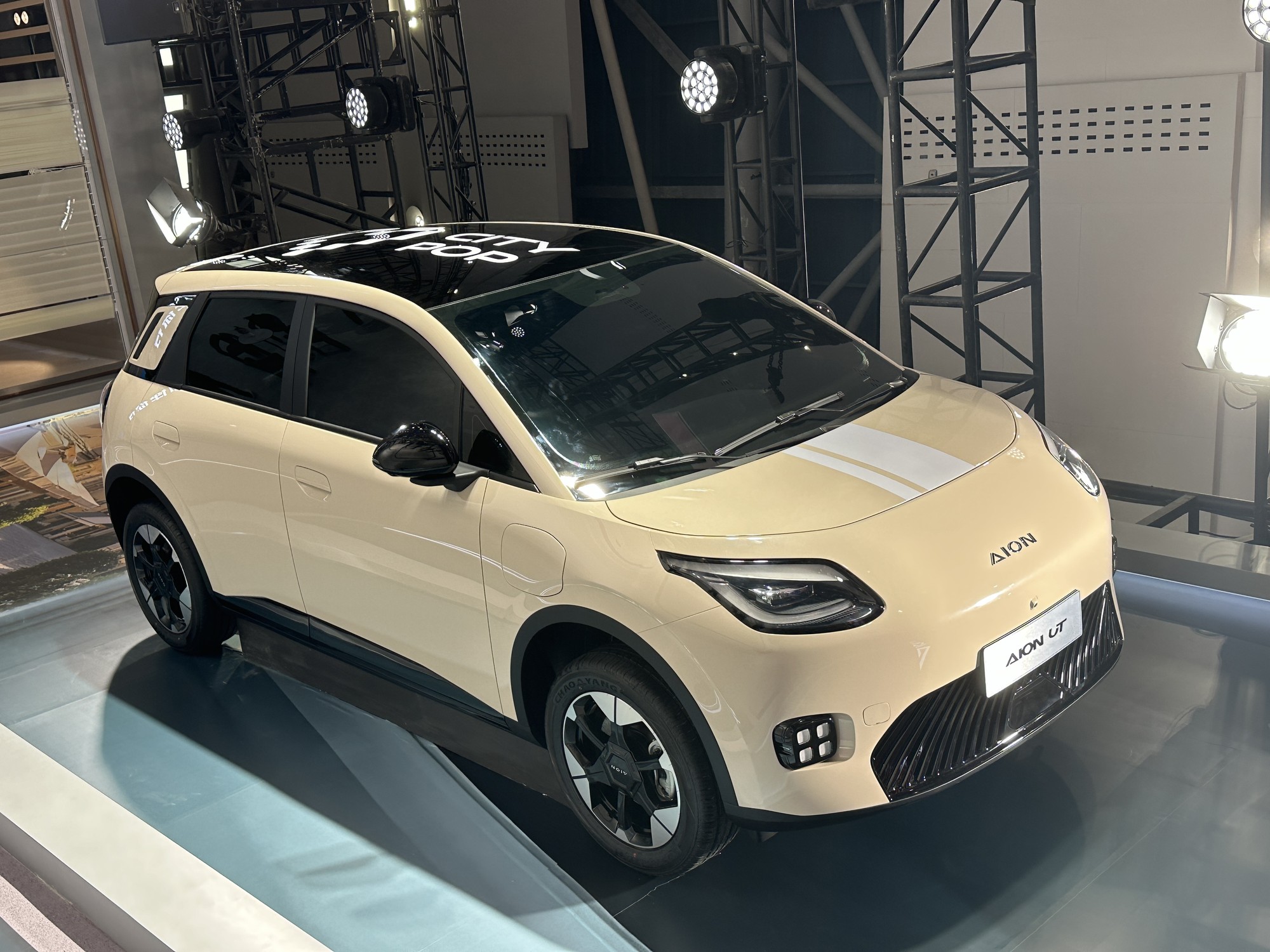
The GAC Aion UT is small proof that the sub-million EV is no longer just a dealer’s fantasy. This fully electric hatchback launched in the Philippines at a ₱998,000 introductory price, which puts a proper five-seat EV with 400 km of rated range into reach of buyers who’d otherwise be staring at a gas hatchback. It’s GAC’s most affordable electric car yet, and it landed with a fight on its mind.

If you watched the 2027 Hyundai Tucson design reveal this week, you know the mainstream brands are still teasing what they’ll bring to the Philippines. The Aion UT is the flip side of that coin — an EV you can actually put money down on today, not next year.
What Is the GAC Aion UT?
The Aion UT is a fully electric, five-door hatchback with seating for five. It carries GAC’s “Milanese Aesthetics” design language — owl-like LED headlights up front, cube-shaped fog lights, prominent wheel arches, and a tailgate spoiler out back. Five colors are on offer: Champs-Élysées Beige, Emerald Green, Rococo White, Seine Silver, and a two-tone combination of Rococo White with Emerald Green.
At its core is GAC’s Magazine Battery — a lithium iron phosphate (LFP) pack with 44.12 kWh of capacity. GAC says the liquid-cooled pack has bullet-penetration protection and a low-temperature heating function to keep cells at optimal temperature, with a claimed lifespan of up to 1.5 million kilometers or 15 years. That’s an aggressive number for a sub-million car.
GAC Aion UT Specs at a Glance
| Specification | GAC Aion UT (PH Elite) |
|---|---|
| Body | 5-door hatchback, 5 seats |
| Motor | Front-mounted single motor, FWD |
| Power | 100 kW / 136 PS |
| Torque | 145 Nm |
| Battery | 44.12 kWh LFP (Magazine Battery) |
| Range | Up to 400 km (NEDC) |
| AC Charging | 6.6 kW |
| DC Charging | 64 kW, 30–80% in ~24 minutes |
| Vehicle-to-Load | Up to 3.3 kW |
| Length × Width × Height | 4,270 × 1,850 × 1,575 mm |
| Wheelbase | 2,750 mm |
| Curb Weight | 1,540 kg |
| Cargo | 440 liters (seats up), ~689 L folded |
| Suspension | MacPherson strut front / torsion beam rear |
| Drive Modes | Comfort, Power, Power Save |
| Warranty | 8-yr/160,000 km comprehensive; 8-yr/200,000 km battery & motor |
Note there are two Aion UTs in the world, and they’re not the same car. The base Philippine model uses the 44.12 kWh / 100 kW / 145 Nm setup above. The version sold in Australia is a bigger 60 kWh battery with a more powerful 150 kW / 210 Nm motor and 430 km of WLTP range. When you read international reviews, keep the smaller PH pack in mind.
What Others Are Saying About the Aion UT
The international consensus is that the Aion UT is the value pick of its class. Australia’s Gay Car Boys reviewed the 60 kWh version and called it “the car the Fiat 500e should have been,” praising the rear legroom that belongs to a car half a meter longer and the Zen-like ride around town. Their verdict: it delivers the range, space, and power that used to cost significantly more, and the only real risk is buying from a dealer network that doesn’t exist yet.
They also flagged real compromises — a slightly nervous rear end from the torsion-beam suspension mid-corner, climate controls buried in the touchscreen, and no spare wheel, just a repair kit. The smart cruise control had software gremlins, though ordinary cruise control behaved itself. More importantly for buyers, GAC answers the network concern head-on: an 8-year/160,000 km vehicle warranty (8-year/200,000 km on the battery and motor) is as long as anyone in the class offers.
The Philippine launch coverage from AutoIndustriya emphasized the value story — this is GAC’s answer to the BYD Dolphin and Geely EX2 in the affordable-EV space, with a long feature list for the money.
Cabin and Tech
Inside, the Aion UT keeps things minimal and tech-forward. There’s an 8.8-inch digital instrument cluster behind the wheel and a massive 14.6-inch portrait touchscreen running the infotainment, with wireless Apple CarPlay and Android Auto. A six-speaker sound system, 360-degree camera, ambient lighting, voice control, and a smartphone app for remote control round out the kit.
Safety is where the sub-million tag starts to look generous. The UT carries forward collision warning with automatic emergency braking, lane departure warning, lane-keeping assist, emergency lane-keeping, blind-spot detection, rear cross-traffic alert, plus stability and traction control and hill-start assist. GAC is giving you a full ADAS stack at a price where most rivals hand you a radio and a prayer.
GAC Aion UT Price in PHP, USD, and INR
The Aion UT Elite carries an SRP of ₱1,068,000. An introductory price of ₱998,000 — a ₱70,000 discount — applies to the first buyers, broadly valid through late September 2026. At the BSP reference rate of about ₱61.60 per US dollar and roughly ₹95.3 per dollar:
| Variant | PHP | USD (est.) | INR (est.) |
|---|---|---|---|
| Aion UT Elite — SRP | ₱1,068,000 | ~$17,340 | ~₹16.5 lakh |
| Aion UT Elite — Intro | ₱998,000 | ~$16,200 | ~₹15.4 lakh |
In the sub-million electric space, the Aion UT slots in against the micro-car tier — Wuling’s Macaron, the BYD Seagull, VinFast’s VF 3 — but it’s a full-size, five-seat hatchback with real cargo space and a proper touchscreen. That distinction matters: this isn’t a quirky city pod, it’s a usable daily car. It competes more directly with the GAC GS4 Max HEV at ₱1.218M and other affordable EV/HEV crossovers in GAC’s own stable, positioning the UT as the pure-electric entry point for the brand.
Is the Aion UT Right for Filipino Driving?
City Driving
This is where the UT shines. Under 4.3 meters long with electric steering, it’s easy to slot into tight Makati and BGC parking and quick through EDSA traffic. The instant torque from the 100 kW motor makes merging and lane changes effortless, and a 400 km rated range is more than enough for weeks of Metro Manila commuting between charges. For city dwellers with home charging, the Aion UT is close to ideal.
Long-Distance Travel
Manila to Baguio is roughly 250 km, so the UT’s 400 km NEDC rating clears a one-way trip on a single charge with margin — though real-world highway range will be lower, so plan a DC top-up to be safe. The 64 kW DC charging does 30–80% in about 24 minutes, which turns an NLEX/SCTEX charging stop into a coffee break rather than an ordeal. The caveat: charging infrastructure outside Metro Manila is still thin, so long provincial runs need planning.
Flooded Situations
Here’s the honest weak spot, and I won’t sugarcoat it. The Aion UT is a compact hatchback, and ground clearance wasn’t published in the official specs — I won’t invent a number. What I can say: like most EVs, it has a sealed, liquid-cooled battery pack, so it won’t hydrolock the way a gas engine will. But a low-riding hatchback in Metro Manila floodwater is a gamble, and unlike body-on-frame SUVs, there’s no high-clearance safety net. If your route regularly floods, this is a car for the dry season or the elevated road network, not for wading.
High Temperatures
The Philippines runs hot, and the LFP chemistry is the right call for that. LFP cells are thermally stable and degrade more slowly in heat than NMC batteries, which suits our 36–38°C summers. GAC’s liquid cooling and low-temperature heating keep the pack managed in both directions. The automatic climate control handles the cabin, though buyers should know the touchscreen controls mean you’ll be hunting for the fan speed on screen rather than reaching for a physical knob.
The Bottom Line
GAC came to the Philippine EV market swinging with the Aion UT. At ₱998,000 intro, you’re getting a full five-seat electric hatchback with a real range figure, an ADAS suite, a big touchscreen, and a warranty that outlasts most competitors — in a segment that’s mostly micro-cars and compromise. It’s a strong argument for going electric now rather than waiting for the next big reveal.
The trade-offs are honest ones: no spare wheel, a touchscreen you’ll need to learn, modest 64 kW DC charging, and the unresolved question of ground clearance in floods. But for the city buyer who wants out of gas prices and into a genuinely usable EV, the Aion UT is one of the most compelling below-a-million options we’ve seen in the Philippines this year.
If you’re still weighing EV vs hybrid before committing, GAC’s own lineup — from the three-row MG RX9 PHEV up to the Outlander GT PHEV — shows there’s a plug-in option at nearly every price point. And if you care about the battery technology behind all these EVs, it’s worth understanding how power-hungry everything is getting and what LFP chemistry brings to the table. The Aion UT is a strong reason to make the jump now.