
Huawei Mate X8 Review: Book-Style Folding Before Launch Day
Huawei has finally put a date on its next foldable flagship: the Mate X8 arrives in China on November 24, unveiled at an event in the country at 14:30 local time, and is already live on the Vmall online store for reservations. What Huawei has confirmed is a solid, unmistakable skeleton — book-style inward folding, five colourways, and four RAM/storage variants, the same lineup the Mate X7 shipped in last year. Beyond that, it is still leaks and guesses. This review walks through exactly what is confirmed, what is rumoured, and why a pre-launch read of the Mate X8 still has value while the device is weeks away. We compare it against the Huawei Mate 90 Pro and the recent Pura 90 Plus, because the foldable race is now a Huawei versus the rest of the premium pack.
| Spec | Status | Details |
|---|---|---|
| Launch date and market | Confirmed | China, November 24, 2026 at 14:30 local (Vmall reservations live) |
| Form factor | Confirmed | Inward-folding book style, announced via Huawei’s Mate X anniversary video |
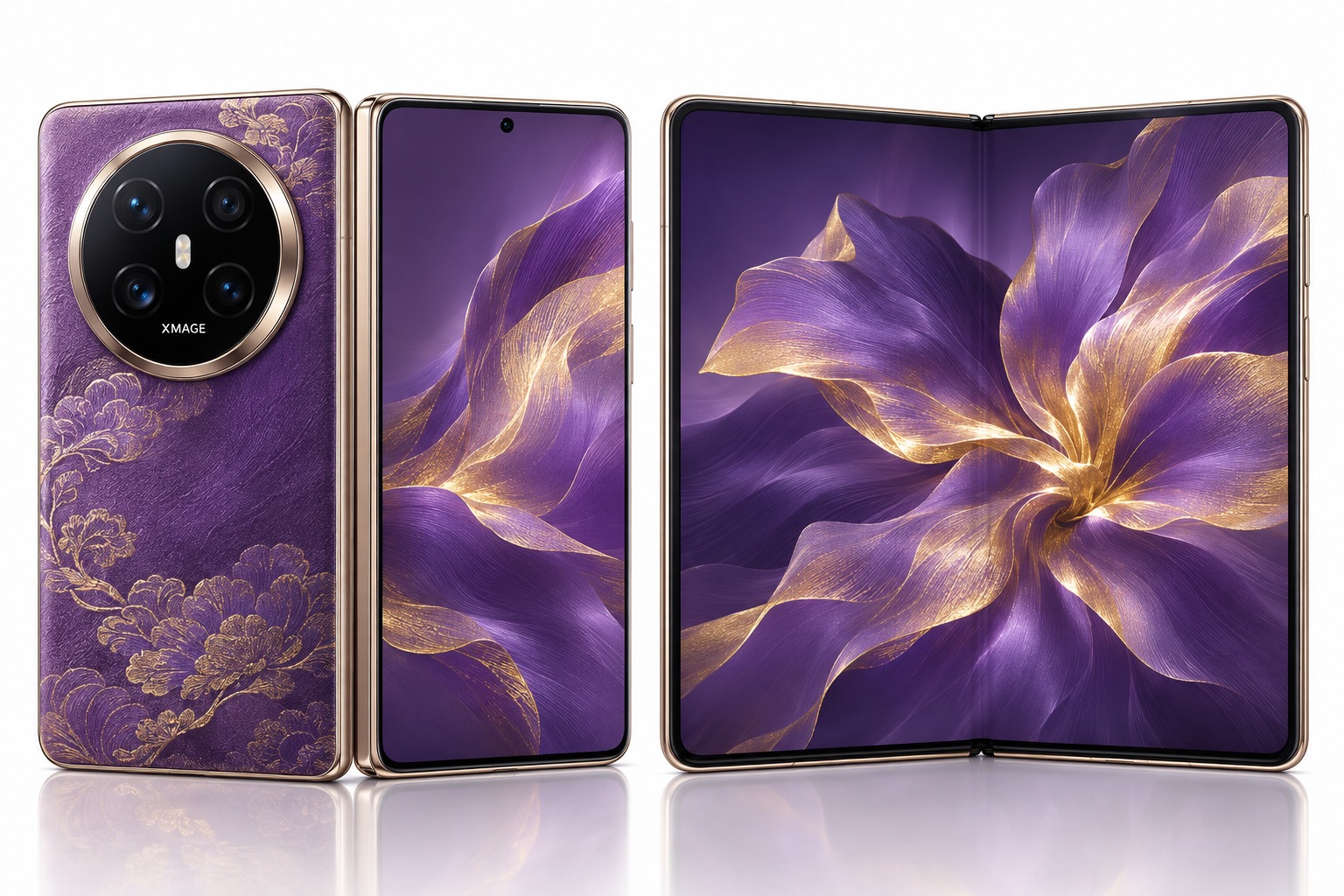
| Rear camera module | Confirmed | Large round module, four lens cutouts, centre flash, XMAGE branding (per official renders) |
| Colour options | Confirmed | Purple Gold Brocade, Azure Sky Black, Snowy White, Qingyun Brocade, Danxia Brocade |
| RAM / storage | Confirmed | 12GB+256GB, 12GB+512GB, 16GB+512GB (Collector’s), 16GB+1TB (Collector’s) |
| Main chipset | Unconfirmed | Tipped to the Kirin 9050 or Kirin 9050 Pro, same family as the Mate 90 series |
| Displays | Unconfirmed | 6.5-inch cover, 8.15-inch inner; LTPO OLED, 1–120Hz, UTG protection |
| Camera system | Unconfirmed | 50MP main with variable aperture, 50MP periscope telephoto, 40MP ultrawide, 8MP front |
| Battery & charging | Unconfirmed | 6,000mAh+, 100W wired, 50W wireless, IP58/IP59 |
Design & Build Quality
The Mate X8 is what Huawei calls a book-style foldable, which means the display lives inside the closed phone rather than on the back. The announcement video and the official renders give away the headline look: a large round camera module in the centre of the rear panel, split into four lens cutouts, with a small selfie camera resting in a punch-hole on both the cover and inner screens. That round module is finished with a centre flash and carries the XMAGE label, Huawei’s imaging brand, which tells you where the camera processing lives. On the outside, the foldable keeps the Mate series’ signature styling with golden accents on the rear panel and a clean, book-like silhouette.
The build is the part that matters most in this price band, and Huawei has traditionally been brutally honest about folding hardware. The announcement video shows the hinge carrying Huawei branding, and the unit photographed by Richard Yu was described as thinner and lighter than every earlier Mate X model. That is a genuine improvement over the Mate X7, but until a real unit lands, the exact materials are still unverified. We are expecting a master-grade aluminium frame similar to the Mate 90 line, with Gorilla Glass on both the outer cover and the inner display. The crease, hinge smoothness, and drop performance are all still unconfirmed. I will not pretend to judge what I have not held.
The five colourways are the most distinctive part of the design: Purple Gold Brocade, Azure Sky Black, Snowy White, Qingyun Brocade, and Danxia Brocade. The brocade tones are a deliberate Huawei signature, and they are not off-the-shelf plastic finishes. A Purple Gold Brocade Mate X8 will obviously look striking on a desk, while Snowy White keeps the foldable feeling like a clean everyday carry.
Display
Every Mate X8 spec in this section is still unconfirmed, and that is fine. The open reports point to a 6.5-inch outer cover display and an 8.15-inch inner screen, both with 1–120Hz refresh, Ultra-Thin Glass protection, and a slightly larger inner panel than the Mate X7’s 6.49-inch cover and 8-inch inner. The inner display is the real deliverable here, and Huawei is pushing the size up again, which means a genuinely immersive canvas when the phone is folded shut.
The refresh range is the more interesting detail. A 1–120Hz LTPO panel with a variable refresh rate means the phones can hold the bottom of the range for everyday tasks and jump to 120Hz for gaming. That is a flexible choice, and it is one reason the Mate X8 is likely to hold its own against the OnePlus Ace 7 Pro and the Oppo Find X10 Pro Max, both of which already ship with high-end LTPO panels. We will want to see the actual peak brightness and colour gamut measurements when the device ships.
Performance
The one thing Huawei has made official is the RAM and storage ladder, and there is no surprise in it. The Mate X8 runs the same four variants as the Mate X7: 12GB+256GB, 12GB+512GB, 16GB+512GB for the Collector’s Edition, and 16GB+1TB for the top Collector’s unit. That is a sensible spread, and it keeps the foldable accessible while giving the premium tier a genuinely large option. There is no microSD slot, which is standard for the Mate line at this tier.
Beneath the RAM, Huawei is expected to reach for the Kirin 9050 or Kirin 9050 Pro, the same system-on-chip that powers the Mate 90 Pro Max and the Mate 90 RS. That matters, because the Kirin 9050 family is a strong silicon that competes directly with the Snapdragon 8 Elite Gen 5 and the MediaTek Dimensity 9400. The difference between the Kirin 9050 and the Kirin 9050 Pro is the number of high-performance cores, so the variant matters, but either way the Mate X8 is a flagship-class engine. We will want benchmark figures before writing a verdict, and no Geekbench numbers exist yet because the phone has not shipped.
Camera
The rear camera module is the most visible part of the Mate X8, and the renders show a round cluster of four lenses in the centre of a large module. Huawei uses the XMAGE label on the camera system, which signals that the image processing is handled in-house rather than licensed. The open speculation points to a 50MP main sensor with a variable aperture, a 50MP periscope telephoto that can shoot further than the standard wide, and a 40MP ultrawide on at least one version of the phone. A few leak circles also mention an 8MP front camera, which would be a step up from the Mate X7’s 5MP selfie shooter.
Variable aperture is the touted headline here. A variable-aperture main camera changes its lens group to adjust depth of field and sharpness, which is a strong idea for foldables that have to pack a lot of glass into a small module. Whether it actually performs as well as the marketing suggests will only be known after a real unit is tested. For a pre-launch review, the camera is the single biggest unknown, and that is exactly why we need independent samples before a verdict.
Battery & Charging
The Mate X8 is expected to carry a 6,000mAh+ battery, which would be a solid figure for a wide-folding unit of this era. Charging is tipped at 100W wired and 50W wireless, which would put the Mate X8 in the upper pack for charging speed. The IP58/IP59 ingress rating is also rumoured, which would give the foldable real-world resilience against dust and low-pressure water jets. None of this is confirmed yet, and there is no official endurance figure or battery life test available.
Battery life is a genuine question for foldables, because the hinge creases cut into the main battery’s usable area and the dual-screen setup eats power. Huawei’s Mate 90 Pro Max managed a 6,900mAh cell, so the Mate X8’s 6,000mAh+ is a sensible step back to keep the unit manageable. We will want a real-world endurance test, not a marketing number, when the phone arrives.
Software
The Mate X8 will ship running HarmonyOS 7.0 with the EMUI 16 skin, which is the same software backbone as the Mate 90 series and the Pura 90 series. That means a consistent foldable interface with optimised gestures for the outer cover and the inner display, plus the own-cloud ecosystem that Huawei pushes for its high-end devices. The update commitment for the Mate X8 has not been stated, and the typical safety net for this tier is four to six years of AndroidOS and security patches.
One thing that matters for the Philippines is that the Mate X8’s launch is China-only at this stage. Huawei’s high-end foldables still do not carry the same Google Mobile Services stack that local users take for granted, so GCash, Maya, and most local banking apps will not run out of the box. Ditching Google for a third-party ecosystem like Fleksio is possible, but it is a workaround, not a clean handover, and it is a real barrier for any international buyer.
Pros and Cons
| Pros | Cons |
|---|---|
| Book-style folding is genuinely more portable than outward-folding rivals like the Samsung Galaxy Z Fold8 Ultra | Rear camera specifications are still unconfirmed |
| Five colourways with a deliberate Huawei brocade signature | Hinge and crease quality not yet verified |
| Four RAM/storage variants, so there is a model for most budgets | No price announced yet |
| XMAGE branding on the camera system promises strong in-house image processing | No real-world camera samples or benchmark data exists yet |
| Large 8.15-inch inner screen is a meaningful upgrade over the Mate X7 | China-only launch at this stage; no PH availability confirmed |
| 6,000mAh+ battery is a solid figure for a wide-folding of this era | Update commitment not stated |
Should You Buy This?
Buy it if you want a genuinely premium book-style foldable and can live with a China-only release for now. The five colourways and the XMAGE camera branding are strong reasons to watch this one, and the Kirin 9050 family would put the Mate X8 against the Mate 90 Pro and Oppo Find X10 Pro Max at the top of its class. If you are upgrading from a Mate X7 and want the next step up in the same family, the Mate X8 is the natural choice.
Skip it if you need a phone that works with your existing local banking and payment apps in the Philippines. The China-only launch means Google Mobile Services are not guaranteed, which is a dealbreaker for most Filipino users. The same goes if you want a fully confirmed spec sheet before you spend on the launch window: the camera, battery, and charging figures are all still unconfirmed.
Final Verdict
The Mate X8 is shaping up to be a carefully built book-style foldable, and Huawei’s decision to confirm the launch date and the RAM/storage ladder in one stroke is a sign of a serious product. The design is distinctive without being comic-book, and the five colourways give the series real personality. The inner display is expected to be larger than the Mate X7’s 8-inch panel, which is welcome for a phone that spends most of its time folded shut.
What we cannot do yet is call the Mate X8 a winner. The camera system is the heart of any flagship, and the variable-aperture 50MP main plus a 50MP periscope telephoto is a sensible upgrade over the Mate X7, but until a unit is in our hands we cannot confirm the sensor, the telephoto reach, or the low-light performance. The Kirin 9050 family is a strong chip, and the 6,000mAh+ battery should give the phone usable endurance, but the only honest answer is that these are all expectations right now.
My recommendation is to wait for the launch day. The Mate X8 is the most substantial Huawei foldable in years, and the pre-release analysis is only the opening act. If the camera and the battery pan out as rumoured, it will be a worthy rival to the OnePlus Ace 7 Pro and the Oppo Find X10 Pro Max. If it arrives as a spec sheet with more questions than answers, it will still be a beautiful phone with a narrower audience. Either way, November 24 is the date to watch.