
iQOO is dropping its new gaming flagship in China today, August 18, and the headline number is impossible to miss: a 9,100mAh battery in a phone that also carries a customized Dimensity 9500M chip and a 144Hz display. After all the giant-battery phones I looked at this year, this one earns its “Ultra” badge through sheer endurance per charge. But a battery this big, at 225 grams, drags a few tradeoffs along with it, and the more I read the spec sheet the more I want to walk through them honestly. Here’s my breakdown of the iQOO Neo 11 Ultra.
Design & Build Quality
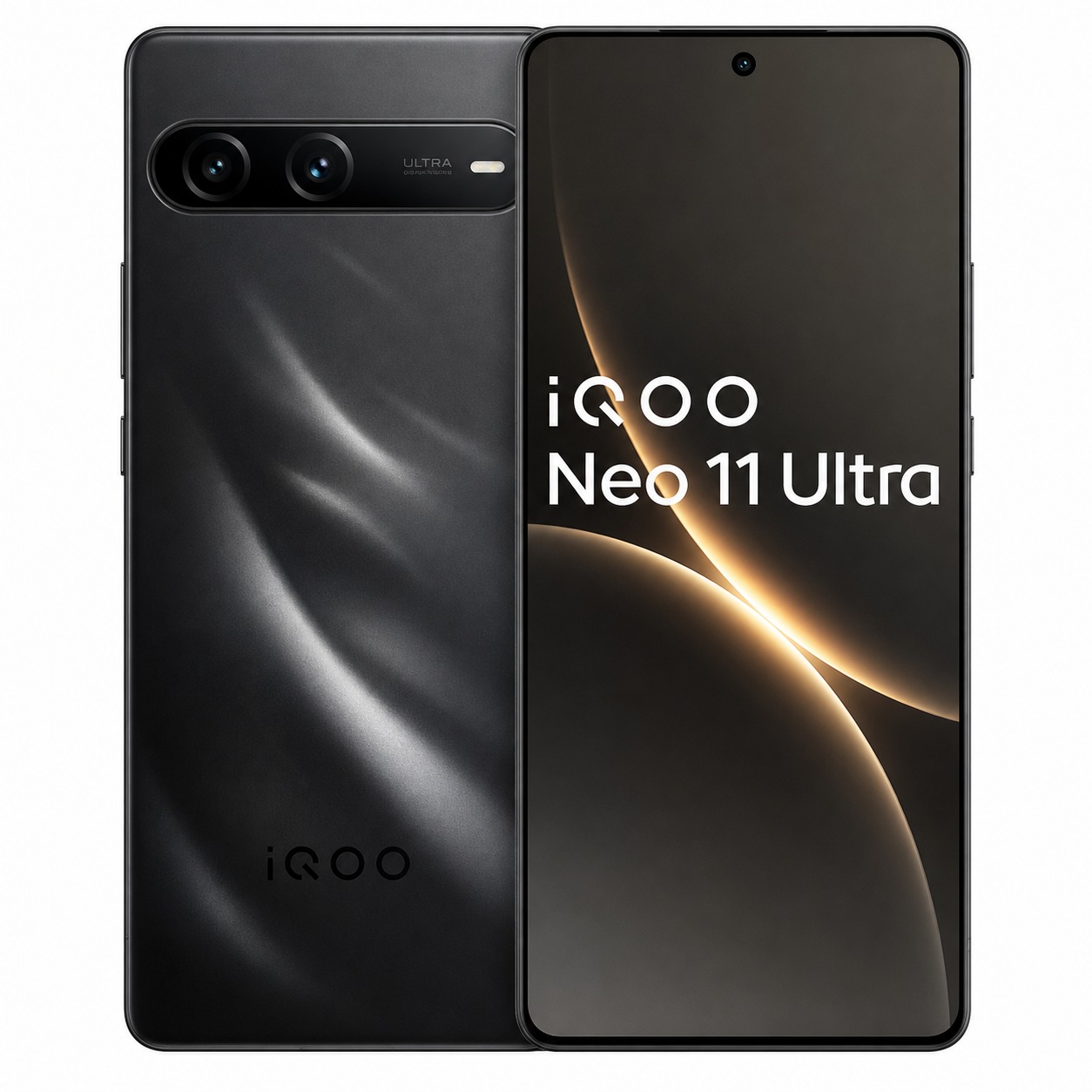
The Neo 11 Ultra leans into a flat, performance-first look. iQOO confirms a metal frame with a matte back finish carrying a subtle 3D “flowing light” effect, and the whole thing is rated IP68 and IP69 — meaning it shrugs off dust, full submersion, and even hot-water jets. That dual rating is rare on gaming phones, which usually stick to a single IP68 at best.
What catches the eye is the camera arrangement. The two rear sensors sit side by side in a horizontal strip rather than a raised square, which gives the back a cleaner, less “camera bump” look. It measures 163.42 x 75.88 x 8.6mm, and the scale of that 9,100mAh cell shows on the scale: 225 grams. That’s heavy for a slab phone — noticeably heavier than flagships that land around 190–210g — and you will feel it in a pocket for the first week.
Three colourways are confirmed for China: Light White, Shadow Black, and a Wind Chaser finish. No surprise here for an iQOO — this is a phone that wants to look fast even when it’s sitting on a desk.
Display
The front is a 6.83-inch flat 2K AMOLED panel built on Visionox’s F2 luminescent material, with a 144Hz refresh rate and iQOO’s Circular Polarized Light 2.0 tech meant to cut eye strain during long sessions. iQOO quotes up to 2,000 nits of peak brightness — a marketing figure that usually means a small bright patch on the screen, not a full-screen burst, so treat it as headline spec rather than something you’ll sustain under the Philippine sun.
One honest flag: leak coverage from GSMArena points to this being a regular LTPS panel rather than LTPO, which typically means it won’t drop to the very lowest refresh rates for always-on display power savings. That’s a small nuance that matters only to battery-obsessed users, and with a 9,100mAh cell on board, it’s a minor concern here.
For a phone aimed at fast-paced games, the flat 2K 144Hz panel is the right call — no edge distortion, and 144Hz feels noticeably smoother in shooters and racers than the 120Hz most rivals settle for.
Performance
Powering the Neo 11 Ultra is the MediaTek Dimensity 9500M, model number MT6993M, an octa-core chip co-developed by iQOO and MediaTek. Built on a 3nm process with an all-big-core CPU and what iQOO calls a “Monster Super Core Engine,” it’s a custom-tuned variant of the Dimensity 9500 family — not the exact same silicon as the flagship iQOO 15T, which runs the separate Dimensity 9500 Monster Edition, but clearly kin to it. Early Geekbench listings show flagship-class scores.
iQOO also slots in its own Q2 gaming chip to handle display and frame-related work, which is how these phones offer things like game-specific frame smoothing without taxing the main processor. Combined with the 9500M, this is squarely aimed at sustained high-refresh gaming sessions. Up to 16GB of RAM and 512GB of storage are on the menu from the China Telecom database listing, so multitasking and large game installs won’t be short on headroom.
Thermal management will be the real test, and one I can’t confirm from a spec sheet alone. A flagship chip under 144Hz load needs good cooling to hold frame rates, and with a heavy 225g body there’s plenty of chassis to soak heat. I’d want to see real sustained-session numbers before signing off on “gaming phone” claims, but the hardware stack is genuinely promising.
Camera
Here’s where the Neo 11 Ultra is unapologetically economical. It ships a dual rear setup: a 50MP main sensor (a Sony sensor, per leaked camera samples) and an 8MP ultrawide. There’s no telephoto at all, and no third macro lens to pad the count. A 16MP front camera sits in the hole-punch cutout for selfies and video calls.
That’s a deliberate choice, and an honest one to flag: this is a gaming-first phone, and iQOO is banking on the main sensor doing the heavy lifting while keeping the module costs down. The 50MP Sony main should deliver solid daylight shots and decent low-light with the right processing, but don’t expect the zoom range or versatility of rivals — the Redmi K100 Pro we looked at carries a 200MP OIS main camera, and the iQOO 15T has a 200MP sensor too. If photography is your priority, this isn’t the device.
For sharing clips and quick social snaps, it’ll do the job. For anything beyond that, you drop a tier compared with the camera-focused flagships at a similar price.
Battery & Charging
The centerpiece. The 9,100mAh battery is one of the largest in any current mainstream flagship, and it charges at 100W. iQOO claims up to 13.7 hours of uninterrupted gameplay in popular MOBAs and around 23 hours of continuous short-video playback — manufacturer claims, so take them as targets, but this is clearly a multi-day-phone territory for most real-world use.
100W wired charging means a 9,100mAh cell can go from flat to a big chunk of charge in around half an hour at the wall, which softens the “this battery is huge” reality check. What I could not confirm anywhere is wireless charging — there’s no indication the Neo 11 Ultra supports it, which would be a genuine miss for a phone launched in 2026 at this tier. I’d treat wireless charging as unsupported until iQOO says otherwise.
For Philippine buyers, the battery is comfortably the strongest reason to consider this phone: it’s built to outlast anyone on heavy use, and 100W keeps top-ups short. The in-box bundle reportedly includes the charger, a protective case, and a cable, which is refreshing.
Software
The Neo 11 Ultra runs Android 16 underneath Vivo’s OriginOS 6, in its China-market form. That brings a serious caveat for Filipino buyers: the China build ships without Google Play Services, so out of the box, GCash, Maya, and a lot of local banking apps won’t run without installing Google services yourself. For a middle-class PH market that lives on those apps, that’s a bigger obstacle than price or weight.
iQOO typically follows its Chinese launches with an India launch for the Neo line — the iQOO Z11 is set to land in India later this week — and those global/India builds ship with proper Google support. If you’re set on this phone, the sensible move is to wait for the India or global variant rather than import a China unit and fight the software. iQOO’s update track record for the Neo series is decent, but I can’t verify a specific OS-upgrade commitment for this model yet, so I’m flagging that as unconfirmed rather than promising it.
Pros and Cons
| Pros | Cons |
|---|---|
| 9,100mAh battery — genuine multi-day endurance | Dual camera only: no telephoto, just 50MP + 8MP ultrawide |
| 100W fast charging with charger in the box | Heavy and thick at 225g and 8.6mm |
| Custom Dimensity 9500M + Q2 gaming chip | China OriginOS 6 build lacks Google Play Services |
| Flat 2K 144Hz AMOLED display | No confirmed wireless charging |
| IP68 + IP69 dust and water resistance | Pricing unconfirmed and likely to climb vs predecessor |
| Metal frame with matte flowing-light finish | Not officially sold in the Philippines |
Should You Buy This?
Buy it if
- You want a battery that lasts — the 9,100mAh cell is top of its class.
- You’re a mobile gamer who wants flagship processing and a 144Hz screen without paying a camera-first premium.
- You’re comfortable waiting for, or importing, a global build that has Google Play.
Skip it if
- Photography matters to you — the dual camera trails rivals like the Redmi K100 Pro’s 200MP OIS shooter.
- You rely on GCash, Maya, or banking apps immediately — the China build needs Google services installed first.
- You want a lighter phone; 225g is a lot to carry daily.
- You need an official Philippine price and warranty — there isn’t one yet.
Final Verdict
The iQOO Neo 11 Ultra is a focused, honest gaming flagship: it spends nearly everything on the battery, the screen, and the chip, and it lets the camera be a bit boring in return. For the right buyer, that trade is exactly right. A 9,100mAh battery with 100W charging, a flat 2K 144Hz panel, and a custom Dimensity 9500M make it one of the most endurance-forward phones iQOO has ever built — a natural successor in spirit to the giant-battery conversation we’ve been having all year.
But it’s also a reminder that “Ultra” doesn’t mean everything. No telephoto, no confirmed wireless charging, a 225g body, and a China-first OriginOS build that complicates life for Filipino users all keep it from being an easy recommendation off the shelf. If iQOO brings the Neo 11 Ultra (or a global sibling) to nearby markets with Google support and a sensible price, it becomes a compelling pick. Until then, it’s a fantastic phone that’s most practical for buyers who’ll import it, flash the global software, and prize battery life above all else.
If this pushed you to compare battery-first flagships, my full Redmi Note 17 Pro Max review sizes it against a 10,000mAh rival, and the iQOO 15T review covers the flagship that shares this chip family. For the camera side of the argument, the Redmi K100 Pro shows what 200MP OIS brings to the table.