
There’s a version of the battery-phone race that never gets attention: the 4G lane. vivo just dropped the V70 Lite 4G into Eurasian markets, and it reads like someone built a flagship around a battery and forgot to argue with the price. An 8,100mAh cell, IP68 and IP69 water resistance, a military-grade shock rating, and a 1.5K 120Hz AMOLED. But it also runs a Unisoc T7300 chipset that has no business being near the word “flagship.” That contrast is the whole story.
If you’ve been following the battery race on Bleuken — the Redmi Note 17 Pro Max at 10,000mAh, the HONOR Turbo 5G at 8,560mAh — you know where this is heading. The V70 Lite 4G is vivo’s answer for the market that doesn’t care about 5G and just wants the thing to survive two days and a dunk in the pool. I spent time with the spec sheet, the official vivo listing, and reader sentiment to figure out where the honest value lives.
Design & Build Quality
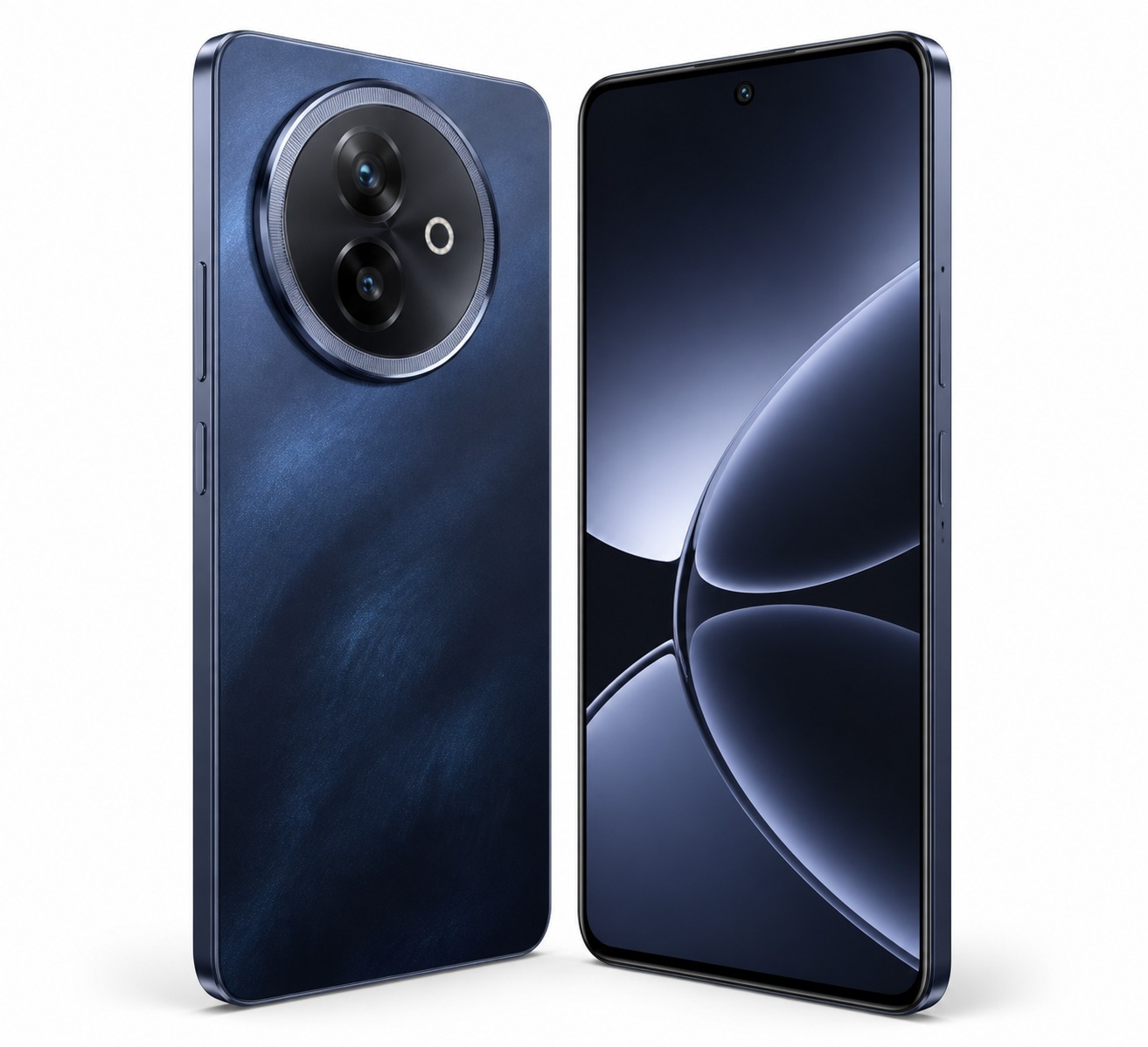
vivo calls this a rebrand of its Y500, and the design carries that DNA: a glass front, a plastic frame with a metallic finish, and a “Nebula Window” camera module that gives the back a premium look it doesn’t fully earn. It’s available in Silk White and Midnight Blue. The Midnight Blue has a subtle satin texture that shifts in the light — the kind of finish that photographs better than it feels.
The build is where this phone punches above its class. IP68 means it shrugs off dust and survives a 1.5-meter dunk for up to 30 minutes. IP69 takes that further — the certification is tested against high-pressure, high-temperature (80°C) water jets, which is why vivo markets it for everything from rain to bathroom streaming to pool dips. On top of that, it carries MIL-STD-810H military-grade shock resistance. Number-crushing drops aren’t guaranteed, but it’s built to handle the daily bumps most budget phones wouldn’t survive.
There’s an underwater photography mode, wet-touch and oily-touch responsiveness, and a battery life-extension mode that kicks in at low charge to stretch out a few extra minutes. It’s clearly designed for people who work outdoors, in kitchens, or on construction sites — not the office-and-coffee crowd.
Display
The 6.83-inch 1.5K AMOLED panel is the surprise hit. At 1,260 x 2,800 pixels and 449 PPI, text is sharp, and the 120Hz refresh rate makes scrolling feel fluid. vivo rates peak brightness at a heady 2,000 nits HBM with SGS five-star sun-readability and low-blue-light certifications. That’s marketing-grade caveat territory — sustained full-screen brightness will settle well below that peak — but in direct sunlight this should still be readable, which matters for a phone aimed at outdoor work.
AMOLED also means deep blacks and punchy colors for movie nights and mobile gaming. The screen-to-body ratio is a claimed 94.47%, so the bezels are thin and the punch-hole selfie camera stays out of the way. The one real gap: HDR support and exact brightness in auto mode aren’t published yet, so treat the 2,000-nit figure as a local peak, not a sustained number.
Performance
Here’s the honest part. The Unisoc T7300 is a 6nm octa-core 4G chipset that pushes roughly 680K points on AnTuTu — a number vivo fans compare favorably against the Snapdragon 685 of older models, and it’s true that the CPU efficiency is notably better. But AnTuTu in the 600K range is firmly mid-range territory, not flagship. GSMArena readers said it plainly: “good display and battery, but embarrassing chipset.” One even joked it was “almost as big as a tablet.”
For day-to-day work — messaging, browsers, video, social — the 8GB of LPDDR4X RAM paired with UFS 2.2 storage is fine. But if you’re chasing sustained high-settings gaming or heavy multitasking, this is the wrong phone. There’s a 3,000mm² vapor-chamber cooling system that helps keep things from throttling during longer sessions, and bypass charging lets you power the phone directly off the charger while plugged in — a genuinely nice touch for gamers who want to cut heat and battery wear. Just keep expectations at “budget chip with good cooling,” not “gaming machine.”
Camera
The rear setup is a 50MP Sony IMX852 main sensor plus a 2MP bokeh depth lens. That’s a strong daylight main camera — clean detail, natural colors, and a well-implemented portrait mode thanks to the dedicated depth sensor. The 32MP front camera is above average for this segment and handles group selfies well thanks to its wide lens. vivo also bundles AI Erase 2.0 and AI UHD 2.0 for object removal and sharpness boosts.
The honest caveats: there’s no ultrawide and no telephoto, so the 2MP “bokeh” camera is the only companion. Underwater mode is a fun differentiator given the IP69 rating, but the quality is limited by the sensor at depth. Low-light shots will lean on computational processing rather than large sensor hardware — expect acceptable results, not the kind of night performance you’d get from a true premium camera phone.
Battery & Charging
This is the headline, and it earns it. The 8,100mAh “BlueVolt” battery (7,920mAh nominal) is rated by vivo for about 10 hours of PUBG gaming, 29.6 hours of video playback, 67 hours of music, or 13.5 hours of navigation in controlled lab tests. In practical terms, that’s easily two days of normal use for most people, and lighter users can stretch to three. It’s the strongest argument for this phone.
Charging tops out at 44W wired, with bypass charging for plugged-in gaming. And vivo claims the cell retains at least 80% capacity after 1,600 full cycles — roughly six years of daily recharge-discharge. Those lab numbers should all carry the usual “your mileage varies” qualifier, but the core here is legitimately class-leading for a 4G device, landing it squarely in the same conversation as the Redmi Note 17 Pro Max and HONOR Turbo 5G on this site. There’s no wireless charging mentioned, so treat that as absent.
Software
It runs OriginOS 6 based on Android 16. OriginOS has grown into one of the more polished Android skins — smooth animations, an Origin Island widget island, drag-and-drop sharing, and a growing AI toolkit including AI Creation, transcript assist, Circle to Search, and live captions. vivo also tosses in one-tap transfer between vivo and iPhones.
The caveat that matters for Filipino buyers: this is a China-ROM/OriginOS build, and the official vivo Uzbekistan listing doesn’t confirm Google Play Services or a local update commitment for the PH market. If it arrives in the Philippines unlocked, GCash, Maya, and banking apps should work on a Google-enabled international build — but that must be verified at launch, and the long-term software support window isn’t published yet. Flag both as open questions.
Pros and Cons
| Pros | Cons |
|---|---|
| 8,100mAh battery — genuine two-to-three-day endurance | Unisoc T7300 is a mid-range 4G chip, not flagship performance |
| IP68 + IP69 + MIL-STD-810H ruggedness | No 5G connectivity at all |
| 6.83" 1.5K 120Hz AMOLED with strong peak brightness | 2MP bokeh lens is decorative; no ultrawide or telephoto |
| Bypass charging + 44W wired; 6-year battery longevity claim | UFS 2.2 storage and no confirmed card slot details |
| 50MP Sony IMX852 main + strong 32MP selfie camera | No PH price or availability yet; import-only for now |
| Dual stereo speakers, wet-touch & underwater modes | Software update commitment unconfirmed |
Should You Buy This?
Buy it if
- You work or live in conditions where a normal phone dies fast — outdoors, kitchens, construction, frequent rain or water exposure.
- Battery life and durability matter more to you than 5G or gaming benchmarks.
- You want a bright, sharp AMOLED screen and don’t mind a modest chipset.
- You’re on a budget and want a phone that could realistically last years on one battery.
Skip it if
- You need 5G — this phone has none, and Philippines 5G networks are already widespread.
- You play heavy games or push sustained multitasking; the chipset will be the bottleneck.
- You want a great ultrawide or telephoto camera — there aren’t any.
- You need confirmed local availability, warranty, and long-term updates in the Philippines.
Final Verdict
The vivo V70 Lite 4G is a purpose-built phone for a specific buyer, and it doesn’t pretend otherwise. It’s the rare device where the battery and the durability are the selling point, not the chipset or the camera. If you’re tired of charging every night, live near water or dust, or just want a tough phone that looks decent and lasts two or three days, this belongs on your short list.
The trade-offs are real and they’re not hidden. It’s a 4G phone with a mid-range processor, a decorative second camera, and no published PH price or update promise yet. Anyone expecting a true flagship will be disappointed before they finish reading the spec sheet.
But for the budget-conscious buyer who prioritizes endurance and ruggedness — the person who’d rather never think about charging or cracked screens — the V70 Lite 4G delivers exactly what it promises. Paired with the battery-first competition on this site, it’s a solid, honest choice for the 4G lane.