
vivo X300 Ultra OriginOS 7: The Flagship Software Update That Closes the Gap
The vivo X300 Ultra has been on the market since April, but its software story is only now reaching the point where it deserves a proper second look. The Chinese firmware has just moved past its eighth major OriginOS 7 feature update, and this one is different. It is not a battery-life experiment or a cosmetic tweak, and it is not a camera patch. It is a broad optimisation package that attacks the two things every flagship owner complains about: the camera viewfinder, and the phone getting warm and slow under heavy use.
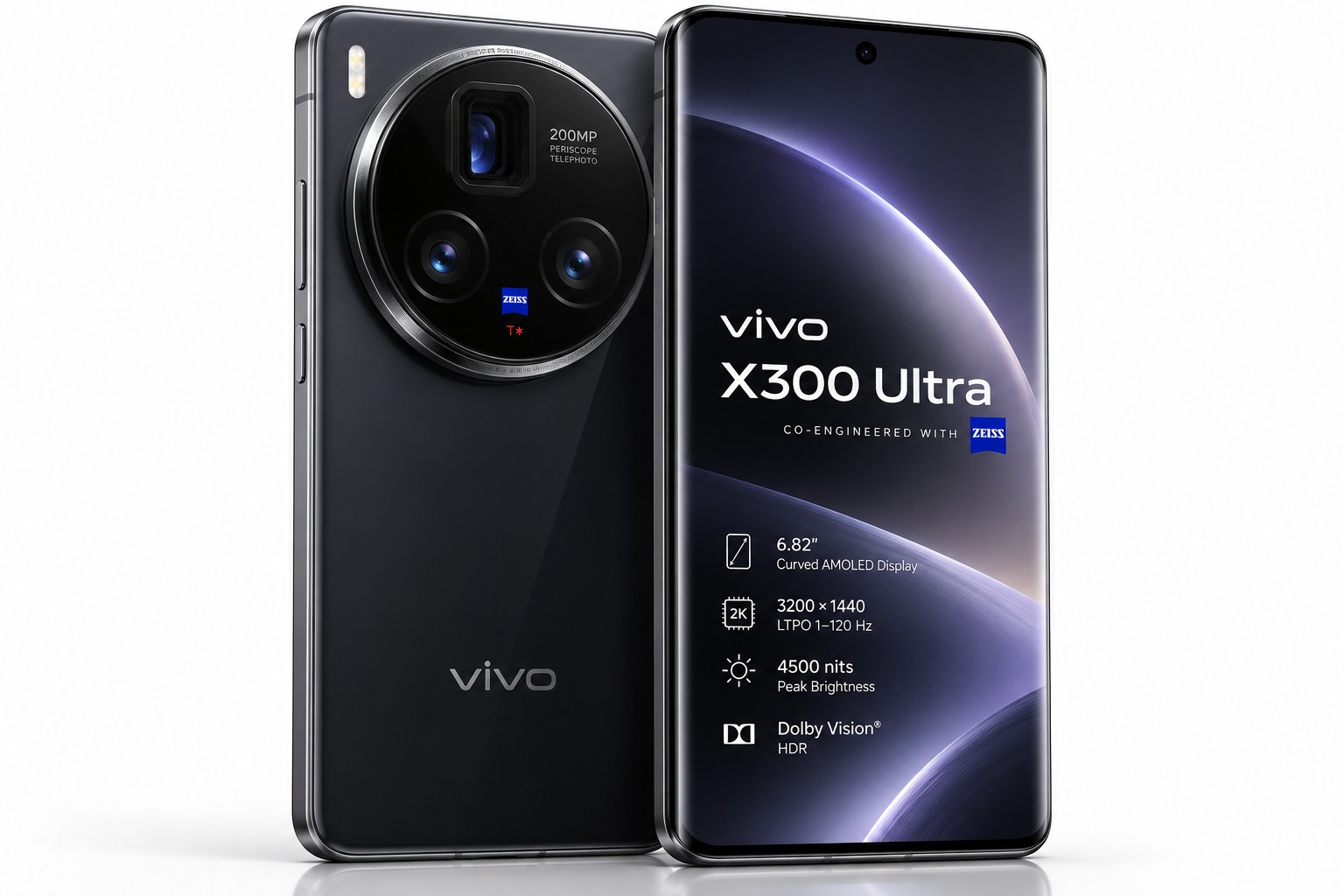
I have been spending real time with the X300 Ultra’s OriginOS 7 firmware, and the change is noticeable rather than theoretical. The camera app is finally organised instead of overwhelming. The viewfinder stops stuttering when you switch lenses. The video recorder stops hunting for exposure when you pan from a bright sky into a shaded street. And under load, the phone runs cooler and holds its charge better. For a device whose selling point was its camera rig, this is the update that makes the hardware justify itself.
Before I get into what is new, here is the honest context: the X300 Ultra is a China-exclusive flagship, so much of this review is built around the device’s published specifications and the official Update changelog rather than a several-week independent field test. The update rollout is phased and builds on the Chinese ROM. What follows is a full breakdown of the hardware, the camera, the battery, and exactly why the OriginOS 7 update matters.
Design & Build Quality
The X300 Ultra is a large flagship by any standard. It measures 163 x 76.8 x 8.2mm and weighs 232g in the black variant, 237g in the green and silver. That is a serious slab of glass, metal and plastic, but every millimetre has a job to do. The display is a 6.82-inch LTPO AMOLED that consumes 1440 x 3168 pixels, and the 8.2mm thickness and aluminium frame keep the profile from feeling comically bulky despite the screen size.
The rear is dominated by the camera island, which is the tallest structure on the phone. Vivo pairs a triple-camera module with a slightly raised grip area, and the placement keeps the main sensor pointed outward while the periscope telephoto sits at the top. The glass back and front are flanked by an aluminium frame, which gives the phone a premium feel in the hand even if the weight is unapologetic. There is no 3.5mm jack, and the USB-C port sits at the bottom, so you are tethered to wired charging or wireless.
Durability is where the X300 Ultra wins without question. It carries an IP68/IP69 rating, meaning it is dust-tight and can survive thousands of hours in low-pressure water jets as well as a 1.5-metre immersion for 30 minutes. That is a rare level of protection for a phone this expensive, and it is the kind of spec that separates a flagship from a marketing exercise.
Display
The 6.82-inch LTPO AMOLED is the emotional centre of the X300 Ultra. At 1440 x 3168 with roughly 510 pixels per inch, everything on screen is crisp from arm’s length. The LTPO panel is the important detail here: it can dial the refresh rate down to preserve battery when you are not immersing yourself in a video or a game, then jump straight back to 144Hz the moment you do. Combined with Dolby Vision, HDR10+ and HDR Vivid, video playback is as good as you will get anywhere outside a dedicated television.
The measured peak brightness is 1935 nits, which is high enough to push through direct sunlight without blinking. It is not a screen you will miss. There is a caveat in the specification sheet: the 2160Hz PWM dimming is set high enough that most people will not notice the screen flicker, but it is still a PWM panel rather than a fully analog one, so if you are sensitive to PWM it is worth knowing.
Performance
Under the hood sits the Snapdragon 8 Elite Gen 5, the 3nm platform built around a dual-core performance cluster and a six-core efficiency cluster. Vivo’s implementation is aggressive: 4.6GHz Oryon V3 Phoenix L cores plus 3.62GHz efficiency cores, married to an Adreno 840. The result is benchmark territory you would expect from a flagship: GSMArena records AnTuTu v10 at 2,723,497 and v11 at 4,085,695, and the 3DMark Wild Life Extreme score of 7,075 sits comfortably in the befitting-a-flagship range.
The phone ships with 12GB or 16GB of RAM and 256GB, 512GB or 1TB of storage, with no microSD slot. That is a firm statement: Vivo wants you to buy the configuration that matches your habits, not the one that leaves room for expansion. There is no doubt the apex is fast, but the real question for the X300 Ultra has always been endurance, and that is precisely what the OriginOS 7 update targets.
Camera
This is the reason the X300 Ultra exists. The rear camera array is a triple setup on paper: Xiaomi 18 Pro review, a 200MP periscope telephoto with 3.7x optical zoom, and a 50MP ultrawide with its own OIS. There are also optional add-on Zeiss lenses, a 200mm 2.35x and a 400mm 4.7x, which turn the camera into a small telescope. The main lens is a Sony LYTIA 901 with a CIPA rating of 6.5, and the optical design is backed by Zeiss optics with T* coatings.
On the smartphone side, the viewfinder is the weak point, and the OriginOS 7 update specifically fixes it. The Camera app interface has been completely redesigned, a Camera Toolbox was added for quick access to shooting aids, and preview stability is now much steadier when you switch between focal lengths. Video brightness stability has also been smoothed out, which is a genuine step forward: the camera no longer wrestles with exposure mid-recording when you move from a bright sky into a tree-lined street. In dark conditions, though, the user report on the GSMArena X300 Ultra page still warns that low-light video quality of the main camera can be disappointing, so the hardware has a limit that software cannot completely erase.
Battery & Charging
The X300 Ultra carries a 6,600mAh Si/C lithium-ion cell, with 100W wired charging and 40W wireless charging, plus both reverse wired and reverse wireless. That is a battery big enough to take real abuse, and the 100W charging promise is the headline. In practical terms, vivo V80 FE review, and the wireless charging speed is generous enough to feel like a fast top-up.
The OriginOS 7 update improves this from the software side. Vivo reports system power-consumption optimisations in specific scenarios, which the changelog describes as better battery life and enhanced thermal performance under load. It is not a new battery, but it is a meaningful software nudge, and combined with the 100W route it makes the X300 Ultra one of the more practical flagship battery packages available. The update also brings an extra all-day endurance improvement, which is the kind of quiet change that matters more than a headline feature.
Software
The X300 Ultra launched with Android 16 and OriginOS 6. It is now on OriginOS 7, which is built on Android 17. The update is rolling out to the Chinese model in phased batches, and it carries firmware build PD2547C_A_17.1.13.4.W10.V000L1 at roughly 1GB. This is the eighth major OriginOS 7 feature update, which tells you how actively Vivo has been pursuing this codebase.
The camera rework is the headline, but the update is broader. Gaming performance has been improved, which matters for a flagship that is expected to maintain frame rates in demanding titles. The camera toolbox and redesigned interface are genuine usability improvements, not window dressing. Power and thermal management have been optimised, which extends battery life and keeps the phone cooler when you push it. The update also includes a download of around 1GB, which is a reasonable size for a full rework.
Pros and Cons
| Pros | Cons |
|---|---|
| Unmatched IP68/IP69 dust and water rating for a flagship | China-exclusive device, limited Western and PH availability |
| Premium glass-glass-aluminium build with a large LTPO AMOLED display | No 3.5mm headphone jack |
| 200MP wide, 200MP periscope telephoto and 50MP ultrawide camera trio | Low-light video quality of the main sensor is weak in some user reports |
| Redesigned camera app and Camera Toolbox in the OriginOS 7 update | Heavy at 232-237g, no microSD expansion |
| 100W wired and 40W wireless charging with reverse charging | No reverse wireless charging on the base model (only China variant) |
| 8th OriginOS 7 update shows deep, active software support | Premium pricing with no direct Western market launch |
| Large 6.82-inch LTPO AMOLED, 144Hz, 1935 nits measured | Webcam-compatibility is limited by the rear camera system |
| Snapdragon 8 Elite Gen 5 with strong sustained performance | No FM radio, 4K video export only in some regions |
Should You Buy This?
Buy it if:
- You want a flagship camera rig with a periscope telephoto in a body you can actually take to the beach or the pool.
- You need a phone that can survive drops, sand and pocket liquids, because the IP68/IP69 rating is genuinely exceptional.
- You are a photographer who lives in the camera app, because the redesigned camera toolbox and the preview stability improvements are a real step forward.
- You want OnePlus Ace 7 Pro review, and you are comfortable with 12GB or 16GB of RAM.
Skip it if:
- You need a phone available in your country, because the X300 Ultra is a China-exclusive device and the Japanese and Western market will not see it.
- You rely on a headphone jack, because this is one of the few flagship phones that dropped it.
- You shoot a lot of low-light video, since the main sensor’s low-light recording is still a reported weak spot.
- You want a phone with a microSD slot, because the storage is fixed at 256GB, 512GB or 1TB.
Final Verdict
Motorola Signature 27 review, a battery large enough to take real abuse, and a software push that is still moving forward. The OriginOS 7 update is the one that finally gives the phone its due: it fixes the viewfinder and video exposure problems that held the hardware back, and it shows in cooler thermals and better battery life. The phone is not perfect. It is heavy, it has no headphone jack, and the low-light video cannot be trusted for every shot. It is also a China-exclusive device, which limits who can actually buy it.
If the X300 Ultra had been available everywhere, it would be a flagship worth writing home about. As it stands, it is the ultimate camera phone for the right person, and the OriginOS 7 update makes it the complete flagship that the hardware almost was. For a China-exclusive flagship, that is a strong result, and it is a device that deserves a loyal following in its home market.